

We may earn a commission when you buy through links on this page, at no extra cost to you. Learn more.
The newair 28 bottle wine fridge is a worthwhile option for wine drinkers who want separate temperature settings for red and white wines in a compact freestanding refrigerator. The NWC028SS01 combines compressor cooling, two temperature zones, adjustable shelving, and a double-pane glass door in a cabinet designed to hold up to 28 standard bottles. Its biggest advantages are flexible temperature control and relatively small dimensions, while its main limitations include restricted capacity for unusually shaped bottles and the need for generous ventilation clearance.
A dedicated wine refrigerator can make a noticeable difference to a home collection, particularly when bottles are purchased for different occasions and served at different temperatures. Newair’s 28-bottle model targets households that want more organized storage than a countertop cooler can provide without committing to a large wine cabinet. The important distinction is that this is a freestanding dual-zone appliance, not a built-in undercounter refrigerator. Understanding its dimensions, temperature limits, rack arrangement, and owner feedback helps determine whether it fits a particular collection.
Specs and Key Features of the Newair NWC028SS01
The Newair NWC028SS01 is a compact compressor wine refrigerator with a stated capacity of 28 standard bottles and two temperature zones. Its specifications make it particularly interesting for households that regularly keep several varieties of wine available for serving.
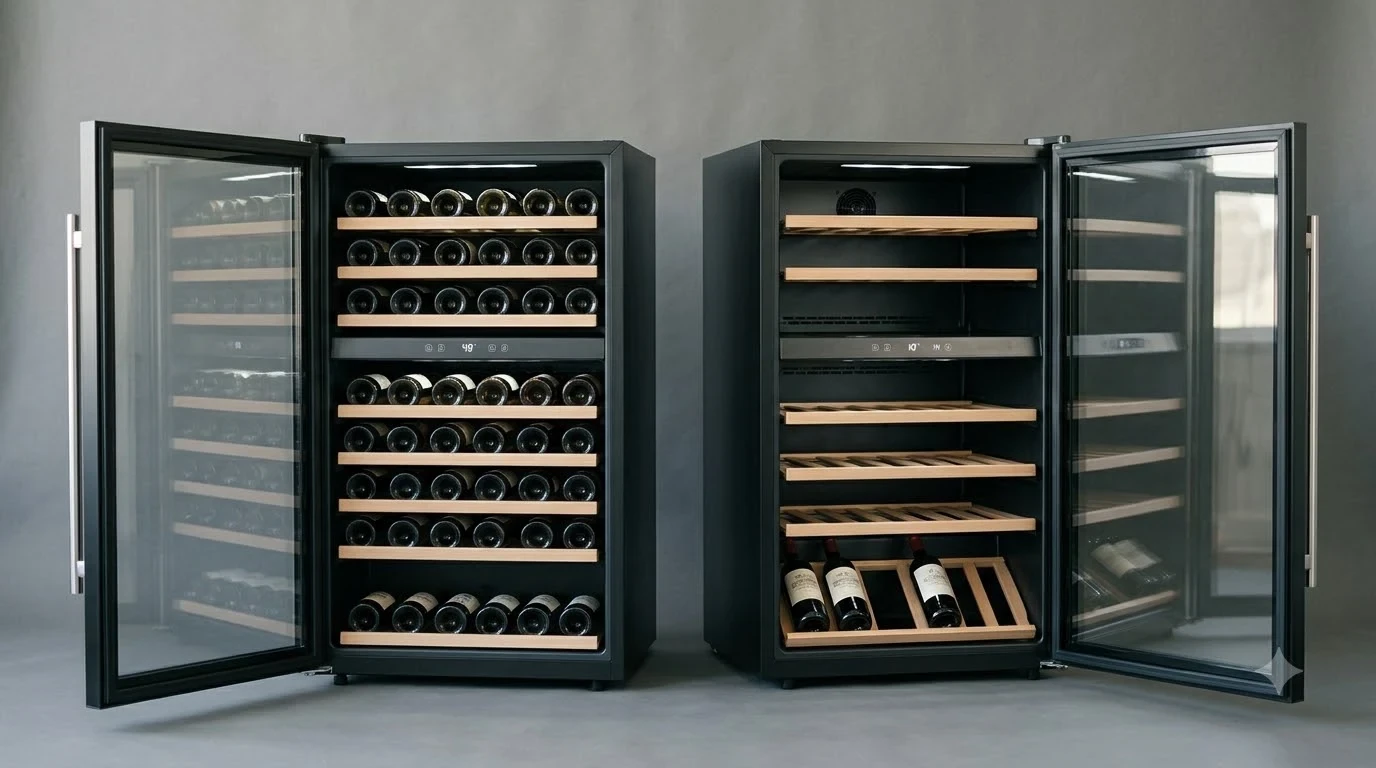
The exterior combines stainless steel and black finishes with a glass door, while the interior uses removable metal racks and LED lighting. Newair also includes a digital temperature display, allowing users to adjust the upper and lower compartments without opening the refrigerator. The double-pane glass construction provides insulation and helps limit exposure to UV light, an important consideration for a collection stored in a room that receives natural daylight.
Here are the principal manufacturer-listed specifications for the model:
| Specification | Newair NWC028SS01 |
|---|---|
| Maximum stated capacity | 28 standard bottles |
| Cooling technology | Compressor |
| Temperature zones | 2 |
| Upper temperature range | 41°F–54°F |
| Lower temperature range | 54°F–64°F |
| Dimensions | 16.93″D x 18.90″W x 33.46″H |
| Storage volume | 2.86 cubic feet |
| Product weight | 62.17 pounds |
| Power consumption | 90 watts |
| Electrical requirements | 120 volts, 60 Hz |
| Listed noise level | 43 dB |
| Wine racks | 5 removable metal racks |
| Interior lighting | LED |
| Door | Double-pane glass |
| Installation | Freestanding |
The 18.90-inch width is a useful selling point for homes with limited floor space. However, buyers should consider the entire installation footprint rather than treating the cabinet dimensions as the only space requirement. The owner’s manual calls for five inches of clearance behind and on both sides of the refrigerator to provide adequate air circulation around the compressor and condenser.
The 28-bottle figure also needs some practical interpretation. Manufacturers generally calculate wine refrigerator capacity using standard Bordeaux-style bottles. A collection containing wide Burgundy bottles, sparkling wine bottles, or unusually long Riesling bottles may not fit the advertised number without rearranging or removing shelves. The stated capacity is therefore a useful reference, not a guarantee that every combination of 28 bottles will fit.
The refrigerator’s 90-watt power rating and 120-volt electrical requirement make its electrical specifications relatively straightforward for a compatible household outlet. Its 43 dB listed noise level is another useful reference, although actual perceived sound depends on the room, installation surface, compressor operation, and surrounding background noise.
For the complete product description and manufacturer-listed specifications, consult the official Newair 28-bottle wine refrigerator listing.
What Owners Like About the Wine Refrigerator
Owner feedback highlights the convenience of dual-zone storage, the attractive appearance, and the relatively compact cabinet. The most useful advantage is being able to keep different wine styles at separate temperatures without purchasing two refrigerators.
Home Depot’s reviewed listing shows an average customer rating of 4.3 out of 5 from 210 reviews, with 85% of reviewers recommending the product. These figures provide an indication of customer satisfaction, although they should not be treated as a guarantee of reliability or performance in every home.
One recurring positive theme is the ability to store red and white wines together. A household might keep Sauvignon Blanc and Chardonnay in the cooler upper compartment while placing bottles of Merlot, Pinot Noir, or Cabernet Sauvignon in the lower compartment. The separate settings make this arrangement more convenient than using a single-temperature refrigerator.
Owners also mention the appearance. The stainless-steel exterior and glass door suit many contemporary kitchens, dining rooms, and home bars. Interior LED illumination makes bottle labels easier to see, while the option to switch off the light is useful for people who prefer a darker storage environment.
Flexible storage and everyday access
The removable rack design is another practical advantage. Standard wine bottles can be arranged horizontally, making it easier to organize a small collection by grape variety, region, or drinking occasion. A household might dedicate one section to everyday whites, another to sparkling wines, and the lower compartment to reds intended for dinner.
Some owners also appreciate the adjustable shelving because it offers more flexibility than a completely fixed rack arrangement. This is particularly useful when a collection includes different bottle shapes. However, flexibility should not be confused with unlimited space. Removing a shelf can make room for a larger bottle, but it also reduces the number of bottles that can be stored simultaneously.
Customer comments also describe helpful interactions with Newair’s support team. One Home Depot reviewer reported receiving assistance after discovering that the interior light was not functioning correctly. Another described receiving troubleshooting assistance after the refrigerator began producing clicking sounds.
These experiences suggest that customer support is a relevant consideration when evaluating the appliance. They do not establish that every service request will have the same outcome, so buyers should retain their purchase documentation and understand the applicable warranty terms.
Common Complaints and Practical Limitations
The main concerns surrounding the Newair 28-bottle wine fridge involve bottle compatibility, occasional operating noises, and reports of damaged deliveries or component problems. These issues do not mean every unit will experience trouble, but they deserve attention before purchase.
One particularly useful owner observation concerns longer wine bottles. A Home Depot reviewer specifically mentioned difficulty fitting some New World wine bottles and German Riesling bottles. This is an important distinction because bottle dimensions vary substantially between producers and regions, even when the wines come in the same nominal 750 ml volume.
For example, a traditional Bordeaux bottle generally has a narrower profile than many Burgundy bottles. Sparkling wine bottles can also have wider bodies that occupy more rack space. If a collection contains Champagne, Pinot Noir, or unusually shaped Riesling bottles, it is sensible to check the rack dimensions and available clearance rather than relying entirely on the advertised 28-bottle capacity.
Noise and operating sounds
Newair lists a 43 dB operating noise specification. Some owners describe the refrigerator as quiet, while others mention clicking sounds during operation. Compressor refrigerators naturally produce operating sounds as their cooling systems cycle, so a completely silent experience should not be expected.
Placement can influence how noticeable those sounds become. A refrigerator installed on an uneven floor or against a surface that amplifies vibration may seem louder than one positioned properly. Leveling the appliance and keeping the required ventilation space clear are sensible first steps when investigating unusual sounds.
Lighting, delivery, and component concerns
Some customer comments describe interior lighting problems. Others concern damaged packaging, dents, or door-related damage on arrival. These reports highlight the importance of inspecting the cabinet, glass, hinges, and electrical operation shortly after delivery.
A wine refrigerator is a relatively heavy appliance, listed at 62.17 pounds before accounting for its contents. Moving it into position and checking its condition should be handled carefully. The glass door and cabinet deserve particular attention because damage can affect both appearance and proper operation.
Temperature performance is another consideration. The manual explains that ambient conditions outside its recommended range can affect cooling performance. A refrigerator placed beside an oven, in direct sunlight, or in a particularly hot room may struggle to maintain the selected temperatures as consistently as one installed in a suitable indoor location.
Tip: Before filling the refrigerator, allow it to operate for several hours and check the temperatures in both compartments with an independent thermometer. This helps identify any installation or temperature-setting issues before the collection is fully loaded.
Who Should Buy the Newair 28-Bottle Wine Fridge?
This model makes the most sense for wine drinkers with a modest but varied collection who want separate serving temperatures for different wine styles. Its 28-bottle stated capacity and compact dimensions offer a practical middle ground between a small countertop cooler and a large cellar cabinet.
It is particularly suitable for households that regularly alternate between whites and reds. The upper compartment’s 41°F to 54°F range can accommodate several white wine serving preferences, while the lower compartment’s 54°F to 64°F range provides flexibility for red wines.
For example, Sauvignon Blanc is commonly served around 45°F to 50°F, while fuller-bodied Chardonnay generally benefits from approximately 50°F to 55°F. A lighter Pinot Noir can be served around 55°F to 60°F, whereas a fuller Cabernet Sauvignon is generally better around 60°F to 65°F. The Newair’s two compartments provide a useful range for organizing these different styles, although the upper and lower temperature limits do not cover every ideal serving temperature equally.
Good candidates for this model
The refrigerator is a sensible choice for people who:
- Keep approximately 15 to 28 standard wine bottles at home.
- Regularly drink both red and white wines.
- Want separate temperature controls rather than one shared setting.
- Have an available freestanding space approximately 19 inches wide.
- Prefer compressor cooling and a digital control panel.
- Want removable racks for occasional bottle-size adjustments.
- Keep their wine collection in an indoor room with suitable ventilation.
It can also suit a home entertaining area where wine is served alongside cocktails and food. For example, a bottle of Prosecco or another sparkling wine can be prepared for an Aperol Spritz recipe, while the lower compartment can hold reds intended for a dinner featuring a chicken Marsala recipe.
Who should consider another refrigerator?
Collectors with several dozen bottles beyond the stated capacity should consider a larger cabinet. The same applies to households that frequently purchase Champagne, sparkling wine, or unusually shaped bottles. A 28-bottle refrigerator may technically offer adequate space for a standard collection but become inconvenient when bottle dimensions vary considerably.
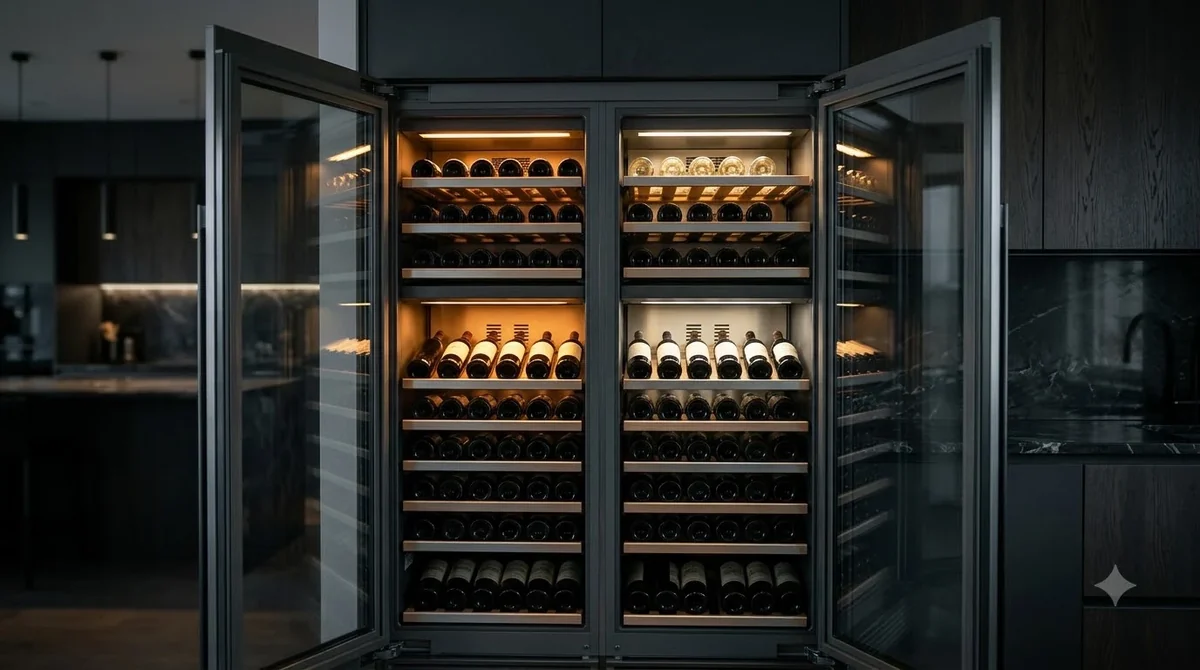
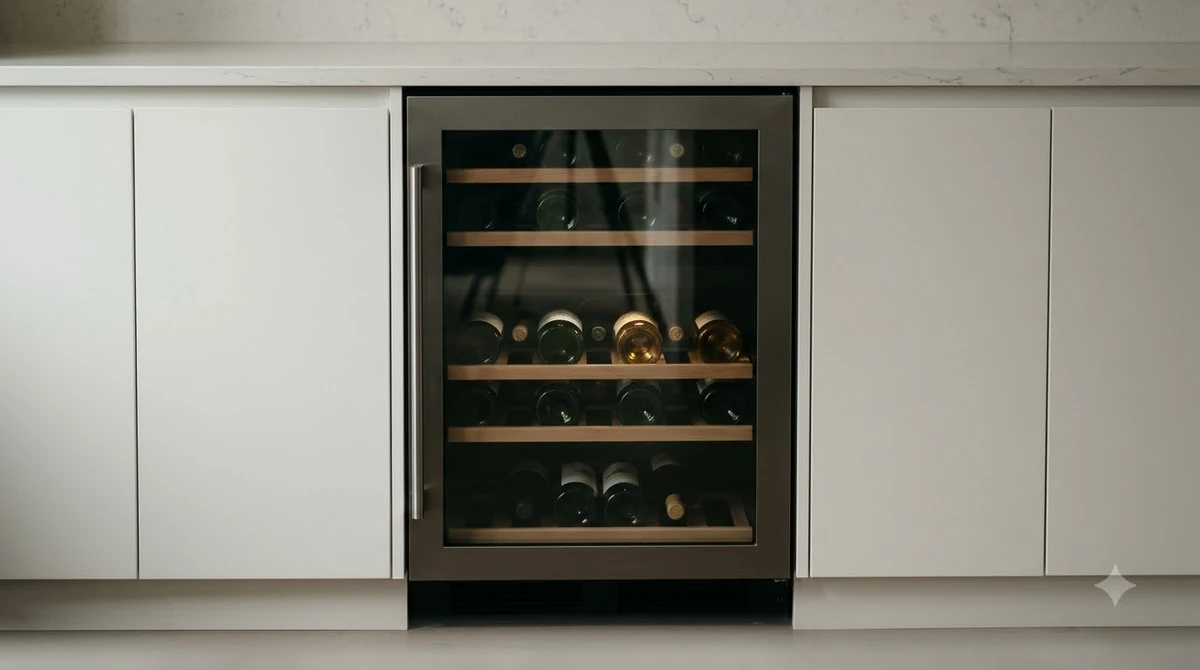
It is also not the right choice for someone who wants an integrated undercounter installation. The owner’s manual explicitly identifies the appliance as freestanding and requires ventilation clearance around its back and sides. It should not be treated as a built-in refrigerator simply because its width appears suitable for a kitchen opening.
Finally, buyers who need temperatures below 41°F or above 64°F should look at other refrigeration options. The NWC028SS01 is designed for wine storage and cooling, not for freezing, keeping beer extremely cold, or replacing a conventional food refrigerator.
How It Compares to Alternative Wine Storage Options
The Newair 28-bottle model occupies a useful position between smaller single-zone wine coolers and larger wine refrigerators. Its main selling point is the combination of dual-zone control and relatively compact dimensions, rather than maximum storage capacity or built-in installation flexibility.
Compared with a single-zone wine cooler, the Newair offers more flexibility for mixed collections. A single-zone refrigerator is simpler to organize because every bottle shares the same temperature setting, but that arrangement is less convenient when a household wants white wines ready for serving while keeping reds at a different temperature.
A larger dual-zone wine refrigerator is another alternative. Models such as the Newair 46-bottle dual-zone wine refrigerator provide additional capacity, which can be useful for people who regularly purchase cases or keep several bottles of the same wine. The trade-off is a larger cabinet and a greater space commitment.
Single-zone versus dual-zone storage
Single-zone storage is appropriate for people who primarily collect one style of wine or prefer to store everything at a consistent cellar temperature. A dual-zone appliance is more convenient for households that regularly serve several varieties at different temperatures.
However, two zones do not automatically mean ideal long-term aging conditions for every wine. The Newair’s upper and lower ranges are designed around practical wine cooling and storage preferences. Collectors planning to age expensive bottles over many years may want a dedicated cellar-style refrigerator with particular attention to temperature stability, humidity, vibration, and light protection.
Small wine coolers versus larger cabinets
A compact 12- or 18-bottle refrigerator can be a better option for someone with a limited collection or very little floor space. These smaller appliances may be easier to position, although their available storage can become restrictive as a collection grows.
At the other end, a 46-bottle or larger cabinet is more suitable for people who buy wine regularly and want room for future purchases. The Newair 28-bottle model is the middle-ground option: enough space for a varied household collection without requiring the footprint of a full-size wine cabinet.
For readers comparing different capacities and designs, the wine refrigerator model reviews section provides a useful starting point for evaluating other storage options. The right choice depends on bottle dimensions, available floor space, cooling requirements, and how frequently the collection changes.
Frequently Asked Questions
Does the Newair NWC028SS01 have a reversible door?
The manufacturer’s listed product specifications do not establish that the door is reversible. Buyers who need a particular hinge orientation should contact Newair before purchasing rather than assume the door can be switched. Door clearance is also important when planning the refrigerator’s position near a wall or kitchen furniture.
Can the Newair 28-bottle refrigerator store opened wine bottles?
Opened wine bottles can be stored upright when sufficient interior clearance is available, although the appliance is primarily designed around horizontal wine-bottle storage. Use a proper closure to limit oxygen exposure, particularly for sparkling wine. Opened still wines generally keep for approximately three to five days in a refrigerator, while sparkling wines usually retain their best quality for one to three days with an appropriate sparkling-wine stopper.
Does the Newair wine fridge require manual defrosting?
The owner’s manual describes an automatic defrosting process in which accumulated ice melts during the compressor’s off-cycle. Water collects in a tray above the compressor, where operating heat helps evaporate it. Excessive ice buildup may indicate that the temperature setting or door seal needs attention.
Can the refrigerator be installed in a garage?
The manual recommends an ambient operating temperature between 64°F and 100°F, making an uncontrolled garage a potentially unsuitable location. Temperatures outside that range can affect cooling performance and the ability to reach the selected settings. An indoor, climate-controlled location is the safer choice for maintaining consistent operating conditions.
What should buyers do if the refrigerator arrives damaged?
Photograph visible damage to the packaging, cabinet, and glass before discarding shipping materials. Contact the retailer and Newair promptly, keeping the purchase receipt and model information available. Avoid operating a refrigerator with damaged electrical components, a compromised power cord, or suspected damage to its refrigerant system.
The Newair 28-bottle wine fridge is a practical choice for households that want compact dual-zone storage, adjustable shelving, and straightforward digital temperature controls. Its limitations are worth considering, especially the freestanding installation requirement, ventilation clearance, and reduced flexibility with oversized bottles. For a mixed collection of everyday reds and whites, however, the NWC028SS01 offers a useful balance of capacity and convenience.
More in Model Reviews
 Magic Chef 44 Bottle Wine Cooler Review for Flexible StorageUpdated Nov 21, 2026
 Whynter 164 Bottle Wine Cooler Review: Capacity, Features, and FitUpdated Nov 21, 2026
 Insignia NS WC16BK6 Review: Compact 16-Bottle Wine StorageUpdated Nov 21, 2026
 Wine Enthusiast Electric Blue Omega Review: Opening, Pouring, and Preserving Made EasierUpdated Nov 21, 2026
 Koolatron 20 Bottle Wine Cooler Review: Features, Fit, and PerformanceUpdated Nov 21, 2026
 NewAir AWC 330E Review for Home Wine StorageUpdated Nov 21, 2026