

We may earn a commission when you buy through links on this page, at no extra cost to you. Learn more.
A Magic Chef wine cooler is a practical option for households seeking dedicated wine storage, straightforward temperature controls, and selected dual-zone configurations without moving into premium wine-cellar equipment. The brand offers compact and larger wine refrigerators, along with combination wine and beverage centers. Its strongest advantages are accessible features, flexible installation on selected models, and useful storage configurations, while shelf design, actual bottle capacity, and long-term reliability deserve careful consideration before buying.
Magic Chef is a familiar appliance name with a range of refrigeration products, including wine coolers designed for kitchens, home bars, and entertainment spaces. Its lineup includes single-zone wine refrigerators and dual-zone wine and beverage centers, so the right choice depends on whether you primarily store wine, chill several beverage types, or need an appliance that fits beneath a counter. This brand hub examines the available product families, practical differences, owner feedback, and the documentation worth reviewing before making a purchase.
Brand Overview: What Magic Chef Offers Wine Collectors
Magic Chef focuses on accessible household appliances, and its wine refrigeration range follows the same practical approach. Buyers can find dedicated wine cabinets as well as combination units that accommodate wine bottles and canned beverages, with different installation options depending on the model.
The brand’s official Wine & Beverage Coolers category includes residential refrigeration products and a separate selection of commercial beverage equipment. This distinction matters because a household wine refrigerator and a commercial display cooler have different intended uses. Someone building a small home wine collection should begin with the residential range rather than assuming every appliance carrying the Magic Chef name is designed for the same environment.
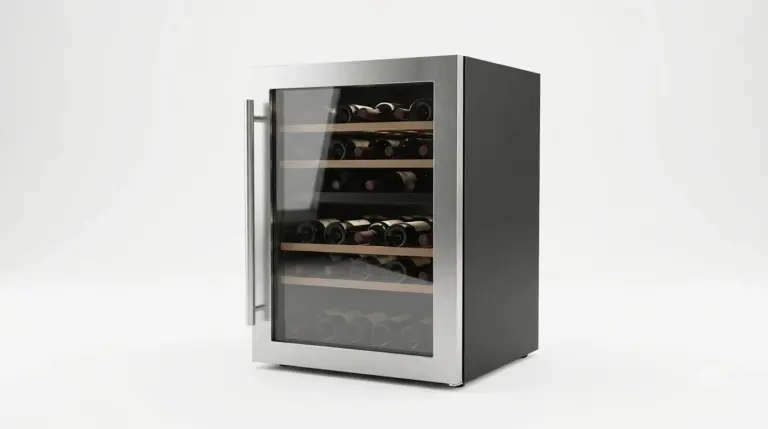
Magic Chef’s range includes glass-door designs, digital temperature controls, interior lighting, and stainless-steel finishes on selected products. Some larger units provide two independently controlled temperature zones, which allow a household to keep different beverages at different serving temperatures. Smaller single-zone appliances are generally easier to accommodate when floor space and bottle capacity are the main concerns.
Is Magic Chef a good brand? The most reasonable answer is that it offers useful features and accessible appliance configurations, but its products should be judged model by model. The HMWC50ST, for example, has a substantial body of owner feedback, with 71% of reviewers recommending it on the Home Depot review page. However, the same feedback includes complaints about shelf construction, bottle spacing, and operating noise.
That mixed picture is important. A wine cooler can look attractive, fit a kitchen opening, and maintain a useful temperature while still being inconvenient to load or retrieve bottles from. Buyers should therefore evaluate storage geometry and installation requirements alongside advertised capacity and temperature settings.
For a broader look at appliance manufacturers, the site’s brand hubs provide additional comparisons. These comparisons are particularly useful when deciding whether to prioritize capacity, installation flexibility, or a particular feature set rather than choosing a refrigerator solely by its brand name.
Magic Chef Product Lines Explained
Magic Chef’s wine refrigeration products fall into a few practical categories: compact single-zone wine storage, larger dedicated wine coolers, and dual-zone wine and beverage centers. The distinction between these groups determines how much space is available and whether wine and other drinks can be stored at separate temperatures.
The following examples illustrate the differences using documented specifications rather than assuming that every Magic Chef model shares the same design.
| Product or model | Configuration | Documented capacity or range | Installation and features |
|---|---|---|---|
| HMWC50ST | Dedicated wine cooler | 50 bottles; 41°F–61°F | Digital thermostat; stainless-steel finish |
| HMWC44DZ | Dual-zone wine and beverage cooler | 44 bottles or 140 cans across separate configurations | Independent zone controls; removable shelves |
| BTWB530ST1 | Dual-zone wine and beverage center | Up to 44 bottles or 104 cans in the manufacturer’s detailed description | Built-in or freestanding; electronic controls |
| MCWBC24DZ1 | 24-inch dual-zone wine and beverage center | Two separately controlled temperature zones | French doors; interchangeable chrome shelves and racks |
Capacity figures deserve special attention. The HMWC44DZ manual divides storage into an upper compartment accommodating up to 16 bottles or 63 cans and a lower compartment accommodating up to 28 bottles or 77 cans. Those separate figures describe the zones and their alternative storage arrangements, not an assurance that every combination of bottles and cans will fit simultaneously.
The BTWB530ST1 is another useful example of the brand’s dual-zone approach. Magic Chef describes it as a 24-inch appliance with a temperature range of 39°F to 61°F, electronic controls, interchangeable storage components, and a fingerprint-resistant stainless-steel frame. Its detailed product description specifies up to 44 bottles or 104 cans, with a mixed-storage configuration also available.
The MCWBC24DZ1 adds French doors and a customizable interior. Its interchangeable sculpted shelves and flat chrome racks are intended to accommodate different beverage arrangements. That flexibility makes it worth considering for households that want one appliance to serve both wine and general beverage storage.
One important buying distinction is that product listings sometimes present bottle and can capacities as alternative maximum configurations. A unit advertised for 44 bottles or more than 100 cans should not be assumed to accommodate both maximum quantities simultaneously. The actual arrangement depends on the shelves, rack positions, and beverage sizes.
For buyers comparing the range, the Galanz brand overview offers another point of comparison when evaluating compact household refrigeration and beverage-storage options.
What Magic Chef Wine Coolers Do Well
Magic Chef wine refrigerators have several useful features for everyday home storage, particularly on the larger models. Temperature controls, glass doors, adaptable shelving, and dual-zone configurations give buyers more flexibility than a basic beverage refrigerator with one undivided compartment.
One of the clearest advantages is the availability of independent temperature zones. On the HMWC44DZ, the upper and lower compartments each have their own temperature control and display. This arrangement makes it possible to store different beverage categories separately instead of forcing everything into one temperature setting.
That distinction is useful for households that regularly serve sparkling wine, whites, reds, and other styles. A practical serving-temperature plan might place sparkling wine around 40°F to 50°F, light whites around 45°F to 50°F, and lighter reds around 55°F to 60°F. A dual-zone appliance gives owners more control over these differences, although the appropriate settings depend on the exact wine and how it will be served.
Another advantage is installation flexibility. Magic Chef identifies selected appliances, including the BTWB530ST1, as suitable for either freestanding or built-in use. This provides more options for kitchen planning, home bars, and dedicated beverage areas. However, the distinction between a genuinely built-in-compatible model and a freestanding-only appliance is essential. Ventilation requirements and clearance instructions must be followed rather than assuming that every wine cooler can safely fit inside cabinetry.
The interior arrangements also provide useful customization. Interchangeable chrome shelves and flat racks on selected models allow the storage layout to accommodate bottles or cans. The HMWC44DZ manual specifically explains how to remove and replace shelves, making it easier to create additional space for larger bottles when necessary.
Owner feedback offers some support for the brand’s everyday convenience. Positive HMWC50ST comments describe straightforward setup, attractive stainless-steel styling, convenient temperature adjustment, and satisfactory cooling. Some owners also appreciate the interior lighting and the ability to fit the appliance into a kitchen or existing beverage area.
These advantages make Magic Chef particularly appealing to buyers who want a functional appliance rather than elaborate cellar-management technology. Digital controls and a dedicated storage compartment can simplify everyday organization, while a glass door makes it easier to see the collection without opening the refrigerator.
Tip: Before purchasing a Magic Chef wine refrigerator, measure your widest bottles, not just your standard Bordeaux-style bottles. Pinot Noir, Champagne, and some Chardonnay bottles can be wider than conventional bottles, reducing the usable capacity of tightly spaced racks.
Common Complaints in Magic Chef Wine Cooler Reviews
Magic Chef wine cooler reviews show a mixture of satisfaction and recurring design concerns. The most useful issues to investigate are shelf stability, actual bottle capacity, noise, and consistency of cooling rather than relying on an overall review average.
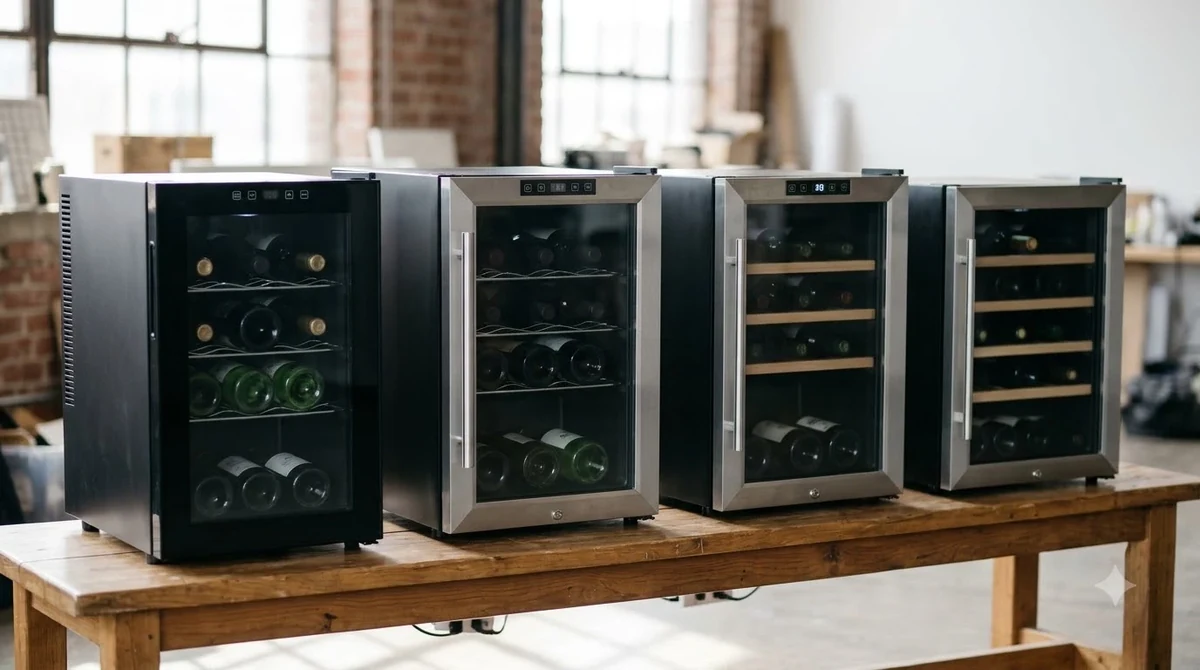
The HMWC50ST provides a useful example because its Home Depot review page displays 546 reviews, an average rating of 4 out of 5, and a 71% recommendation rate. These figures indicate that many owners are satisfied, but they also leave a meaningful proportion of customers who report problems or have reservations about the appliance.
Shelf spacing and bottle access: Several owners describe difficulty accommodating larger bottles between closely spaced shelves. Wider Pinot Noir and Syrah bottles can be especially troublesome. One reviewer estimated that a nominal 50-bottle cabinet could hold only around 38 to 40 bottles comfortably when wider bottles were included and double-stacking was considered.
That is a significant difference for anyone purchasing a wine refrigerator based on the advertised maximum. Bottle capacity is generally calculated using a particular standard bottle shape and an optimized arrangement. Real collections contain sparkling bottles, Burgundy-style bottles, larger formats, and occasional irregular shapes. Each can change the practical storage total.
Shelf construction: Some reviews mention racks that feel flimsy or do not slide smoothly. Other owners have raised concerns about shelf stability when pulling racks out with bottles loaded. These problems affect everyday convenience and deserve attention if the cooler will be opened frequently.
Operating noise: Compressor-based wine refrigerators produce normal operating sounds, but owner experiences vary. Some HMWC50ST reviewers describe quiet operation, while others mention humming, clicking, unusual noises, or sounds that are noticeable from nearby rooms. A wine cooler installed in an open-plan living area may therefore be a less suitable choice for someone who is particularly sensitive to appliance noise.
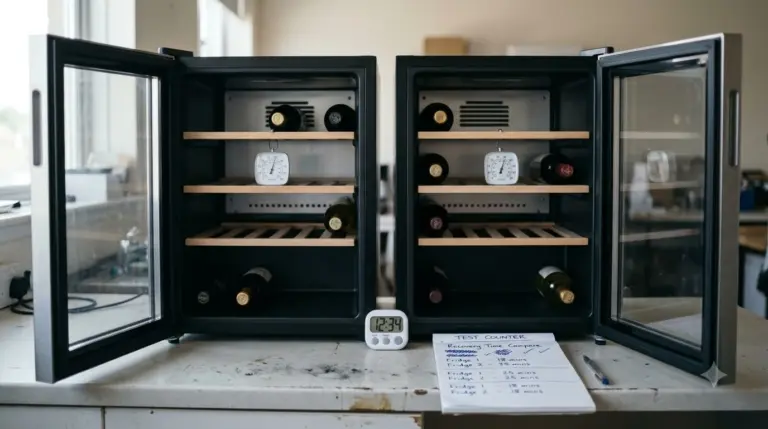
Temperature accuracy and reliability: Some owners report satisfactory temperature maintenance, while others describe discrepancies between the display and their independent thermometer. There are also reports of cooling problems after extended use. These experiences do not establish that every Magic Chef wine cooler has a reliability defect, but they make it sensible to monitor actual cabinet temperature after installation.
Buyers should also distinguish between isolated complaints and recurring patterns. A single report of a defective door does not establish a widespread manufacturing issue. Repeated concerns about cramped shelving, however, are directly relevant to the physical design and should influence the purchasing decision.
Overall, owner feedback suggests that Magic Chef can meet ordinary home-storage needs, but buyers expecting premium shelf mechanisms, exceptionally quiet operation, or a precise advertised bottle count may want to compare other manufacturers before committing.
How to Choose the Right Magic Chef Wine Fridge
The right Magic Chef wine fridge depends on collection size, bottle shape, preferred storage temperature, and installation location. Start by deciding whether you need dedicated wine storage or a combination refrigerator for wine and other drinks.
Choose single-zone storage for a focused collection. If most of your collection consists of wines that you store at approximately the same temperature, a single-zone refrigerator may be sufficient. The HMWC50ST, for example, offers a stated temperature range of 41°F to 61°F. This gives owners flexibility for different storage and serving preferences, although it does not provide independent settings for separate compartments.
Choose dual-zone storage for mixed collections. A dual-zone Magic Chef appliance makes more sense if you want to store sparkling wines, whites, reds, and other beverages at different settings. The HMWC44DZ offers independent upper and lower controls, while the BTWB530ST1 provides a documented range of 39°F to 61°F across its dual-zone arrangement.
Think about the wines you actually buy. Sparkling wine is commonly served around 40°F to 50°F, light whites around 45°F to 50°F, and full-bodied whites around 50°F to 55°F. Lighter reds generally benefit from serving temperatures around 55°F to 60°F. A dual-zone design helps separate these categories, but it does not replace thoughtful temperature selection.
Calculate usable capacity instead of trusting the headline number. A nominal 50-bottle refrigerator may not comfortably hold 50 bottles if the collection includes wide Burgundy bottles or Champagne. Make a list of your most common bottle shapes and compare their dimensions with the available rack spacing. If the manufacturer’s documentation does not provide enough detail, inspect the interior photographs and ask the retailer about shelf clearance before ordering.
Check the installation measurements. The BTWB530ST1 and HMWC44DZ have documented dimensions of 23.4 inches wide, 24.4 inches deep, and 34.4 inches high. These measurements are useful for planning, but they should not be treated as the complete cabinet-opening requirements. Door movement, handle projection, ventilation, electrical access, and any required clearances also matter.
Decide whether mixed beverage storage is genuinely useful. A wine and beverage center is convenient if you want to store soda cans, sparkling water, and wine in the same appliance. However, a dedicated wine refrigerator may offer a more suitable shelf arrangement if nearly all your storage consists of bottles.
It is also useful to compare the brand against alternatives. The Black and Decker brand overview can help shoppers examine another familiar appliance name, while the ROVSUN brand overview provides another comparison point for beverage and wine refrigeration.
Warranty, Manuals, and Customer Support
Magic Chef provides product documentation and support resources that buyers should use before installation and whenever an operating problem occurs. The manual is particularly important because controls, shelf arrangements, installation clearances, and troubleshooting procedures differ between models.
For the HMWC44DZ, the user manual is a detailed reference covering installation, operation, cleaning, maintenance, and troubleshooting. Its contents include separate instructions for freestanding and built-in installation, temperature controls, display indicators, standby operation, control locking, interior lighting, automatic defrost, and door reversal.
The manual also explains how to remove and reinstall shelves safely. Owners are instructed to remove bottles or cans before lifting a shelf and sliding it out. When reinstalling a shelf, its tabs must engage correctly with the cabinet guides. This is important because an incorrectly seated shelf can create an unstable storage surface.
One useful reference is the Magic Chef HMWC44DZ user manual. It provides model-specific instructions rather than generic advice that may not match the appliance in your kitchen.
For the BTWB530ST1, Magic Chef’s official product page identifies a one-year parts-and-labor warranty and a five-year limited compressor parts warranty. These terms should not automatically be applied to other Magic Chef refrigerators. Warranty coverage can vary by model, and the applicable documentation should be reviewed before purchase.
It is sensible to keep the receipt, model number, serial number, and original documentation together. Product registration can also help the manufacturer contact an owner about product updates or safety notifications. The HMWC44DZ manual specifically identifies registration as a way to support more efficient warranty-service processing.
When a cooler does not reach its selected temperature, begin with the model’s troubleshooting instructions. Check that the door closes properly, ventilation openings are unobstructed, and the temperature setting is appropriate. Allow time for the appliance to stabilize after installation or a substantial change in its contents.
Do not attempt refrigerant-system repairs or electrical modifications as routine household maintenance. The manufacturer’s instructions identify electrical and refrigerant-related precautions, and repairs involving these systems should be handled by appropriately qualified service personnel.
Frequently Asked Questions
Is a Magic Chef wine cooler suitable for long-term wine aging?
Selected Magic Chef models provide temperature controls that can support ordinary home wine storage. However, long-term aging also benefits from stable conditions, limited vibration, protection from direct sunlight, and appropriate humidity. A beverage refrigerator should not automatically be treated as a dedicated professional wine cellar.
Can Magic Chef wine coolers accommodate Champagne bottles?
Champagne bottles are generally wider and heavier than standard Bordeaux-style bottles, so compatibility depends on the particular rack spacing and shelf arrangement. Some Magic Chef manuals explain how to remove shelves to accommodate larger bottles. Always assess the actual interior dimensions before assuming that a full collection of sparkling wine will fit.
Does a Magic Chef wine cooler have an automatic defrost function?
The HMWC44DZ user manual includes a dedicated automatic-defrost section. This documentation applies to that model and should not be assumed to describe every Magic Chef wine refrigerator. Owners should consult the manual corresponding to their specific model number for its defrosting and maintenance procedures.
Can the door swing direction be changed on Magic Chef wine refrigerators?
The HMWC44DZ manual includes a section covering reversible-door installation. However, door reversibility is model-dependent rather than a universal feature across the brand. Check the hinge arrangement and installation instructions before planning a cabinet layout around a particular swing direction.
How much electricity does a Magic Chef wine cooler consume?
Energy consumption depends on the compressor, cabinet insulation, room temperature, ventilation, door-opening frequency, and individual model specifications. The HMWC44DZ manual includes energy-saving recommendations, but its general instructions do not establish one electricity-consumption figure for the entire Magic Chef range. Look for the appliance’s specific energy information when estimating operating costs.
Magic Chef is a reasonable brand to consider if you want practical wine storage, accessible controls, and selected dual-zone options for a home kitchen or bar. Its main limitations involve the differences between advertised and usable bottle capacity, mixed owner experiences with shelving and noise, and the need to verify specifications for each individual model. Compare the physical dimensions, temperature arrangement, warranty, and owner feedback before choosing a Magic Chef wine refrigerator for your collection.
More in Brand Hubs
 Icyglee Wine Fridge: Compare Capacities, Features and ModelsUpdated Nov 20, 2026
 Fomup Wine Fridge: Explore Models, Features, and Buying TipsUpdated Nov 20, 2026
 Aaobosi Wine Fridge: Compare Models and Choose the Right CoolerUpdated Nov 20, 2026
 Orymuse Wine Fridge Reviews: Compare Capacities, Features and WarrantyUpdated Nov 20, 2026
 Tylza Wine Fridge: Find the Right Cooler for Your CollectionUpdated Nov 20, 2026
 Vintec Wine Fridge: Features, Warranty, and Buying AdviceUpdated Nov 20, 2026