

We may earn a commission when you buy through links on this page, at no extra cost to you. Learn more.
A libbey decanter is a practical choice for controlled wine service, individual servings, and attractive tabletop presentation, but the right model depends on whether you need a small serving carafe or a full-size vessel for aerating wine. Libbey offers several capacities, including the compact 8.5-ounce 719, the 10-ounce 782, and larger carafes designed for sharing. Its clear-glass construction and selected Safedge rim designs make the collection especially relevant to everyday hospitality and restaurant service. However, shoppers should distinguish a small portioning carafe from a traditional wine decanter before choosing.
Libbey is a familiar name in beverage service, and its carafes offer a straightforward way to present wine without investing in elaborate specialty glassware. The collection includes compact vessels for measured servings as well as larger formats for pouring wine at the table. Understanding the differences between these designs is important because capacity, dimensions, and pouring functionality affect how useful a particular carafe will be at home or in a commercial setting.
Specs and Key Features
The main strength of the Libbey decanter selection is its practical range of sizes and uncomplicated glass construction. The 719 and 782 are particularly useful reference points because they demonstrate how much the collection can vary between compact serving pieces and more substantial tabletop carafes.
The 719 is a compact clear-glass carafe measuring approximately 4.88 inches tall, while the 782 stands 6.5 inches tall and provides a different filling arrangement. Neither should automatically be treated as a traditional 750-milliliter wine decanter. The larger Libbey options, including the 97000, provide considerably more room for serving wine to multiple people.
| Model | Listed capacity | Height | Notable feature |
|---|---|---|---|
| Libbey 719 | 8.5 oz / 251 ml | 4.88 in. | Compact carafe with Safedge rim |
| Libbey 782 | 10 oz / 296 ml | 6.5 in. | 6 oz below-neck capacity |
| Libbey 739/69401 | 10.75 oz / 318 ml | 7 in. | Pour Line design |
| Libbey 927634 | 36 oz / 1,065 ml | 10 in. | Ensemble Carafe |
| Libbey 97000 | 39.75 oz / 1,172 ml | 10.88 in. | Larger beverage-service carafe |
These figures come from Libbey’s foodservice product information and wine brochure, with the 782 dimensions corroborated by KaTom. The 782 deserves particular attention because its 10-ounce capacity is measured to the rim, while its usable capacity below the neck is listed as 6 ounces. This distinction matters for anyone expecting to pour a full 10-ounce serving without filling the vessel to its opening.
The 719 is better understood as a small serving carafe than as an aeration vessel. Its 8.5-ounce listed capacity is appropriate for individual beverage presentations, but it cannot accommodate a complete standard wine bottle. The larger 97000, by comparison, holds substantially more than a liter and is more suitable for shared table service.
Material and rim construction are additional considerations. Libbey identifies glass as the composition of the 719 and highlights its Safedge beaded rim. KaTom also identifies a Safedge rim guarantee on the 782. These features provide useful information about the intended service environment, although a reinforced rim does not make the entire glass vessel unbreakable.
For buyers who are also assembling a coordinated table setting, matching a carafe with appropriate wine glasses can make a greater difference to the overall presentation than choosing an unusually decorative vessel. The carafe handles the serving function, while the glasses should be selected according to the wine being poured.
What Owners Like
Customer feedback on Libbey’s smaller carafes frequently emphasizes portion control, straightforward presentation, and versatility. These benefits make the products particularly attractive to restaurants, tasting rooms, catered events, and households that serve wine in smaller quantities.
WebstaurantStore’s customer review summary for the 719 identifies consistent pouring and attractive presentation as recurring positives. Individual reviewers also describe using the vessels for wine and cocktails. This feedback suggests that their appeal is not limited to one beverage category.
One of the most useful advantages is the ability to prepare individual servings before bringing drinks to the table. Instead of repeatedly opening a bottle or passing it around, a host can portion wine into several small carafes. This approach can be convenient for informal dinners, tasting events, and occasions where guests prefer different beverages.
Another positive is the uncomplicated transparent appearance. Clear glass works with most dinnerware, table linens, and wine colors. A carafe filled with pale Sauvignon Blanc looks distinctly different from one holding a dark Cabernet Sauvignon, allowing the beverage itself to contribute to the presentation.
The smaller models also have uses beyond wine. A WebstaurantStore reviewer describes using the 8.5-ounce carafe for sauces, salsa, salad dressings, and grape juice. Other customer feedback discusses cocktails and individual beverage service. For households that regularly entertain, this flexibility can make a compact carafe more useful than a specialized decorative decanter that spends most of its time stored away.
The Safedge rim is another appreciated feature. Libbey describes its beaded rim construction as part of the 719’s durability-oriented design. For commercial users who handle glassware repeatedly, a specified rim feature is preferable to choosing a product based on appearance alone.
There is also a practical advantage to the collection’s different capacities. A restaurant serving measured wine portions does not necessarily need a large decanter. A household serving two people, meanwhile, may find a medium-sized carafe more convenient than a vessel designed to hold an entire bottle.
Overall, the positive feedback points toward usefulness rather than luxury. Libbey’s smaller carafes are appreciated for making beverage service more organized, attractive, and consistent. Buyers who prioritize these qualities are more likely to be satisfied than shoppers expecting a handcrafted centerpiece or a specialist wine-aeration instrument.
Common Complaints
The principal concern with smaller Libbey carafes is that their capacities are easy to misunderstand. Their compact dimensions can also create expectations about durability that may not match the experience of every buyer.
Consider the 719’s 8.5-ounce capacity. A standard 750-milliliter bottle contains approximately 25.4 fluid ounces, so the 719 cannot hold a complete bottle. Its role is individual serving or portioning, not full-bottle decanting.
The 782 creates a different potential misunderstanding. Its 10-ounce figure describes the rim-full capacity, while KaTom lists 6 ounces below the neck. Buyers who want a comfortable serving level should use the below-neck figure when planning portions rather than assuming the entire advertised capacity is available for routine pouring.
Durability is another issue raised in customer feedback. One WebstaurantStore reviewer reported that the 8.5-ounce carafe was thinner and more fragile than expected. That reviewer also described receiving damaged pieces in a shipment. Other buyers reported satisfactory durability, so the feedback should be understood as a potential handling and shipping concern rather than proof that every carafe has a manufacturing defect.
The Safedge designation also needs to be interpreted correctly. A rim designed to resist chipping does not protect the entire vessel against impact. The base, body, and sides remain vulnerable to accidental knocks, especially when glassware is crowded together in a commercial washing area.
Another limitation is that the smaller models are not particularly suitable for traditional decanting. A full-bodied young red wine such as Cabernet Sauvignon may benefit from exposure to oxygen in a larger vessel with an appropriate surface area. An 8.5-ounce carafe filled almost to the top does not provide the same working space.
Some shoppers may also find the styling too simple. Clear glass and conventional proportions are easy to coordinate, but they do not provide the visual impact of a hand-blown decanter with an elaborate silhouette. Libbey’s practical approach is better suited to regular beverage service than to collectors seeking unusual glass artistry.
Finally, packaging deserves consideration. The 719 is listed by Libbey in a 36-piece case pack. This is convenient for hospitality businesses that need multiple matching pieces, but it may be excessive for someone furnishing a small home bar. Buyers should establish the actual selling unit and packaging quantity before placing an order.
Tip: Before ordering, compare the model’s usable filling capacity with your intended serving size. A 10-ounce rim-full specification does not necessarily mean you can comfortably pour 10 ounces without reaching the opening.
Who Should Buy and Who Should Skip
Libbey carafes are a sensible purchase for people who prioritize practical beverage service, uncomplicated glass construction, and repeatable portions. They are less suitable for buyers whose main objective is aerating a complete bottle of wine or displaying a large, decorative centerpiece.
Who should buy a Libbey carafe?
Restaurant and bar operators are among the clearest potential buyers. The compact 719 and Pour Line 739/69401 provide options for individual beverage service. The smaller capacities can help staff prepare consistent portions rather than relying entirely on free pouring.
Wine-tasting hosts may also appreciate smaller carafes. They can separate different wines into individual vessels, allowing guests to compare pours without passing a single bottle around the table. This works particularly well for tasting flights featuring Pinot Noir, Merlot, and Cabernet Sauvignon.
Households that entertain regularly can benefit from the versatile presentation. A carafe can hold water, juice, cocktails, or a modest quantity of wine. The transparent construction also makes it easy to identify the beverage at a glance.
Buyers furnishing casual dining spaces may prefer the restrained appearance over ornate glassware. A clear carafe fits traditional, contemporary, and minimalist table settings without requiring a matching decorative collection.
People who value straightforward functionality should consider the 782 and other compact options. Their dimensions are manageable, and the different capacities make it possible to select a vessel according to the intended serving routine.
Who should skip it?
Buyers looking for a traditional full-bottle decanter should avoid assuming that the 719 or 782 will meet their needs. Neither provides the room of a larger 750-milliliter-plus vessel.
Wine enthusiasts who regularly aerate young Bordeaux, Syrah, or Cabernet Sauvignon should consider a dedicated decanter with a broader bowl and greater capacity. These wines can benefit from a larger contact area between wine and air, particularly when served soon after opening.
Collectors seeking hand-blown crystal, intricate decorative shapes, or a highly distinctive presentation may also prefer another category of glassware. Libbey’s smaller carafes emphasize practical service rather than exclusive craftsmanship.
Finally, buyers who need only one small carafe should pay attention to case quantities. A product intended for restaurant supply may be packaged in quantities that are inconvenient for individual households.
How It Compares to Alternatives
Libbey’s different carafe sizes offer more flexibility than treating every vessel as the same type of decanter. The most useful comparison is between its compact serving models, its larger beverage carafes, and the separate category of traditional wine-aeration decanters.
The 719 is the smallest practical option among the main models discussed here. At 8.5 ounces, it is suited to individual servings and tabletop presentation. The 782 increases the listed capacity to 10 ounces, although its 6-ounce below-neck capacity is an important consideration for measured pours.
The 739/69401 Pour Line model has a listed capacity of 10.75 ounces and a height of 7 inches. Its taller proportions and product description make it a distinct option for beverage service involving wine, spirits, and oil. It is worth considering when a more elongated silhouette is desirable.
The 927634 Ensemble Carafe and 97000 Carafe are considerably larger. Their listed capacities of 36 and 39.75 ounces respectively make them more appropriate for sharing beverages at a table. They are not interchangeable with the smaller individual-serving models.
KaTom’s 782 listing also highlights the practical value of its Safedge rim guarantee. This is a useful point of comparison when selecting glassware for repeated service. However, shoppers should compare the complete product specifications rather than assuming that a particular rim treatment makes every model equally resistant to damage.
Traditional wine decanters serve a different purpose. Their broader bodies generally provide more wine-to-air contact, and their larger capacities allow an entire bottle to be transferred from its original container. A small Libbey carafe can present wine attractively, but that does not automatically make it an equivalent replacement.
The distinction becomes especially important with young red wines. A 750-milliliter bottle of Cabernet Sauvignon transferred to a suitable large decanter can receive more aeration than the same wine divided among several small serving carafes. If aeration is your priority, capacity and body shape should take precedence over compact dimensions.
For buyers assembling a complete wine-service setup, matching the decanter to the glass is also important. A larger bowl is often useful for light-bodied reds such as Pinot Noir, while a narrower flute is traditionally selected for sparkling wine. Explore red wine glasses for still-wine service and champagne flutes when sparkling wine is part of the occasion.
The following comparison provides a straightforward buying perspective:
- Choose the 719 for compact individual portions and flexible tabletop use.
- Choose the 782 when its taller profile and 6-ounce below-neck serving capacity suit your needs.
- Choose the 739/69401 for its taller Pour Line format and multipurpose beverage presentation.
- Choose the 927634 or 97000 when a substantially larger shared-serving capacity is important.
- Choose a traditional wine decanter when the main objective is aerating a complete bottle rather than portioning drinks.
Libbey’s collection is most compelling when buyers recognize that different vessels solve different service problems. The smaller models are not inferior versions of the larger ones; they simply serve a different purpose.
For the manufacturer’s specifications and product details, consult the official Libbey 719 carafe listing, which identifies its capacity, dimensions, glass construction, and Safedge rim feature.
Care, Handling, and Wine Service
Proper handling is important for maintaining clear glassware and reducing the risk of chips or cracks. Even a carafe with a Safedge rim should be treated as breakable glass, particularly during washing, drying, and storage.
Start by rinsing the vessel soon after use. Wine residue can leave visible marks when it dries, especially around the bottom and neck. A gentle rinse with lukewarm water helps prevent deposits from becoming harder to remove.
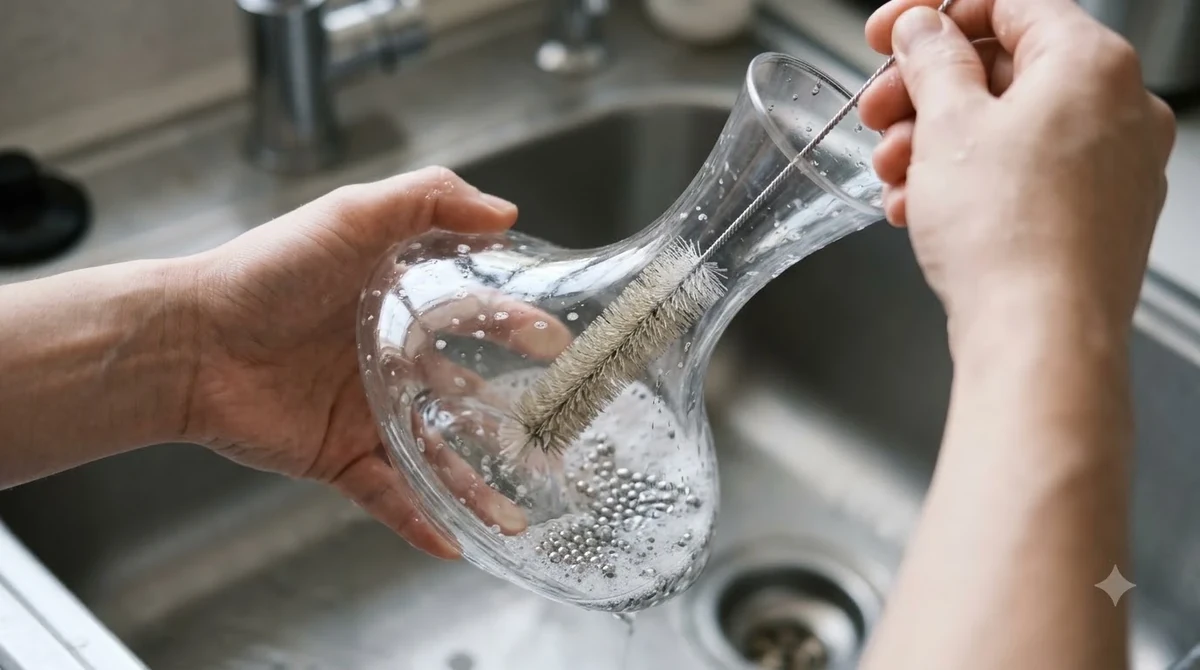
Use a mild dishwashing detergent and a soft cleaning tool rather than an abrasive pad. The opening of a compact carafe can make the interior harder to reach than that of a conventional drinking glass. A suitably sized bottle brush may help, but avoid applying excessive pressure to the sides or base.
After washing, rinse thoroughly to remove detergent residue. Allow the vessel to dry completely before storage. Moisture trapped inside a narrow opening can leave water marks or an unpleasant smell, particularly if the carafe is stored upside down on a surface that prevents air circulation.
Dishwasher suitability should be confirmed for the specific model and current product instructions rather than assumed across the entire Libbey collection. Commercial washing environments can expose glassware to repeated impacts, crowded racks, and temperature changes. A careful loading arrangement helps reduce unnecessary contact between individual pieces.
For storage, keep carafes upright or in a stable position that protects their rims. Avoid stacking glass vessels unless the manufacturer specifically permits it. A crowded shelf can cause the opening of one carafe to strike another when items are removed.
Wine itself also requires appropriate service. A compact carafe is useful for presentation, but it does not replace temperature control. Sparkling wine is generally served around 40 to 50 degrees Fahrenheit, light whites around 45 to 50 degrees, and full-bodied whites around 50 to 55 degrees.
Light-bodied reds are generally served around 55 to 60 degrees, while full-bodied reds are commonly served around 60 to 65 degrees. These temperature ranges help preserve the intended balance between freshness, aroma, and structure.
When serving young, full-bodied red wines that benefit from decanting, a dedicated larger vessel is generally the better choice. A typical starting point for decanting young full reds is 30 to 60 minutes, although the appropriate time depends on the individual wine.
For a more complete glassware setup, buyers can also explore the Glassware Brands collection to compare different approaches to wine presentation. Coordinating the serving vessel, drinking glass, and temperature makes the experience more consistent than focusing on the carafe alone.
In short, gentle cleaning, careful storage, and appropriate wine temperatures will help make a Libbey carafe useful for regular service. The most important precaution is remembering that a protective rim feature is not a substitute for careful handling.
Frequently Asked Questions
Is a Libbey decanter made from lead-free glass?
The product specifications reviewed identify the relevant models as glass, but they do not provide a universal lead-content certification for every Libbey carafe. Buyers who require a documented material declaration should request confirmation for the exact item number before purchasing. This is especially relevant for commercial purchasing specifications.
Can a Libbey carafe be used to serve wine by the glass?
Yes. Small carafes are particularly useful for preparing individual portions before service. A restaurant can use separate vessels for different wines, helping distinguish selections such as Pinot Grigio and Merlot during a tasting or meal.
Does Libbey make carafes with measurement markings?
Libbey’s Pour Line 739/69401 is specifically described as a pour-control decanter, making it a relevant option for measured beverage service. The available product information does not establish that every Libbey carafe includes printed graduations. Buyers should distinguish a designated pour-control design from a vessel with clearly numbered measurement markings.
Can a Libbey carafe be used for nonalcoholic wine?
Yes. A clear-glass carafe can serve nonalcoholic wine, grape juice, sparkling juice, and other suitable beverages. For sparkling drinks, leave adequate headspace to accommodate bubbles and reduce the likelihood of overflow during pouring.
Does the Libbey 719 have enough capacity for two standard wine servings?
The 719’s listed capacity is 8.5 ounces, so it cannot accommodate two standard 5-ounce wine servings. Its practical use is closer to one generous serving or a smaller shared pour. Buyers planning two full servings should select a larger vessel.
The Libbey decanter collection is a practical option for buyers who value clear-glass presentation, useful capacity choices, and straightforward beverage service. The 719 and 782 are particularly relevant for individual portions, while the larger 927634 and 97000 are better suited to shared pours. Choose according to usable capacity and intended function, and consider a traditional full-size wine decanter if aeration is your main priority.
More in Wine Glasses
 Zwiesel Glas Champagne Flutes for Durable Everyday Sparkling WineUpdated Nov 20, 2026
 Vera Wang Crystal Wine Glasses: Design, Quality and Buying AdviceUpdated Nov 20, 2026
 West Elm White Wine Glasses: Compare Designs for Better Everyday Wine ServiceUpdated Nov 20, 2026
 Zalto Stemless Wine Glasses: Discover Their Distinctive DesignsUpdated Nov 20, 2026
 Viski Champagne Glasses That Match Your Style and Sparkling WineUpdated Nov 20, 2026
 Vista Alegre Decanter Review: Crystal Style and Wine ServiceUpdated Nov 20, 2026