

We may earn a commission when you buy through links on this page, at no extra cost to you. Learn more.
The term left foot charley wine identifies the wines and hard cider produced in Traverse City by Left Foot Charley from fruit grown by independent Northern Michigan partners. The winery is known for working with small vineyards rather than relying on a single estate, and its range includes aromatic whites, site-specific reds, sparkling wine, and cider. Its location in the former Northern Michigan Asylum also makes it an unusual urban stop in Michigan wine country.
Left Foot Charley is best understood as a grower-centered winery: its character comes from the vineyards it works with as much as from the cellar in Traverse City. That approach lets drinkers explore northern Michigan grapes such as Riesling, Pinot Blanc, Kerner, Cabernet Franc, and Blaufränkisch through one producer.
Left Foot Charley’s Traverse City Story
Left Foot Charley combines a distinctly local identity with an unconventional winery setting. Founded in 2004 by winemaker Bryan Ulbrich, it operates in the former Northern Michigan Asylum, now part of the Village at Grand Traverse Commons in Traverse City. It is an urban winery rather than a vineyard estate, so the production facility and visitor experience sit within the city instead of among rows of vines.
The name and location can make the winery sound like a novelty, but its central idea is serious and practical: give skilled small growers a route to bottle their fruit as individual wines. Northern Michigan has many growers with vineyard parcels but no winery of their own. Left Foot Charley builds long-term relationships with those farms, sets shared growing goals, and makes wines intended to show differences in site, soil, exposure, and vintage. This puts it in a different category from a large estate winery that grows most of its grapes on one property.
The winery’s history began with a vineyard problem rather than a polished business plan. In 2004, Ulbrich was asked to help revive a favorite vineyard that had become overgrown and faced powdery mildew pressure after changing ownership. He and his wife Jennifer changed their plans to work on the site and save its Riesling crop. The rescue produced a small harvest, while the relationships formed around that work helped shape the business that followed.
That collaborative model is a useful starting point for reading a bottle. A named-vineyard bottling emphasizes one site, while a multi-vineyard wine can offer balance across several locations. For a broader overview, see our guide to Wine Brands.
Lake Michigan Shapes the Growing Season
Left Foot Charley’s grape sources are concentrated in northern Michigan, especially the Old Mission Peninsula and Leelanau Peninsula, with additional growers in Antrim and Benzie counties. These are cool-climate areas where Lake Michigan and Grand Traverse Bay help moderate temperature swings, allowing grapes to ripen in a region that experiences cold winters.
The water surrounding the peninsulas affects both ends of the growing season. Left Foot Charley explains that cool spring water can delay budbreak, reducing the chance that newly emerged shoots will be caught by a late frost. In autumn, the bays release stored warmth, often keeping local sites above freezing into November. That longer shoulder season gives growers more time to bring grapes toward ripeness before winter weather arrives.
Site selection still matters. The winery says it looks for west- and south-facing slopes, which receive useful sunlight, and it points to the region’s glacially shaped hills and varied soils as important influences on flavor. A vineyard on a breezy slope near the bay may not behave exactly like a more sheltered site inland. The appellation and vineyard name therefore offer useful context, not just decorative geography.
That cool climate favors aromatic whites such as Riesling, Pinot Blanc, Pinot Gris, and Kerner, while Chardonnay and sparkling wines offer other expressions of freshness. Cabernet Franc and Blaufränkisch add red-wine breadth.
Sixteen Growers Give the Wines Their Identity
Left Foot Charley does not own its own vineyards; it works with independent farms that grow grapes to agreed specifications. Its vineyard page lists 16 local growers, most with compact plantings that are managed as family-scale farms rather than as large commercial estates. This network lets the winery source different varieties from sites suited to each grape, while growers can focus on farming instead of running a tasting room and cellar.
The individual vineyard details show how specific the model can be. Bird’s Perch Vineyard on Old Mission Peninsula is listed with 1 acre of Riesling, while Terminal Moraine has 1.8 acres of Riesling. Longcore’s Yard D’Vine has Cabernet Franc and Riesling on 1 acre, and Island View Vineyard has 1 acre planted to Pinot Blanc. These are not interchangeable parcels: grape variety, slope, soil, and exposure all contribute to the material the winemaker receives.
The broader list includes a wider range of grapes and growers. Seventh Hill Farm is listed with 5 acres of Riesling, Traminette, and Pinot Blanc; Tale Feathers Vineyard has 2.5 acres of Pinot Gris; and Manigold Vineyard has 1 acre of Gewürztraminer. Eden Hill Vines in Benzie County is listed with 5 acres of Chardonnay and Blaufränkisch. The figures are useful because they show how many varieties can be supported by relatively small plantings spread across several northern Michigan locations.
For a drinker, the practical takeaway is to pay attention to the vineyard line on a bottle or tasting list. A single-vineyard Pinot Blanc offers a focused look at one site, while a Riesling drawn from several vineyards may be assembled to achieve balance across a particular harvest. Neither is automatically better: one emphasizes place, while the other gives the winemaker more options to shape texture and acidity.
Riesling, Pinot Blanc, Kerner, and Blaufränkisch
The winery’s range is broader than a single signature grape, but aromatic whites are a natural entry point. Riesling is a useful place to start because it can show citrus, orchard fruit, floral notes, and pronounced acidity, with sweetness depending on the particular bottling. Pinot Blanc offers another white-wine direction, while Kerner brings an aromatic profile associated with central European wine regions.
Published reviews give a sense of the range without implying that every past vintage is still available. Decanter’s Michigan regional tasting awarded 92 points to Left Foot Charley’s 2017 Island View Vineyard Pinot Blanc from Old Mission Peninsula, describing greengage plum, lime peel, stony notes, crisp acidity, and a light body. The same regional tasting gave the 2018 Kerner from Old Mission Peninsula 89 points, noting apricot, fresh flowers, cream, and a clean, fresh palate. Those are vintage-specific evaluations, not promises about a current release.
There are sparkling and red wines in the mix as well. Wine Enthusiast’s overview of Michigan wineries describes a creamy, bready blanc de blancs made from 100% Chardonnay grown on a fourth-generation Old Mission Peninsula vineyard. The magazine also highlights a bright Pinot Blanc sourced from a vineyard with the state’s oldest planting of the grape. Together, these examples show how the grower network can support both traditional varieties and less familiar northern Michigan expressions.
On the red side, the vineyard roster includes Cabernet Franc and Blaufränkisch. Cabernet Franc is a familiar grape in many cool-climate regions, while Blaufränkisch is more closely associated with central Europe and can bring a darker-fruited, savory character to a red-wine flight. The winery also makes hard cider, so the tasting selection is not limited to grape wines. For broader contrast, readers can compare this regional, cool-climate range with a more ripe-fruited American red such as the one discussed in our austin hope red wine profile. Treat the historic reviews in the table as a map of the producer’s style, not a promise of current availability: the lineup changes with harvests and cellar decisions, so ask which pours are single-vineyard selections, blends, or less common northern Michigan grapes.
| Wine example | Vintage and place | Published detail |
|---|---|---|
| Island View Vineyard Pinot Blanc | 2017, Old Mission Peninsula | 92 points from Decanter; lime peel, greengage plum, stony notes, crisp acidity |
| Kerner | 2018, Old Mission Peninsula | 89 points from Decanter; apricot, fresh flowers, cream, clean finish |
| Blanc de blancs | Chardonnay from Old Mission Peninsula | 100% Chardonnay; described by Wine Enthusiast as creamy and bready |
Food Pairings and Serving Temperatures
Left Foot Charley’s high-acid whites and sparkling wines are especially flexible at the table. Match the weight and sweetness of the dish to the wine: a dry Riesling or Pinot Blanc can work with delicate fish, roast chicken, fresh cheeses, and vegetable dishes, while a fruitier or off-dry Riesling can suit food with a little sweetness or chile. Acidic dishes call for a wine with equal or higher acidity, so a bright white is often a safer match for vinaigrette or citrus-based sauces than a soft, low-acid wine.
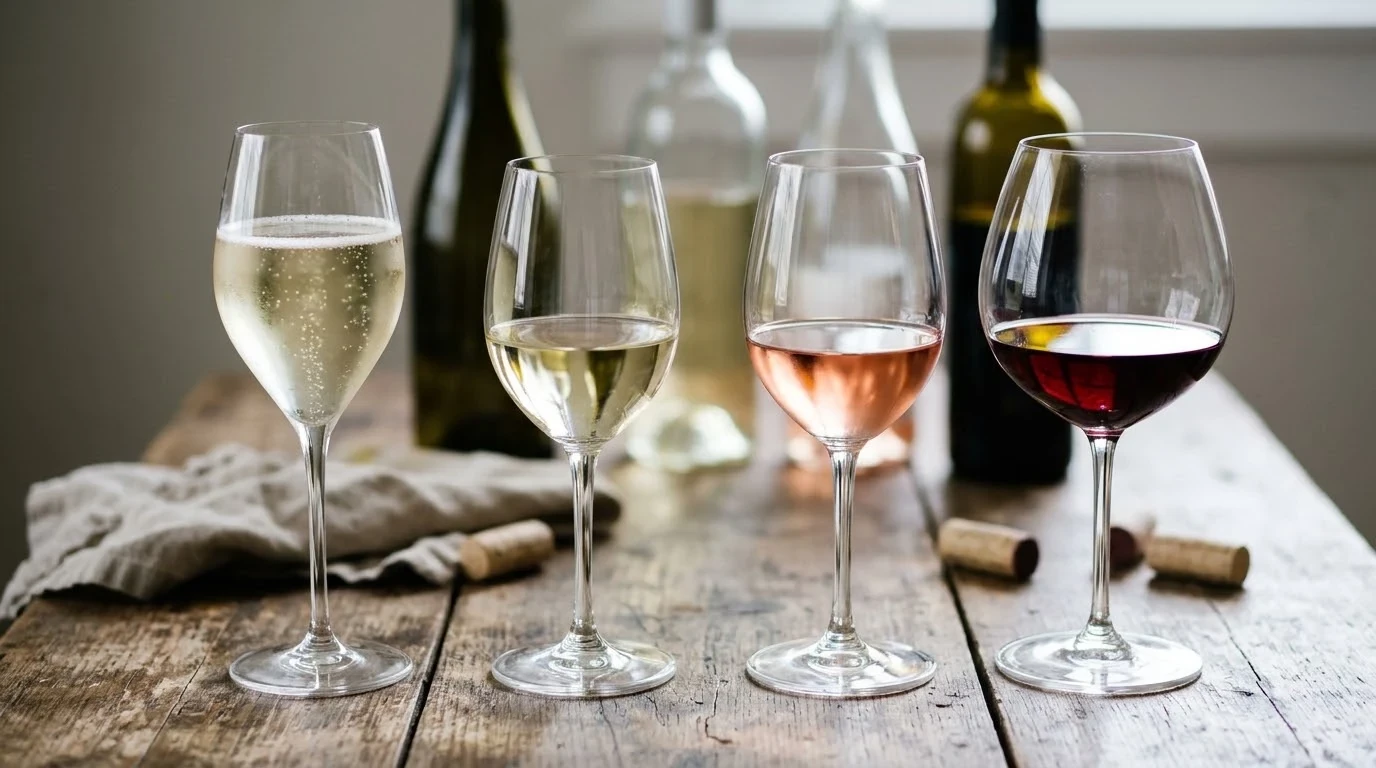
Temperature helps preserve the shape of each wine. Serve sparkling wine around 40–50°F, light whites and rosé around 45–50°F, and fuller whites around 50–55°F. A refrigerator can make a bottle too cold if it stays there for hours; taking it out briefly before pouring can let aromas emerge. For sparkling wines, a well-chilled glass helps retain freshness and slows the loss of bubbles.
For the reds, match the food to the wine’s structure rather than choosing by color alone. Cabernet Franc can work with roast poultry, grilled vegetables, mushrooms, or pork, especially when the dish has savory browned flavors. Salt and fat can soften the perception of tannin, while chile heat can feel stronger alongside wines with higher alcohol or tannin. Avoid pairing a strongly tannic red with oily fish, where the textures and flavors can clash.
Tip: Start a tasting with sparkling wine or a lighter white, then move toward fuller whites and reds. Pour about 5 ounces for a standard wine serving; a 750 ml bottle yields roughly five such glasses.
Fresh chèvre, mild cow’s-milk cheese, and simple cured meats leave room for a crisp white to show its acidity; richer cheeses and fattier meats may suit fuller whites or reds. For another high-acid white-wine reference, see our overview of aveleda wine.
Planning a Visit to the Urban Winery
The tasting room is at 806 Red Drive, Suite 100, in the Village at Grand Traverse Commons in Traverse City. It shares a building with the winery’s production facility, so visitors can taste wine in the same complex where the grapes are made into finished bottles. The setting is unusual for a wine region: rather than driving between vineyard estates, visitors can sample wines in a restored historic campus close to the city.
The tasting room serves wine and cider by the glass or bottle, as well as tasting flights. Charcuterie and small plates are available, and nearby Village restaurants offer another option for a meal. A patio beneath mature trees gives guests an outdoor place to sit, with seasonal arrangements that include shade in summer and heaters or firepits in colder weather. For groups larger than 6, the winery asks visitors to contact it directly when booking a reservation.
The separate Barrel Room is at 1400 Yellow Drive, behind the winery facility. Its barrels are housed in a 19th-century root cellar, and the winery offers curated selections and guided experiences paired with artisan cheeses and cured meats. This is a different experience from a casual flight at the tasting-room bar, so it can be a good choice for visitors who want to spend more time discussing individual wines and the cellar.
Before visiting, check the winery’s official site for current hours, tasting formats, and reservations. The tasting room and Barrel Room have separate schedules, and special experiences may require advance booking. Ask which wines are being poured if you hope to try a particular vineyard bottling or an older vintage.
Frequently Asked Questions
Why is the winery called Left Foot Charley?
The name comes from a childhood nickname for Bryan Ulbrich, whose left foot turned inward and who often tripped while running with enthusiasm. The winery’s own story says the nickname grew out of family gatherings, although its exact origin remains partly mysterious.
What was Left Foot Charley’s first wine?
The first small harvest from the rescued vineyard became a dry Riesling. Bryan and his wife Jennifer canceled their vacation so they could work on the vineyard and bring in that crop.
Does Left Foot Charley make wine for other producers?
Yes. A Northern Express profile describes the winery’s custom-crush work, a service in which a grower supplies grapes and a separate producer handles winemaking. The article identifies Left Foot Charley as a production partner behind wines from four other local wineries.
Which apple variety appears in the grower network?
The winery’s vineyard list identifies Northern Spy apples at Island View Orchard on Old Mission Peninsula. The same orchard listing also includes Pinot Gris, Blaufränkisch, Chardonnay, Kerner, and Auxerrois.
What does the Left Foot Charley Wine Club include?
The winery describes club benefits as exclusive wine selections plus discounts on bottles, glass pours, flights, and tasting experiences. Membership also connects customers with the winery’s community of growers, winemakers, and wine enthusiasts.
Left Foot Charley offers a distinctive way to explore northern Michigan because its wines connect independent vineyard sites with an urban cellar in Traverse City. Start with Riesling or Pinot Blanc to understand the region’s freshness, then try Kerner, Blaufränkisch, sparkling wine, or cider to broaden the picture. A tasting flight is a practical way to discover which vineyard expressions suit your palate before choosing a bottle.
More in Wine Brands
 Underwood Wine Price: Compare Bottles, Cans, and Pack SizesUpdated Nov 21, 2026
 Zenato Wine Price: Compare Styles and Choose the Right BottleUpdated Nov 21, 2026
 Zuccardi Wine Price: Compare Bottles and Find the Right RangeUpdated Nov 21, 2026
 Yellow Tail Moscato Review: Taste, Sweetness and Serving TipsUpdated Nov 21, 2026
 Wolf Blass Yellow Label Review: Choose Your Best StyleUpdated Nov 21, 2026
 Wolffer Estate Rose Review: Choose the Right Bottle for Your TableUpdated Nov 21, 2026