

We may earn a commission when you buy through links on this page, at no extra cost to you. Learn more.
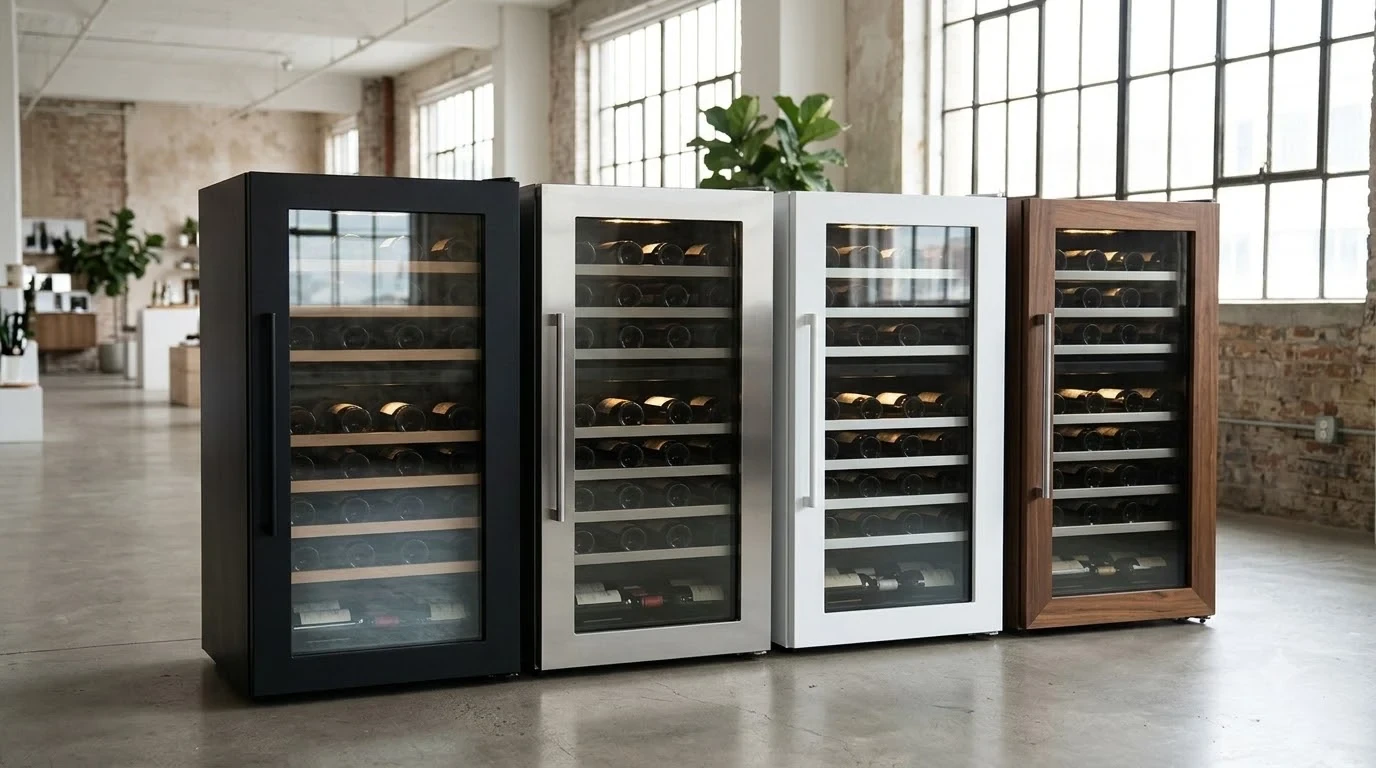
The KitchenAid under counter wine fridge is a stylish built-in wine cellar with two temperature-controlled zones, space for up to 46 standard Bordeaux-size bottles, and full-extension racks. The KUWR314KSS is particularly appealing for homeowners who want a finished, integrated kitchen appearance and separate storage temperatures for reds and whites. However, its advertised capacity deserves careful consideration because wider and unusually shaped bottles can reduce the number that fit comfortably.
A dedicated wine refrigerator can make a kitchen more convenient, especially when a collection includes bottles intended for different serving temperatures. KitchenAid’s undercounter wine cellars combine glass doors, illuminated interiors, adjustable temperature zones, and cabinet-friendly installation. The KUWR314KSS is a useful example of the range, with metal-front racks and a stainless steel exterior. Other versions offer different finishes and rack materials, so buyers should compare the actual model numbers rather than assuming every KitchenAid wine cellar has identical features. This review examines the design, storage limitations, temperature controls, customer feedback, and installation considerations that matter before choosing one.
Specs and Key Features
The KitchenAid KUWR314KSS is designed for homeowners who want a dedicated wine storage appliance without sacrificing the appearance of their kitchen cabinetry. Its main attractions are the dual-zone cooling arrangement, full-extension metal-front racks, UV-protected glass, and a flush installation design.
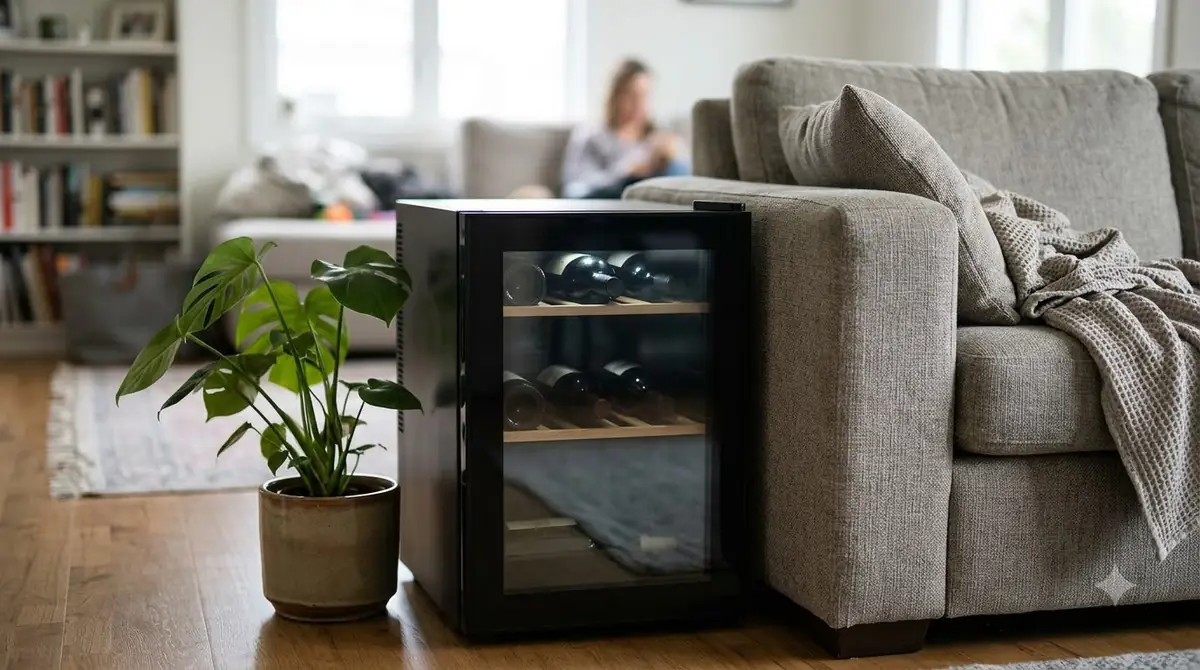
The manufacturer advertises storage for 46 standard wine bottles, arranged across six racks. Five upper racks are designed for eight Bordeaux-size bottles apiece, while the lower rack accommodates six Champagne-style bottles. This is a useful reference for understanding the advertised capacity, but it should not be treated as a guarantee that every collection will fit 46 bottles. Bottle diameter, length, shoulder shape, and storage orientation all influence the practical total.
| Specification | KitchenAid KUWR314KSS |
|---|---|
| Appliance type | Undercounter wine cellar |
| Nominal width | 24 inches |
| Advertised capacity | 46 standard bottles |
| Wine racks | 6 |
| Upper temperature zone | 42°F–54°F |
| Lower temperature zone | 42°F–64°F |
| Upper rack arrangement | 5 racks, 8 Bordeaux-size bottles each |
| Lower rack arrangement | 6 Champagne-style bottles |
| Rack construction | SatinGlide full-extension metal-front racks |
| Lighting | Motion-activated LED |
| Door | UV-protected thermal glass |
| Door opening | Up to 115 degrees |
| Additional features | Temperature monitoring, door alarm, automatic defrost |
One of the more practical features is the independent temperature control. KitchenAid specifies a 42°F to 54°F range for the upper compartment and 42°F to 64°F for the lower compartment. This allows owners to organize wines according to storage or serving preferences rather than placing every bottle in one uniformly chilled space. The available range is especially useful for households that regularly keep sparkling wines, crisp whites, and reds ready for different occasions.
The temperature monitoring system adds another layer of convenience. KitchenAid states that the appliance activates an over-temperature alarm and indicator light when its sensors detect temperatures above 70°F for more than four hours. That warning can help owners recognize a cooling problem before assuming the appliance is operating normally. It is a monitoring feature, not a guarantee that wine will remain unaffected during every power interruption or equipment failure.
The glass door also incorporates UV protection. Wine storage benefits from limiting exposure to damaging light, so this feature is useful in a kitchen where the appliance may be visible throughout the day. Motion-activated LED lighting illuminates the interior as someone approaches, then gradually dims and turns off when it is no longer needed. Owners can view the collection without repeatedly opening the door.
Another convenience is the full-extension SatinGlide rack system. The racks pull outward to provide access to bottles farther inside the compartment. Metal fronts also give the KUWR314KSS a contemporary appearance that coordinates with stainless steel kitchen appliances. Backlit touch controls sit between the temperature zones, displaying their current settings and status alerts.
The appliance includes a door alarm that alerts owners if the door remains open for five minutes or longer. The alert repeats every two minutes until the door is closed or the controls are touched. Automatic defrost is included to reduce frost buildup without requiring routine manual defrosting. Together, these features make the KUWR314KSS more than a simple chilled cabinet, although the rack dimensions remain an important buying consideration.
For the manufacturer’s complete feature descriptions and model information, consult the official KitchenAid KUWR314KSS product page.
What Owners Like
The strongest appeal of KitchenAid’s undercounter wine cellar is its combination of appearance and everyday convenience. Owners shopping for a permanent kitchen installation often want an appliance that looks like part of the cabinetry rather than a separate freestanding cooler.

The flush installation design addresses that preference. KitchenAid describes the hidden hinges as a way to position the closed door in line with surrounding cabinet fronts. The door can swing open 115 degrees, providing access without the prominent hinge arrangement found on some conventional wine refrigerators. This is particularly attractive in a renovated kitchen where cabinet alignment and matching finishes are important design considerations.
Customers also have a reason to appreciate the two-zone arrangement. A single-temperature wine cooler can be limiting for households that regularly serve both white and red wines. The KUWR314KSS allows owners to set the upper compartment between 42°F and 54°F and the lower compartment between 42°F and 64°F. These ranges provide flexibility for organizing different bottles and preparing them for serving.
For example, Sauvignon Blanc and Riesling are generally served chilled, while lighter reds such as Pinot Noir benefit from cooler serving temperatures than fuller-bodied Cabernet Sauvignon. A two-zone appliance can make it easier to keep different categories organized without moving bottles between a kitchen refrigerator and a separate wine cabinet.
The pull-out racks are another useful design detail. A fixed shelf requires owners to reach past bottles at the front to retrieve something farther inside. Full-extension racks bring more of the stored collection forward, making selection and restocking easier. This becomes especially useful when the cooler is positioned under a countertop and the owner cannot comfortably reach deep into the compartment.
The illuminated interior also contributes to usability. Motion-activated LEDs make it easier to identify a bottle without turning on additional kitchen lighting. The glass front offers a view of the collection, while the lighting makes the display more noticeable when someone approaches.
Customer feedback on KitchenAid’s product listings includes positive comments about the appearance and general storage usefulness. Home Depot’s listing for the related KUWL314KBS also includes a customer report that the cooler holds plenty of wine. That is encouraging for shoppers who prioritize appearance and regular household storage, although individual experiences should not be mistaken for proof that every bottle configuration will fit.
The choice of rack finish also appeals to buyers with different kitchen styles. Metal-front racks on the KUWR314KSS coordinate with a more contemporary stainless steel aesthetic. KitchenAid’s KUWR214KSB, by comparison, uses full-extension wood-front racks for a warmer appearance. Both versions provide dual-zone cooling and an advertised 46-bottle capacity.
Another positive is the collection of monitoring and convenience features. An over-temperature warning, door alarm, touch controls, and automatic defrost reduce some of the routine attention required by a dedicated wine cabinet. Owners who want a built-in appliance rather than a basic beverage refrigerator may find this feature combination particularly appealing.
For households that entertain, the appliance can also support a convenient serving routine. Sparkling wine can be chilled ahead of a celebration, while still wines can be organized in the other compartment. A chilled bottle of Prosecco is useful for preparing an Aperol Spritz recipe, while a separate supply of still wine can be kept ready for dinner.
Common Complaints
The most important concern is the difference between advertised bottle capacity and practical storage capacity. KitchenAid specifies 46 standard bottles, but owner feedback raises questions about how comfortably the racks accommodate a full load.
One customer review published on KitchenAid’s KUWR314KBS product page describes difficulty fitting eight bottles across the advertised rack arrangement. The reviewer reports that the shelves were not deep enough for the expected configuration. Another customer raises concerns about fitting wider Chardonnay bottles and sparkling wine containers. These are individual experiences rather than controlled measurements, but they identify a real issue buyers should investigate before installation.
The problem is not unique to one wine style. Bottles vary considerably in dimensions even when they hold the same volume. A conventional Bordeaux bottle is relatively narrow and regular in shape. Burgundy-style bottles have broader shoulders, while Champagne bottles generally have thicker bodies and heavier glass. Some premium Chardonnay and sparkling wine bottles can occupy noticeably more rack space than standard Bordeaux bottles.
This means the advertised 46-bottle figure is most relevant to collections that closely follow the manufacturer’s stated bottle arrangement. Someone who primarily buys standard Bordeaux-shaped bottles may have a different experience from someone who collects Champagne, Burgundy, or unusually shaped bottles.
The lower shelf deserves particular attention because KitchenAid’s advertised configuration assigns it six Champagne-style bottles. If an owner frequently purchases larger sparkling bottles, the practical capacity may be lower than the headline number. A collection with a mixture of bottle shapes can also require rearranging or leaving some rack positions unused.
Temperature-zone placement is another consideration. The upper zone reaches a maximum of 54°F, while the lower zone can reach 64°F. That distinction matters to owners who want to organize wines around their preferred serving temperatures. Someone expecting both compartments to provide identical temperature flexibility may find the arrangement restrictive.
For example, a household that wants to store reds in the upper compartment and whites below should consider whether the available temperature ranges suit that arrangement. The appliance’s zones are independently controlled, but they do not have identical operating ranges. Planning around the actual temperature limits is more useful than assuming that either section can serve every purpose.
Customer feedback also includes concerns about reliability. A Home Depot review of the related KUWL314KBS reports a unit that would not turn on, despite the interior lighting working. This is one customer’s experience and should not be interpreted as a failure rate for the entire product family. Nevertheless, it reinforces the importance of understanding retailer return conditions, delivery inspection procedures, and service arrangements before purchasing a built-in appliance.
Availability can also be a practical issue. KitchenAid’s product listings may show individual models as temporarily out of stock, and retailers can carry different finishes or model revisions. Buyers should confirm that the exact model number on their purchase documents matches the appliance being delivered.
Tip: Before purchasing, measure the widest and longest bottles in your collection. Ask the retailer or manufacturer whether those exact bottle shapes fit the racks, particularly if you regularly buy Champagne, sparkling wine, Burgundy, or oversized Chardonnay bottles. Do not plan a kitchen around the advertised 46-bottle capacity until the rack arrangement has been checked against your collection.
Finally, the KUWR314KSS is a specialized wine cellar rather than a general-purpose refrigerator. It is not designed to replace a full kitchen refrigerator or provide unrestricted storage for cans, food containers, and miscellaneous beverages. Buyers who need mixed beverage storage should compare dedicated beverage centers instead of assuming that a wine cellar offers the same flexibility.
Who Should Buy and Who Should Skip
The KitchenAid undercounter wine fridge makes the most sense for homeowners who value an integrated kitchen appearance, dedicated wine storage, and separate temperature settings. It is less compelling for buyers who prioritize maximum usable bottle capacity above appearance or need to store many oversized bottles.
Homeowners planning a kitchen renovation are among the strongest potential buyers. A 24-inch undercounter appliance can fit into a dedicated cabinet opening, and the hidden-hinge design helps create a coordinated appearance. The glass door and motion-activated lighting also make the wine collection part of the kitchen’s visual design.
Frequent entertainers may also appreciate the convenience. Having chilled white wine, sparkling wine, and red wine organized in one appliance can simplify preparation for dinner parties. A bottle can be selected without searching through the main refrigerator, and the full-extension racks provide easier access when the appliance is stocked.
Wine enthusiasts with a predominantly standard Bordeaux-style collection are more likely to benefit from the advertised arrangement. Those who mainly store conventional 750 ml bottles should still account for differences in bottle length and shoulder shape, but their collection is generally a closer match for the manufacturer’s stated capacity configuration.
Households that regularly prepare wine-based meals may also find dedicated storage useful. For example, a bottle of dry white wine can be kept ready for seafood dishes, while red wine can be available for richer recipes such as a chicken Marsala recipe. The appliance does not determine the ideal wine pairing, but having separate storage zones can make meal preparation and entertaining more convenient.
However, buyers who regularly collect large-format bottles or a wide variety of Champagne and Burgundy shapes should be cautious. A 46-bottle rating may sound generous, but the actual number of bottles that fit can depend heavily on the collection. Someone buying an expensive built-in cooler primarily for maximum capacity should inspect the rack layout before committing to the installation.
Budget-conscious shoppers may also want to consider simpler wine refrigerators. KitchenAid’s flush installation, metal-front racks, lighting, and monitoring features are attractive, but those features may not be necessary for someone who only needs a compact place to chill a few bottles. A basic freestanding cooler may satisfy that requirement without requiring a dedicated cabinet opening.
Renters should think carefully about the installation requirements as well. A built-in appliance is a more substantial commitment than a portable wine refrigerator. Moving it between homes can involve cabinet modifications, electrical considerations, and professional installation work.
Buyers who expect a single appliance to store wine, canned drinks, snacks, and other refrigerated items should also consider a beverage center. The wine cellar’s racks are designed around bottles, so using it as a general-purpose refrigerator would sacrifice much of its intended storage organization.
In short, the KUWR314KSS is best considered a design-oriented wine storage appliance with useful temperature controls, rather than a universal solution for every bottle collection. Its value depends on how well its dimensions, rack layout, and operating temperatures match the owner’s actual needs.
How It Compares to Alternatives
KitchenAid offers several undercounter wine cellar configurations, so buyers can compare rack materials, finishes, and design details without automatically moving to another appliance category. The most relevant comparison is between the KUWR314KSS and the wood-front KUWR214KSB, followed by the broader KUWL/R324S and KUWL/R524S feature groups.
The KUWR314KSS is the metal-front option. Its SatinGlide racks provide full-extension access, while the metal finish complements a contemporary kitchen. The UV-protected thermal glass door, motion-activated lighting, dual-zone controls, and monitoring features make it suitable for owners who want a coordinated stainless steel appearance.
The KUWR214KSB takes a different visual approach. It has full-extension wood-front racks rather than the metal-front arrangement. Its advertised capacity is also 46 standard bottles, and KitchenAid specifies the same upper and lower temperature ranges as the KUWR314KSS. The practical decision is therefore more about appearance and the preferred rack material than a major difference in advertised storage capacity.
KitchenAid’s broader feature guide also identifies KUWL/R324S and KUWL/R524S configurations. Both feature groups have 5.2 cubic feet of capacity, two temperature-controlled zones, motion-activated LED lighting, and temperature monitoring. The KUWL/R324S group uses metal-front racks, while the KUWL/R524S group uses wood-front racks. The guide also identifies personalization as a feature of the higher KUWL/R524S group.
These feature groups help explain why checking the full model number matters. The letters and numbers distinguish configuration, door swing, feature package, width, and finish. A product description that simply says KitchenAid 24-inch wine cellar may not tell buyers everything they need to know about rack construction or cabinet appearance.
The following comparison summarizes the most relevant differences:
| Model or group | Rack design | Advertised capacity | Main distinction |
|---|---|---|---|
| KUWR314KSS | Metal-front, full-extension | 46 bottles | Contemporary stainless steel appearance |
| KUWR214KSB | Wood-front, full-extension | 46 bottles | Warmer rack appearance |
| KUWL/R324S | Metal-front | 5.2 cu. ft. | Feature-group configuration |
| KUWL/R524S | Wood-front | 5.2 cu. ft. | Personalization-oriented feature group |
One important distinction is that cubic-foot capacity and bottle capacity are not interchangeable measurements. A model with 5.2 cubic feet of interior volume does not necessarily provide more practical bottle positions than a model advertised for 46 standard bottles. Rack dimensions and bottle compatibility determine how efficiently the space can be used.
When comparing KitchenAid with other wine refrigerator categories, the main question is whether built-in installation is necessary. A freestanding wine refrigerator can be a more flexible option for a room without a dedicated cabinet opening. A countertop or compact wine cooler may also be sufficient for someone with a small collection. On the other hand, these alternatives may not offer the same integrated cabinet appearance or the same storage layout.
Buyers should also distinguish a wine cellar from a beverage center. A wine cellar uses bottle-oriented racks and temperature zones intended for wine. A beverage center generally offers shelves or racks better suited to cans, bottles, and other refrigerated drinks. Someone who wants to keep mixers and soft drinks alongside wine may find a beverage center more practical.
For a wider look at appliance comparisons and buying considerations, the model reviews section provides another starting point. The important lesson is to compare exact model numbers, usable interior arrangements, and installation specifications rather than choosing solely by brand name or advertised capacity.
Frequently Asked Questions
Can the KitchenAid wine fridge store wine long term?
It can provide dedicated chilled storage, but serving-temperature control and long-term cellar aging are different requirements. Wine intended for extended aging generally benefits from stable conditions around 55°F, appropriate humidity, and protection from vibration and light. Owners with valuable aging collections should evaluate the appliance’s actual environmental stability and suitability for their storage goals rather than relying on bottle capacity alone.
Does the KitchenAid wine cellar have a reversible door?
Door swing is an important distinction among undercounter appliances. KitchenAid identifies left-swing and right-swing versions within its model lineup, so buyers should select the configuration that matches the kitchen layout. Confirm the exact suffix and hinge orientation before ordering because the wrong swing direction can make access awkward in a tight cabinet run.
Can wine bottles be stored horizontally in the KitchenAid cellar?
The appliance uses dedicated horizontal wine racks designed to support bottle storage. Horizontal positioning keeps the wine in contact with a natural cork in traditionally cork-sealed bottles, helping prevent the cork from drying out. Screw-cap bottles do not have the same cork-moisture requirement, although they can still be stored horizontally if the rack supports them securely.
Does the glass door completely prevent wine from aging prematurely?
No glass-door feature should be treated as complete protection against every factor that affects wine aging. UV protection helps reduce exposure to ultraviolet light, but temperature fluctuations, excessive heat, and unsuitable storage conditions can still affect wine. Keeping the appliance away from direct sunlight and other strong heat sources remains sensible practice.
Should a wine refrigerator be switched on immediately after delivery?
Follow the model’s installation and use instructions regarding positioning, leveling, electrical connection, and initial operation. Refrigeration appliances transported in different orientations can have specific settling requirements, so the delivery team’s guidance and the manufacturer’s instructions should take priority. Confirm that the appliance is level and has the required installation clearances before loading it with wine.
The KitchenAid undercounter wine cellar range offers an appealing combination of cabinet-friendly design, dual-zone temperature control, illuminated storage, and convenient full-extension racks. The KUWR314KSS is a strong candidate for a kitchen where appearance and organized wine storage matter, but its advertised 46-bottle capacity should be evaluated against the actual dimensions of your collection. Compare the metal-front and wood-front versions, confirm the door swing and installation requirements, and investigate bottle compatibility before making a final decision.
More in Model Reviews
 Magic Chef 44 Bottle Wine Cooler Review for Flexible StorageUpdated Nov 21, 2026
 Whynter 164 Bottle Wine Cooler Review: Capacity, Features, and FitUpdated Nov 21, 2026
 Insignia NS WC16BK6 Review: Compact 16-Bottle Wine StorageUpdated Nov 21, 2026
 Wine Enthusiast Electric Blue Omega Review: Opening, Pouring, and Preserving Made EasierUpdated Nov 21, 2026
 Koolatron 20 Bottle Wine Cooler Review: Features, Fit, and PerformanceUpdated Nov 21, 2026
 NewAir AWC 330E Review for Home Wine StorageUpdated Nov 21, 2026