

We may earn a commission when you buy through links on this page, at no extra cost to you. Learn more.
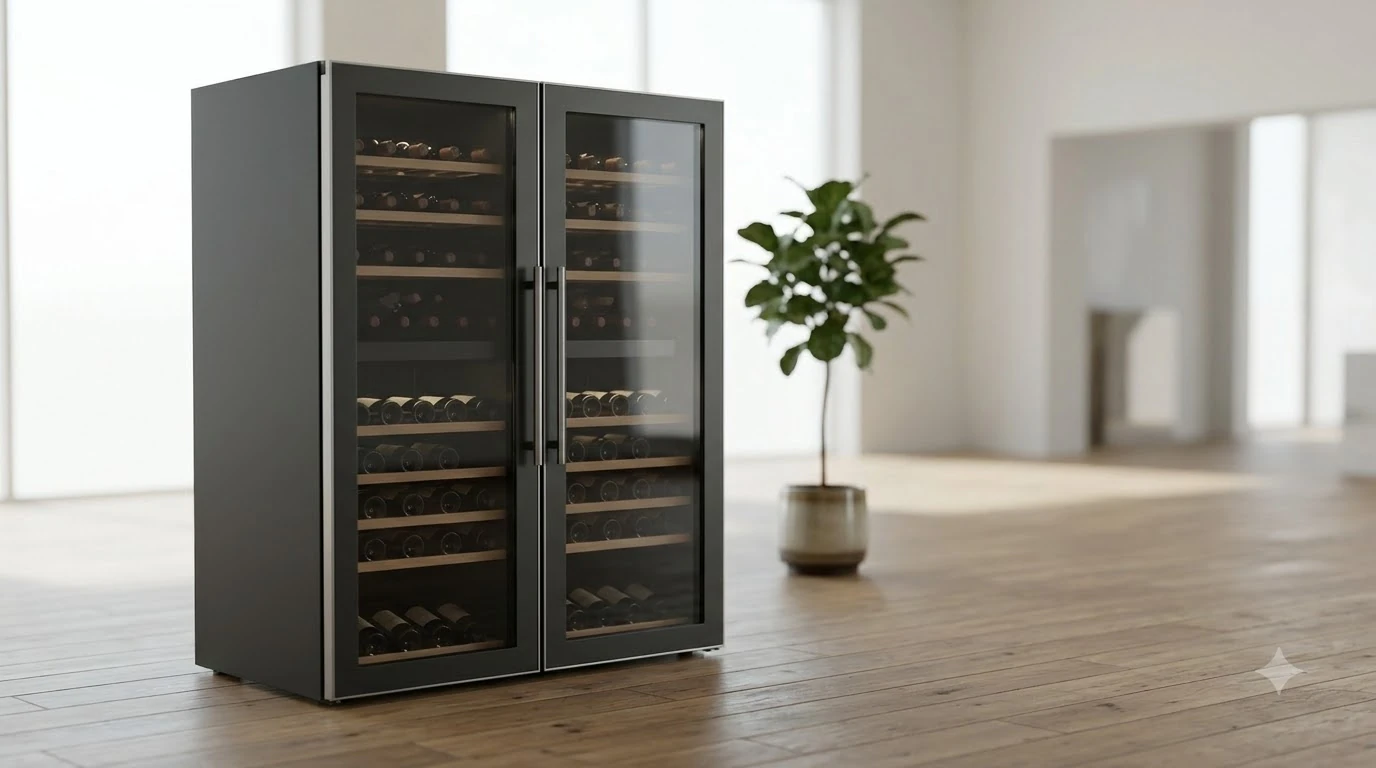
A KitchenAid beverage cooler is a 24-inch built-in dual-zone undercounter refrigerator that pairs an upper cold-drink compartment with a 14-bottle lower wine rack in a flush-mount cabinet. It works best for households that want cans, mixers, and everyday wine bottles chilled in one kitchen island or wet bar footprint rather than a single-purpose wine cellar. The main trade-offs are non-reversible door hinges, tight spacing for wide Burgundy bottles, and the lack of ENERGY STAR certification.
Built-in undercounter refrigeration solves a common kitchen bottleneck by pulling canned seltzers, beer, garnishes, and ready-to-pour wine out of the main family refrigerator. Within the KitchenAid undercounter refrigeration lineup, the 24-inch dual-zone beverage center is engineered to sit flush beneath standard 36-inch countertops while matching surrounding cabinetry or stainless appliance suites. Evaluating its published engineering specs alongside verified owner feedback clarifies where the unit excels and where its layout creates friction.
KitchenAid Beverage Cooler Specs and Key Features
The flagship 24-inch KitchenAid beverage center provides 4.8 cubic feet of internal capacity divided between two independently controlled temperature zones, with an upper section settable from 33°F to 40°F and a lower wine section settable from 42°F to 64°F, according to KitchenAid product specifications. Its exterior cabinet measures 23.88 inches wide and 34.18 inches tall to the cabinet top, allowing flush installation inside a standard 24-inch by 24-inch base cutout.
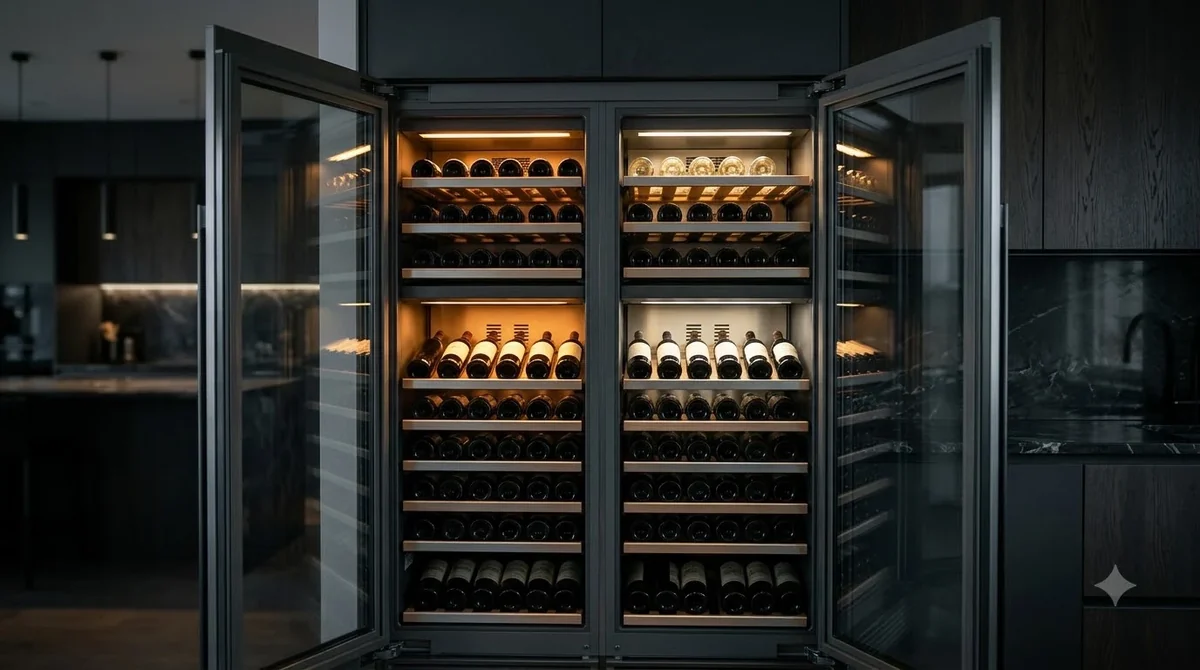
Inside the upper compartment, KitchenAid uses one fixed full-depth tempered glass shelf and one fixed half-depth glass shelf with metallic front accents. That half-depth upper shelf creates vertical clearance near the front of the cabinet so tall wine bottles, sparkling water carafes, or cocktail mixers can stand upright without tipping. Below the backlit touch control divider, two SatinGlide full-extension racks hold up to 14 standard 750 ml Bordeaux-style wine bottles horizontally, with either wood or metal rack fronts depending on the exterior finish selected.
Protection and monitoring features are built directly into the control board and glass assembly. The door uses UV-protected thermal glass to block ultraviolet light that can prematurely age delicate white and sparkling wines. Motion-activated soft white LED lighting illuminates the interior as someone walks past and gradually dims afterward, while a Temperature Monitoring System triggers an audible over-temperature alert and indicator light if internal air stays above 70°F for more than four hours. A door-ajar alarm chimes after five minutes and repeats every two minutes until the door closes.
| Specification | KitchenAid 24-Inch Beverage Center (KUBL524 / KUBR524 / KUBR214 Series) |
|---|---|
| Total Storage Capacity | 4.8 cu. ft. (up to 14 standard 750 ml wine bottles plus upper beverage shelves) |
| Upper Zone Temperature Range | 33°F to 40°F (cans, beer, soda, charcuterie, garnishes) |
| Lower Zone Temperature Range | 42°F to 64°F (red, white, and sparkling wine bottles) |
| Cabinet Dimensions (H x W x D) | 34.18 in. cabinet height (34.38 in. at hinge) x 23.88 in. W x 23.625 in. D (excluding handle) |
| Depth with Handle / Door Open 90° | 26.43–26.44 in. with handle / 48.0 in. with door open 90 degrees |
| Required Cutout Dimensions | 24.0 in. W x 24.0 in. D x 34.5–35.0 in. H |
| Door Hinge & Swing | Hidden hinges, 115-degree maximum swing, factory-fixed left (KUBL) or right (KUBR) |
| Electrical Requirement | 115V, 60Hz, 15A or 20A dedicated grounded 3-prong circuit |
| Certifications & Base Warranty | Star-K Certified Sabbath Mode, UL Listed; not ENERGY STAR qualified; 2-year base limited warranty |
Installation tolerances require close attention before ordering because KitchenAid does not offer field-reversible hinges on these models. Buyers must specify a left-hinge SKU (prefixed KUBL) or a right-hinge SKU (prefixed KUBR) to match the room layout. According to the KitchenAid Use and Care Guide, the cabinet needs 1/4 inch of clearance on both sides and across the top, an unobstructed front base grille for compressor airflow, and at least 2-1/2 inches of clearance on the hinge side when placed next to a fixed wall so the door and pull-out wine racks can clear the frame.
What Owners Like About the KitchenAid Beverage Cooler
Verified buyers consistently highlight the flush built-in appearance, intuitive dual-zone temperature separation, and smooth full-extension wine racks as the strongest day-to-day advantages of this cooler. In living rooms, butler pantries, and open-concept kitchen islands, the hidden-hinge geometry lets the door sit even with surrounding 24-inch cabinetry rather than jutting out like a freestanding mini fridge.
Smooth Cabinet Integration and Finish Options
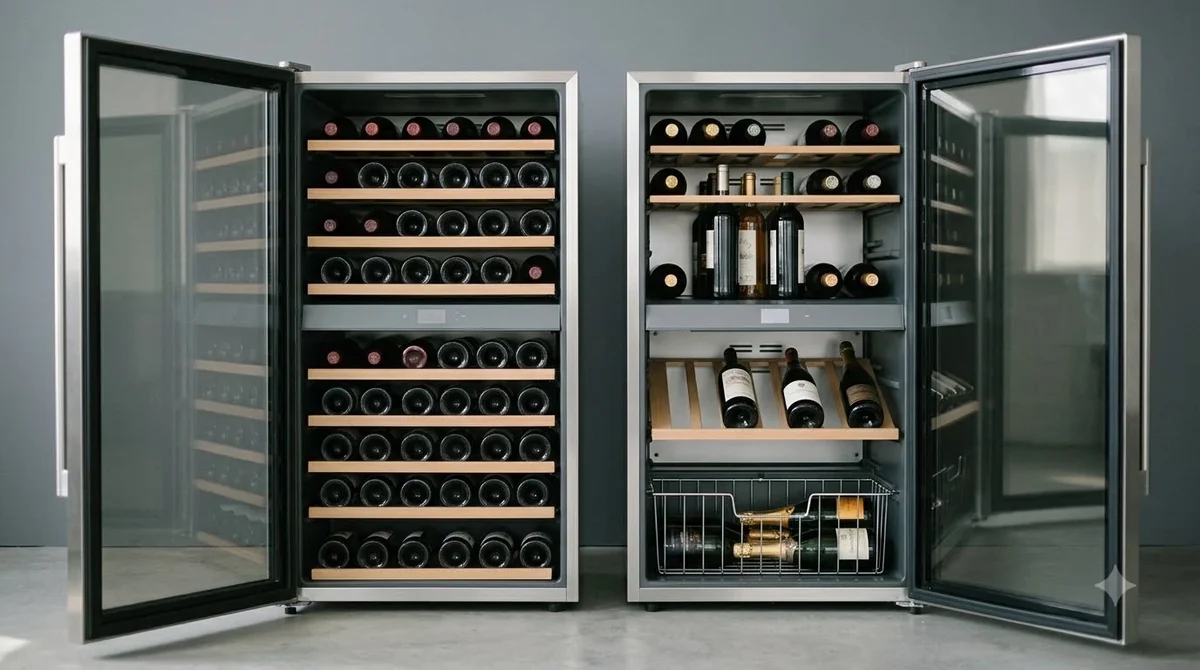
Design-focused renovators frequently select the panel-ready models (such as KUBR214KPA or KUBL524SPA) because they accept a custom 3/4-inch wood overlay weighing up to 20 pounds or a glass-frame overlay up to 10 pounds. Once fitted with matching cabinet millwork and hardware, the appliance blends directly into custom bar cabinetry. Buyers who prefer exposed metal appreciate KitchenAid’s PrintShield stainless finish, as well as specialty hues like Juniper and Black Ore, which resist fingerprints during busy gatherings.
Practical Dual-Zone Entertaining Layout
Unlike single-zone beverage fridges that force owners to compromise between ice-cold cans and overly chilled red wine, the split-zone layout handles both categories at once. Setting the upper compartment between 35°F and 38°F keeps canned sodas, craft beer, and white wine spritzer ingredients crisp, while setting the lower zone near 55°F keeps red wine ready to pour or holds white wine at cellar temperature. Motion-activated interior LEDs also earn praise during evening hosting because guests can see what is stocked through the tinted glass before opening the door.
Smooth SatinGlide Racks and Quick Recovery
The two lower SatinGlide racks pull out smoothly on ball-bearing glides, making it easy to read bottle labels in the back row without lifting bottles out of the cradle. Owners also value the Maximum Cool function, which drops both zones to their lowest temperature settings for up to 24 hours to pull heat out of newly loaded cases of warm cans before a party.
Tip: When stocking warm cans or bottles from room temperature, activate Maximum Cool two to three hours ahead of time and avoid pushing cans flush against the rear evaporator plate on the top shelf, which prevents localized ice crystals from forming in low-sugar sodas.
Common Complaints and Real-World Limitations
The most recurring owner complaints involve localized freezing on the top shelf when set near 33°F, tight vertical clearance on the lower wine racks for oversized bottles, and non-reversible doors. While overall satisfaction remains high across major appliance retailers, these engineering trade-offs show up repeatedly in multi-month owner feedback.
Top-Shelf Over-Chilling Near 33°F
Because the upper zone can be dialed all the way down to 33°F—just one degree above the freezing point of water—several owners report that cans placed near the back wall of the top shelf occasionally freeze or bulge if the compressor runs a long cycle after warm drinks are loaded. Raising the upper zone target to 36°F or 37°F eliminates freezing while keeping canned beer and sparkling water cold.
Tight Rack Spacing for Burgundy and Champagne Bottles
The 14-bottle capacity rating is based on standard 750 ml Bordeaux bottles measuring roughly 3 inches in diameter. Wider Pinot Noir, Chardonnay, or Champagne bottles often rub against the rack above or require staggered placement, reducing real-world wine capacity from 14 bottles down to 10 or 12. Households with larger collections of wide-shouldered bottles typically pair this unit with a dedicated cellar from our best rated wine cooler guide rather than relying on the two lower racks alone.
Fixed Hinges, Noise Sensitivity, and Lack of ENERGY STAR
Because the hinge side is locked at the factory, ordering the wrong swing direction requires returning the entire unit. A smaller subset of owners also notes audible compressor hum in ultra-quiet open floor plans if the cabinet is not leveled across all four feet, as well as occasional motion-sensor sensitivity where passing foot traffic keeps the interior LEDs lit longer than expected. Finally, the unit lacks ENERGY STAR certification, meaning annual electricity draw is slightly higher than certified compact coolers.
Who Should Buy and Who Should Skip
How It Compares to Alternatives
Within the built-in undercounter market, the 24-inch KitchenAid beverage center competes directly against luxury dual-zone models from Sub-Zero, U-Line, and Marvel, as well as KitchenAid’s own narrower 15-inch beverage center. KitchenAid occupies an upper-mid tier that balances flush cabinetry aesthetics and dual-zone electronics with accessible service networks, while ultra-luxury brands charge substantially more for dual-compressor engineering and tighter humidity control.
KitchenAid vs. Sub-Zero, Marvel, and U-Line
Homeowners comparing built-in refrigeration on Houzz and appliance forums frequently weigh KitchenAid against Sub-Zero’s 24-inch undercounter beverage center. Sub-Zero 24-inch undercounter beverage centers use dual-evaporator architecture and magnetic door gaskets that hold temperatures within one degree of setpoint according to Sub-Zero specifications, whereas KitchenAid relies on a single compressor with damper-controlled airflow between its two zones. Marvel and U-Line offer comparable 24-inch stainless and panel-ready beverage centers with Dynamic Cooling Technology or convection cooling, and several Marvel and U-Line configurations include field-reversible hinges—an advantage over KitchenAid’s factory-fixed left or right hinge SKUs.
24-Inch Beverage Center vs. 15-Inch Beverage Center and 46-Bottle Wine Cellar
According to KitchenAid’s specification sheets, buyers tight on horizontal cabinetry can step down to KitchenAid’s 15-inch beverage center, which offers 2.8 cubic feet of capacity for narrow bar runs while keeping standard 34-inch undercounter height. Conversely, households whose priority is wine storage rather than canned drinks can choose KitchenAid’s 24-inch undercounter wine cellar, which replaces the upper glass beverage shelves with full-height wooden wine racks holding up to 46 bottles across two zones. Choosing between the two 24-inch models comes down to whether tall upright mixers and canned drinks or high horizontal bottle density matter more in daily use.
Installation, Temperature Setup, and Daily Care
Proper cabinet preparation and temperature staging prevent the two most common ownership headaches—compressor vibration noise and frozen top-shelf cans. Before sliding the cabinet into a 24-inch opening, installers must verify floor levelness, electrical receptacle placement, and door-swing clearance against adjacent walls or drawer pulls.
Cabinet Cutout, Ventilation, and Door Clearance
KitchenAid’s installation guide specifies a 24-inch wide by 24-inch deep rough opening with a height between 34.5 and 35 inches so the leveling legs can raise the cabinet flush beneath a 36-inch countertop. A dedicated 115V, 60Hz, 15A or 20A grounded three-prong outlet must sit inside the cutout or in an adjacent cabinet without extension cords. Because heat exhausts through the front bottom louver, blocking that toe-kick grille with custom cabinetry trim causes compressor overheating and premature failure. When placing the hinge side next to a perpendicular wall, leaving at least 2-1/2 inches of filler space allows the hidden hinge to open past 90 degrees so the lower SatinGlide racks pull out completely.
Recommended Temperature Settings for Drinks and Wine
Setting the upper zone to 37°F or 38°F keeps canned sodas, sparkling water, and beer cold without risking ice formation near the back evaporator plate. That upper shelf also holds chilled ingredients for cocktails like an aperol spritz recipe—such as Prosecco splits, club soda, and sliced oranges—at ideal 40°F to 45°F serving temperatures. In the lower zone, setting the thermostat to 55°F provides safe mid-range storage for both reds and whites, while setting it to 60°F keeps fuller reds like those paired with a rich chicken marsala recipe ready to pour straight from the rack. Automatic defrost runs periodically without user intervention, and wiping the interior liner with mild dish soap and warm water every few months keeps gaskets clean and odor-free.
Frequently Asked Questions
Does the KitchenAid beverage cooler come with a built-in ice maker?
No, KitchenAid 24-inch and 15-inch beverage centers do not include an internal ice maker or water line hookup. Because all 4.8 cubic feet of cabinet volume listed in KitchenAid’s specifications is dedicated to chilled shelves and wine racks, households needing undercounter ice must install a separate 15-inch clear ice maker alongside the beverage center.
What is Star-K Certified Sabbath Mode on a KitchenAid beverage center?
Star-K Certified Sabbath Mode disables the interior motion-activated LED lights, touch-panel display readouts, and audible door-ajar or over-temperature tones so opening the door does not trigger electronic responses during religious observances. The cooling system continues cycling normally on a timed compressor schedule until the user manually exits Sabbath Mode.
Can you lock the door or control panel on a KitchenAid beverage cooler?
KitchenAid 24-inch beverage centers do not include a physical key lock on the glass door, which is an important consideration for households with young children. However, the backlit interior touch divider includes a Control Lock function that prevents accidental changes to the upper or lower temperature setpoints.
How do you clean the condenser coils on a built-in KitchenAid beverage center?
The condenser coils sit behind the removable front base grille at the bottom of the cabinet, meaning you do not need to pull the unit out of the cabinetry for routine maintenance. KitchenAid’s owner manual recommends unplugging the appliance and vacuuming dust and pet hair from the front grille and condenser fins every six to twelve months using a soft brush attachment.
What does the KitchenAid 2-year limited warranty cover on built-in beverage centers?
KitchenAid’s base 2-year limited warranty covers replacement parts and factory-authorized repair labor for defects in materials or workmanship across the entire appliance from the original purchase date. After the second year ends, sealed refrigeration system parts such as the compressor and evaporator are no longer covered under the base warranty unless an extended service plan is purchased.
For homeowners building a cohesive kitchen island or wet bar, the 24-inch KitchenAid beverage cooler delivers strong visual integration, practical dual-zone flexibility, and smooth full-extension wine racks. Confirming the exact left- or right-hinge model number before ordering and keeping the upper zone set near 37°F ensures reliable daily performance for both chilled drinks and everyday wine bottles.
More in Model Reviews
 Magic Chef 44 Bottle Wine Cooler Review for Flexible StorageUpdated Nov 21, 2026
 Whynter 164 Bottle Wine Cooler Review: Capacity, Features, and FitUpdated Nov 21, 2026
 Insignia NS WC16BK6 Review: Compact 16-Bottle Wine StorageUpdated Nov 21, 2026
 Wine Enthusiast Electric Blue Omega Review: Opening, Pouring, and Preserving Made EasierUpdated Nov 21, 2026
 Koolatron 20 Bottle Wine Cooler Review: Features, Fit, and PerformanceUpdated Nov 21, 2026
 NewAir AWC 330E Review for Home Wine StorageUpdated Nov 21, 2026