

We may earn a commission when you buy through links on this page, at no extra cost to you. Learn more.
The kalamera beverage cooler is a worthwhile option for homeowners who want separate storage for wine and everyday drinks in one 24-inch refrigerator. The Kalamera KRC-150CB offers space for 21 wine bottles and 75 beverage cans, with independent temperature controls, front ventilation, and built-in or freestanding installation. Its main advantages are its flexible storage arrangement and dual-zone design, while potential cooling reliability, delivery damage, and long-term service concerns deserve consideration before purchasing.
A dedicated beverage refrigerator can make a kitchen, entertainment area, or home bar more practical by keeping drinks organized and ready to serve. Kalamera offers several refrigerator configurations, but its 24-inch KRC-150CB dual-zone model is particularly interesting because it combines wine storage with a separate compartment for cans. Understanding its actual capacity, temperature limits, installation requirements, and customer feedback helps determine whether this appliance matches your household’s needs.
Specs and Key Features of the Kalamera KRC-150CB
The Kalamera KRC-150CB is a dual-zone refrigerator with separate compartments for wine and beverages. Its combination of 21-bottle and 75-can storage makes it more versatile than a conventional single-purpose wine refrigerator, particularly in a household that regularly entertains guests.
The manufacturer specifies a stainless steel exterior, double-pane tempered glass doors, wooden wine shelving, and metal beverage shelving. Both compartments have independent touch controls, allowing different temperature settings without requiring a second refrigerator. The official Kalamera KRC-150CB product specifications provide the model’s full dimensions, capacity, temperature ranges, and installation information.
One particularly useful feature is the temperature-memory function. Kalamera says the appliance restores its previous temperature settings after power is restored. That is convenient following a brief electrical interruption, although it does not replace checking the actual compartment temperatures after an outage.
| Specification | Kalamera KRC-150CB |
|---|---|
| Appliance type | Dual-zone wine and beverage refrigerator |
| Wine capacity | 21 bottles |
| Beverage capacity | 75 cans |
| Wine temperature range | 40°F–66°F |
| Beverage temperature range | 38°F–50°F |
| Dimensions | 22.4″D × 23.4″W × 33.9″H |
| Weight | 106.9 pounds |
| Wine shelving | 7 wooden shelves |
| Beverage shelving | 5 iron shelves |
| Door construction | Dual-pane tempered glass |
| Ventilation | Front-venting |
| Installation | Built-in or freestanding |
| Electrical requirements | 110V / 60Hz |
| Input power | 132W |
| Published noise level | Under 40 dB |
These specifications come from the manufacturer’s KRC-150CB product listing. It is important to distinguish this model from similarly named Kalamera refrigerators. For example, the KRC-150BV is a separate single-zone beverage refrigerator, while the KRC-150CB provides two independently controlled compartments.
The distinction matters because temperature ranges, shelf arrangements, and intended storage uses can differ considerably between models. Buyers should also distinguish the KRC-150CB from the KRC-150CB-VC version described in the available instruction manual. The two listings share several dimensions and features, but their stated can capacities are not identical.
What Owners Like About the Refrigerator
Customer feedback highlights the attractive appearance, convenient storage, and relatively unobtrusive operation as appealing features. The manufacturer’s own product page includes positive comments about the refrigerator’s appearance, installation dimensions, and compressor noise, although the feedback also contains complaints that should not be overlooked.
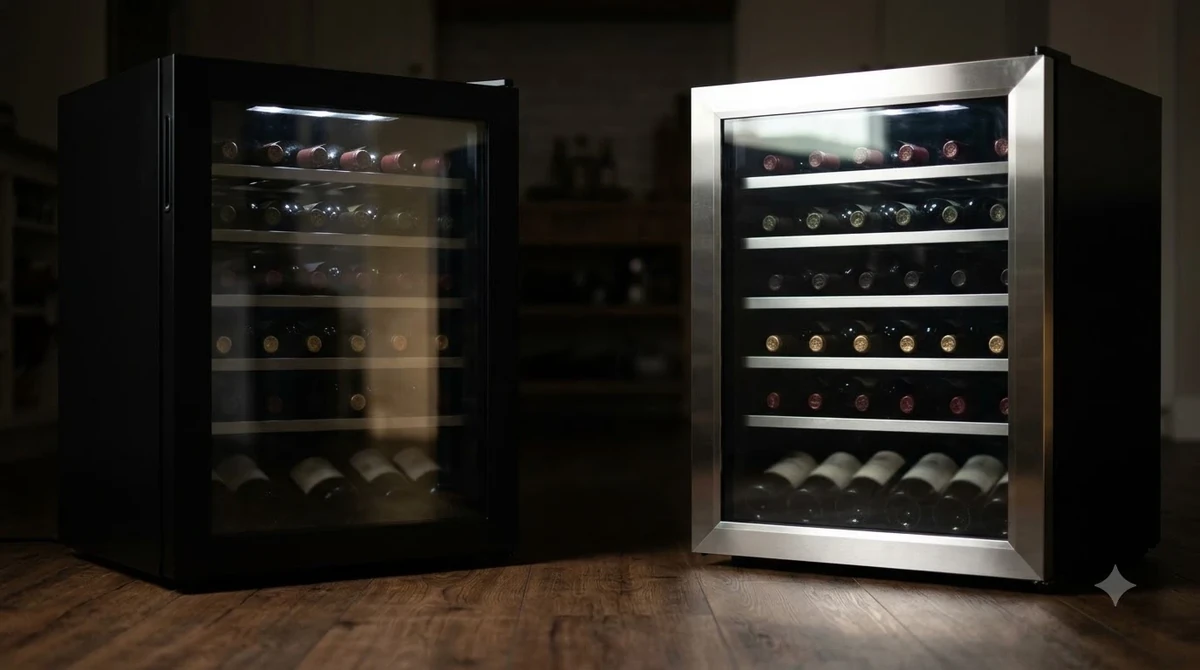
The stainless steel appearance and glass doors make the refrigerator suitable for spaces where appliances remain visible. Instead of hiding drinks behind a solid cabinet door, owners can see their wine and cans through the glass. The blue interior lighting also creates a recognizable home-bar appearance, particularly in an entertainment room or kitchen with subdued lighting.
Storage flexibility is another advantage. Seven wooden wine shelves provide dedicated space for bottles, while five metal shelves organize the beverage compartment. This separation makes it easier to maintain different temperatures for sparkling water, soft drinks, beer, and wine rather than trying to accommodate everything in a conventional refrigerator.
Several customer comments on Kalamera’s product page are encouraging. One owner describes the compressor as barely audible when operating and says the unit appears well constructed. Another appreciates the advertised dimensions and straightforward handle installation, although that customer’s experience after only three days was too limited to establish long-term reliability.
The front-venting configuration is also appealing for kitchen renovations. Many homeowners want a refrigerator that fits beneath a countertop rather than occupying valuable floor space as a freestanding appliance. A correctly installed front-venting model can make this arrangement possible.
The dual-zone layout is especially useful for households that regularly serve both wine and chilled beverages. For example, a dinner party might involve chilled Sauvignon Blanc, sparkling water, and soft drinks. Separate temperature settings allow each category to be stored according to its intended serving temperature.
For homeowners comparing several appliances, the best rated wine cooler options provide useful context for deciding whether a dedicated wine refrigerator or a combination wine-and-beverage model is more appropriate.
Common Complaints and Potential Drawbacks
The most important concerns involve cooling performance, product longevity, and delivery condition. Positive comments about appearance and convenience do not eliminate the possibility of mechanical problems, and prospective buyers should evaluate the available negative feedback before committing to an installation.
One owner review on Kalamera’s product page reports that the refrigerator stopped cooling after approximately three years. Another customer describes receiving a damaged unit, although that reviewer subsequently reported that the replacement was satisfactory. These experiences demonstrate why delivery inspection and warranty clarification deserve attention.
Temperature consistency is another issue worth monitoring. A refrigerator’s digital display indicates its set temperature, but that number does not automatically establish that every shelf maintains the same temperature. Air circulation, door openings, room conditions, and the placement of newly loaded drinks can influence cooling performance.
Other Kalamera beverage refrigerator models have also received complaints about inadequate cooling and door-sealing problems. However, these reports should not be treated as proof that the KRC-150CB has identical problems. The KRC-150BV, for example, is a different single-zone product, so its owner experiences are relevant only as broader brand-level context.
Noise expectations also require some care. Kalamera publishes a noise level below 40 dB for the KRC-150CB, but compressor and fan sounds can vary with operating conditions and installation. A refrigerator installed inside cabinetry may also produce vibrations if it is not properly leveled or if surrounding panels touch the appliance.
The appliance’s weight is another practical drawback. At 106.9 pounds before loading, the refrigerator is not a particularly convenient item to move into position without assistance. A kitchen renovation should account for delivery access, cabinet preparation, electrical placement, and the final installation position.
Finally, the 38°F lower limit of the beverage compartment may not satisfy everyone. It is appropriate for many chilled drinks, but customers who prefer beverages close to freezing may want a refrigerator with a lower published temperature setting.
The available feedback therefore presents a mixed picture. The design and storage arrangement are appealing, but cooling performance and durability should be treated as purchase considerations rather than assumed strengths.
Who Should Buy the Kalamera Beverage Cooler and Who Should Skip It
The Kalamera KRC-150CB makes the most sense for homeowners who want a combination wine and beverage refrigerator with separate temperature controls. Its 21-bottle wine compartment and 75-can beverage compartment are useful for a household that entertains regularly or wants to move drinks out of the main kitchen refrigerator.
It is particularly suitable for a built-in home bar, a remodeled kitchen, or an entertainment room with a properly prepared 24-inch cabinet opening. The 33.9-inch height and 23.4-inch width are useful starting points for planning, although the complete installation requirements must be considered before ordering.
Buy it if you want two temperature zones
Wine and soft drinks do not necessarily belong at the same temperature. The wine compartment operates between 40°F and 66°F, while the beverage compartment operates between 38°F and 50°F. This makes the refrigerator a practical choice for someone who keeps both bottles and ready-to-drink beverages on hand.
For example, a household might set the beverage side to 38°F for sparkling water and soft drinks, while using the wine side at approximately 55°F for a mixed collection. These settings offer flexibility for everyday use without needing two separate appliances.
Buy it if you are planning a built-in installation
The front-venting design is a significant advantage for homeowners who want an undercounter refrigerator. The stainless steel panels and glass doors also fit naturally into many contemporary kitchen designs.
Nevertheless, cabinet measurements should be confirmed before purchase. The published width of 23.4 inches and depth of 22.4 inches are not interchangeable with the dimensions of the cabinet opening. Door swing, handle projection, surrounding panels, and shelf extension all affect whether the installation will work comfortably.
Skip it if you need commercial-level storage
The 21-bottle and 75-can capacities are intended for domestic use rather than large restaurants, busy hospitality operations, or commercial beverage service. A business that needs frequent restocking may require a larger refrigerator with a capacity and cooling specification designed for its workload.
Similarly, serious wine collectors who prioritize long-term aging conditions may prefer a dedicated wine cellar or a refrigerator specifically designed around wine storage. The Kalamera’s beverage compartment is useful, but its dual-purpose arrangement is not automatically the ideal solution for every wine collection.
It may also be unsuitable for anyone who needs extremely cold drinks below 38°F. The beverage compartment’s published temperature range establishes a clear limit, so buyers should not expect the refrigerator to operate like a freezer.
Finally, cautious buyers who place the highest priority on long-term repair support should investigate the applicable warranty and service arrangements before purchasing. The available customer feedback makes this a sensible precaution.
How It Compares to Alternative Beverage Refrigerators
The Kalamera KRC-150CB occupies a middle ground between a dedicated wine cooler and a conventional beverage refrigerator. Its strongest distinction is the combination of two independent compartments, while its main limitation is that its storage capacity and temperature range are designed for ordinary household entertaining rather than specialized commercial requirements.
One alternative is a conventional single-zone beverage refrigerator. The Kalamera KRC-150BV is an example of this category, with a published capacity of 170 standard 12-ounce cans. Its larger can capacity makes it more appropriate for households that primarily store soft drinks, canned beverages, and similar products rather than a combination of wine and drinks.
The trade-off is straightforward. A single-zone refrigerator dedicates its interior to beverages, while the KRC-150CB divides its storage between wine and cans. Someone who rarely drinks wine may get more practical value from the larger single-zone configuration.
Another alternative is a dedicated wine refrigerator. These appliances prioritize bottle storage, wine shelving, and temperature management. They can be more appropriate for collectors who want to store a larger collection without sacrificing shelf positions to cans and other beverages.
The choice becomes clearer when the main storage requirements are compared:
| Comparison factor | Kalamera KRC-150CB | Single-zone beverage refrigerator | Dedicated wine refrigerator |
|---|---|---|---|
| Primary purpose | Wine and beverages | Cans and drinks | Wine bottles |
| Temperature zones | 2 | Usually 1 | 1 or more, depending on model |
| Wine storage | 21 bottles | Not the main purpose | Model dependent |
| Beverage storage | 75 cans | Model dependent | Not the main purpose |
| Best application | Mixed home bar | Drink-focused storage | Wine collection |
A separate consideration is whether the appliance will be installed beneath a countertop. The KRC-150CB has front ventilation, making it more appropriate for this arrangement than a refrigerator that relies exclusively on rear or side ventilation. However, installation instructions must still be followed carefully.
For a more detailed look at wine-focused refrigeration, consider the Brand x Type refrigerator reviews when comparing different appliance configurations and intended uses.
The right choice ultimately depends on what occupies most of the refrigerator. If wine and cans both matter, the dual-zone Kalamera has a clear functional advantage. If the household stores almost exclusively cans, a single-zone model with greater beverage capacity may be a more logical purchase.
Installation, Temperature Settings, and Everyday Care
Correct installation is essential for consistent operation and convenient access. The Kalamera KRC-150CB is a substantial appliance measuring 22.4 inches deep, 23.4 inches wide, and 33.9 inches high, so the installation area should be prepared before delivery.
Begin by checking the cabinet opening and the refrigerator’s complete external dimensions. The manufacturer recommends at least 1/4 inch of clearance on each side and 1 inch behind for the described built-in installation. Its installation guidance also discusses additional spacing for maintenance and easier access.
Pay particular attention to the front ventilation area. A front-venting refrigerator needs unobstructed airflow at the front of the appliance. Decorative cabinet panels, rugs, or objects placed in front of the ventilation opening can interfere with normal operation.
The manufacturer’s guidance also mentions using a 1/2-inch filler strip or side panel on the hinge side when installing between frameless cabinets. This helps prevent the door from interfering with adjacent cabinetry. That detail can be particularly important in a custom kitchen where cabinet doors and appliance doors have limited clearance.
Allow the refrigerator to settle before use
Kalamera recommends allowing the refrigerator to remain upright for at least 24 hours before plugging it in after unpacking. Its installation instructions also advise waiting 24 hours before loading beverages after installation to allow the refrigerant to settle.
Do not rush this process. The appliance weighs 106.9 pounds, and its position should be finalized before loading wine bottles and cans. The manufacturer also advises against tilting it more than 45 degrees during transportation.
Choose suitable temperatures for the contents
Temperature settings should reflect the beverages being stored rather than simply using the coldest available setting. For many household applications, the beverage compartment can be set around 38°F to 40°F, while the wine compartment can be adjusted to suit the bottles being kept inside.
For example, a collection containing Chardonnay, Sauvignon Blanc, and Pinot Noir requires some consideration because these wines are not necessarily served at identical temperatures. A setting around 55°F provides a useful general storage compromise for a mixed collection, while individual serving temperatures can be adjusted after removing bottles.
For serving, sparkling wine is generally best around 40°F to 50°F, light whites and rosé around 45°F to 50°F, and full-bodied whites around 50°F to 55°F. Light reds are often served around 55°F to 60°F, while full-bodied reds generally benefit from 60°F to 65°F.
Tip: Use an independent refrigerator thermometer to check actual temperatures after installation. Allow the refrigerator to stabilize before making conclusions about cooling performance, and check different shelf positions rather than relying exclusively on the digital display.
Keep the interior clean and organized
The instruction manual recommends cleaning the refrigerator with a soft cloth and mild detergent mixed with water. Avoid abrasive cleaners and solvents, which can damage the finish or interior surfaces. Unplug the appliance before cleaning.
The manual also describes an automatic defrost system. This means the refrigerator is designed to handle its defrost cycle without requiring routine manual defrosting. However, excessive condensation, unusual water accumulation, or persistent frost should still be investigated.
Try not to overload either compartment. The manufacturer’s capacities are based on standard bottle and can arrangements, so oversized wine bottles, unusually tall beverage containers, and irregular packaging may reduce the practical storage capacity.
Wine bottles should also be arranged securely rather than stacked in a way that places unnecessary pressure on shelving. The wooden racks are intended for wine storage, while the metal shelves serve the beverage compartment.
For a household that regularly prepares drinks and meals, the refrigerator can also complement a dedicated serving area. Chilled ingredients for an Aperol Spritz recipe or beverages served alongside a chicken Marsala recipe can be organized without taking up the main refrigerator’s everyday food-storage space.
Routine checks of door alignment, ventilation, and internal temperatures help identify problems early. These small maintenance habits are particularly useful for a refrigerator installed beneath a counter, where access to the rear and sides may be limited.
Frequently Asked Questions
Does the Kalamera KRC-150CB have a reversible door?
The available KRC-150CB product specifications do not clearly establish reversible hinges for this exact model. A separate instruction manual for the KRC-150CB-VC describes reversible door hinges, but that should not automatically be assumed to apply to every KRC-150CB configuration. Confirm the hinge arrangement for the exact model before designing a tight cabinet installation.
Can the Kalamera beverage cooler store sparkling wine bottles?
It can accommodate standard wine bottles, but the manufacturer does not establish a universal capacity for larger sparkling wine bottles. Champagne bottles can have wider bodies than standard Bordeaux bottles, so they may reduce the number of bottles that fit on a shelf. Measure the bottle and available shelf clearance before planning a collection around oversized formats.
Does the Kalamera beverage cooler have a child safety lock?
The separate KRC-150CB-VC instruction manual describes a safety lock as part of its illustrated product features. However, buyers should confirm that the feature is included with their precise model and configuration. A child safety lock is a separate consideration from the refrigerator’s ordinary door-closing mechanism.
Can the Kalamera refrigerator operate during a power outage?
No refrigerator can continue actively cooling without an appropriate power supply. The KRC-150CB’s temperature-memory function is designed to restore its previous settings when electricity returns. It does not provide backup battery refrigeration or guarantee that stored drinks maintain their original temperature throughout an extended outage.
What warranty does Kalamera provide?
Kalamera’s official FAQ states that its products have a one-year warranty covering manufacturing defects. The company explains that eligible malfunctions during the warranty period are handled through replacement parts. Keep the purchase record and verify the terms applicable to the exact model and retailer before buying.
The Kalamera KRC-150CB is an appealing combination refrigerator for homeowners who want wine and everyday beverages stored separately in one appliance. Its dual-zone controls, front ventilation, and 21-bottle and 75-can capacity make it a practical candidate for a properly planned home bar. However, the mixed customer feedback means installation planning, temperature verification, and warranty checks should be part of the buying decision rather than afterthoughts.
More in Model Reviews
 Magic Chef 44 Bottle Wine Cooler Review for Flexible StorageUpdated Nov 21, 2026
 Whynter 164 Bottle Wine Cooler Review: Capacity, Features, and FitUpdated Nov 21, 2026
 Insignia NS WC16BK6 Review: Compact 16-Bottle Wine StorageUpdated Nov 21, 2026
 Wine Enthusiast Electric Blue Omega Review: Opening, Pouring, and Preserving Made EasierUpdated Nov 21, 2026
 Koolatron 20 Bottle Wine Cooler Review: Features, Fit, and PerformanceUpdated Nov 21, 2026
 NewAir AWC 330E Review for Home Wine StorageUpdated Nov 21, 2026