

We may earn a commission when you buy through links on this page, at no extra cost to you. Learn more.
The j lohr chardonnay alcohol content typically falls around 13.5% to 14.5% ABV, depending on the specific wine and vintage, with Riverstone Chardonnay commonly falling near 14% ABV. The winery’s 2024 Riverstone production outline reports 14.1% alcohol by volume, while its Paperwhite Unoaked Chardonnay has a documented figure of 13.5% ABV. These California Chardonnays are dry white wines, and their alcohol levels reflect differences in grape ripeness, winemaking, and individual bottlings.
J. Lohr makes several Chardonnay wines, so there is no single alcohol percentage that applies to every bottle carrying the winery’s name. Riverstone, Paperwhite, October Night, and Arroyo Vista offer different expressions of the grape, with differences in oak treatment, texture, acidity, and alcohol. Understanding those distinctions makes it easier to select a bottle, estimate the alcohol in a serving, and choose an appropriate food pairing.
J. Lohr Chardonnay Alcohol Content by Wine Type
Riverstone Chardonnay is generally around 14% ABV, while Paperwhite offers a lighter alternative at 13.5% ABV in its documented production outline. These figures provide a useful starting point, but the exact percentage depends on the particular bottling and vintage.
The clearest documented example is the 2024 J. Lohr Estates Riverstone Chardonnay. Its official production outline lists 14.1% alcohol by volume. This is a relatively full alcohol level for a dry white wine and contributes to the impression of body and warmth that can accompany ripe fruit and barrel-aged Chardonnay.
Paperwhite Unoaked Chardonnay provides a useful comparison. J. Lohr’s 2023 Paperwhite production outline lists 13.5% ABV, placing it 0.6 percentage points below the documented 2024 Riverstone figure. That difference is not enormous, but it can matter to someone comparing two bottles or estimating alcohol consumption across several servings.
Other J. Lohr Chardonnay bottlings include October Night and Arroyo Vista. Their individual alcohol percentages should not automatically be assumed to match Riverstone. Each wine has its own production decisions, grape composition, and vintage conditions.
| J. Lohr Chardonnay | Documented ABV | Style | Key distinction |
|---|---|---|---|
| 2024 Riverstone | 14.1% | Barrel-aged | Rich, textured Chardonnay |
| 2023 Paperwhite | 13.5% | Unoaked | Fresh, crisp Chardonnay |
| October Night | Vintage-dependent | Barrel-aged | Rich, layered expression |
| Arroyo Vista | Vintage-dependent | Barrel-aged | Another distinct winery Chardonnay |
The table uses documented figures rather than treating an entire wine collection as having one fixed alcohol level. In particular, the Riverstone and Paperwhite numbers refer to different vintages. For an individual bottle, its stated ABV is the most useful figure for determining its alcohol concentration.
For additional context, readers comparing popular supermarket Chardonnays can also explore Black Box Chardonnay alcohol content and Yellow Tail Chardonnay alcohol content. Those comparisons help show how alcohol levels vary among different producers and styles.
Why Riverstone Chardonnay Has Around 14% ABV
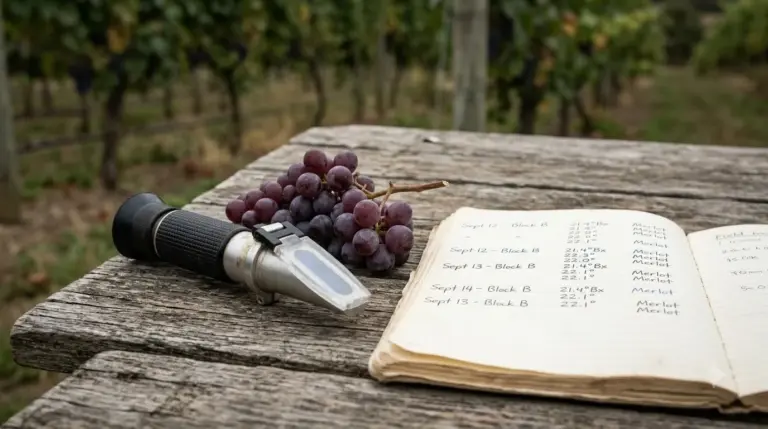
Riverstone’s alcohol level reflects ripe Chardonnay grapes grown in Arroyo Seco, Monterey County, where cool coastal influences help preserve acidity during the growing season. Its 2024 production outline reports 25.1 degrees Brix at harvest and a finished alcohol level of 14.1% ABV.
Brix measures the concentration of soluble solids in grape juice, with sugar making up most of that measurement. During fermentation, yeast converts grape sugar into alcohol and carbon dioxide. Generally, higher sugar concentrations at harvest provide more potential alcohol, although the final result also depends on fermentation and winemaking decisions.
Riverstone’s 25.1 degrees Brix figure helps explain why the wine can reach an alcohol level above 14%. It is a ripe-fruited Chardonnay rather than an intentionally low-alcohol white wine. However, its alcohol level is only one part of its overall character.
The winery identifies Arroyo Seco AVA in Monterey County as the wine’s origin. The vineyard soils include Elder loam and riverstones deposited by the Arroyo Seco River. J. Lohr also describes the influence of cool weather and winds from nearby Monterey Bay, which help retain natural grape acidity.
This combination matters because ripe grapes can produce a wine with substantial alcohol without necessarily creating a flat or excessively heavy impression. Acidity provides freshness and structure, helping balance the warmth and weight associated with alcohol.
The 2024 Riverstone wine has a reported pH of 3.56 and total acidity of 6.13 grams per liter. These measurements help explain why the winery describes the wine as having balanced acidity alongside its ripe fruit character.
For the winery’s complete description of its 2024 bottling, including vineyard origin, grape composition, food pairings, and winemaking details, see the official J. Lohr Riverstone Chardonnay page.
How Winemaking Affects J. Lohr Chardonnay Alcohol
Grape sugar determines much of a wine’s potential alcohol, but fermentation and maturation shape the final style. Riverstone and Paperwhite demonstrate how two J. Lohr Chardonnays can have different alcohol levels while sharing the same primary grape variety.
Riverstone: Barrel fermentation and malolactic conversion
The 2024 Riverstone Chardonnay is made entirely from Chardonnay grapes. Its production outline reports that 74% of the wine underwent malolactic fermentation, a process that converts sharper malic acid into softer lactic acid.
This process can make Chardonnay seem rounder and creamier. It does not directly create a higher alcohol percentage. Instead, it changes the wine’s acidity and texture, influencing how the alcohol is perceived alongside the fruit and oak characteristics.
Riverstone is barrel fermented, aged, and stirred by hand for seven to nine months. The winery lists American, Hungarian, and French oak cooperage. Aging on the lees, or sur lie, also contributes to the wine’s textured mouthfeel.
Its documented aromatic and flavor profile includes pear, white peach, citrus, baking spices, honey, hazelnut, and cocoa. These characteristics can create an impression of richness that complements the wine’s 14.1% alcohol content.
Paperwhite: Stainless steel and freshness
Paperwhite takes a different approach. The 2023 production outline identifies it as an unoaked Chardonnay fermented in stainless steel, with no malolactic fermentation. Its reported alcohol level is 13.5% ABV.
The absence of oak and malolactic conversion helps preserve a cleaner, more direct expression of Chardonnay fruit. J. Lohr describes Paperwhite with white flowers, citrus zest, and hazelnut aromas, followed by a fresh and crisp palate.
Paperwhite’s documented total acidity is 5.9 grams per liter, and its residual sugar is 2.90 grams per liter. These measurements reinforce its dry, freshness-focused style rather than suggesting a sweet wine.
The difference between the two wines illustrates an important point: oak aging and malolactic fermentation influence texture and flavor, while alcohol concentration primarily depends on the amount of fermentable sugar converted during fermentation.
The winery also provides a separate official Paperwhite Chardonnay description, which explains its stainless-steel fermentation, unoaked style, and fresh fruit character.
Alcohol in a Glass and a Full Bottle
A standard wine serving is approximately 5 ounces, and a typical 750 ml bottle provides about five such glasses. At 14.1% ABV, Riverstone contains more alcohol per equal-sized serving than a wine bottled at 13.5% ABV.
To understand the difference, it helps to calculate the approximate amount of pure alcohol in a serving. A 5-ounce pour contains about 147.9 ml of wine. Multiplying that volume by 14.1% gives approximately 20.9 ml of pure alcohol.
For Paperwhite at 13.5% ABV, the same serving contains approximately 20.0 ml of pure alcohol. The difference is about 0.9 ml per 5-ounce glass. Although relatively small, the difference becomes more noticeable when comparing several equal-sized servings.
| Serving or container | Wine volume | Riverstone at 14.1% ABV | Paperwhite at 13.5% ABV |
|---|---|---|---|
| Small pour | 3 oz | 0.423 oz alcohol | 0.405 oz alcohol |
| Standard pour | 5 oz | 0.705 oz alcohol | 0.675 oz alcohol |
| Larger pour | 6 oz | 0.846 oz alcohol | 0.810 oz alcohol |
| Full bottle | 750 ml | 105.75 ml alcohol | 101.25 ml alcohol |
These figures are mathematical estimates based on the stated ABV and serving volume. Actual pours can vary, and a larger glass does not necessarily mean a standard serving. The alcohol concentration remains the same regardless of the glass size.
For an additional comparison, a 750 ml bottle contains approximately five standard 5-ounce servings. This makes the standard serving useful when estimating how much alcohol is in a bottle without confusing container size with alcohol concentration.
Tip: Use the stated ABV and the actual volume poured when comparing wines. A 14.1% Riverstone serving contains slightly more alcohol than an equal-sized serving of 13.5% Paperwhite, even though both are dry Chardonnays.
Readers comparing creamy Chardonnay styles can also look at Butter Chardonnay alcohol content. Comparing the figures side by side is more informative than relying on descriptions such as rich, smooth, buttery, or full-bodied.
How J. Lohr Chardonnay Tastes at Its Alcohol Level
Riverstone’s approximately 14% ABV contributes to its fuller impression, but its fruit, acidity, and oak are equally important. The result is a Chardonnay that combines ripe orchard fruit with citrus freshness and a rounded, textured palate.
The 2024 Riverstone production outline identifies pear, white peach, floral notes, citrus, baking spices, and honey among its defining characteristics. The winery’s description also highlights Meyer lemon, ripe peach, citrus cream, hazelnut, cocoa, and a subtle oak finish.
These flavors are not evidence that the wine contains a high level of residual sugar. The 2024 Riverstone outline reports just 0.25% residual sugar and classifies the wine as dry. Fruit aromas and a soft, creamy impression can make a dry Chardonnay seem richer than its sweetness level suggests.
Does higher ABV make Chardonnay taste sweeter?
Alcohol can contribute a perception of warmth and body, sometimes making a wine seem fuller or softer. However, sweetness and alcohol are separate characteristics. A wine can have 14.1% ABV and still be dry, as the Riverstone production figures demonstrate.
Oak aging can add aromas associated with vanilla, toast, and baking spices. Malolactic fermentation can contribute a softer impression, while lees aging can add texture. These elements may make a Chardonnay seem creamy without requiring a high residual sugar level.
Paperwhite provides a contrasting experience. Its stainless-steel fermentation and lack of malolactic conversion support a fresher, more citrus-driven profile. Its 13.5% ABV also places it slightly below the documented Riverstone figure.
For readers choosing between different Chardonnay styles, the useful distinction is not simply high versus low alcohol. Consider whether the desired wine should be crisp and direct or richer and more textured.
Serving Temperature and Food Pairings
J. Lohr Chardonnay is best served cool enough to preserve freshness without suppressing its aromas. Riverstone’s richer texture and oak character work particularly well with seafood, poultry, and creamy cheeses, while Paperwhite suits lighter dishes.
For Riverstone, a serving temperature of approximately 50 to 55 degrees Fahrenheit is a good starting point for a fuller-bodied white wine. Paperwhite can be served slightly cooler, around 45 to 50 degrees Fahrenheit, to emphasize its crisp citrus character.
Food pairings for Riverstone Chardonnay
J. Lohr specifically recommends triple crème brie, Gruyère, and Asiago cheese with Riverstone. Its creamy texture and ripe fruit flavors can complement the richness of these cheeses without losing the freshness supplied by its acidity.
Seafood is another strong choice. Mussels in white wine sauce, shrimp scampi, and sautéed scallops are among the winery’s recommended pairings. These dishes work particularly well because their savory flavors and moderate richness complement the wine’s citrus, peach, and subtle oak notes.
Roast chicken and sesame-apricot chicken are also suitable options. The savory character of poultry matches Riverstone’s body, while the fruit component complements gentle sweetness in sauces and accompaniments.
Food pairings for Paperwhite
Paperwhite’s fresher style is particularly suitable for lighter fare. Fresh shellfish and sea bass with spring vegetables are examples of the types of dishes that complement its citrus-driven character.
Food acidity also matters. A dish with strong lemon or vinegar flavors generally needs a wine with equal or higher acidity to prevent the wine from tasting flat. Riverstone’s reported total acidity of 6.13 grams per liter helps support its compatibility with many citrus-seasoned seafood dishes.
Very spicy food requires more care. Alcohol and tannin can amplify chili heat, so heavily spiced dishes may make a relatively high-alcohol Chardonnay seem warmer. Mildly seasoned chicken, seafood, and vegetable dishes are more reliable choices.
For a simple dinner, serve Riverstone with grilled chicken, scallops, or Gruyère cheese. Choose Paperwhite for sea bass, shellfish, or a lighter vegetable-based meal.
Choosing a Bottle and Storing J. Lohr Chardonnay
Choosing between J. Lohr Chardonnays starts with the style you prefer rather than the alcohol percentage alone. Riverstone is the more textured, barrel-aged option, while Paperwhite is the fresher unoaked alternative.
The winery’s Chardonnay collection also includes October Night and Arroyo Vista. These wines provide additional expressions of Chardonnay, so their alcohol levels and flavor profiles should be evaluated separately rather than assumed to match Riverstone.
When comparing bottles, three details are particularly useful: the wine’s name, its vintage, and its stated ABV. A product listing may describe a general or previously available bottling, whereas the winery’s production outline can provide detailed information for a specific vintage.
For example, the 2024 Riverstone production outline lists 14.1% ABV. Wine.com also lists the 2024 Riverstone at 14.1% ABV. These matching figures support using 14.1% as a reliable reference for that particular vintage rather than treating it as a universal figure for every J. Lohr Chardonnay.
Storage also influences the wine’s condition after purchase. Keep unopened bottles in a cool, dark location, ideally near 55 degrees Fahrenheit, away from direct sunlight and significant temperature changes. Bottles with traditional cork closures are generally stored on their sides to help keep the cork from drying out.
Riverstone is intended to be enjoyed upon release or within five years of its vintage, according to J. Lohr. That recommendation provides a useful guideline for deciding whether to open the bottle soon rather than holding it indefinitely.
Once opened, refrigerate the Chardonnay and use a suitable wine stopper. Most opened still wines retain their best quality for approximately three to five days under refrigeration, although the wine’s aroma and freshness can gradually decline after opening.
If serving the bottle at refrigerator temperature, allow it to warm slightly in the glass if the aromas seem muted. Excessive cold can reduce the expression of fruit, oak, and other aromatic characteristics.
For a broader look at other producers and wine styles, the Wine Brands section offers additional comparisons that can help readers understand differences in grape varieties, alcohol concentration, and winemaking approaches.
Frequently Asked Questions
Is J. Lohr Chardonnay gluten-free?
Wine made from grapes is generally considered naturally gluten-free because grapes do not contain gluten. J. Lohr’s Riverstone production outline identifies the wine as 100% Chardonnay, rather than a grain-based alcoholic beverage. Individual ingredient and production questions can be directed to the winery.
Does J. Lohr Chardonnay contain sulfites?
Wine commonly contains sulfites, which can occur naturally during fermentation and may also be used in winemaking to protect wine from oxidation and unwanted microbial activity. Sulfite labeling requirements in the United States apply when a wine contains at least 10 parts per million of total sulfur dioxide. The presence and amount of sulfites are separate from a wine’s ABV.
Is J. Lohr Riverstone Chardonnay suitable for aging?
Yes, Riverstone has some short-term cellaring potential. J. Lohr’s production outline recommends enjoying the wine now or within five years of its vintage. Its barrel maturation and acidity contribute to its structure, although it is not necessary to age the wine before opening it.
What grape varieties are used in J. Lohr Riverstone Chardonnay?
The 2024 Riverstone is made from Chardonnay, but its blend includes ten different Chardonnay clones. These include Mount Eden and Hyde-Wente, alongside clones 4, 5, 17, 548, 76, 95, 96, and 809. Different clones can contribute variations in aroma, texture, and fruit expression.
Is Riverstone Chardonnay certified sustainable?
Yes, J. Lohr identifies Riverstone as a Certified California Sustainable Winegrowing wine. The winery explains that the certification indicates at least 85% of the grapes came from certified sustainable vineyards and that the wine was produced in a certified sustainable winery. This certification concerns growing and production practices, not the wine’s alcohol concentration.
J. Lohr Chardonnay generally falls in the 13.5% to 14.5% ABV range across its documented styles, with 2024 Riverstone at 14.1% and 2023 Paperwhite at 13.5%. Comparing the specific wine and vintage gives the clearest picture of its alcohol content, while serving temperature, food pairing, and winemaking style help determine which bottle best suits your preferences.
More in Wine Brands
 19 Crimes Cali Red Price: What to Expect and How to BuyUpdated Nov 21, 2026
 Louis Latour Wine Price: Compare Bottles by Style and TierUpdated Nov 20, 2026
 Yellow Tail Moscato Price: What to Expect Before You BuyUpdated Nov 20, 2026
 Sutter Home Sweet Red Review: Find the Right Food PairingsUpdated Nov 20, 2026
 Franzia Chillable Red Review: Find the Right Serving StyleUpdated Nov 20, 2026
 Veuve Clicquot Rose Review: Flavor, Food Pairings and Buying AdviceUpdated Nov 20, 2026