

We may earn a commission when you buy through links on this page, at no extra cost to you. Learn more.
The simplest way to understand how to read a wine list is to scan its layout first, then use the grape or region, producer, vintage, style, and serving format to narrow the choices. You do not need to recognize every appellation or pronounce every name to order well. Start with a wine style you enjoy, set a comfortable budget, and ask one or two focused questions when a description is unclear.
A restaurant wine list is part menu, part map of the restaurant’s taste. It may be a single page of familiar varietals or a long book arranged by country and appellation. Once you know what each detail tells you—and what it cannot tell you—you can compare options without treating the list like an exam.
Start With the Layout and Wine Categories
Most lists are organized either by color and origin or by flavor and body; both formats are useful once you know what to look for. A traditional list may move from sparkling wine to white, rosé, red, and dessert wine, then divide each group by country and region, while a more casual menu may sort bottles as crisp, aromatic, light-bodied, or full-bodied.

On a regional list, look for the broadest heading first. France may be divided into Bordeaux, Burgundy, the Loire Valley, and the Rhône; Italy may be grouped by Tuscany, Piedmont, Veneto, and Sicily. These places offer clues about grapes and style: white Burgundy is generally Chardonnay, red Burgundy is generally Pinot Noir, and red Bordeaux commonly blends Cabernet Sauvignon and Merlot.
Other restaurants group wines by feel: “fresh and lively” suggests high acidity, while “rich and rounded” may mean fuller body, ripe fruit, or oak influence. Terms such as “mineral” and “natural” are not precise flavor guarantees. Treat these headings as a first filter, not a promise. The WSET explanation of restaurant wine-list structures describes both traditional regional organization and newer style-based formats.
Use an index or sommelier selection before reading every entry. A short highlighted list may feature the wine director’s favorites or bottles chosen for the menu; it is a shortcut, not a guarantee that every wine will suit you.
Decode the Details in Each Wine Listing
A typical entry names some combination of producer, grape, wine or vineyard name, appellation, country, vintage, and price. The order varies, and some entries omit details that seem obvious to the restaurant, so learn to identify the pieces rather than expecting one universal format.
The producer is the winery or person responsible for making or bottling the wine. The grape names the fruit when a wine is varietally labeled; a regional or proprietary name may identify a blend instead. An appellation is the defined place of origin. Napa Valley Cabernet Sauvignon gives you a grape and a broad region, while Barolo identifies an appellation associated with Nebbiolo. Two producers in the same appellation can still make very different wines.
A vineyard name identifies a site; “cuvée” can identify a particular selection or blend. A bin number such as 3B6 is usually an inventory reference, not a quality grade. Country abbreviations such as ITA, FRA, or USA save space. Terms like “estate,” “reserve,” and “old vine” vary in meaning by country, so do not assume they mean the same thing everywhere.
Here is a simplified example: “Domaine Example, Pinot Noir, Willamette Valley, Oregon, 2022.” Read it as producer first, grape second, growing region third, broader location fourth, and harvest year last. Another entry might read “Barolo DOCG, Piedmont, Italy, 2019,” giving you the appellation rather than naming Nebbiolo first. If you can identify producer, place, and grape or style, you already have enough information to ask an informed question.
Use Grapes and Regions to Predict the Style
The grape name gives a practical preview of acidity, tannin, body, and common aromas, while the region explains the setting in which that grape was grown. Neither guarantees an exact flavor, because ripeness, winemaking, aging, and producer choices also shape the finished wine.
For reds, Cabernet Sauvignon is usually high in tannin; Merlot is medium in tannin and softer. Pinot Noir generally has low-to-medium tannin and high acidity, making it a flexible lighter red. Syrah tends to have medium-plus to high tannin and a fuller profile. These contrasts are more useful than memorizing dozens of descriptors.
For whites, Sauvignon Blanc and Riesling are generally high in acidity. Chardonnay usually has medium acidity and can range from lean to creamy, while Moscato is generally lower to medium in acidity and often aromatic, sometimes sweet. “Dry Riesling” signals little perceptible sweetness; other Rieslings can range from dry to sweet.
Regional names also help: Marlborough in New Zealand is associated with Sauvignon Blanc, Chablis in Burgundy with Chardonnay, Rioja in Spain with Tempranillo, and Chianti in Tuscany with Sangiovese. A broad region allows more variation than a narrow appellation. If you like a grape but not its listed origin, ask for the same variety from another place, such as Sauvignon Blanc outside Sancerre. Unfamiliar names need not be difficult. Albariño from Rías Baixas, Grüner Veltliner from Austria, and Mencía from Spain are approachable starting points. Connect a new grape to a style you know by asking whether it is light or full, crisp or soft, dry or sweet. The Wine Q&A and wine basics primer can help build this vocabulary.
Understand Vintage, Sweetness, and Other Style Clues
The vintage is the year the grapes were harvested, not the year the wine was bottled or placed on the restaurant list. It can matter a great deal for age-worthy wines from climates with variable growing seasons, but it is not a simple score that tells you whether every bottle from that year is good or bad.
For wines intended to be enjoyed young, producer and region often tell you more than a one-year difference in vintage. For age-worthy Cabernet Sauvignon from Bordeaux or Pinot Noir from Burgundy, harvest conditions can have a greater effect. Nonvintage sparkling wine blends harvests to maintain a house style; vintage Champagne identifies a single harvest year.
“Dry” means little perceptible sugar; “off-dry” means slight sweetness remains. Sweetness is not the same as fruitiness: a dry wine can smell of peach or berries. Dessert wine should generally be at least as sweet as the dessert, or it may taste thin beside it.
Other terms point to method or sweetness. Rioja’s Crianza, Reserva, and Gran Reserva indicate different aging requirements; Champagne’s Brut is dry, while Demi-Sec is sweeter. Prosecco is made primarily from Glera and commonly uses the tank method; Champagne and Cava undergo second fermentation in the bottle. These are style clues, not quality rankings.
Alcohol by volume is another clue. A wine at 11.5% ABV may feel lighter than a similar wine at 14.5%, though sugar, acidity, ripeness, and winemaking also affect body. Higher alcohol can feel warm beside spicy food.
Compare Glasses, Bottles, and the Real Value
Before choosing a wine, confirm whether the number on the list is for a glass, carafe, half-bottle, or full bottle. A glass gives you flexibility and lets diners choose different wines, while a bottle often makes more sense when several people want the same selection.
A standard bottle contains 750 milliliters, and a typical five-ounce pour gives about five glasses. A magnum holds 1.5 liters—twice a standard bottle—and yields about ten five-ounce pours. A half-bottle holds 375 milliliters and provides roughly two and a half such pours. Restaurants do not all pour exactly five ounces, so treat these figures as planning estimates rather than a promise about the glass in front of you.
| Format | Volume | Approximate 5-oz pours | Useful for |
|---|---|---|---|
| Half-bottle | 375 ml | 2.5 | One or two diners who want a little wine |
| Standard bottle | 750 ml | 5 | A small table sharing one selection |
| Magnum | 1.5 L | 10 | A larger group or a longer meal |
| Double magnum | 3 L | 20 | A celebration with several guests |
Compare the number of glasses your group will order with the bottle format. A bottle may be cheaper than four separate pours, but it is not better if diners want different styles. A carafe or half-bottle can be a middle ground. For an event, estimate how much wine for 100 guests or calculate how many glasses in a magnum before ordering.
Value is not simply the lowest number on the page. A familiar name may carry a premium, while a less famous region offers an appealing alternative. WSET suggests exploring Greek Xinomavro or dry Hungarian Furmint; Wine Enthusiast likewise highlights lesser-known grapes and regions. Judge value by quality and fit, not markup alone. The second-cheapest bottle is not automatically the smartest purchase. A wine director may take care with the house wine or least expensive bottle. Choose a comfortable range, compare two or three options, and state your maximum bottle budget before hearing suggestions. Wine Enthusiast’s restaurant wine-list advice also emphasizes that a wine’s value is not determined simply by its position on the list.
Match the Wine to the Meal and Ask Better Questions
Food pairing is easier when you focus on acidity, sweetness, tannin, alcohol, and the dish’s main flavor or texture. You do not need one perfect wine for every plate; a balanced choice you enjoy is enough.
Acidic food needs wine with equal or higher acidity; Sauvignon Blanc and Riesling can work with lemon, vinaigrette, or tomatoes. Salt and fat soften tannin, helping Cabernet Sauvignon pair with fatty steak or salty hard cheese. Oily fish can clash with tannic reds, so consider a crisp white or lighter red instead. Choose a dessert wine at least as sweet as the dessert; Moscato can suit a fruit tart. Chili heat is amplified by alcohol and tannin, so a high-alcohol, tannic red can make spicy food feel hotter. A lower-alcohol white with some sweetness or rosé may be easier with hot sauce.
For a table ordering different dishes, choose a flexible wine. High-acid whites such as Riesling, Albariño, and Grüner Veltliner cover varied foods; Pinot Noir is a useful lighter red, and rosé can suit diners split between red and white. A Tuscan dish with a Tuscan wine or Loire goat cheese with Loire white is another sensible starting point. Ask specific questions. Instead of “What is good?” try “Which Pinot Noir is lighter and more acidic?” or “I like dry whites with little oak; which bottle fits?” Name a wine you enjoy and ask for something similar. Point to a range on the list to communicate your budget comfortably.
Tip: Pick one familiar reference point before you ask for help: a grape, region, or bottle you already enjoy. Then add one preference—such as dry, lighter-bodied, or low in oak—and your server can make a much more useful comparison.
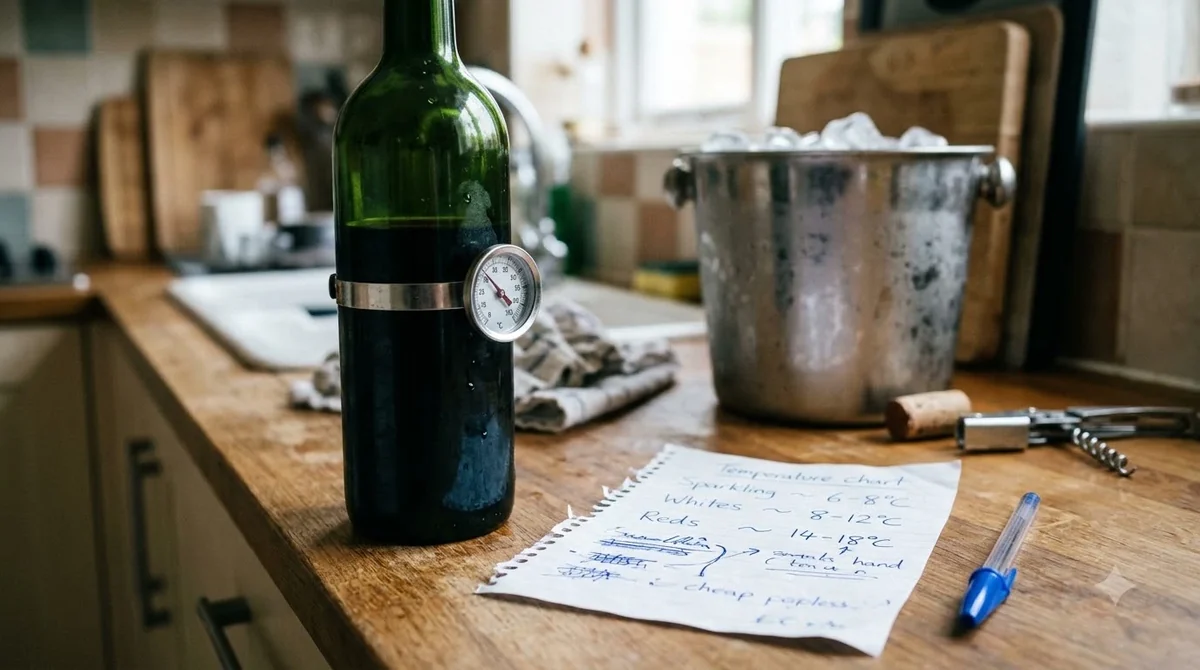
For a glass pour, ask whether it is five ounces. Before a bottle is opened, confirm its producer, wine, and vintage. The sample is mainly a check for faults, not a chance to change your mind about the style. Wet cardboard or damp newspaper can signal cork taint; describe the smell and ask the server to check it. Temperature changes the impression of a wine: sparkling is generally served at 40–50°F, light whites and rosé at 45–50°F, sweet whites at 43–50°F, fuller whites at 50–55°F, light reds at 55–60°F, and full reds at 60–65°F. An icy white can seem muted, while a warm red can taste more alcoholic. Ask for more chilling or a few minutes to warm the glass when needed.
Frequently Asked Questions
These answers cover a few practical details that are useful after you have chosen a bottle, from decanting a young red to understanding restaurant corkage policies.
How long should a young full-bodied red wine breathe?
A young full-bodied red can benefit from 30–60 minutes in a decanter. This is particularly useful for structured wines such as Cabernet Sauvignon and Syrah, although not every red needs decanting.
How long does opened wine usually last?
Opened still wines generally keep for about 3–5 days in the refrigerator, while sparkling wines usually keep for 1–3 days. Fortified wines can last several weeks after opening, depending on the style and storage conditions.
What is a corkage fee?
A corkage fee is a restaurant charge for opening a bottle brought by a guest. Policies vary, so ask about bottle limits and permitted wine types before arriving with one.
What is a wine flight?
A wine flight is a group of smaller pours served together for comparison. Restaurants may arrange a flight by grape, region, producer, or vintage. Comparing several wines side by side can reveal differences that are harder to notice when tasting them separately.
Should you store an unopened wine bottle upright?
Bottles with natural cork closures are generally stored on their sides to keep the cork from drying out. A storage area near 55°F is a useful target, with minimal temperature fluctuation, vibration, and direct light.
Reading a wine list is a practical skill, not a test of memorized regions or pronunciation. Focus on grape or style, origin, vintage, format, and budget; one familiar reference point and a clear question can make the choice straightforward.
More in Wine Basics
 What Is The Best Wine For Mimosas? Choose Bubbly That Balances Orange JuiceUpdated Nov 20, 2026
 Which Prosecco Is Best for Your Taste and OccasionUpdated Nov 20, 2026
 Which Wine Is Best For Health? Understand the Risks and BenefitsUpdated Nov 20, 2026
 Which Champagne Is Best for Your Taste and OccasionUpdated Nov 20, 2026
 What To Put In A Wine Gift Basket For A Thoughtful, Memorable GiftUpdated Nov 20, 2026
 What Is the Best Wine for Mulled Wine? Choose a Smooth, Fruity RedUpdated Nov 20, 2026