

We may earn a commission when you buy through links on this page, at no extra cost to you. Learn more.
The houdini wine stopper is a practical wine-preservation accessory that uses a vacuum pump and stopper to remove excess air from an opened bottle and slow oxidation. Its main appeal is a straightforward preservation system with a reusable stopper, a compact pump, and a push-button release mechanism on certain versions. It is a useful option for households that regularly save unfinished bottles, although reports of inconsistent seals and bottle-fit problems make compatibility an important consideration before buying.
Finishing an entire bottle of wine in one sitting is not always practical. A weekday dinner, a casual glass after work, or a tasting of several different wines can leave an unfinished bottle that needs to be closed properly. Houdini offers several wine-stopper accessories, including basic reusable stoppers and vacuum-preservation systems. Understanding the difference between these designs is essential because a simple stopper and a vacuum pump perform different jobs. This review examines the vacuum-style Houdini preserver, its features, customer feedback, practical limitations, and the situations in which another type of wine accessory might make more sense.
Specs and Key Features
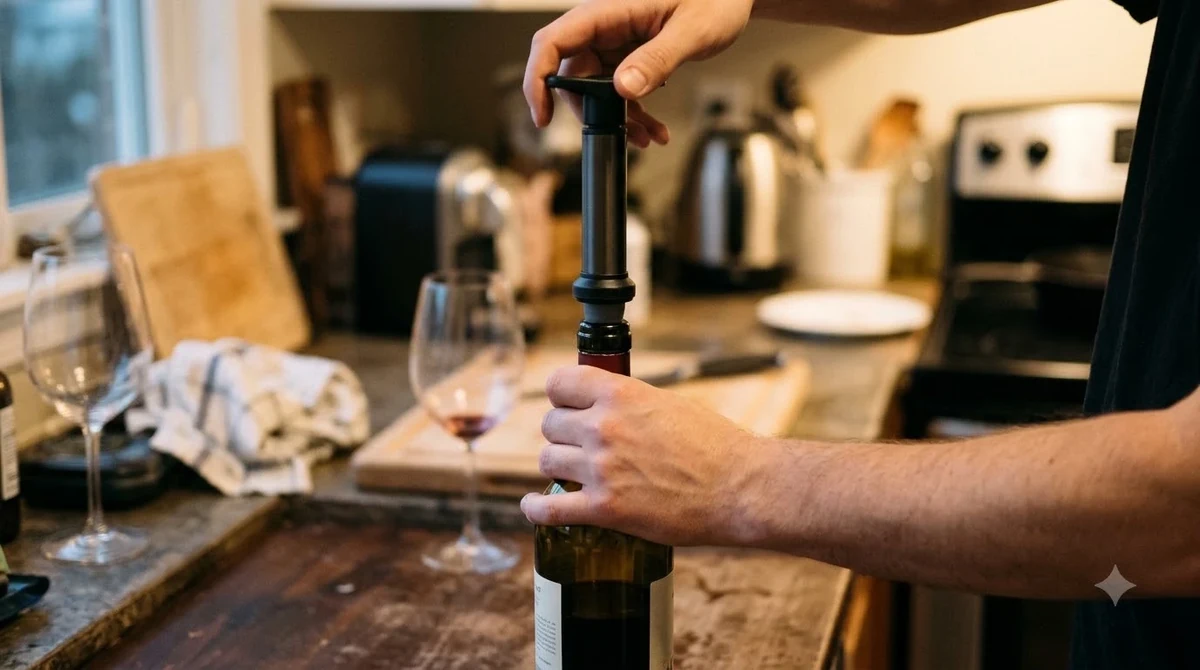
The Houdini Wine Preserver is designed to close an opened wine bottle while removing some of the air remaining inside. Its central components are a hand-operated pump and a stopper that creates a seal at the bottle opening. The design is intended to slow oxidation and help retain wine flavor and aroma between servings.
One important distinction is that Houdini products are not all identical. Retailers list different versions, including a black vacuum pump system, a silver vacuum preserver, and simpler silicone or rubber bottle stoppers. Their materials, dimensions, included accessories, and operating mechanisms should not be treated as interchangeable specifications.
Vacuum preservation rather than simple closure
The vacuum version has a more involved function than an ordinary bottle plug. After pouring wine, the user inserts the stopper into the bottle opening and operates the pump to remove excess air. The resulting reduced-air environment is intended to slow the oxidation process that gradually changes the aroma and flavor of an opened wine.
Canadian Tire describes its Houdini vacuum model as having a patented push-button stopper that holds the vacuum for days. The retailer also identifies an ergonomically designed pump handle. These features make the product particularly interesting for people who prefer a manual preservation tool rather than an electric wine system. The Canadian Tire product specifications provide additional details about this particular black model.
The wording about preservation for days should be understood as the product’s intended function, not a guarantee that every wine will remain unchanged for that length of time. Wine condition after opening depends on the original wine, storage temperature, exposure to air, and the effectiveness of the seal.
Specifications vary between versions
The following comparison separates the documented specifications of two vacuum-preserver listings. The dimensions should not be combined into one universal Houdini specification because the retailers describe different product versions.
| Specification | Target version | At Home silver version |
|---|---|---|
| Product type | Vacuum wine preserver | Vacuum wine preserver |
| Included stoppers | 2 | Not specified |
| Listed height | 5.12 inches | 6.9 inches |
| Listed width | 2.09 inches | 4.4 inches |
| Listed depth | 2.09 inches | 2.2 inches |
| Weight | 0.28 pounds | 0.3 pounds |
| Materials | Plastic and stainless steel | Plastic |
| Cleaning | Spot clean or wipe clean | Not specified |
| Operation | Manual vacuum pump | Push-button operation |
Target also describes its version as suitable for most wine bottles and compact enough for storage or transport. The two included stoppers are a useful practical feature because they allow the user to close more than one bottle without moving the same stopper immediately between bottles. However, the listing does not establish that every bottle opening will be compatible. Its Houdini Wine Preserver product listing provides the specific dimensions, materials, included accessories, and cleaning instructions.
Canadian Tire lists another black Houdini vacuum model under manufacturer part number H3-013001TCAN. Its listed assembled height is 4.92 inches, with a length and width of 1.77 inches each. The retailer identifies the package as a three-piece set and describes the main material as plastic. These details reinforce why buyers should compare the actual product listing rather than assuming all Houdini vacuum accessories have identical dimensions or package contents.
Basic Houdini stoppers are a different product
Houdini also sells simple bottle stoppers that do not require a vacuum pump. These generally rely on a flexible sealing section that fits into the bottle neck. Some listings describe silicone or rubber construction, reusable designs, and dishwasher-safe cleaning instructions.
That simpler design is useful for preventing spills and closing a bottle between servings, but it does not perform the same air-removal function as the vacuum system. A shopper looking specifically for vacuum preservation should avoid confusing a basic Houdini silicone stopper with a complete pump-and-stopper set.
What Owners Like
The strongest appeal of the Houdini vacuum preserver is its relatively uncomplicated manual operation. It addresses an everyday problem without requiring electricity, batteries, a complicated setup, or a large piece of countertop equipment.
Customer feedback published by At Home includes positive comments about ease of use and the convenience of having a stopper available when wine remains in the bottle. Other comments describe the product as useful for ordinary household storage. These experiences suggest that the design can satisfy people who want a straightforward way to close unfinished wine.

Simple operation for everyday wine drinkers
A manual pump is easy to understand in principle. The user does not need to select a preservation program or adjust electronic settings. Instead, the bottle is closed with the stopper and the pump is operated until the desired vacuum is created.
This simplicity is valuable for people who open wine several times a week but do not need professional wine-cellar equipment. Someone who pours a glass of Sauvignon Blanc with dinner on Tuesday and returns to the same bottle on Wednesday can appreciate having a dedicated closure tool ready.
The compact format is another practical advantage. Target lists its version at approximately 0.28 pounds, while At Home lists the silver version at 0.3 pounds. Both are lightweight enough to store alongside a corkscrew, foil cutter, and other ordinary bar accessories.
Reusable accessories reduce dependence on replacement corks
A reusable stopper is more convenient than attempting to force the original cork back into a bottle. Natural corks can expand after removal, become damaged during opening, or be difficult to reinsert. A purpose-built stopper avoids some of these frustrations.
The vacuum version also combines the stopper and pump into a single preservation routine. This can be more appealing than purchasing a separate closure and then trying to improvise a way to reduce the air remaining inside the bottle.
For households that entertain occasionally, the system offers a practical way to manage several open bottles during a gathering. Different guests can sample a Pinot Noir, a Cabernet Sauvignon, and a Chardonnay without requiring every bottle to be finished immediately. The extra included stopper on the Target version makes this arrangement more convenient.
Useful for an organized home bar
A compact preserver fits naturally into a home bar setup. It can be stored beside glassware, bottle openers, measuring tools, and wine accessories rather than occupying a dedicated appliance space.
People assembling a practical bar cart can use the Houdini preserver as part of a small collection of reusable accessories. Its purpose is specific, and it does not require the additional storage space associated with larger preservation systems.
There is also a gifting advantage. Wine accessories are useful gifts for people who already enjoy entertaining, particularly when paired with wine glasses, a corkscrew, or a selection of bottles. The Houdini name and recognizable pump-style design make it a straightforward accessory to understand without requiring an elaborate demonstration.
Common Complaints
The main concern with the Houdini vacuum preserver is consistency. Customer feedback includes reports of incomplete seals, poor bottle compatibility, and vacuum pressure that does not remain stable, which means the product’s intended preservation benefit depends heavily on a reliable fit.
Positive feedback exists, but the negative comments identify practical issues that matter more than cosmetic preferences. A wine preserver needs to maintain its seal after the pump is removed. If it cannot do that, the user may receive little benefit from the vacuum mechanism.
Inconsistent vacuum retention
One Canadian Tire customer reports that the pump seemed to create a vacuum initially but that the seal did not remain effective after approximately one hour. Another customer describes an incomplete seal and notes that the pump did not produce the expected clicking sound associated with reaching minimum vacuum pressure on similar devices.
These complaints are important because the main reason to purchase this version is its ability to reduce air exposure. A system that loses its vacuum shortly after operation may function more like an ordinary stopper than a genuine vacuum-preservation accessory.
However, customer experiences do not establish that every Houdini unit has this problem. A poorly fitted stopper, an incorrectly positioned seal, a damaged component, or a defective unit could produce different results. The useful takeaway is that buyers should pay attention to whether the vacuum holds rather than assuming that operating the pump automatically confirms successful preservation.
Bottle compatibility is not universal
At Home feedback includes a complaint from a customer who found that the stopper did not fit a couple of bottles. This is a meaningful limitation for people who regularly purchase wines from different producers and regions.
Wine bottle openings are not always identical. Although many standard 750 ml bottles use familiar neck dimensions, variations in glass construction and bottle shape can affect how a stopper sits. A stopper that feels secure in one bottle may not produce the same fit in another.
Retail descriptions such as fits most wine bottles should therefore be treated as a general compatibility claim rather than proof of universal fit. If a bottle has an unusual neck or closure arrangement, a different preservation accessory may be necessary.
Pressure-release controls can be inconvenient
The push-button design is intended to make releasing the vacuum easier when removing the stopper. In practice, an At Home reviewer reports that the pressure-release mechanism was easy to activate accidentally.
This creates an understandable frustration. The user wants the stopper to remain sealed while the bottle is stored, but an easily triggered release mechanism can compromise that purpose. A button that is convenient during removal should not be so exposed that ordinary handling releases the pressure unintentionally.
Not every version has the same cleaning instructions
Cleaning expectations also differ between Houdini products. Target lists spot cleaning or wiping for its vacuum-preserver unit. That is not the same as a dishwasher-safe designation for a separate silicone stopper.
Owners should avoid assuming that every removable component can be immersed or placed in a dishwasher. A pump mechanism contains moving parts and may not tolerate the same cleaning routine as a simple silicone bottle plug.
Tip: After operating a vacuum preserver, pay attention to whether the stopper remains firmly seated and the vacuum stays intact. If the seal releases unexpectedly, reposition the stopper and repeat the process rather than assuming that the bottle is protected simply because the pump was used.
Who Should Buy and Who Should Skip
The Houdini vacuum preserver makes the most sense for occasional wine drinkers who regularly leave part of a bottle unfinished and want a reusable manual preservation accessory. It is less attractive for people who need guaranteed compatibility across unusual bottle shapes or who expect a completely maintenance-free preservation system.
The decision should depend on drinking habits, the types of wine bottles used, and the importance of keeping an opened bottle in good condition over several days.
Who should consider buying it
Occasional wine drinkers: Someone who pours one or two glasses at dinner and saves the remaining wine can benefit from having a dedicated closure system. The manual pump is a practical alternative to repeatedly reinserting an original cork.
People who enjoy sampling different wines: Wine enthusiasts who open several bottles during a tasting may appreciate having multiple stoppers available. The Target version, for example, is listed with two included stoppers, which can help manage more than one unfinished bottle.
Small-space home bar owners: The compact dimensions listed by Target and At Home make the vacuum preserver relatively easy to store. It does not require an electrical outlet or a large dedicated area.
Gift buyers: A wine preserver can be a useful addition to a gift for someone who already owns wine glasses and a corkscrew. It has a clear purpose and is suitable for ordinary household entertaining.
Who should skip it
People who frequently open unusual bottle shapes: The reported fit problems suggest that buyers with a wide variety of specialty bottles should prioritize a system with confirmed compatibility for their specific collection.
Collectors preserving expensive bottles: A basic vacuum stopper should not be treated as a professional wine-storage solution. People who regularly preserve valuable wines may prefer a more specialized preservation method designed around their storage needs.
People who want maximum simplicity: If the only requirement is preventing a bottle from spilling in the refrigerator, a simple reusable silicone stopper may be sufficient. The pump mechanism adds another step that may not be necessary for this limited purpose.
People who expect long-term preservation: The Houdini system is intended to slow oxidation, not stop every chemical change in wine. Someone expecting an opened bottle to remain identical to a newly opened bottle for weeks should reconsider those expectations.
Match the preserver to the wine-drinking routine
A household that opens a bottle on Friday and finishes it on Saturday has different needs from a collector who pours small tasting samples throughout the week. For the first household, a basic stopper may be sufficient. For the second, a vacuum preserver could be useful if its seal performs consistently.
Wine style also matters. Delicate aromatic whites and lighter reds can show noticeable changes after opening, while full-bodied reds may evolve differently as they receive oxygen. A preserver can help reduce further air exposure, but it does not reverse oxidation that has already occurred.
For a person who regularly enjoys several wine styles, a small accessory collection is often more useful than relying on one universal solution. A basic stopper, a drip-control accessory, and a manual vacuum system each address a different part of the serving and storage process.
How It Compares to Alternatives
The Houdini vacuum preserver occupies a middle ground between a basic bottle stopper and more specialized wine-preservation equipment. Its main selling point is the combination of a manual pump and reusable stopper, while simpler closures focus primarily on sealing the bottle opening.
Retail listings identify other categories of wine-preservation accessories, including silicone stoppers, dual-purpose pourer stoppers, and vacuum systems from other brands. Comparing these categories helps clarify whether the Houdini design is actually necessary for a particular household.
Houdini vacuum preserver versus a basic silicone stopper
A basic silicone stopper is designed to close the bottle opening. It generally uses a flexible material to create a snug fit and does not require a separate pump. This makes it easier to use when the goal is simply to prevent spills and limit the bottle’s exposure to the surrounding air.
Houdini’s vacuum version adds an air-removal step. That extra function is useful for people specifically looking for a reduced-air environment, but it also introduces additional components that must work correctly.
Canadian Tire lists a separate Houdini silicone bottle stopper in a two-piece package. This is an important distinction when shopping for the brand: a product labeled simply as a Houdini bottle stopper is not necessarily the same thing as the complete vacuum-preservation system.
Houdini versus a pourer stopper
A dual-purpose wine pourer stopper combines serving and closing functions. Canadian Tire describes a separate Houdini pourer-stopper design that allows wine to be poured through the accessory and then sealed by flipping it into its closed position.
This design is convenient for frequent serving because the user does not need to remove and reinstall a separate stopper for every pour. However, its primary benefit is serving convenience and closure rather than active vacuum removal.
People who want a cleaner pouring experience may find this type more useful than a pump system. Someone who is particularly concerned about reducing the air inside an opened bottle may prefer the vacuum version instead.
Houdini versus other vacuum-preservation systems
Other brands also offer manual vacuum wine-preservation systems. Target identifies the OXO Vacuum Wine Preserver and Vacu Vin Wine Saver as alternatives in the same general category.
These products address a similar problem: reducing the amount of air inside an opened bottle. Their pump designs, stopper mechanisms, included accessories, and compatibility requirements can differ, so a direct comparison should focus on the exact package rather than the brand name alone.
A useful purchasing approach is to compare the number of included stoppers, the replacement-accessory situation, the ease of releasing the vacuum, and the availability of clear operating instructions. A system that creates a reliable seal with a comfortable removal mechanism is more useful than one with impressive-looking features but inconsistent performance.
When a different wine accessory makes more sense
Not every wine problem requires a vacuum pump. If wine drips down the outside of the bottle during pouring, a wine drip stopper addresses that specific issue more directly. If the concern is organizing accessories for a dinner party, a dedicated bar setup may be more useful.
For people who enjoy opening themed bottles during the holiday season, a wine advent calendar serves an entirely different purpose by introducing a selection of wines rather than preserving an unfinished bottle. These accessories are not direct substitutes for the Houdini preserver, but they illustrate why the intended use should guide the purchase.
Readers comparing different wine tools can also explore the site’s broader Accessory Brands coverage to understand the differences between serving, opening, pouring, and preservation equipment.
Frequently Asked Questions
These answers address practical details that can help buyers distinguish the Houdini vacuum preserver from other bottle-closure accessories. The most important consideration is whether the particular version matches the bottle and cleaning requirements of the intended use.
Can a Houdini wine stopper be used on sparkling wine bottles?
A standard wine vacuum stopper should not automatically be considered suitable for sparkling wine. Carbon dioxide creates pressure inside sparkling wine bottles, and removing air is not the same as retaining carbonation. A dedicated sparkling-wine stopper is designed to secure the bottle while helping retain its bubbles, making it the more appropriate accessory for Champagne, Cava, and Prosecco.
Does the Houdini vacuum preserver work with screw-cap wine bottles?
Some screw-cap bottles have neck openings that may accommodate a separate stopper, but compatibility depends on the bottle’s opening dimensions and the stopper design. A screw cap is already designed to close its bottle, so the original cap can remain a practical option if it is undamaged and can be securely replaced. A vacuum attachment should only be used when it seats properly and maintains a reliable seal.
Can the Houdini wine stopper preserve homemade wine?
A suitable bottle opening is the primary physical requirement for using a stopper with homemade wine. However, homemade wine can vary in carbonation, sediment, bottle construction, and closure requirements. A vacuum stopper should not be used as a substitute for a closure specifically designed for a pressurized bottle or a fermentation container.
Can a Houdini vacuum pump be used with replacement stoppers from another brand?
Compatibility depends on the connection and sealing design of both components. A replacement stopper may have a different attachment profile even if it appears to fit the bottle neck. Before mixing accessories, confirm that the stopper is designed for the particular pump system rather than assuming that all vacuum wine stoppers use interchangeable connections.
Does the Houdini preserver need batteries or electricity?
The manual Houdini vacuum-preserver design uses a hand-operated pump rather than an electrically powered preservation cycle. Canadian Tire identifies the product as a pump-and-stopper system with an ergonomic pump handle. This makes the manual version suitable for storage in a kitchen drawer or portable bar kit without needing a charging cable or battery supply.
The Houdini Wine Preserver is a practical accessory for people who regularly save unfinished bottles and prefer a manual vacuum system. Its compact design, reusable stoppers, and straightforward operating concept are appealing, but reported problems with fit and vacuum retention deserve consideration before purchase. Choose the exact Houdini version that matches your bottle collection and preservation needs, and remember that a reliable seal and proper refrigeration matter just as much as the pump itself.
More in Wine Accessories
 Vinglace Wine Tumbler Review: A Glass-Lined Choice for Better SippingUpdated Nov 20, 2026
 ZWILLING Electric Wine Opener Review: Features and DrawbacksUpdated Nov 20, 2026
 Vinturi Electric Wine Opener Review for Easy UncorkingUpdated Nov 20, 2026
 Vinabon Wine Aerator Review for Easier, Cleaner Wine ServingUpdated Nov 20, 2026
 Vacu Vin Electric Wine Opener Review: Easy Cork Removal for Home Wine LoversUpdated Nov 20, 2026
 Rabbit Wine Accessories for Easier Home Wine ServiceUpdated Nov 20, 2026