

We may earn a commission when you buy through links on this page, at no extra cost to you. Learn more.
The houdini wine opener is a practical choice for everyday bottle opening, particularly the cordless electric model, which removes natural and synthetic corks using simple two-button operation. Its battery-powered design makes opening wine easier than using a traditional manual corkscrew, while the Houdini range also includes winged and waiter’s styles for people who prefer mechanical simplicity. The main trade-offs are battery dependence, the need to remove foil separately on the electric model, and mixed owner feedback about the durability of some manual designs.
Choosing a wine opener is a small decision that can make a noticeable difference during dinner parties, casual evenings, and regular wine service. Houdini offers several approaches, from a cordless electric corkscrew to compact manual tools, so the right choice depends on how frequently bottles are opened and how much physical effort the user wants to avoid. This review examines the electric model in detail while considering the other Houdini designs and the practical differences between them.
Specs and Key Features
The Houdini Electric Corkscrew is designed around straightforward, button-operated cork removal rather than manual twisting. Its cordless construction, recessed spiral, and compatibility with synthetic corks make it a convenient option for households that open different types of wine regularly.
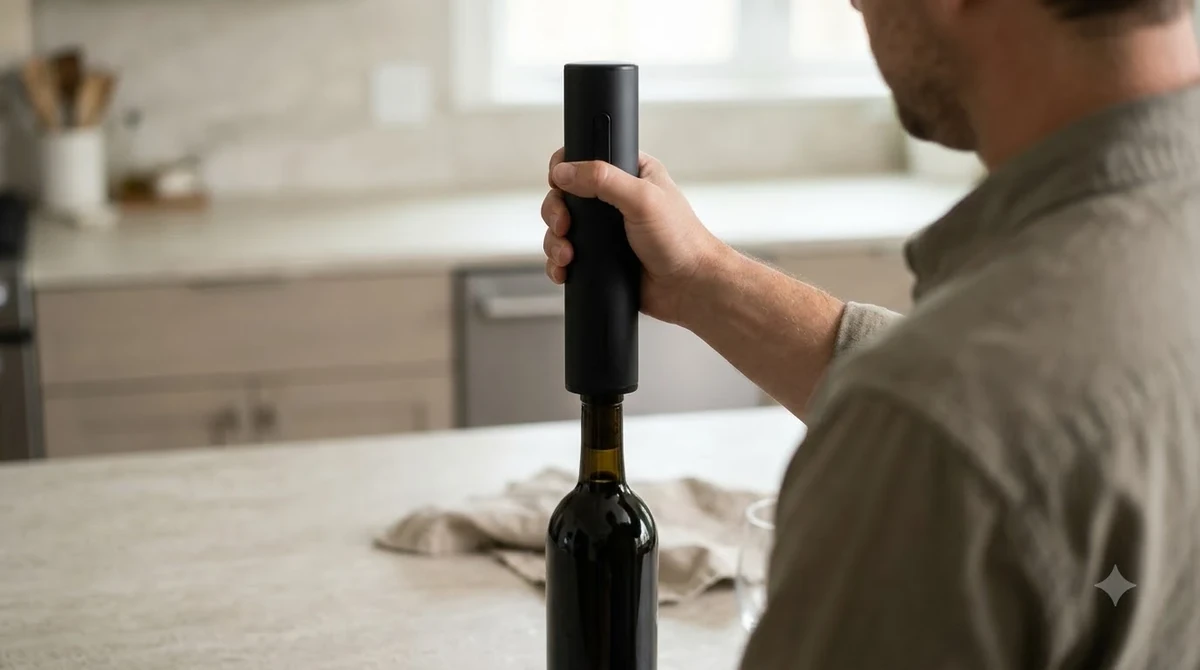
According to Target’s product specifications, the electric model measures approximately 10.31 inches tall and 2.81 inches across its other dimensions. It weighs 0.95 pounds and combines stainless steel with plastic components. The relatively narrow body is easy to hold, although its height means it needs more vertical storage space than a compact waiter’s corkscrew.
The most important functional feature is its recessed spiral. This design helps position the opener over the bottle neck, reducing the need to judge the angle of a separate corkscrew manually. Once the mechanism is aligned, the user presses the down-arrow control to extract the cork. Pressing the up-arrow control reverses the mechanism and releases the cork from the spiral.
Target lists four AA alkaline batteries as the power source and confirms that they are included. This is convenient because the opener can be used without waiting for a rechargeable battery to charge. However, it also means that spare batteries should be available if the opener is used frequently or stored for long periods.
| Specification | Houdini Electric Corkscrew |
|---|---|
| Product type | Cordless electric corkscrew |
| Height | 10.31 inches |
| Length | 2.81 inches |
| Width | 2.81 inches |
| Weight | 0.95 pounds |
| Construction | Stainless steel and plastic |
| Power source | Four AA alkaline batteries |
| Batteries included | Yes |
| Cork compatibility | Natural and synthetic corks |
| Controls | Down-arrow and up-arrow buttons |
| Cleaning | Spot clean or wipe clean |
| Warranty | One-year limited warranty, according to the manufacturer response on Target |
One important omission is a built-in foil cutter. The electric corkscrew is intended to work after the foil has been removed, and the manufacturer specifically warns that foil can damage the spiral. Buyers who expect an all-in-one opener should account for this extra preparation step.
The operating system is simple enough for someone unfamiliar with electric wine accessories. It does not require a complicated sequence of adjustments, and the two controls have distinct purposes. However, the user still needs to position the opener properly and keep it aligned with the bottle neck throughout extraction.
Care instructions are similarly straightforward. Target recommends spot cleaning or wiping the unit rather than washing it under running water. This distinction matters because the electric mechanism and battery compartment should not be treated like ordinary dishwasher-safe kitchen utensils.
For shoppers who prefer a manual tool, Houdini also makes a magnetic waiter’s corkscrew. That version measures approximately 5.04 inches long and weighs 0.21 pounds. It includes a built-in foil cutter and a magnet for refrigerator storage, offering a substantially smaller alternative to the electric model.
What Owners Like
The strongest practical advantage of the Houdini electric opener is its uncomplicated operating process. Instead of rotating a handle and gradually pulling a cork upward, users position the unit and operate two clearly differentiated buttons. This makes it particularly appealing for casual wine drinkers who prefer a more automated approach.
Another useful feature is its stated compatibility with synthetic corks. Synthetic closures can sometimes feel different from natural cork during extraction, and an opener designed for both types provides greater flexibility when a household buys wines from different producers. The recessed spiral also gives the user a defined position over the bottle instead of requiring the same level of manual alignment as a basic corkscrew.
Battery operation is another point in its favor. Four included AA batteries mean the product does not depend on a charging stand or a particular charging cable. For someone who opens a few bottles per week, this arrangement can be convenient because the opener can be kept in a kitchen drawer or on a serving station and used when required.
Target’s manufacturer Q&A includes a response from Lifetime Brands stating that battery life averages approximately three to five months with minimal use. This is not a guaranteed operating period for every household, since battery performance depends on usage frequency, battery quality, and storage conditions. Nevertheless, it provides a useful indication of the expected maintenance cycle for occasional users.
The broader Houdini selection is also an advantage for shoppers who want a consistent set of wine accessories. The brand’s products include manual corkscrews, electric openers, aerating pourers, and wine stoppers. This makes it possible to choose an opener based on personal preferences without abandoning the same general accessory range.
The Houdini Wing Corkscrew offers another positive example of the brand’s practical approach. Shop TODAY selected it as a beginner-friendly manual opener, noting that its handles rise naturally as the spiral enters the cork. That movement gives users a visual indication of when to push the arms downward.
In its evaluation, Shop TODAY reported that the winged model removed the cork completely without jamming. The evaluation also noted mild splintering during insertion but did not find cork pieces in the wine. These observations suggest that the winged design can be approachable for new users, provided they understand the opening sequence.
For people who prefer traditional equipment, the manual waiter’s model offers a different set of benefits. Its compact dimensions make it suitable for a picnic basket, kitchen drawer, or small serving area. The integrated foil cutter and refrigerator magnet are useful additions, although the manual leverage system requires more technique than the electric version.
The best owner experience therefore depends on selecting the appropriate Houdini mechanism. Electric operation emphasizes convenience, the winged design emphasizes familiar mechanical leverage, and the waiter’s corkscrew emphasizes compactness. Buyers should avoid assuming that positive experiences with one style automatically predict the durability or usability of another.
Common Complaints
The main limitation of the Houdini electric corkscrew is that it is not completely self-sufficient. It needs four AA batteries, requires foil removal before operation, and occupies more storage space than a small manual opener.

The absence of an included foil cutter is particularly relevant for people who expect to open bottles immediately after taking the opener out of its storage location. Before operating the electric spiral, users must remove the foil from the bottle neck. Lifetime Brands specifically explains in its Target Q&A that foil can damage the spiral, so skipping this preparation step is not recommended.
Battery dependence is another potential frustration. Unlike a mechanical corkscrew, an electric opener can become unusable when its batteries are depleted. Households that open several bottles during a celebration may prefer to keep spare AA batteries nearby rather than discovering a power problem halfway through serving guests.
There is also a storage consideration. At approximately 10.31 inches tall, the electric model needs more vertical clearance than a compact manual tool. It may fit comfortably in a bar cabinet or countertop organizer, but a shallow utensil drawer is less suitable.
Owner feedback for Houdini manual products raises a separate concern about construction quality. Target’s listing for the Deluxe Magnetic Waiter’s Corkscrew includes reports of difficult leverage, components coming apart, and breakage after limited use. These complaints are particularly relevant for buyers considering the inexpensive manual version for frequent service.
Such feedback should not automatically be applied to the electric corkscrew. The two products use different operating mechanisms and have different constructions. However, it does show why the Houdini name alone should not be treated as a guarantee that every opener in the range offers the same long-term durability.
The winged model has a different limitation: it requires the user to understand how the arms work. Although the movement is fairly intuitive once learned, someone unfamiliar with this mechanism may initially turn the handle without allowing the arms to rise correctly.
Shop TODAY also identifies the lack of a foil cutter as a drawback of the Houdini Wing Corkscrew. This means users of that model need a separate cutter or another appropriate way to remove the foil. The electric and winged models therefore share a practical disadvantage for buyers who want a complete opening kit in one object.
Another possible complaint is the limited feedback available while the electric opener operates. Users should not assume that the mechanism has completed its job merely because the motor has made a sound. They should follow the button sequence and confirm that the cork has been removed before lifting the unit away from the bottle.
Finally, the one-year limited warranty identified in the manufacturer response provides some coverage but does not eliminate the importance of careful handling. Buyers should retain their purchase information and review the applicable warranty terms if the opener develops a mechanical or electrical problem.
Who Should Buy and Who Should Skip
The Houdini Electric Corkscrew is best suited to people who want an uncomplicated way to open everyday wine bottles without relying on manual leverage. It makes particular sense for households that regularly serve both natural-cork and synthetic-cork wines and prefer a cordless tool that operates with simple buttons.
It is also a reasonable option for a home bar where several accessories are stored together. The stainless steel and plastic construction gives it a conventional kitchen-accessory appearance, while the narrow body avoids the bulk of some larger countertop appliances. Its operation is straightforward enough for guests to use after a brief explanation.
Occasional wine drinkers may appreciate the included batteries because there is no initial charging routine. A person who opens a bottle on Friday evening, for example, does not need to maintain a charging stand throughout the week. Keeping spare batteries in the same cabinet makes the arrangement more dependable.
However, the electric model is less attractive for someone who wants the smallest possible opener. A compact waiter’s corkscrew takes up considerably less space and does not depend on batteries. Travelers, restaurant staff, and people who frequently carry wine accessories may find the manual format more practical.
Buyers who want to avoid battery maintenance entirely should also consider the Houdini Wing Corkscrew. Its two-arm mechanism uses manual force rather than an electric motor. Shop TODAY’s evaluation found it relatively approachable for beginners, with the naturally raised handles helping indicate when the cork is ready to be extracted.
The magnetic waiter’s model may appeal to someone who values a built-in foil cutter and refrigerator storage. Its compact 5.04-inch length makes it easier to keep close to a bottle collection. However, its owner feedback includes durability and leverage complaints, so it is not the obvious choice for someone seeking a manual tool for heavy daily use.
There are also buyers who should consider alternatives outside the Houdini range. Anyone who wants rechargeable operation, a charging stand, or an integrated foil cutter may prefer an electric model with those specific features. Similarly, a wine collector who frequently opens older bottles with fragile corks may need a specialized two-pronged opener rather than a conventional electric spiral.
People who host large gatherings should think about reliability during repeated opening sessions. The Houdini electric model can be convenient for ordinary home use, but the need for batteries means preparation matters. A traditional mechanical backup is a sensible addition to any serving area, particularly when multiple bottles are expected to be opened.
Tip: Keep a manual corkscrew and a spare set of AA batteries in the same storage area as the Houdini electric opener. Remove the foil completely before using the electric spiral, and keep the opener upright and centered over the bottle neck during extraction.
For anyone assembling a complete wine-serving station, an appropriate bar cart can provide organized space for the opener, glasses, stoppers, and serving accessories. A dedicated storage area also reduces the likelihood of misplacing small components between uses.
How It Compares to Alternatives
The Houdini Electric Corkscrew is most compelling when convenience is the priority, but other opener designs offer different advantages. The Houdini Wing Corkscrew, Houdini waiter’s model, OXO Steel Vertical Lever Corkscrew, and Cuisinart CWO-25 each approach cork extraction differently.
The Houdini Wing Corkscrew is the closest manual alternative within the same range. Its two raised arms provide mechanical leverage, allowing users to insert the spiral by turning a central handle and then push the arms downward to extract the cork. Shop TODAY selected this model as a beginner-friendly choice and reported successful extraction without jamming during its evaluation.
Its main disadvantage is the lack of an included foil cutter. It also requires a twisting motion, so it does not offer the same button-operated convenience as the electric model. Nevertheless, it avoids battery maintenance and offers a straightforward mechanical design.
The Houdini Deluxe Magnetic Waiter’s Corkscrew takes a more compact approach. Its integrated foil cutter, refrigerator magnet, and manual construction make it attractive for users who want a small accessory rather than an electric appliance. However, the owner complaints about difficult leverage and breakage make durability an important consideration.
The OXO Steel Vertical Lever Corkscrew is a more substantial manual alternative. Shop TODAY identified it as its preferred manual opener in its comparison, highlighting the built-in foil cutter and relatively limited physical movement required. Its mechanism uses a lever rather than the two-arm design found on the Houdini winged model.
The Cuisinart CWO-25 Electric Wine Opener is another alternative for people who want powered operation. Shop TODAY describes it as including a charging stand and foil cutter. Those features may suit a household that prefers a dedicated countertop setup instead of keeping spare AA batteries available.
| Opener | Operating style | Notable advantage | Main consideration |
|---|---|---|---|
| Houdini Electric Corkscrew | Battery-powered | Two-button cork removal | Four AA batteries and separate foil removal |
| Houdini Wing Corkscrew | Manual, winged | Raised arms indicate extraction movement | No included foil cutter |
| Houdini Magnetic Waiter’s Corkscrew | Manual, waiter’s style | Compact design and built-in foil cutter | Mixed durability feedback |
| OXO Steel Vertical Lever Corkscrew | Manual, vertical lever | Built-in foil cutter and reduced manual effort | Larger lever-style design |
| Cuisinart CWO-25 | Electric, rechargeable | Charging stand and foil cutter | Requires charging and countertop storage |
These comparisons highlight an important distinction: electric and manual openers should not be judged by exactly the same criteria. A battery-operated device is designed to reduce physical effort, while a manual tool is generally more compact and does not depend on an electrical power source.
For someone who already owns several wine accessories, the Houdini electric model can be a useful addition rather than a complete replacement for existing equipment. A compact manual opener provides a backup, while an electric tool handles routine opening duties when convenience matters most.
Houdini’s broader accessory selection also makes it possible to assemble a coordinated collection. Buyers who want to expand beyond the opener can consider a wine opener and preserver set, particularly if they regularly save unfinished bottles for another evening.
For shoppers comparing different manufacturers and accessory categories, the site’s Accessory Brands section offers another starting point for evaluating wine-related tools. Comparing the mechanism, included accessories, cleaning requirements, and expected maintenance is more useful than choosing solely by appearance.
For an independent look at manual alternatives, Shop TODAY’s wine opener comparison discusses the Houdini Wing Corkscrew alongside several other manual and electric designs. Its observations help explain why a familiar manual mechanism can still be a sensible choice even when electric alternatives are available.
Overall, the Houdini electric model is the stronger option for buyers who prioritize simple operation, while the winged model is more suitable for people who want a manual tool with a recognizable mechanism. The OXO and Cuisinart alternatives are worth considering if a built-in foil cutter or charging stand is a higher priority.
Frequently Asked Questions
Can the Houdini electric corkscrew open bottles with plastic closures?
Yes. Target’s product description specifically includes synthetic corks in its compatibility information. This makes the electric model suitable for many bottles that use manufactured closures rather than traditional natural cork.
Does the Houdini electric opener work with unusually wide bottle necks?
The published product dimensions describe the opener itself rather than a universal neck-width tolerance. For unusually shaped bottles, positioning and alignment should be checked carefully before operating the spiral. Do not force the mechanism onto a bottle that does not fit securely.
Can the Houdini electric corkscrew be used for sparkling wine bottles?
Traditional sparkling wine bottles use pressure-retained closures rather than ordinary wine corks that are removed with a spiral. The Houdini electric corkscrew is designed for standard cork extraction, not for removing sparkling wine closures. Follow the bottle manufacturer’s opening instructions for Champagne, Cava, and other sparkling wines.
Can the Houdini opener remove a cork that has broken inside the bottle neck?
A broken cork may require a different approach from ordinary extraction. For a cork that remains accessible, a carefully centered spiral may help, but a badly fragmented or deeply lodged cork can be difficult to remove with a standard electric mechanism. Avoid repeatedly forcing the spiral into loose cork fragments.
Where should the Houdini electric corkscrew be stored between uses?
A dry kitchen drawer or bar cabinet is suitable, provided the opener is protected from spills and accidental impacts. If it will remain unused for an extended period, removing the batteries can help prevent damage from battery leakage. Keep the spiral away from loose metal objects that could bend or damage its working parts.
The Houdini wine opener range offers practical choices for different opening preferences, with the electric corkscrew standing out for its uncomplicated button-operated mechanism and compatibility with natural and synthetic corks. Its battery requirements and separate foil-removal step are manageable trade-offs for occasional home use, although buyers seeking a compact manual tool may prefer one of the winged or waiter’s designs. For the best fit, prioritize the opening mechanism, construction, and maintenance requirements rather than choosing by appearance alone.
More in Wine Accessories
 Coravin Vs Vacu Vin: Choose the Right Wine Saver for Your BottlesUpdated Nov 21, 2026
 Zwilling Wine Stopper Review: Preserve Open Bottles LongerUpdated Nov 21, 2026
 Wine Enthusiast Wine Preserver Review: Features, Benefits and LimitationsUpdated Nov 21, 2026
 Wine Enthusiast Wine Stopper: An Easier Way to Reseal Open BottlesUpdated Nov 21, 2026
 Vintorio Wine Opener: Two-Step Cork RemovalUpdated Nov 21, 2026
 Zwilling Wine Aerator Review: Aerate, Pour, and Seal With One ToolUpdated Nov 21, 2026