

We may earn a commission when you buy through links on this page, at no extra cost to you. Learn more.
The haier 8 bottle wine fridge is a compact, single-zone thermoelectric wine cellar designed for keeping up to eight standard wine bottles organized and chilled in a small household space. The Haier HVTEC08ABS offers electronic temperature adjustment from 46°F to 66°F, four chrome storage racks, and a double-pane glass door. Its quiet cooling design and countertop-friendly footprint are appealing, but temperature performance depends heavily on the surrounding room temperature, and the model is discontinued.
The Haier eight-bottle wine cellar is worth considering for someone who keeps a modest wine selection and wants a dedicated appliance instead of storing bottles in a kitchen refrigerator. Its small capacity makes it a specialized purchase rather than a serious wine-storage solution. Buyers should pay particular attention to the exact model number, ventilation requirements, cooling performance, and condition before purchasing one, especially on the secondhand market.
Specs and Key Features
The Haier HVTEC08ABS combines compact storage, electronic controls, and thermoelectric cooling in a freestanding appliance. Its strongest selling points are its eight-bottle capacity, four chrome racks, and adjustable temperature range, although the single-zone configuration limits how differently red and white wines can be stored simultaneously.
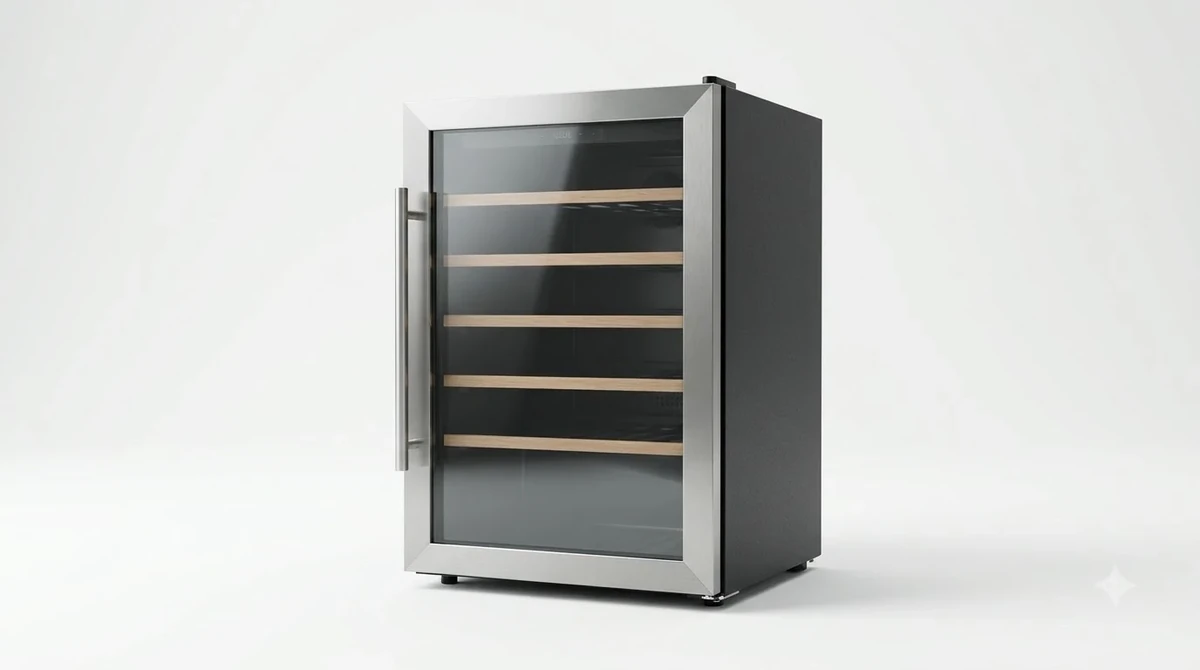
Haier specifies dimensions of 18 inches high, 10 inches wide, and 20 5/8 inches deep. That narrow 10-inch width is particularly useful for households with limited floor or counter space. However, the appliance still needs additional clearance around its cabinet, so the advertised width should not be mistaken for its complete installation footprint.
The HVTEC08ABS uses thermoelectric cooling rather than a conventional compressor. This system avoids the regular compressor cycling associated with some larger refrigerators and is designed to produce relatively little vibration. Haier also describes the system as ultra-quiet, making it attractive for kitchens, dining areas, and other shared living spaces. The manufacturer’s Haier HVTEC08ABS product specifications provide the model’s complete listed dimensions and feature details.
The electronic control panel provides temperature adjustment, while a blue LED display shows the operating temperature. A soft interior light helps owners identify bottles without removing them from the cabinet. The door features double-pane insulation, and the black exterior gives the unit a relatively understated appearance.
| Specification | Haier HVTEC08ABS |
|---|---|
| Rated capacity | 8 bottles |
| Cooling technology | Thermoelectric |
| Temperature range | 46°F–66°F |
| Temperature zones | 1 |
| Storage racks | 4 chrome racks |
| Height | 18 inches |
| Width | 10 inches |
| Depth | 20 5/8 inches |
| Net weight | 20.9 pounds |
| Electrical requirement | 115V, 60Hz |
| Installation | Freestanding |
| Warranty listed by manufacturer | Limited 1 year |
These specifications come from Haier’s product information for the HVTEC08ABS. They should not automatically be applied to every Haier eight-bottle wine cooler. The company has produced multiple compact wine cellar models with different rack arrangements, dimensions, and control systems.
One important distinction is the difference between advertised capacity and practical capacity. Eight standard 750 ml bottles are the intended storage target, but unusually wide bottles may reduce the number that fit comfortably. Champagne bottles, wider sparkling wine bottles, and some Burgundy-shaped bottles can be more challenging than standard Bordeaux bottles.
The four chrome racks provide a dedicated position for each storage level, helping keep bottles organized. Their wire construction also allows air to circulate around the bottles. Owners should avoid forcing wider bottles into tight spaces or overloading the shelves, because doing so can interfere with airflow and make bottles difficult to retrieve.
Haier lists a limited one-year parts and labor warranty for this particular model. Because the manufacturer identifies the HVTEC08ABS as no longer being manufactured, buyers should not assume that a used unit automatically qualifies for warranty coverage or that replacement components will remain readily available.
For additional appliance comparisons, the wine cooler model reviews section can help put compact storage options into perspective.
What Owners Like
The most appealing characteristics of the Haier eight-bottle cellar are its small footprint, simple controls, and relatively quiet cooling approach. For someone who wants eight bottles close at hand rather than a large collection, these features make the appliance easier to incorporate into everyday household routines.
The compact dimensions are an obvious advantage. At 10 inches wide and 18 inches high, the HVTEC08ABS occupies considerably less visual space than a full-size wine refrigerator. It can suit a small kitchen, apartment, dining room, or home entertaining area, provided the surrounding space meets the manufacturer’s ventilation requirements.
The black cabinet and glass door also make the appliance more presentable than an ordinary storage box. The bottles remain visible without opening the door, and the recessed handle keeps the exterior relatively clean. The blue LED lighting provides additional visibility, although it is best used occasionally rather than left on continuously.
Electronic temperature adjustment is another practical benefit. Instead of relying on an imprecise dial, the owner can select a setting using the control panel. The listed 46°F to 66°F range covers several common wine-serving temperatures, from chilled whites to moderately cool reds.
Thermoelectric cooling is particularly attractive to people who dislike the sound of a conventional refrigerator cycling on and off. The system uses semiconductor-based cooling rather than a compressor, reducing mechanical vibration. The owner’s manual describes this technology as producing minimal noise and vibration.
Independent owner-review summaries also report positive comments about the relatively quiet operation. However, these accounts are not a guarantee that every individual unit will operate silently. The cooling fan can still produce an audible background sound, particularly in a very quiet room.
Storage organization is another advantage. Four chrome racks give the owner a straightforward way to separate everyday bottles by grape, occasion, or drinking order. For example, a household might keep Sauvignon Blanc, Chardonnay, Pinot Noir, and Merlot together without using several kitchen shelves.
The eight-bottle capacity can also encourage a more intentional rotation. Rather than buying large quantities that remain untouched for months, owners can keep a small selection of bottles intended for near-term enjoyment.
For casual entertaining, this is a practical arrangement. A bottle of sparkling wine can be chilled ahead of a gathering, while a few everyday whites and reds remain accessible. Someone planning an outdoor-style gathering might also use the cooler to prepare bottles for an Aperol Spritz recipe, although the appliance should not be expected to replace an ice bucket for rapid chilling.
Another benefit is the straightforward operating concept. There are no complicated wine-management menus or multiple independent temperature zones. The owner adjusts one setting and organizes the bottles within a single cabinet. This simplicity can be preferable for people who want a small appliance that requires little day-to-day attention.
Overall, the owner-oriented advantages are practical rather than sophisticated. The Haier is designed to keep a short selection of bottles together in a dedicated cooling space. It is not intended to provide the environmental control, capacity, or long-term storage flexibility of a larger wine cabinet.
Common Complaints and Cooling Limitations
The biggest limitation of the Haier HVTEC08ABS is its dependence on ambient temperature. Although its electronic controls offer settings between 46°F and 66°F, the thermoelectric cooling system cannot necessarily achieve the selected temperature in a warm room. This is an important distinction for buyers who expect refrigerator-like performance in every environment.
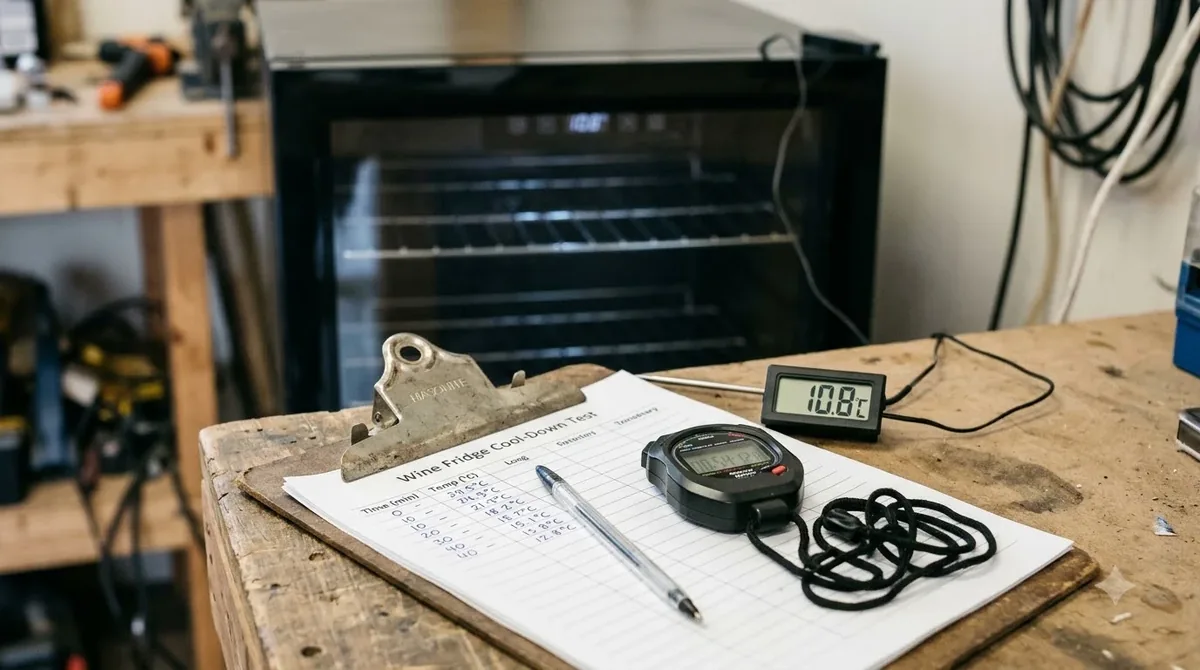
Haier’s owner’s manual gives a useful example: when the surrounding room temperature reaches 77°F, the lowest achievable cabinet temperature may be approximately 50°F to 52°F. At an ambient temperature of 73°F, the cabinet may reach approximately 46°F to 48°F. These figures illustrate why room placement matters as much as the temperature selected on the display.
In practical terms, someone living in a warm apartment or keeping the cooler beside an oven may struggle to achieve the coldest advertised setting. A room with relatively stable temperatures is a better environment for this type of appliance.
Thermoelectric cooling also has limitations compared with compressor-based refrigeration. Its performance is more sensitive to external heat, and it may take longer to recover after repeated door openings or the addition of several room-temperature bottles. Buyers who frequently load the cabinet with new bottles should account for this limitation.
Another potential complaint is audible fan noise. Although thermoelectric systems generally produce less mechanical vibration than compressor systems, they are not completely silent. An operating fan can create a continuous hum that becomes noticeable in a quiet bedroom or small studio apartment.
Owner-review summaries describe mixed experiences with this issue. Many comments characterize the cooler as quiet, while some users report that the humming sound is irritating. The distinction is important: quiet operation is a relative advantage, not a promise of silence.
Capacity is another obvious drawback. Eight bottles may sound sufficient until a household starts storing different wines for several occasions. A few everyday reds, several whites, and two sparkling bottles can quickly fill the cabinet. There is little room for unexpected purchases or larger-format bottles.
The single-zone design creates a separate limitation. Red and white wines can share the appliance, but they cannot have independently controlled temperatures. A setting that works well for chilled Chardonnay may be too cold for a red intended for serving, while a setting suitable for red wine may leave white wine warmer than desired.
There is also a practical difference between storing wine and serving wine. A wine refrigerator is primarily intended to maintain bottles at a selected temperature. It is not necessarily designed to bring a warm bottle down to serving temperature quickly, particularly when the room itself is hot.
Availability is a further concern. Haier’s official product page identifies the HVTEC08ABS as no longer manufactured, and Best Buy’s product listing states that the model is no longer available in new condition. Buyers are therefore more likely to encounter remaining inventory, used units, or secondhand listings than a conventional current-production retail purchase.
Some owner-review summaries also mention discrepancies between listed and measured dimensions. This makes it sensible to measure an actual used unit before purchasing it, especially when the appliance needs to fit beneath kitchen cabinets or between other countertop appliances.
Finally, a one-year warranty is relatively limited for someone expecting many years of trouble-free service. Since this model is discontinued, the availability of repair assistance and replacement parts deserves attention before paying for a used appliance.
Who Should Buy and Who Should Skip
The Haier eight-bottle wine cellar makes the most sense for casual wine drinkers with limited storage needs and a suitable indoor location. It is less appropriate for serious collectors, people living in consistently hot rooms, or households that need separate cooling temperatures for different wine styles.
Consider this model if the household typically keeps between four and eight bottles available for everyday drinking. Its small dimensions and dedicated racks can make it a useful alternative to leaving wine bottles on a kitchen counter or placing them in a refrigerator used for food.
Apartment residents may also appreciate the compact design. The narrow cabinet is easier to accommodate than a larger wine refrigerator, and its black exterior can fit into many kitchen or dining-room arrangements.
People who mostly drink wines that benefit from moderate chilling may find the temperature range useful. For example, Sauvignon Blanc is generally served around 45°F to 50°F, while Chardonnay is commonly served around 50°F to 55°F. Light-bodied Pinot Noir is often served around 55°F to 60°F.
These serving temperatures demonstrate the flexibility of the adjustable thermostat, but they do not mean the cooler can maintain every target under every room condition. Buyers should consider the ambient-temperature limitations before relying on it for particularly cold white-wine storage.
The model can also suit someone who wants to keep a few bottles of red wine away from direct sunlight and ordinary kitchen temperature fluctuations. A moderate storage setting can be more convenient than repeatedly moving bottles between a cupboard and refrigerator.
However, the Haier is not a strong choice for anyone who regularly buys wine by the case. Eight bottles provide limited room for building a collection, and frequent rearrangement can become inconvenient.
It is also a poor fit for households that enjoy Champagne or sparkling wine regularly and want several bottles chilled simultaneously. Sparkling wine is generally served around 40°F to 50°F, and a single-zone cabinet shared with warmer-serving reds requires compromises.
Collectors interested in aging expensive wines for several years should consider a more specialized wine-storage cabinet. Long-term storage places greater emphasis on consistent environmental conditions, appropriate humidity, protection from light, and stable temperatures than a small beverage cooler can necessarily provide.
Another group that should probably skip the Haier is anyone who needs a built-in appliance. The owner’s manual explicitly states that the wine cellar is designed for freestanding installation and should not be recessed into an enclosed cabinet.
People with particularly sensitive hearing should also think carefully about placement. Even a relatively quiet fan may be distracting if the cooler sits immediately beside a desk, bed, or frequently used seating area.
Finally, anyone considering a used HVTEC08ABS should be comfortable inspecting an older electrical appliance. A low purchase cost is not particularly attractive if the cooling system, fan, door seal, or control panel requires repair shortly afterward.
Tip: Before purchasing a secondhand Haier eight-bottle wine cellar, ask the seller to run it for several hours, confirm that the display and controls work, inspect the door seal, and measure the actual cabinet temperature with an independent thermometer. A displayed temperature setting alone does not prove that the cooler can reach or maintain that temperature.
How It Compares to Alternatives
The Haier HVTEC08ABS competes primarily with other compact wine refrigerators rather than full-size wine cabinets. Its strongest distinction is the combination of an eight-bottle capacity, narrow 10-inch width, four chrome racks, and thermoelectric cooling. The most meaningful alternatives are different types of wine-storage appliances with different priorities.
A larger single-zone compressor wine refrigerator is a sensible alternative for households that need more capacity or live in warmer environments. Compressor cooling is generally better suited to overcoming substantial ambient heat, and larger models provide more room for bottle variety. The trade-off is a larger footprint and potentially more noticeable compressor noise.
A dual-zone wine refrigerator is another option for households that regularly drink both reds and whites. Instead of sharing one temperature setting, the appliance has separate compartments or zones. This makes it easier to keep white wine colder while maintaining red wine at a more moderate temperature.
The downside is that dual-zone appliances generally occupy more space and can be unnecessarily complicated for someone who only needs a handful of bottles. A larger cabinet is not automatically a better purchase if most of its capacity will remain unused.
A simple wine rack is the lowest-complexity alternative. It provides storage organization without electricity, fan noise, or temperature controls. However, it does not actively cool wine, so the room itself determines the storage environment.
For a household that already has a consistently cool, dark storage area, a rack may be sufficient. For someone who wants wine chilled and ready to serve, a dedicated refrigerator is more convenient.
The Haier also differs from an ordinary kitchen refrigerator. A kitchen refrigerator generally operates at colder temperatures than most wine-serving targets, and frequent food storage activity can cause temperature fluctuations. A dedicated wine cooler gives bottles their own space and adjustable temperature control.
However, a wine cooler should not be confused with a professional wine cellar. The Haier is a compact cooling appliance, not a comprehensive long-term aging system. Buyers should select it for convenience and short-term organization rather than assume that its eight-bottle capacity makes it suitable for every type of collection.
The following comparison summarizes the practical differences between these categories:
| Storage option | Capacity approach | Temperature control | Best application |
|---|---|---|---|
| Haier HVTEC08ABS | 8 bottles | Single zone, 46°F–66°F | Small household wine selection |
| Larger compressor cooler | Typically more than 8 bottles | Usually single zone | Higher capacity and warmer rooms |
| Dual-zone wine refrigerator | Varies by model | Two independent zones | Separate red and white storage |
| Wine rack | Varies by design | No active temperature control | Organizing bottles in suitable rooms |
| Kitchen refrigerator | Shared food-storage space | Food refrigeration settings | General household refrigeration |
For someone choosing between these categories, the main question is whether eight dedicated bottles are genuinely enough. If the answer is yes, the Haier’s compact design remains appealing. If the collection is growing or the household wants independent temperatures for red and white wine, a larger alternative is more practical.
How to Choose a Used Haier Wine Cooler
Because the HVTEC08ABS is discontinued, buying one requires more attention to condition and model identification than purchasing a currently supported appliance. A careful inspection can help distinguish a functional older cooler from a unit that looks attractive but has cooling or electrical problems.
Start by confirming the model number on the identification label. Haier has produced several eight-bottle models, including units with different control layouts and shelf configurations. The HVTEC08ABS specifications should only be used to evaluate a unit that actually carries that model designation.
Next, examine the cabinet exterior. Look for corrosion, damaged corners, loose hinges, and dents that could affect the door alignment. The double-pane glass should be free from significant damage, and the door should close evenly without needing to be pushed into position.
Inspect the recessed handle and control panel. Test the temperature buttons and display, and confirm that the interior light switches on and off. A functioning light is not essential to cooling performance, but damaged controls may indicate broader wear or previous electrical problems.
Ask the seller to demonstrate the cooling system while the unit is operating. Ideally, observe it over several hours rather than accepting a brief demonstration immediately after plugging it in. Place an independent thermometer inside and compare the reading with the display.
Remember that ambient temperature affects the result. A used cooler tested in a cool room may perform differently in a warm kitchen. If possible, establish the temperature of the surrounding room during the demonstration.
Inspect the fan and its filter for dust accumulation. The owner’s manual specifically recommends cleaning the external fan filter every six months or sooner if dirt, dust, or hair builds up. A heavily obstructed filter can interfere with cooling performance.
Finally, check the included accessories. Confirm that the chrome racks are present, the leveling feet are intact, and the power cord has no visible damage. Missing racks may be difficult to replace on a discontinued model.
Buyers should also clarify whether the seller offers a return period or any written guarantee. A private secondhand sale may offer no meaningful warranty protection, even if the original appliance carried a limited one-year manufacturer’s warranty.
Installation, Maintenance, and Storage Tips
Correct placement is particularly important for the Haier’s thermoelectric cooling system. The appliance requires adequate airflow around its cabinet, a level supporting surface, and protection from direct heat and sunlight. Poor installation can undermine the performance of an otherwise functional cooler.
Haier recommends 2 inches of clearance on both sides and at the rear, plus 4 inches above the unit. These measurements matter when planning a countertop location. An opening that is exactly 10 inches wide is not sufficient for the cooler if there is no room for the required side ventilation.
The manual also advises leaving enough space in front for the door to open to approximately 120 degrees. This is important if the appliance is positioned beside a wall or another kitchen unit.
Choose a stable, level surface away from ovens, radiators, direct sunlight, and other heat sources. Avoid placing the cellar in an unheated garage or a location with substantial moisture. The manufacturer’s installation guidance also specifies freestanding use rather than enclosed built-in installation.
After positioning the unit, adjust the leveling feet as necessary. A level appliance helps the door sit correctly and reduces the possibility of movement during normal use.
When first operating the cellar, allow the interior to cool before loading it with bottles. Room-temperature bottles introduce additional heat, so filling the cabinet with eight warm bottles at once can delay the process of reaching the selected temperature.
For routine maintenance, unplug the appliance before cleaning or servicing it. The manual recommends cleaning the fan filter every six months, or more frequently when dust or hair accumulates. A vacuum cleaner can be used to remove loose debris from the filter.
The interior can be cleaned with a soft cloth or sponge and a solution of approximately 3 to 4 tablespoons of baking soda mixed with warm water. Avoid applying water directly to electrical components or the cooling system. Allow cleaned surfaces to dry before restarting the appliance.
Use the interior light sparingly. Haier’s manual recommends leaving it off during normal operation. This reduces unnecessary illumination inside the cabinet and keeps the bottles in a darker environment.
Wine organization deserves attention, too. Store standard bottles horizontally where the rack design allows, and avoid overcrowding the shelves. Leave sufficient space for circulation rather than trying to squeeze additional bottles into an eight-bottle appliance.
Serving temperature should also be considered separately from storage temperature. A light white such as Sauvignon Blanc is generally served at 45°F to 50°F, while a fuller Chardonnay is often better around 50°F to 55°F. Light reds such as Pinot Noir generally benefit from serving temperatures around 55°F to 60°F.
A single-zone cooler cannot maintain all these temperatures simultaneously. A practical approach is to choose a moderate setting that suits the wines most frequently stored and adjust the serving temperature shortly before opening a particular bottle.
For example, a bottle of Pinot Noir can be removed from a cooler set for white wine and allowed to warm slightly before serving. Conversely, a white wine can be chilled further in an ice bucket if the cabinet is set for red wine.
For long-term storage, the Haier should not be treated as a substitute for a dedicated cellar. Traditional wine-storage guidance generally favors a stable environment near 55°F, darkness, and minimal temperature fluctuation. This compact appliance is better understood as a convenient short-term holding and chilling solution.
After opening a bottle, reseal it properly and refrigerate it. Most opened still wines are best consumed within approximately 3 to 5 days, while sparkling wines generally retain their freshness for around 1 to 3 days with a suitable sparkling-wine stopper.
These practices help owners get more practical value from a small wine refrigerator without expecting it to perform beyond its intended purpose.
Frequently Asked Questions
Does the Haier HVTEC08ABS have a reversible door?
The manufacturer’s listed specifications identify a curved double-pane insulated door but do not establish that this particular model has a reversible hinge. Buyers should inspect the hinge arrangement and consult the model-specific installation documentation before planning a door-swing change. Do not assume that features from another Haier wine cellar apply to this unit.
Can the Haier eight-bottle wine cellar store Champagne bottles?
It may accommodate some sparkling wine bottles, but the wider diameter of certain Champagne bottles can make the standard rack arrangement restrictive. The stated eight-bottle capacity is not a guarantee that eight unusually shaped bottles will fit. Measure the bottle diameter and compare it with the available rack spacing before loading the cabinet.
Does the Haier wine cellar automatically restart after a power outage?
The model’s published specifications do not provide a definitive automatic-restart guarantee for every power-interruption scenario. After an outage, check that the appliance is receiving power, inspect the display, and verify the actual interior temperature. Avoid assuming that the previous temperature setting was maintained throughout the interruption.
Can the Haier wine cooler be transported on its side?
For moving an older appliance, keeping it upright is the safer general approach unless the model-specific instructions state otherwise. Secure loose racks and accessories, protect the glass door, and avoid striking the cooling assembly. Allow the unit to settle upright before reconnecting it if its orientation changed during transportation.
Is the Haier HVTEC08ABS suitable for storing wine collections for several years?
It is primarily a compact household wine cooler rather than a dedicated long-term aging cabinet. Long-term wine storage requires stable environmental conditions over extended periods, and the thermoelectric system’s sensitivity to ambient heat makes placement particularly important. Collectors with valuable bottles intended for several years of aging should consider a purpose-built wine-storage cabinet with more comprehensive environmental control.
The Haier HVTEC08ABS remains an appealing compact wine cellar for households that need eight dedicated bottle positions, simple electronic controls, and relatively quiet thermoelectric cooling. Its most important limitations are ambient-temperature sensitivity, single-zone operation, restricted capacity, and discontinued-product availability. Anyone considering one should verify the exact model, test its cooling performance, and confirm that adequate ventilation is possible before purchasing.
For a small collection of everyday bottles, a properly functioning Haier can still serve a useful purpose. Buyers who need greater capacity, stronger cooling in warm rooms, or separate red and white storage temperatures will be better served by a larger, more modern wine refrigerator.
More in Model Reviews
 Magic Chef 44 Bottle Wine Cooler Review for Flexible StorageUpdated Nov 21, 2026
 Whynter 164 Bottle Wine Cooler Review: Capacity, Features, and FitUpdated Nov 21, 2026
 Insignia NS WC16BK6 Review: Compact 16-Bottle Wine StorageUpdated Nov 21, 2026
 Wine Enthusiast Electric Blue Omega Review: Opening, Pouring, and Preserving Made EasierUpdated Nov 21, 2026
 Koolatron 20 Bottle Wine Cooler Review: Features, Fit, and PerformanceUpdated Nov 21, 2026
 NewAir AWC 330E Review for Home Wine StorageUpdated Nov 21, 2026