


We may earn a commission when you buy through links on this page, at no extra cost to you. Learn more.
A ge wine fridge is a practical choice for households that want recognizable appliance-brand construction, straightforward temperature controls, and dedicated wine storage in several available capacities. GE offers conventional single-zone wine centers, combination beverage and wine refrigerators, and higher-capacity GE Profile dual-zone models. The right choice depends on bottle capacity, installation requirements, temperature flexibility, shelf design, and the specific model’s reliability record.
GE wine refrigerators appeal to buyers who want a dedicated appliance rather than a collection of bottles occupying space in a kitchen refrigerator. The range includes compact options for everyday bottles and larger wine centers intended for more extensive collections. However, GE models are not interchangeable: a basic wine center and a dual-zone Profile refrigerator serve different storage needs. This brand overview explains the differences, what owner feedback suggests, and how to find the correct manual and support information before purchasing.
Brand Overview: GE Wine Refrigerators and Their Place in the Market
GE is an established household appliance brand with wine storage products spanning basic wine centers, combination beverage refrigerators, and more feature-rich wine coolers under its Profile range. Its appeal is the combination of familiar appliance styling, practical controls, and models that can fit different kitchen layouts.
The GE name appears on several types of wine storage appliances. Some products prioritize straightforward bottle storage, while others combine wine racks with space for cans and other beverages. Higher-tier options add features such as independently controlled temperature zones, sliding racks, door alarms, and installation flexibility.
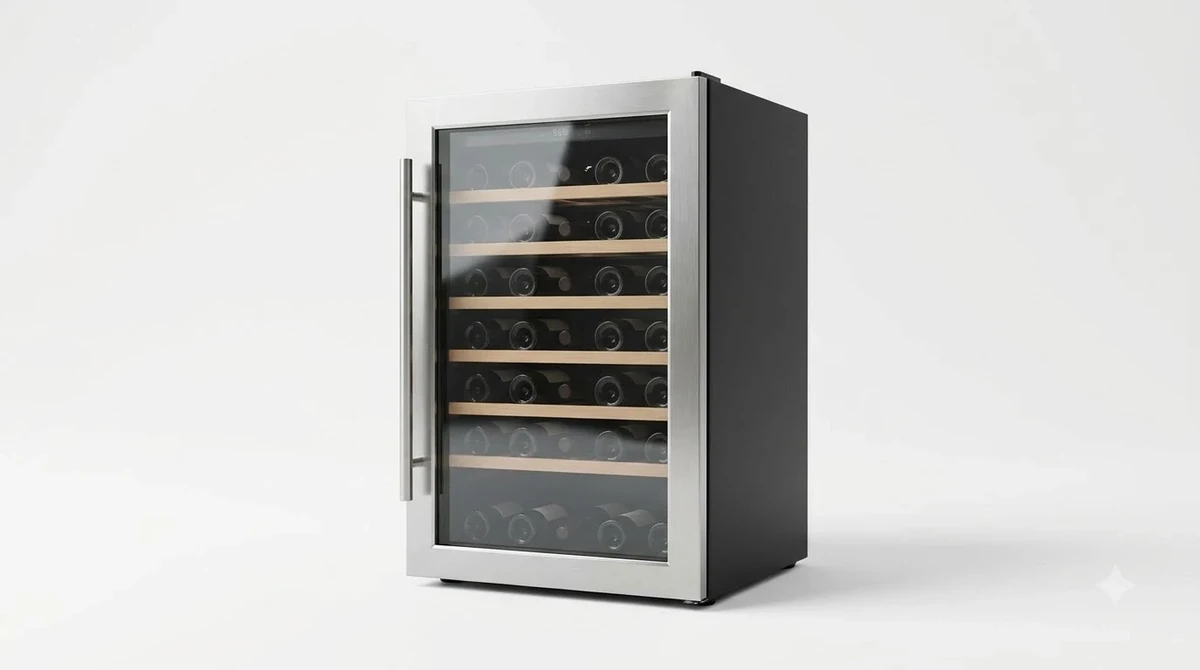
One important distinction is that GE wine storage products do not all offer the same level of temperature control. A single-zone refrigerator maintains one shared temperature throughout its interior. A dual-zone appliance divides storage into two separately controlled temperature areas. This difference matters to households that regularly keep both red and white wine ready for serving.
The GE Profile 44-Bottle Dual Zone Wine Cooler, model PWS06DSPSS, illustrates the more feature-rich end of the range. GE specifies a 4.80-cubic-foot capacity, six wine racks, and two temperature zones. Its upper compartment operates between 43°F and 55°F, while its lower compartment operates between 55°F and 62°F.
By comparison, the GWS04 family represents a more conventional wine-center approach. The GWS04HAESS is listed as a 30-bottle wine cooler with five racks and upfront electronic temperature controls. Its stainless steel door and large glass window provide a more traditional wine-cellar appearance without the additional complexity of separate cooling zones.
GE is therefore worth considering when a buyer values a recognizable appliance manufacturer and wants a choice between simple and more sophisticated storage arrangements. Nevertheless, the brand name alone cannot establish the expected lifespan or reliability of an individual wine refrigerator. Model-specific feedback, warranty terms, replacement-part availability, and installation requirements deserve equal attention.
For readers comparing manufacturers, the brand hubs section provides a useful starting point for evaluating other appliance names and their product categories.
Product Lines Explained: Wine Centers, Beverage Centers, and Dual-Zone Models
GE’s wine storage products fall into three useful categories: dedicated single-zone wine centers, combination beverage and wine centers, and larger dual-zone refrigerators. Understanding these categories makes it easier to select an appliance that matches the collection rather than paying for features that will rarely be used.
| Product category | Representative model | Capacity | Temperature zones | Notable features |
|---|---|---|---|---|
| Dedicated wine center | GWS04HAESS | 30 bottles | Single-zone design | Five racks, electronic controls |
| Beverage and wine center | GVS04BQNSS | 31 wine bottles or 109 cans | 1 | Five removable shelves, compressor cooling |
| GE Profile wine cooler | PWS06DSPSS | 44 bottles | 2 | Six sliding wine racks, audible door alarm |
The figures above come from GE’s product information and retailer listings. They describe representative models, not universal specifications for every GE wine refrigerator. Model availability and specifications can differ across retailers and product generations.
Dedicated single-zone wine centers
A dedicated wine center is the simplest category to understand. Its primary purpose is holding wine bottles in a temperature-controlled compartment, rather than accommodating a mixture of cans, bottles, and other refreshments.
The GWS04HAESS is a representative example. Its advertised capacity is 30 bottles, supported by five wine racks. The upfront electronic controls make temperature adjustment accessible without requiring owners to reach inside the cabinet.
This type of appliance is particularly suitable for households that primarily drink one style of wine or are comfortable keeping their entire collection at a shared storage temperature. It can also make sense for buyers who want a dedicated wine cabinet without needing the additional capacity of a larger refrigerator.
Combination beverage and wine centers
The GVS04BQNSS combines wine storage with general beverage capacity. GE’s comparison information lists room for 31 wine bottles or 109 cans, with a 4.10-cubic-foot interior and five removable shelves.
Its layout is attractive to households that want one compact appliance for entertaining supplies, bottled beverages, and wine. However, the shared temperature zone means that it does not independently maintain different temperatures for different beverage categories.
That distinction is especially important for wine enthusiasts. A beverage center may be convenient for everyday household use, but it should not automatically be treated as equivalent to a dedicated dual-zone wine refrigerator.
GE Profile dual-zone wine coolers
The PWS06DSPSS is a more specialized product. Its 44-bottle capacity, six wine racks, and separate upper and lower temperature controls make it more suitable for collections containing different wine styles.
GE specifies an upper temperature range of 43°F to 55°F and a lower range of 55°F to 62°F. This arrangement provides more flexibility than a single-zone cabinet, although buyers should remember that the two compartments still have defined operating ranges rather than unlimited temperature settings.
The model also has full-extension sliding racks with wooden fronts, an audible door alarm, and both built-in and freestanding installation capability. These features make it a more substantial kitchen appliance than a basic countertop or compact freestanding wine refrigerator.
GE also has other wine-storage products under its broader appliance family, so shoppers should compare exact model numbers rather than assuming that every product carrying the GE name has the same design or capabilities.
What GE Wine Coolers Do Well
GE’s strongest selling points are the range of storage formats, familiar electronic controls, and practical design features available on selected models. The brand offers options for buyers who need a relatively straightforward 30-bottle cabinet as well as households that want 44-bottle dual-zone storage.
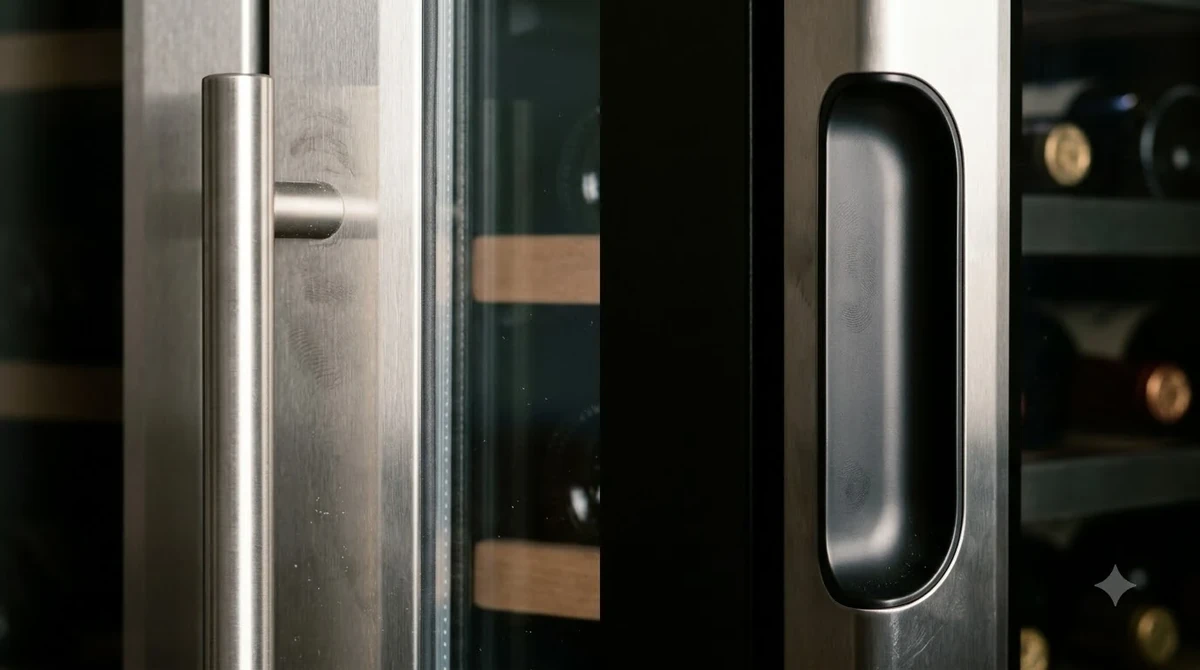
Useful capacity choices
Capacity is one of the clearest differences between the models. A 30-bottle wine center can be appropriate for someone maintaining a small household selection, while a 44-bottle appliance provides additional room for different regions, producers, and vintages.
The advertised capacity should still be treated as a guide rather than a guarantee that every collection will fit. Wine bottles do not all have identical dimensions. Standard Bordeaux-shaped bottles are generally easier to arrange than wider Burgundy bottles, sparkling wine bottles, and some specialty formats.
Buyers with a mixed collection should think about the actual number of bottles they own rather than relying exclusively on the advertised maximum. Leaving some space between bottles also makes it easier to retrieve individual selections without repeatedly rearranging the shelves.
Accessible controls and useful displays
Electronic temperature controls are a useful feature on the GWS04HAESS. They provide a more convenient adjustment method than appliances that rely exclusively on mechanical dials.
The PWS06DSPSS adds touch controls positioned at the upper front of the refrigerator. Separate temperature zones make it possible to organize the appliance around different serving preferences instead of imposing one temperature on every bottle.
These features are particularly useful in households that serve several wine styles. A chilled Sauvignon Blanc, for example, generally benefits from a cooler serving temperature than a full-bodied Cabernet Sauvignon. Separate compartments can help organize those different needs.
Installation flexibility
Some GE wine refrigerators are designed primarily as freestanding appliances, while selected higher-capacity models support built-in installation. The PWS06DSPSS is specifically identified by GE as suitable for both built-in and freestanding use.
This flexibility can help buyers planning a kitchen renovation or looking for an under-counter appliance. It also means that a GE model may fit into a more permanent kitchen arrangement without requiring a separate freestanding cabinet.
However, installation compatibility must be confirmed using the exact model’s installation documentation. A wine refrigerator that looks suitable for a cabinet opening is not necessarily approved for that installation method.
Practical storage details
Sliding wine racks are another useful feature. On the PWS06DSPSS, GE specifies six wine racks with wooden fronts and full-extension slides. Pull-out access makes it easier to identify bottles and retrieve selections toward the back of the compartment.
The audible door alarm is also useful. A refrigerator door that remains slightly open can interfere with temperature stability, so an alert provides an additional reminder to close the appliance properly.
For buyers who prioritize organization, these features may be more valuable than decorative lighting or exterior finishes. A wine cooler should make it convenient to store, identify, and remove bottles while maintaining a suitable environment.
Overall, GE offers several practical features across its wine-storage range. The important qualification is that features belong to individual models, not automatically to every refrigerator bearing the brand name.
Common Complaints and What GE Wine Cooler Reviews Reveal
GE wine cooler reviews show a mixture of positive experiences and complaints, with cooling consistency, noise, shelf usability, and long-term reliability deserving particular attention. Customer feedback is useful for identifying potential problems, but experiences with one model should not be generalized to the entire brand.
Cooling performance and reliability
Cooling performance is the most important consideration for any wine refrigerator. A cabinet that looks attractive and has convenient controls is of limited value if it cannot maintain its selected temperature.
Some GE owner feedback is positive, with customers appreciating the cooling function and general appliance appearance. Other reviews raise concerns about cooling failures and units that stop maintaining their selected temperatures.
For example, feedback concerning the GVS04 beverage and wine center includes reports of units that initially performed satisfactorily but later developed cooling problems. These complaints are relevant because a refrigerator’s appearance and initial operation cannot establish its long-term dependability.
It is also important to distinguish between different types of complaints. A temperature that fluctuates slightly during normal compressor operation is not necessarily equivalent to a refrigerator that consistently fails to cool. Owners should document actual interior temperatures and the appliance’s behavior before arranging service.
Noise and vibration
Compressor-based wine coolers can produce operating sounds as the cooling system cycles. Some noise is normal, but repeated clicking, unusually loud operation, or persistent vibration can warrant investigation.
Customer comments on GE beverage and wine products include reports of occasional strange noises and concerns about operating volume. This is especially relevant when the refrigerator will be installed in an open-plan kitchen, dining room, or entertainment space.
Installation can also affect perceived noise. An appliance that is not level or has inadequate clearance around its cabinet may vibrate against surrounding surfaces. Buyers should follow the installation instructions and avoid assuming that every sound indicates a mechanical failure.
Shelf access and bottle compatibility
Shelf usability is another recurring subject in wine cooler feedback. Some owners appreciate the storage arrangement, while others find certain trays awkward to use or have difficulty removing bottles.
This problem is not exclusive to GE. Wine storage capacity is usually calculated around standard bottle shapes, and wider bottles can create problems in closely spaced racks.
Before buying, consider the bottles that dominate the collection. A household that regularly buys sparkling wine, Burgundy, or large-format bottles should investigate shelf spacing rather than relying only on the advertised bottle count.
How to interpret owner feedback
Retailer reviews can help identify strengths and weaknesses, but they are not controlled reliability studies. A customer reporting a successful first year and another reporting a cooling failure after several years provide different kinds of information.
Look for recurring comments involving the same model, especially when they describe similar symptoms. Pay attention to the age of the appliance, the circumstances of the failure, and whether the customer received a satisfactory service response.
The Black and Decker brand comparison is another useful reference for shoppers considering a more general-purpose appliance brand rather than a dedicated wine-storage product.
Tip: Before purchasing a GE wine cooler, read feedback for the exact model number rather than relying on reviews of the GE brand as a whole. Prioritize repeated reports about temperature stability, compressor problems, shelf access, and noise over comments that discuss appearance alone.
How to Choose a GE Wine Fridge
The best GE model depends on how many bottles need storage, whether different wines require separate temperature settings, and where the refrigerator will be installed. A few practical checks can eliminate unsuitable options before comparing finishes and additional features.
1. Estimate the collection size
Start by counting the bottles that will actually go into the appliance. A 30-bottle cabinet may be sufficient for a household with a modest collection, whereas a 44-bottle unit offers additional flexibility.
Do not purchase based on the current bottle count alone if the collection is expected to grow. At the same time, an oversized appliance can consume valuable kitchen space unnecessarily.
Consider whether the refrigerator will hold only wine or a combination of beverages. The GVS04BQNSS is designed to accommodate either 31 wine bottles or 109 cans, making its combination format a consideration for households with varied storage needs.
2. Decide between single-zone and dual-zone cooling
A single-zone refrigerator is suitable when most of the collection will be stored at one shared temperature. It is generally a simpler arrangement and can be sufficient for people who mainly purchase one style of wine.
A dual-zone model is more useful when the collection regularly includes both reds and whites that need different serving conditions. The GE Profile PWS06DSPSS provides two temperature ranges, with the upper compartment operating from 43°F to 55°F and the lower compartment from 55°F to 62°F.
Remember that storage temperature and serving temperature are related but not identical considerations. Many full-bodied reds are served around 60°F to 65°F, while light whites are commonly served around 45°F to 50°F. The available zone settings should be compared with the wines you actually drink.
3. Measure the installation location
Measure the intended opening in three dimensions: height, width, and depth. Include the space needed for the door to open, access to the controls, and any ventilation or installation clearances specified by GE.
For the PWS06DSPSS, GE lists overall dimensions of 33.75 inches high, 23.5 inches wide, and 24.625 inches deep. Its built-in capability makes it a candidate for a suitable kitchen installation, but the manufacturer’s installation instructions remain essential.
Do not assume that the dimensions of a different GE model will be similar. Even small differences can create problems with cabinet alignment, door clearance, and access to the electrical connection.
4. Evaluate the shelf arrangement
Check whether the shelves are removable, sliding, or fixed. Pull-out racks can make it easier to access bottles, while removable shelves may offer more flexibility for unusual bottle shapes.
For example, the PWS06DSPSS has six full-extension wine racks with wooden fronts. The GVS04BQNSS uses a different arrangement of five removable shelves, including three full-depth and two half-depth shelves.
These designs suit different storage priorities. Buyers who mainly keep traditional wine bottles may prefer dedicated racks, while households storing a mixture of beverage containers may appreciate adjustable shelf arrangements.
5. Check the support and warranty details
Warranty coverage should be reviewed before purchasing, especially for an appliance that will run continuously. GE lists a limited one-year entire-appliance warranty for the PWS06DSPSS.
Read the complete written warranty to understand exclusions, service requirements, and the process for requesting repairs. Also consider whether replacement shelves, door components, and other model-specific parts can be obtained if needed.
The Rovsun brand overview can provide another point of comparison when researching alternative wine cooler manufacturers and their different product approaches.
GE Wine Cooler Manuals, Maintenance, and Troubleshooting
Finding the correct GE wine cooler manual is an important part of ownership because operating controls, shelf adjustments, cleaning procedures, and troubleshooting instructions vary by model. The most reliable starting point is the model-specific GE Appliances support page.
Finding the correct owner’s manual
Start by locating the model and serial number. For the GWS04 and GVS04 models covered in GE’s owner documentation, the identification label is located inside the wine cooler or beverage center on the left side.
Once the model number is available, enter it into the GE Appliances support website. The corresponding support page can provide the owner’s manual, installation instructions, maintenance information, troubleshooting guidance, and replacement-part information where available.
For older GWS04 and GVS04 appliances, GE provides a combined wine center and beverage center owner’s manual. It covers operating controls, cleaning, installation, troubleshooting, and warranty information.
Owners can consult the GE wine center and beverage center owner’s manual for the covered GWS04 and GVS04 models.
Do not assume that a manual for one model applies to another. The controls, temperature ranges, installation requirements, and internal shelf arrangements can differ substantially between a basic wine center and a Profile dual-zone refrigerator.
Basic cleaning and maintenance
Regular cleaning helps maintain a tidy interior and prevents spills or debris from interfering with bottle storage. Remove bottles before cleaning and follow the manufacturer’s instructions for the interior surfaces and shelves.
GE’s manual specifically instructs owners to unplug the appliance before cleaning, replacing a light bulb, or performing repairs. It also warns against using harsh cleaners that can damage plastic components.
Take care with glass shelves and covers. GE cautions against exposing cold glass to warm water because sudden temperature changes can cause breakage. Allow removable components to adjust to a suitable temperature before cleaning them.
Clean spills promptly and dry the interior thoroughly before returning bottles. Check door seals periodically for visible damage or dirt that could interfere with proper closure.
Troubleshooting a wine cooler that is not cooling
If a GE wine refrigerator stops maintaining its selected temperature, begin with basic checks that do not involve opening the sealed refrigeration system.
- Check the electrical supply. Confirm that the appliance is plugged into an appropriate outlet and that the circuit is functioning.
- Inspect the temperature setting. Make sure the controls have not been accidentally adjusted or switched off.
- Check the door. Confirm that the door closes completely and that bottles or shelves are not obstructing it.
- Review the installation. Make sure the appliance is level and that the specified ventilation clearances are maintained.
- Allow for temperature recovery. A recently loaded refrigerator or one that has been opened repeatedly may need time to return to its operating temperature.
- Record the symptoms. Note unusual noises, display behavior, temperature readings, and how long the appliance has been operating.
- Contact GE support if the problem continues. Provide the model and serial numbers and arrange qualified service when necessary.
Do not attempt to repair the compressor, refrigeration lines, or electrical components without the appropriate qualifications. GE’s owner documentation states that repairs should be performed by a qualified service professional.
A persistent rise in temperature, repeated clicking, or a compressor that fails to operate should not be dismissed as ordinary cycling noise. Prompt troubleshooting can help determine whether the issue involves the power supply, controls, door closure, or a more significant refrigeration-system problem.
Warranty and GE Customer Support
GE’s support system is an important consideration for buyers who want access to model-specific documentation and service information. The manufacturer’s online support resources provide a way to identify the correct manual, review troubleshooting instructions, and find assistance for eligible appliances.
GE specifies a limited one-year warranty covering the entire PWS06DSPSS appliance, including parts and labor. This is the stated coverage for that particular model, not a guarantee that every GE wine refrigerator has identical warranty terms.
What to check before buying
Read the warranty documentation for the exact model and retain the purchase receipt. Confirm the coverage period, what components are included, and whether any conditions apply to installation or servicing.
For built-in installations, it is particularly important to follow the manufacturer’s requirements. Incorrect installation can complicate service arrangements and may affect coverage where warranty conditions are not satisfied.
Using GE’s online support
The GE Appliances support website allows owners to search for documentation by model number. Depending on the product, available resources may include owner’s manuals, installation instructions, maintenance guidance, troubleshooting articles, and repair-part information.
For a GWS04 or GVS04 wine center, the combined manual is a useful starting point because it addresses both product families. Owners of the PWS06DSPSS should use its dedicated support page rather than relying on instructions intended for older wine-center models.
When contacting support, prepare the model number, serial number, purchase information, and a clear description of the problem. If the refrigerator is not cooling, include the selected temperature and actual interior temperature readings. This information can make the initial service discussion more productive.
Buyers comparing appliance brands should also consider the availability of local service and replacement components. A good feature list is less valuable if getting assistance or obtaining a replacement part becomes unnecessarily difficult.
GE is a reasonable brand to include on a wine refrigerator shortlist, especially for shoppers who want conventional appliance styling, different storage capacities, and selected dual-zone options. However, careful model selection and a review of owner feedback remain essential before making a purchase.
Frequently Asked Questions
Is a GE wine cooler suitable for long-term wine aging?
A dedicated wine refrigerator can provide a more appropriate storage environment than a conventional kitchen refrigerator, but suitability depends on temperature stability, humidity, vibration, and light exposure. GE’s published product specifications primarily describe cooling and storage features rather than guaranteeing professional cellar-aging conditions. Collectors planning to age valuable bottles for many years should evaluate those additional environmental factors.
Does GE manufacture wine refrigerators under other appliance families?
GE’s wine storage selection includes products identified under the GE Profile family, and the wider GE Appliances portfolio also includes Café-branded wine coolers. These products can have different styling, capacities, and feature combinations. Compare the manufacturer’s complete specifications rather than assuming that branding alone establishes the appliance’s capabilities.
Can a GE wine cooler store sparkling wine bottles?
Many standard wine racks are designed around conventional bottle dimensions, so wider sparkling wine bottles may not fit every shelf comfortably. Champagne bottles can have broader bodies than typical Bordeaux bottles. Measure the available rack spacing and compare it with the bottles you intend to store before relying on the advertised capacity.
Does a GE wine refrigerator need to be leveled after moving?
Proper leveling is an important part of appliance installation and can help reduce unwanted vibration and ensure the door operates correctly. GE includes leveling provisions on selected models, including the PWS06DSPSS. Follow the exact installation instructions after moving the refrigerator rather than assuming the factory adjustment will remain correct.
What information is needed to register a GE wine refrigerator?
Owners should retain the model number, serial number, purchase information, and installation details. GE’s documentation encourages appliance registration so product information and warranty details can be made available when needed. The identification label location depends on the model, so consult the appropriate owner’s manual when locating it.
A GE wine fridge can be a sensible addition to a kitchen or entertaining area when its capacity, temperature arrangement, and installation requirements match the household’s needs. The GWS04 is a straightforward choice for dedicated storage, the GVS04 combines wine and beverage functionality, and the PWS06DSPSS offers a larger dual-zone arrangement. Compare exact model specifications, investigate owner feedback, and review the warranty before choosing the right appliance.
More in Brand Hubs
 Icyglee Wine Fridge: Compare Capacities, Features and ModelsUpdated Nov 20, 2026
 Fomup Wine Fridge: Explore Models, Features, and Buying TipsUpdated Nov 20, 2026
 Aaobosi Wine Fridge: Compare Models and Choose the Right CoolerUpdated Nov 20, 2026
 Orymuse Wine Fridge Reviews: Compare Capacities, Features and WarrantyUpdated Nov 20, 2026
 Tylza Wine Fridge: Find the Right Cooler for Your CollectionUpdated Nov 20, 2026
 Vintec Wine Fridge: Features, Warranty, and Buying AdviceUpdated Nov 20, 2026