

We may earn a commission when you buy through links on this page, at no extra cost to you. Learn more.
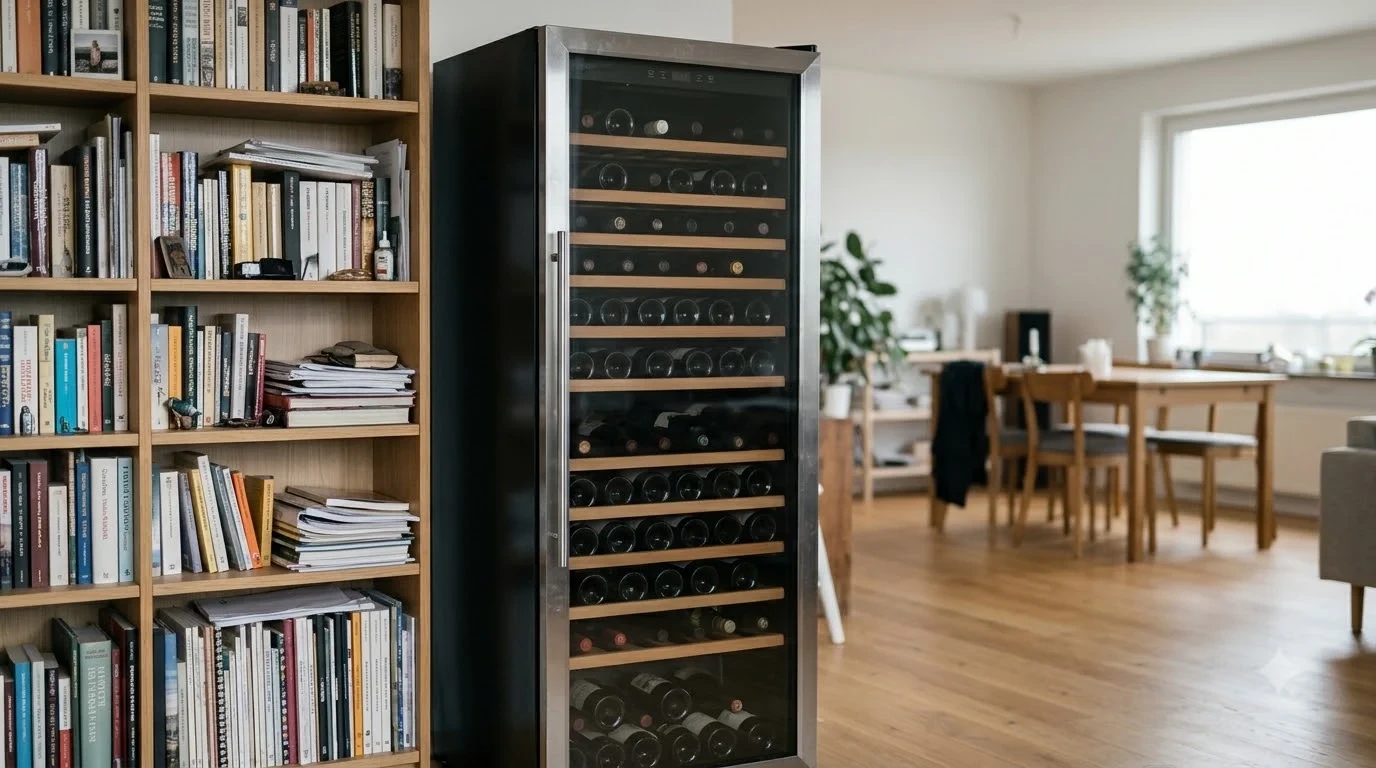
The danby under counter wine fridge is a spacious 24-inch wine storage option, with the DWC057D1CSS offering room for up to 63 standard 750 ml bottles, adjustable temperature controls, extendable shelves, and front ventilation for under-counter installation. Its reversible stainless steel door, blue LED lighting, and temperature alarms make it a practical choice for a dedicated home wine collection. However, buyers should pay particular attention to cabinet dimensions, ventilation, and the limitations of a single-temperature storage compartment before purchasing.
The Danby DWC057D1CSS is particularly interesting for homeowners who want a relatively large wine collection close to their kitchen or entertaining area without dedicating an entire room to wine storage. It combines a compact 24-inch exterior width with a stated 5.7-cubic-foot interior capacity. This review examines its specifications, installation requirements, storage arrangement, temperature performance features, and potential drawbacks to help determine whether it belongs in your kitchen or home bar.
Danby DWC057D1CSS Specs and Key Features
The Danby DWC057D1CSS combines substantial bottle capacity with a cabinet designed for integration into a kitchen or bar layout. Its headline specifications are the 63-bottle capacity, 5.7-cubic-foot volume, reversible door, and front-venting cooling arrangement.
Danby identifies this model as a 24-inch under-counter wine cooler with stainless steel styling and natural beechwood-trimmed wire shelves. The shelves extend outward to make bottle access easier, while internal sensors monitor the cabinet and respond to temperature changes. Temperature recall, a door-ajar alarm, and a temperature alarm provide additional monitoring features. The manufacturer’s official DWC057D1CSS product specifications provide the full feature and dimension list.
The exterior dimensions are especially important because a wine refrigerator must fit its enclosure without obstructing its ventilation system. Danby publishes a width of 23.81 inches, a depth of 25.31 inches, and a height of 34.31 inches. The appliance weighs 110.23 pounds before packaging, so moving it into position is a two-person job rather than a casual solo installation.
| Specification | Danby DWC057D1CSS |
|---|---|
| Product type | Under-counter wine cooler |
| Capacity | 63 standard 750 ml bottles |
| Interior volume | 5.7 cubic feet |
| Width | 23.81 inches |
| Depth | 25.31 inches |
| Height | 34.31 inches |
| Product weight | 110.23 pounds |
| Temperature range | 41°F to 64°F |
| Temperature adjustment | Digital controls in 1-degree increments |
| Shelving | Extendable wire shelves with beechwood trim |
| Door | Reversible stainless steel design |
| Interior lighting | Blue LED lighting with multiple modes |
| Defrost | Automatic operation |
| Warranty | 12 months parts and labor with in-home service |
One particularly useful specification is the 41°F to 64°F temperature adjustment range. The default setting is 54°F, according to the owner’s manual. That gives the owner flexibility to maintain a cooler environment for white wines or a warmer setting for reds, although the appliance maintains one general temperature rather than separate wine compartments.
The control panel adjusts the temperature in 1-degree increments. It also remembers the selected temperature following a power interruption and automatically returns to normal operation when electricity is restored. This is useful for households that experience occasional power interruptions and do not want to reconfigure the appliance after every outage.
Another practical feature is the reversible door. Depending on the arrangement of surrounding cabinets and countertops, the opening direction can make a meaningful difference to everyday access. The two-intensity blue LED display lighting also makes bottle labels easier to see without relying on the kitchen’s overhead lights.
What Owners Like About Danby Wine Coolers
Danby’s strongest selling points are practical rather than complicated: generous bottle capacity, accessible storage, adjustable lighting, and a relatively straightforward digital interface. These features address the everyday requirements of storing and retrieving wine rather than adding unnecessary connected technology.
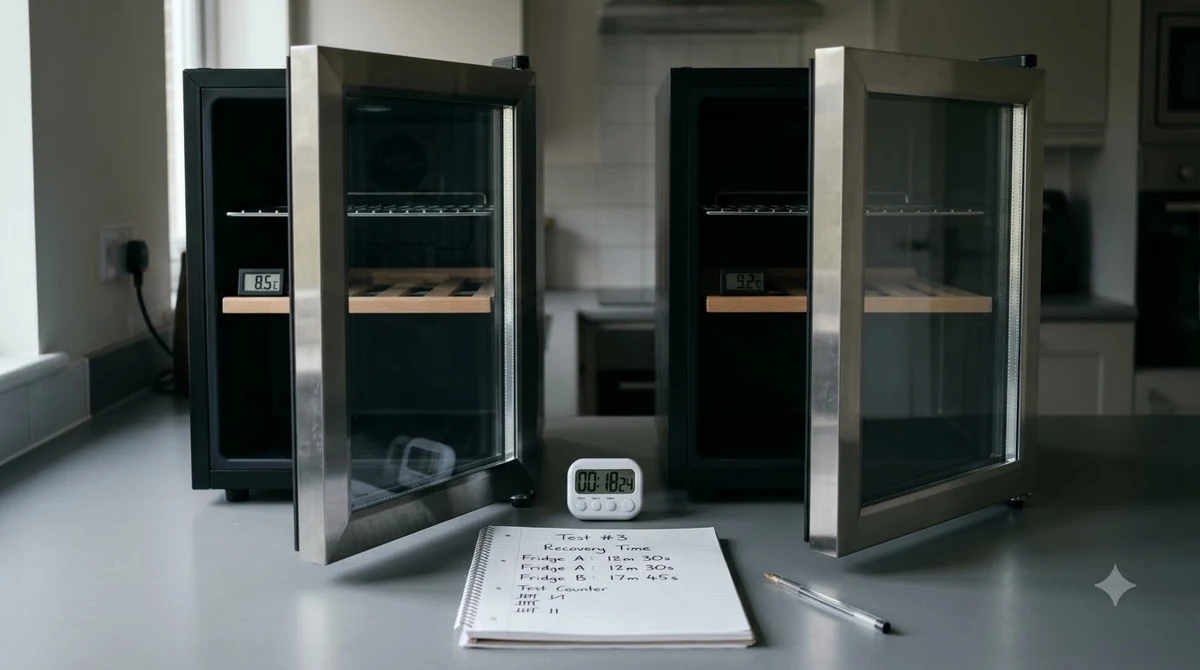
The extendable shelves are particularly useful for people who regularly rotate bottles between storage and serving. Instead of reaching deep into the cabinet, the owner can pull a shelf outward to inspect labels and select a bottle. Natural beechwood trim also gives the interior a more traditional wine-cellar appearance than an entirely plastic or metal storage arrangement.
The stated 63-bottle capacity is another major attraction. For comparison, Danby’s separate DWC93BLSDB freestanding cooler is specified for 36 standard bottles. The larger under-counter model therefore makes more sense for a collection that has outgrown a compact wine refrigerator but does not require a commercial cellar.
There is an important distinction between manufacturer specifications and independently verified owner experience, however. The available retailer feedback examined for this review includes comments about the DWC93BLSDB, not a sufficiently established body of reviews for the exact DWC057D1CSS model. Those comments can offer some perspective on Danby’s smaller wine coolers, but they should not be treated as proof of identical performance.
In the DWC93BLSDB feedback published by Best Buy, customers mention attractive appearance, convenient interior lighting, and useful storage capacity. Some also describe the refrigerator as reasonably quiet for a small appliance. These are encouraging characteristics, although the larger DWC057D1CSS has its own cooling system, dimensions, and installation requirements.
Convenience is another positive aspect of the DWC057D1CSS. Its digital controls are accessible, its door can be reversed, and the temperature memory function reduces the need for manual adjustments after an interruption. The alarms also provide useful information when the door is not fully closed or the cabinet temperature moves outside specified limits.
For entertaining, a dedicated wine refrigerator can also simplify preparation. A bottle of sparkling wine can be moved to a colder serving environment before guests arrive, while Chardonnay, Riesling, and Pinot Noir can be organized for different meals. A bottle intended for a chicken Marsala recipe can be stored alongside other dinner wines instead of occupying space in the main refrigerator.
These advantages make the model attractive to households that value organization and convenient access. The important qualification is that advertised capacity assumes standard bottle dimensions and a particular arrangement of bottles. A collection with numerous oversized bottles will not necessarily fit the published maximum.
Common Complaints and Potential Limitations
The most important limitations to consider are the single-zone temperature arrangement, the physical demands of installation, and the difference between advertised bottle capacity and practical storage space. These issues do not automatically make the refrigerator unsuitable, but they can influence whether it meets a particular household’s expectations.
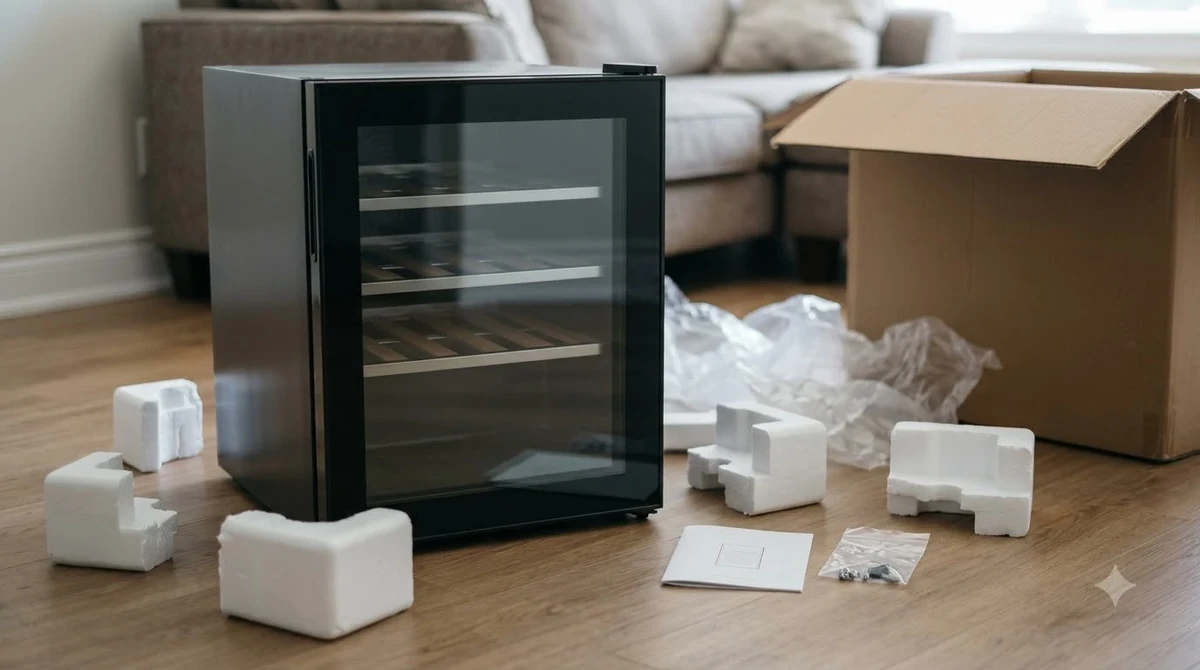
The first consideration is temperature flexibility. Although the DWC057D1CSS has a broad 41°F to 64°F adjustment range, the cabinet does not provide independently controlled red and white wine compartments. Someone who wants to maintain Sauvignon Blanc at a cooler temperature while keeping Cabernet Sauvignon warmer will need a different storage arrangement.
For a mixed collection, a single setting around 54°F can serve as a general storage compromise. Individual bottles can then be brought to their preferred serving temperatures before opening. For example, sparkling wine is generally served at 40°F to 50°F, light whites and rosé at 45°F to 50°F, and full-bodied reds at 60°F to 65°F. A storage temperature is not necessarily the ideal drinking temperature.
Another limitation is bottle geometry. Danby’s 63-bottle claim is based on standard 750 ml bottles, not every possible wine bottle format. Champagne bottles, some Burgundy bottles, and unusually shaped bottles can take up additional shelf space. The maximum capacity should therefore be viewed as a standard-bottle storage figure rather than a guaranteed count for every collection.
Installation also requires careful planning. A refrigerator that is approximately 24 inches wide may look like an easy replacement for an existing cabinet opening, but the required enclosure dimensions and electrical access matter just as much as the exterior measurements. A surface-mounted electrical outlet inside the enclosure can also interfere with the required depth.
Noise is another consideration for an open-plan kitchen. Danby’s general guidance places Danby refrigerators and freezers within a 35-to-46-decibel operating range. That is a useful reference, but it does not establish a guaranteed sound level for every installation condition. Compressor and fan operation can be noticeable in a quiet room.
There is also no reason to assume that a reversible door automatically means effortless installation. The hinge arrangement, available opening space, adjacent wall position, and full extension of the shelves all need to be considered before changing the opening direction.
Finally, the warranty is relatively limited in duration. Danby lists 12 months of parts and labor coverage with in-home service for this model. Buyers looking for longer standard coverage should compare warranty terms before making a final appliance decision.
Tip: Do not purchase this wine refrigerator based on the 24-inch width alone. Measure the entire cabinet opening, including height and depth, identify the location of the electrical outlet, and confirm that the front ventilation grille will remain completely unobstructed.
Who Should Buy the Danby DWC057D1CSS and Who Should Skip It
The DWC057D1CSS is best suited to wine enthusiasts who want a relatively large, dedicated storage cabinet in a temperature-controlled indoor kitchen or home bar. It is less suitable for people who need separate red and white wine temperatures, outdoor installation, or a refrigerator that can accommodate many oversized bottles.
Consider this model if your existing wine storage is consistently full. Its 63-bottle specification provides substantially more room than the 36-bottle DWC93BLSDB, making it a logical option for someone expanding an established collection. The 24-inch format also offers a useful alternative to a full-height freestanding wine cabinet.
It is also worth considering for households that regularly entertain. Having bottles organized in one location makes it easier to prepare for dinner parties, holiday gatherings, and weekend celebrations. The reversible door can help accommodate different kitchen layouts, while the extendable shelves simplify access when the refrigerator is well stocked.
Buyers who prefer a dedicated wine-only appliance may also appreciate that the interior is arranged around horizontal bottle storage. A beverage center designed for cans and miscellaneous drinks may provide more general-purpose flexibility, but it does not necessarily offer the same bottle-focused organization.
On the other hand, skip this model if your collection is relatively small. A 63-bottle refrigerator can take up valuable cabinet space when a smaller unit would satisfy your actual storage requirements. The additional capacity is only useful if you regularly have enough bottles to justify it.
People who drink reds and whites at very different temperatures should also consider a dual-zone appliance. Although the DWC057D1CSS offers temperature adjustments between 41°F and 64°F, its single-zone arrangement cannot maintain two separate temperatures simultaneously.
It is also not the right choice for an outdoor kitchen, an unheated garage, or a porch. Danby specifically states that its wine refrigerators are intended for temperature-controlled indoor environments. Installing the appliance in an unsuitable location can affect its operation and warranty coverage.
Finally, anyone planning to conceal the refrigerator behind cabinetry should confirm the installation details before purchasing. The front ventilation grille must remain open, and the door must have sufficient clearance to allow the shelves to extend. A visually attractive installation that blocks airflow is a poor trade-off.
How It Compares to Danby Alternatives
Danby’s product range includes both wine-only refrigerators and beverage centers, so buyers should compare the actual storage arrangement rather than choosing solely by brand or exterior appearance. The DWC057D1CSS is the most appropriate option of the three models discussed here for a larger dedicated wine collection.
The DWC93BLSDB is a smaller freestanding wine cooler with a published 36-bottle capacity. Best Buy lists its dimensions as 17.5 inches wide, 20 inches deep, and approximately 32.7 inches high. It has a single temperature zone and an analog temperature control, making it a simpler alternative for households that do not need 63-bottle storage.
However, the DWC93BLSDB is specifically described as freestanding. It should not be treated as a direct under-counter replacement simply because its dimensions appear convenient. Its ventilation requirements differ from those of the DWC057D1CSS.
Another alternative is the Danby DBC051D1BSS French-door beverage center. This appliance is designed for mixed beverage storage and has two temperature zones. Danby specifies capacity for up to 64 twelve-ounce cans and 27 standard wine bottles.
Its wine compartment operates between 41°F and 64°F, while its beverage compartment operates between 37°F and 64°F. That arrangement is useful for households that want wine and other drinks in the same appliance, but the wine capacity is considerably smaller than the DWC057D1CSS.
| Feature | DWC057D1CSS | DWC93BLSDB | DBC051D1BSS |
|---|---|---|---|
| Appliance type | Wine cooler | Wine cooler | Beverage center |
| Wine capacity | 63 bottles | 36 bottles | 27 bottles |
| Other beverage capacity | Wine-focused | Wine-focused | 64 cans |
| Temperature zones | One | One | Two |
| Temperature control | Digital | Analog | Digital |
| Installation type | Front-venting under-counter installation | Freestanding | Built-in |
| Best suited for | Larger wine collections | Smaller collections | Mixed beverage storage |
The comparison highlights an important buying decision. If wine storage is the priority, the DWC057D1CSS has the strongest capacity advantage. If you need a combination of cans and wine, the DBC051D1BSS is more versatile. If you have limited space and a smaller collection, the DWC93BLSDB offers a more compact freestanding arrangement.
Buyers researching additional wine storage appliances can also browse our wine cooler model reviews for other product categories and storage configurations. Comparing temperature zones, capacity, and installation requirements is more useful than relying on a manufacturer’s advertised bottle count alone.
Installation, Temperature Settings, and Long-Term Care
Correct installation is essential for getting consistent performance from the DWC057D1CSS. The owner’s manual specifies a front-breathing design, a minimum cabinet opening, and a level installation surface, so preparation should happen before the refrigerator is moved into position.
According to the Danby owner’s manual, the cabinet opening must measure at least 24 inches wide, 35 inches high, and 25 inches deep. These measurements refer to the enclosure rather than the refrigerator itself. The electrical outlet should ideally be positioned in adjacent cabinetry or flush-mounted in the rear wall to avoid reducing the usable depth. The DWC057D1CSS owner’s manual provides the installation diagrams, operating instructions, and maintenance details.
The manual also explains that the appliance’s front ventilation opening must remain unobstructed. Blocking this area can cause higher operating temperatures, increased energy use, and possible overheating or system failure. This is particularly important in custom kitchens where decorative trim or a cabinet door might otherwise cover the lower grille.
Door clearance deserves attention as well. Danby advises leaving 2 to 4 inches between the appliance and an adjacent wall when installation near a corner is unavoidable. The door must open beyond 90 degrees to allow full shelf extension.
After transportation, the refrigerator should stand upright for approximately six hours before being connected to electricity. This waiting period helps reduce the possibility of cooling-system problems resulting from handling during delivery. The appliance should also be leveled using its adjustable foot to minimize vibration and operating noise.
Choosing a suitable wine temperature
The DWC057D1CSS offers a temperature range of 41°F to 64°F, with a factory default setting of 54°F. For a collection containing different wine styles, a moderate setting can provide a practical long-term storage environment.
For reference, lighter wines generally require cooler serving temperatures than full-bodied reds. Sparkling wines are commonly served at 40°F to 50°F, light whites and rosé at 45°F to 50°F, and full-bodied whites at 50°F to 55°F. Light reds are generally served at 55°F to 60°F, while fuller reds are served at 60°F to 65°F.
These serving temperatures should not be confused with the temperature used for long-term storage. A bottle can be stored at a moderate cellar temperature and chilled or allowed to warm shortly before serving. This approach is particularly useful in a single-zone refrigerator.
For entertaining, the appliance can help keep a selection of wines organized before guests arrive. A bottle of sparkling wine intended for an Aperol Spritz recipe can be prepared separately from the bottles reserved for dinner. The same approach works for white wine intended for seafood and lighter reds planned for richer dishes.
Keeping the shelves and interior clean
Danby’s general maintenance guidance recommends cleaning the interior and exterior every few months with mild detergent and water. Harsh chemicals should be avoided because they can damage the exterior finish and interior surfaces.
Inspect the door seal regularly to make sure it closes properly. A poorly sealed door allows unwanted warm air to enter, making it harder for the refrigerator to maintain its selected temperature. Check the ventilation opening for dust or obstructions and inspect the shelving for loose components.
Do not cover the shelves with aluminum foil or other materials that restrict air circulation. The owner’s manual specifically warns that obstructed circulation can negatively affect the internal temperature. Leave sufficient space for air movement around stored bottles and avoid loading a large quantity of warm bottles at once.
Temperature alarms are useful indicators rather than substitutes for routine checks. The manual explains that a door left open for five minutes triggers an audible alarm. A high-temperature alarm is activated when the interior exceeds 73°F for one hour, while extremely low temperatures can also trigger warnings and protective operation.
Regular maintenance helps keep the refrigerator operating as intended. However, owners should not attempt repairs involving the refrigerant circuit or electrical components without appropriate professional assistance.
Frequently Asked Questions
Does the Danby DWC057D1CSS have a front-facing vent?
Yes. Its owner’s manual describes a front-breathing cooling arrangement. The lower front ventilation opening must remain unobstructed because blocked airflow can increase operating temperatures and energy consumption.
How many bottles fit on the individual shelves?
Danby’s manual specifies 16 bottles on the top shelf, nine bottles on each of shelves two through five, and 11 bottles on the bottom shelf. This arrangement produces the stated maximum of 63 standard 750 ml bottles.
Can the temperature display switch between Fahrenheit and Celsius?
Yes. The owner’s manual explains that pressing and holding the up and down temperature buttons together for approximately three to five seconds changes the display between Fahrenheit and Celsius. This changes the displayed measurement scale rather than the appliance’s underlying cooling capability.
What happens if the wine cooler loses electricity?
The temperature memory function retains the previously selected setting. Once electrical power returns, the refrigerator resumes normal operation automatically. The owner should still check the cabinet temperature after an extended outage before serving particularly temperature-sensitive bottles.
Does the refrigerator require a special electrical outlet?
The owner’s manual specifies a properly grounded three-prong electrical connection. It also advises against using extension cords or sharing the same wall outlet with another appliance. A qualified electrician should address any uncertainty about the home’s grounding arrangement.
The Danby DWC057D1CSS is a compelling option for households that need substantial wine storage in a 24-inch under-counter format. Its 63-bottle capacity, extendable shelves, digital temperature controls, and front ventilation make it particularly appealing for a dedicated indoor wine cabinet. The most important purchasing considerations are the single-zone temperature arrangement and the exact installation dimensions. If those requirements suit your kitchen and collection, this Danby model deserves a place on your shortlist.
More in Model Reviews
 Magic Chef 44 Bottle Wine Cooler Review for Flexible StorageUpdated Nov 21, 2026
 Whynter 164 Bottle Wine Cooler Review: Capacity, Features, and FitUpdated Nov 21, 2026
 Insignia NS WC16BK6 Review: Compact 16-Bottle Wine StorageUpdated Nov 21, 2026
 Wine Enthusiast Electric Blue Omega Review: Opening, Pouring, and Preserving Made EasierUpdated Nov 21, 2026
 Koolatron 20 Bottle Wine Cooler Review: Features, Fit, and PerformanceUpdated Nov 21, 2026
 NewAir AWC 330E Review for Home Wine StorageUpdated Nov 21, 2026