

We may earn a commission when you buy through links on this page, at no extra cost to you. Learn more.
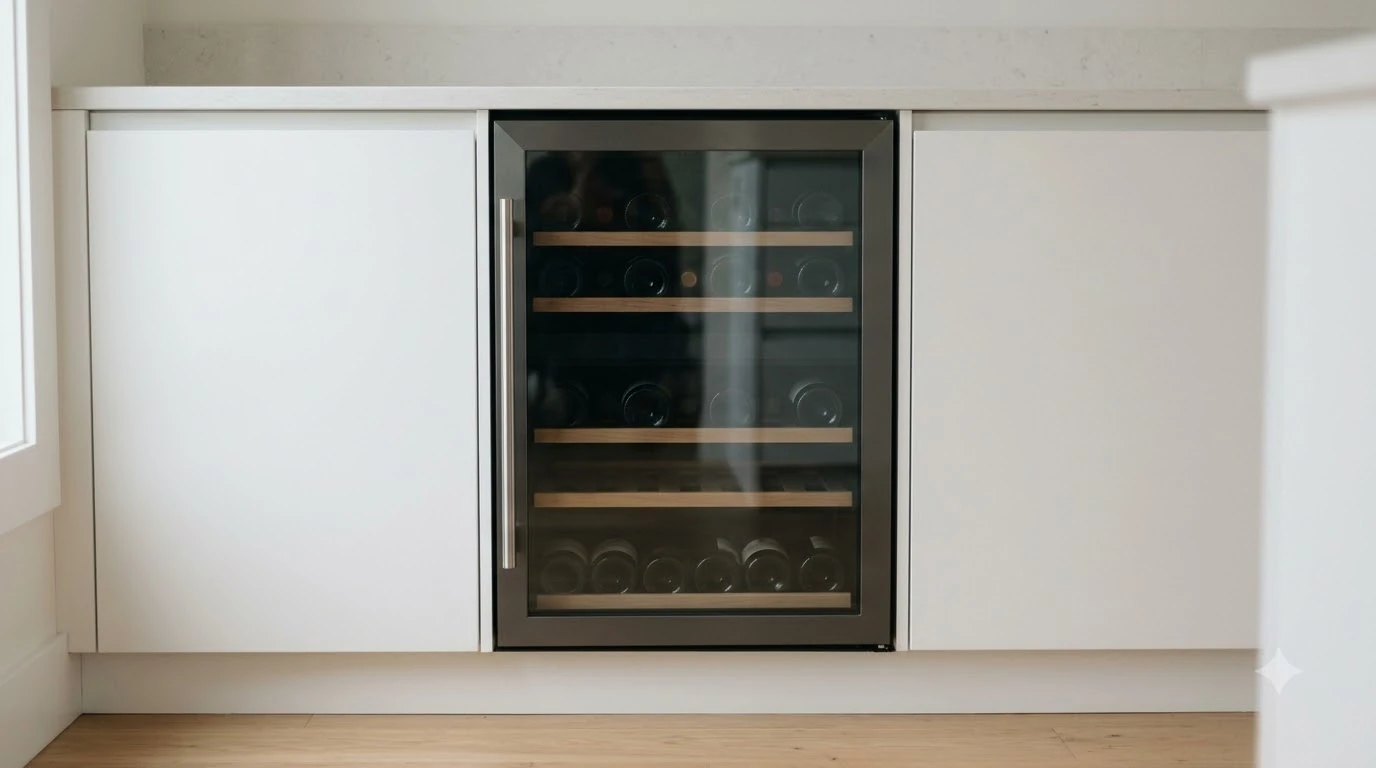
The danby built in wine fridge DWC057A1BSS is a practical choice for homeowners who want under-counter storage for up to 60 wine bottles, adjustable temperatures and a stainless steel glass-front design. Its 5.7 cu. ft. cabinet, seven shelves, fan-forced cooling and reversible door make it appealing for a dedicated kitchen or home-bar installation. However, its single temperature zone, 45-decibel noise specification and relatively short 12-month manufacturer warranty are important considerations before purchasing.
A dedicated wine refrigerator can make a kitchen more convenient, particularly if the household regularly keeps sparkling wine, Sauvignon Blanc, Chardonnay, Pinot Noir and Cabernet Sauvignon available. The Danby DWC057A1BSS targets that need with a full-width under-counter cabinet rather than a small countertop cooler. This review examines its specifications, owner feedback, practical limitations and installation requirements to help determine whether it deserves space in your kitchen.
Specs and Key Features of the Danby DWC057A1BSS
The Danby DWC057A1BSS combines a 60-bottle advertised capacity with a temperature range of 41°F to 64°F. Its strongest specifications are its substantial storage volume, seven shelves, reversible door and fan-forced cooling system, although buyers should understand that it is a single-zone appliance rather than a refrigerator with independent red and white wine compartments.
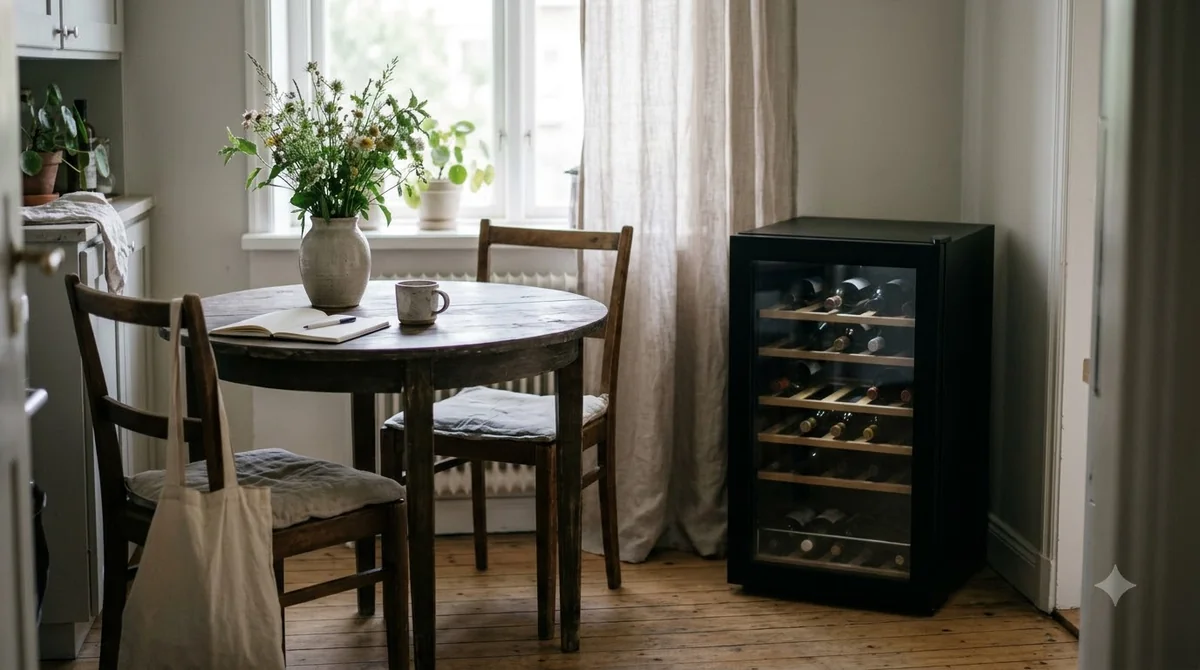
Danby lists the cabinet at 5.7 cubic feet, with exterior measurements of 23.8 inches wide, 25.4 inches deep and 35.25 inches high. Those measurements make it a potential fit for a conventional 24-inch under-counter appliance space, but the actual opening, finished flooring, countertop overhang and installation clearances still need to be checked before ordering.
| Specification | Danby DWC057A1BSS |
|---|---|
| Product type | Built-in under-counter wine cooler |
| Model number | DWC057A1BSS |
| Advertised capacity | 60 bottles |
| Cabinet volume | 5.7 cu. ft. |
| Temperature range | 41°F–64°F |
| Temperature zones | Single zone |
| Shelves | 7 |
| Exterior dimensions | 23.8 x 25.4 x 35.25 inches |
| Interior dimensions | 20.9 x 17.6 x 27.8 inches |
| Cooling system | Fan-forced cooling |
| Defrost | Automatic / frost-free |
| Noise specification | 45 dB at high operation |
| Electrical requirements | 115 V, 2.1 A |
| Product weight | 110.5 lb |
| Door | Reversible, dual-pane glass |
| Warranty | 12 months parts and labor |
These specifications come from Danby’s published product information and specifications. The 60-bottle figure refers to standard 750 ml bottles, not every possible wine-bottle shape. Champagne bottles, unusually wide Burgundy bottles and larger formats can occupy more shelf space, so an actual collection may not reach the advertised maximum capacity.
The exterior is designed to complement kitchen cabinetry. A stainless steel frame surrounds the glass door, while blue LED lighting illuminates the interior. Danby also describes the glass as providing protection against potentially harmful ultraviolet light. This combination makes the cooler suitable for homeowners who want their wine collection visible without making the appliance a separate focal point.
One particularly useful feature is temperature memory. If power is interrupted, the refrigerator is designed to return to its previous temperature setting after power is restored. This does not eliminate the possibility of temperature fluctuations during an outage, but it reduces the need to manually reprogram the unit after a temporary interruption.
The manufacturer’s Danby DWC057A1BSS product specifications provide the most useful starting point for checking dimensions, electrical requirements and included features. Buyers should also obtain the owner’s manual before finalizing cabinetry measurements.
Another specification worth understanding is the single-zone configuration. The thermostat controls one shared storage environment, so the entire collection operates at the same selected temperature. This arrangement is straightforward for people who primarily store one category of wine or prefer a common cellar temperature, but it does not provide the independent serving temperatures available from a dual-zone refrigerator.
What Owners Like About the Danby Wine Cooler
Owner feedback highlights the DWC057A1BSS’s appearance, storage capacity and straightforward controls. Customer comments also mention convenient visibility through the glass door, attractive interior lighting and generally satisfactory cooling, although the relatively small number of published reviews means these observations should be treated as individual experiences rather than proof of long-term reliability.
One of the most appealing aspects is the 60-bottle capacity. A household that regularly buys wine by the case can benefit from keeping bottles in a dedicated location rather than spreading them across kitchen cabinets, pantry shelves and a regular refrigerator. The seven-shelf arrangement also makes it easier to organize a collection by producer, grape variety or drinking occasion.
For example, a homeowner might reserve the upper shelves for sparkling wines and lighter whites, keep everyday Pinot Noir and Merlot in the middle, and place bottles intended for longer storage on the lower shelves. Because the refrigerator uses one temperature setting, this organization is about convenience rather than separate temperature control.
The glass door is another recurring positive. A customer review published through Walmart describes the cooler as attractive and appreciates being able to see available bottles without repeatedly opening the door. That visibility is useful in a home bar, particularly when guests are choosing between different wines for dinner.
The blue LED interior lighting contributes to this presentation. It illuminates the bottles and makes labels easier to locate, particularly in a kitchen with relatively low ambient lighting. The stainless steel framing also gives the appliance a more integrated appearance than a basic black freestanding wine cabinet.
Temperature controls are another practical advantage. The digital thermostat offers a selectable range from 41°F to 64°F, covering many common wine-storage and serving preferences. Owners do not need to rely on an imprecise dial with numbered settings, although the selected temperature should still be verified against actual cabinet conditions if precision matters.
The reversible door provides additional flexibility. In some kitchens, the door must open away from a dishwasher, cabinet handle or nearby wall. Being able to change the opening direction can make a difference in a tight under-counter installation, particularly when the appliance sits at the end of a cabinet run.
Fan-forced cooling is also useful for a relatively full cabinet. Rather than relying entirely on passive movement of cold air, the system circulates air through the interior. This is intended to help maintain a more consistent temperature across the storage area, although loading patterns, door openings and the surrounding room temperature can still influence performance.
Overall, the positive feedback is most relevant to buyers who value practical capacity and appearance. The product is not a sophisticated wine-cellaring system with multiple independent storage environments, but it offers several features that make everyday bottle organization more convenient.
Common Complaints and Limitations
The main limitations of the Danby DWC057A1BSS are its single-zone temperature arrangement, modest warranty period and potentially noticeable operating noise. Buyers should also account for bottle-size restrictions and installation requirements rather than assuming that a nominal 60-bottle capacity guarantees room for every type of wine bottle.
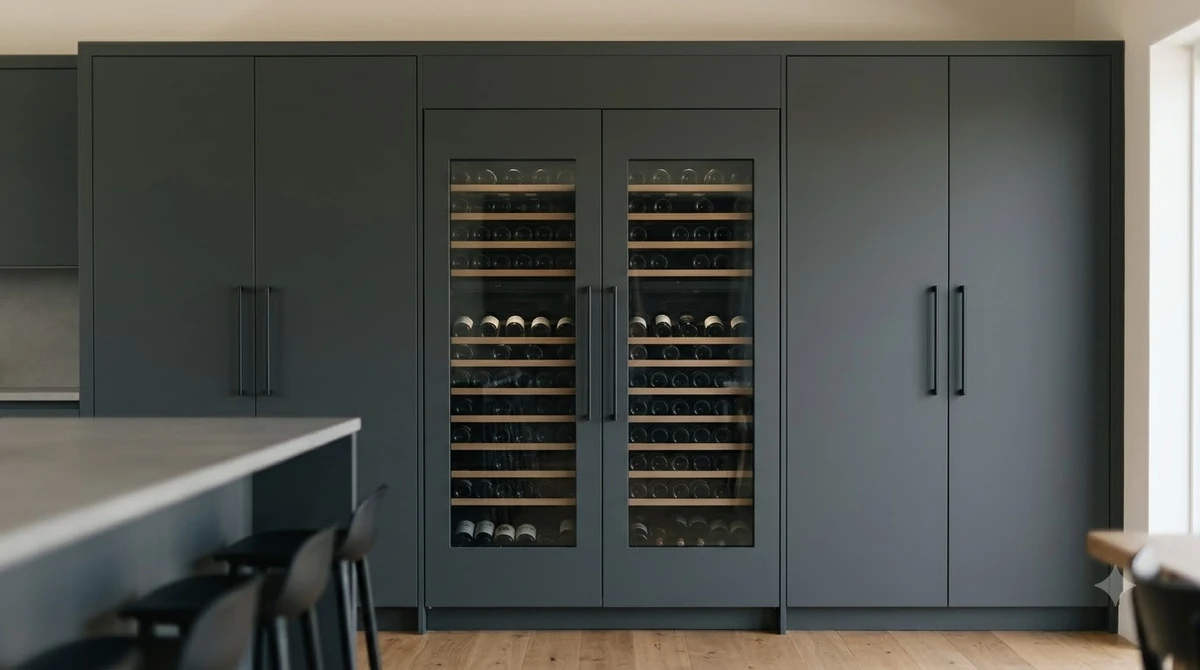
Noise deserves attention before installation. Danby lists a high operating noise rating of 45 decibels. This is not an indication that the unit produces that sound continuously, since compressor and fan operation can vary, but it gives homeowners a useful reference when deciding whether to place the refrigerator directly beside a living area, dining table or open-plan seating space.
Owner feedback is mixed on this subject. Some Walmart reviewers describe the appliance as quiet, while another customer specifically comments that it is somewhat noisy. These different experiences do not establish a widespread defect. Room acoustics, installation leveling, nearby cabinetry and individual sensitivity to mechanical sounds can all affect how noticeable a refrigerator becomes.
Another limitation is the single-zone design. The 41°F to 64°F range looks versatile, but the refrigerator cannot simultaneously maintain one temperature for white wine and another for red wine. A household that frequently serves both categories at different temperatures may prefer a dual-zone appliance.
For example, Sauvignon Blanc and Riesling are commonly served cooler than many medium-bodied reds. Pinot Noir generally benefits from serving temperatures around 55°F to 60°F, while fuller-bodied Cabernet Sauvignon is often served around 60°F to 65°F. One shared compartment cannot provide all these serving conditions at once.
The advertised capacity can also be misleading if interpreted too literally. Sixty standard bottles is a useful reference, but larger sparkling bottles, Champagne formats and wider Burgundy bottles can reduce the number that fit comfortably. The interior dimensions of 20.9 inches wide, 17.6 inches deep and 27.8 inches high should be considered alongside the actual bottle shapes in a collection.
Warranty coverage is another point to review. Danby specifies 12 months of parts and labor coverage with in-home service. Installation and yearly maintenance cleaning are excluded. For an appliance installed inside custom kitchen cabinetry, an owner may want to understand service access and potential removal costs before purchasing.
There is also no reason to assume that the appliance is suitable for an outdoor kitchen. Danby explicitly excludes outdoor and uncontrolled-temperature environments from its intended use. A covered patio, garage or outdoor entertaining area can experience temperatures that interfere with normal refrigeration performance and affect warranty coverage.
Finally, the appliance does not provide Wi-Fi connectivity according to AJ Madison’s product listing. Buyers looking for smartphone temperature monitoring, app notifications or remote adjustments should consider this a conventional digital wine cooler rather than a connected smart appliance.
These limitations do not necessarily make the model a poor purchase. They simply define its intended role: a relatively straightforward, single-temperature wine refrigerator for a climate-controlled indoor environment.
Who Should Buy and Who Should Skip This Model
The DWC057A1BSS makes the most sense for homeowners who need a dedicated 60-bottle wine cabinet beneath a kitchen counter and are comfortable keeping their collection at one temperature. It is less suitable for collectors who need separate red and white storage zones, extensive long-term cellar management or an appliance designed for outdoor use.
Good reasons to consider buying it
A household with approximately 25 to 50 bottles in regular rotation can benefit from the additional space. The advertised 60-bottle capacity provides some room for expansion, although bottle shapes and shelf arrangement will influence the practical total.
It is also a sensible option for people who entertain regularly. A home bar or kitchen island can become more organized when sparkling wine, dry whites and reds have a dedicated storage location. Guests can view the collection through the glass door, while the digital thermostat makes the shared temperature setting straightforward to adjust.
Homeowners undertaking a kitchen renovation may appreciate the under-counter format. At 23.8 inches wide and 35.25 inches high, the appliance has dimensions that are close to common kitchen-appliance footprints. Its reversible door can also help accommodate different cabinet arrangements.
The temperature range offers reasonable flexibility for a mixed everyday collection. A setting around 55°F is a useful general storage starting point for many wines, while bottles can be brought to their preferred serving temperatures before opening. This approach is particularly practical for households that do not require separate serving-ready compartments.
Reasons to look elsewhere
Collectors who regularly purchase premium wines for extended aging may want to investigate specialized wine cabinets with more detailed humidity, vibration and temperature-management specifications. Danby lists fan-forced cooling and dual-pane glass, but the published product information does not establish that this model provides every feature expected from a dedicated long-term cellar.
Dual-zone shoppers should also look at alternatives. If one compartment needs to hold white wines around 45°F to 50°F while another holds reds at a warmer temperature, a single-zone appliance cannot satisfy both requirements simultaneously.
Small households with fewer than 15 bottles may find a 60-bottle cabinet unnecessarily large. A compact wine refrigerator could occupy less valuable kitchen space while still meeting their storage needs.
Buyers who prioritize smart controls should look for a model with documented Wi-Fi connectivity, app-based monitoring and remote alerts. Similarly, homeowners who want custom cabinetry integration should confirm whether the refrigerator accepts custom door panels. AJ Madison identifies the DWC057A1BSS as not accepting custom panels.
The appliance is also not a suitable choice for an unconditioned garage or outdoor kitchen. Its intended environment is indoors, where room temperatures can be maintained within the operating conditions described by the manufacturer.
Tip: Before purchasing, count the actual bottles you plan to store and measure your cabinet opening in three places: width, height and depth. Leave room for the installation and ventilation requirements in Danby’s owner’s manual, and confirm that the door can open fully without hitting neighboring cabinetry.
How the Danby Compares to Alternative Wine Coolers
The Danby DWC057A1BSS competes most directly with other under-counter wine refrigerators and compact wine cabinets. Its 60-bottle capacity and 5.7 cu. ft. volume place it in a larger household-storage category, while its single-zone design makes it simpler than refrigerators that divide wine into independently controlled compartments.
One alternative is a smaller freestanding Danby wine cooler such as the DWC350BLP. Lowe’s describes that model as a 35-bottle refrigerator with a 3.2 cu. ft. capacity, seven shelves and a temperature range of approximately 43°F to 57°F. Its 17.5-inch width is considerably narrower than the 23.8-inch DWC057A1BSS.
The smaller model may be more appropriate for apartments, smaller wine collections and spaces without a dedicated 24-inch appliance opening. However, it is identified as a freestanding product, so it should not automatically be treated as a direct substitute for an under-counter installation. Installation suitability must be established from the specific model’s manual.
Another comparison is the Danby DWC057D1BSS. This is a related 24-inch under-counter wine cooler with a 5.7 cu. ft. capacity and a similar 41°F to 64°F temperature range. Its listed configuration includes five shelves, extendable shelving, natural beechwood-trimmed wire shelves, temperature recall and door-ajar and temperature alarms.
The DWC057D1BSS may appeal to buyers who prefer wood-trimmed shelving and additional monitoring features. The DWC057A1BSS, by comparison, has seven listed shelves and a stainless steel exterior with a conventional digital display. Both models should be evaluated using their individual installation guides rather than relying on their similar model numbers.
There is also an important distinction between a single-zone wine cooler and a dual-zone beverage center. A dual-zone appliance can dedicate different temperatures to wine and other drinks. Danby’s DBC051D1BSS, for example, is listed as an under-counter French-door beverage center with separate wine and beverage temperature ranges.
That arrangement may suit a household that wants wine alongside cans and other chilled drinks. However, a beverage center is not necessarily a better wine-storage solution for someone who primarily needs a dedicated wine cabinet. Shelf layout, bottle capacity and the amount of space allocated to wine all matter.
For readers comparing different appliance categories, the broader model reviews collection can help provide additional context. The important distinction is to compare actual dimensions, installation type, storage capacity and temperature configuration rather than choosing solely by the advertised number of bottles.
The Danby DWC057A1BSS remains a reasonable middle-ground option for buyers who want a relatively straightforward 60-bottle cabinet. Its appeal is less about advanced technology and more about providing substantial under-counter storage with a clean exterior design.
Installation, Temperature Settings and Everyday Care
Proper installation is particularly important for the DWC057A1BSS because it is a relatively heavy appliance intended for an under-counter position. Danby lists the product weight at 110.5 pounds, so moving it into a finished kitchen opening requires appropriate handling and enough access to position it safely.
Start by measuring the available opening rather than relying only on the nominal 24-inch appliance category. The cabinet must accommodate the refrigerator’s 23.8-inch width, 25.4-inch depth and 35.25-inch height, with the additional clearances and ventilation arrangements required by the owner’s manual.
Danby’s general guidance explains that certain wine refrigerators can be installed in cabinetry when their specific ventilation requirements are met. The company also warns against fully enclosing appliances without allowing the necessary front airflow. These instructions should not be replaced with assumptions based on the appearance of the front grille.
Electrical preparation matters as well. The published specifications identify 115 volts and 2.1 amps. Danby does not recommend connecting the unit through an extension cord, so the installation should provide an appropriate nearby electrical outlet.
Transportation is another detail that can affect the first installation. Danby instructs owners to allow the appliance to stand upright for six hours before plugging it in if it has been transported on its side. This waiting period should be included in the delivery and installation schedule.
Choosing a useful temperature
The refrigerator’s 41°F to 64°F range provides flexibility for common wine styles. A general storage setting around 55°F is a reasonable starting point for a mixed collection, rather than attempting to keep every bottle at its ideal immediate serving temperature.
Serving temperatures are different from long-term storage temperatures. Sparkling wine is generally served around 40°F to 50°F, light whites and rosé around 45°F to 50°F, and fuller-bodied whites around 50°F to 55°F. Light reds are commonly served around 55°F to 60°F, while fuller reds are often served around 60°F to 65°F.
Because the Danby is a single-zone model, owners can choose a compromise storage setting and bring individual bottles closer to their preferred serving temperatures shortly before opening. A bottle of Sauvignon Blanc, for example, can be chilled further before dinner, while a Cabernet Sauvignon can be allowed to warm slightly after removal from the cabinet.
Wine organization can also make everyday use more convenient. Grouping bottles by style or drinking occasion reduces the amount of time spent searching for a particular wine. Sparkling bottles, everyday whites, lighter reds and fuller-bodied reds can be arranged in separate shelf groups where their bottle dimensions permit.
Maintaining the refrigerator
Routine care begins with keeping the door closed properly. Frequent opening allows warmer room air to enter the cabinet, which can increase cooling demand. Avoid placing the appliance directly beside heat-producing equipment if the kitchen layout offers another suitable position.
Clean the exterior and glass door using appropriate nonabrasive materials. Avoid harsh cleaning products that could damage the finish or leave residue on the glass. Shelf cleaning should be performed carefully, with bottles removed and the shelves handled according to the owner’s instructions.
Monitor the door seal for damage and ensure the door closes evenly. A poorly seated seal can allow cold air to escape and make temperature maintenance more difficult. If cooling performance changes unexpectedly, check the power supply, thermostat setting and door closure before assuming that a major component has failed.
Danby also explains that compressor operation and periodic fan activity are normal parts of refrigerator operation. Occasional mechanical sounds should therefore be distinguished from persistent abnormal noises, repeated temperature failures or signs of physical damage.
For wine enthusiasts who enjoy hosting, a dedicated cooler can make entertaining easier. Bottles for a relaxed Aperol spritz recipe gathering, a dinner featuring a chicken Marsala recipe, or an afternoon with a Hugo spritz recipe can be organized in advance. The refrigerator’s main role is to provide convenient, consistent storage rather than replace the final chilling or serving preparation required for each drink.
Finally, keep the manufacturer’s warranty information and owner’s manual accessible. Danby’s 12-month parts and labor coverage excludes installation and yearly maintenance cleaning, so understanding the difference between appliance defects and excluded service work can help avoid confusion if support is needed.
Frequently Asked Questions
Can the Danby DWC057A1BSS store Champagne bottles?
It can accommodate wine bottles within its physical shelf dimensions, but the advertised 60-bottle capacity is based on standard 750 ml bottles. Champagne bottles often have wider bodies than conventional Bordeaux bottles, so fewer may fit on a shelf. Measure larger bottles and check their clearance before filling the cabinet.
Does the Danby DWC057A1BSS have a temperature alarm?
The published DWC057A1BSS feature list identifies temperature memory after a power failure but does not list a dedicated temperature alarm or door-ajar alarm. Those features are documented on some related Danby models, including the DWC057D1BSS. Buyers who specifically need audible or visual alerts should verify the exact model specifications.
Can the Danby wine cooler be installed next to a dishwasher?
Installation beside a dishwasher should be assessed carefully because dishwashers can release substantial heat and moisture during operation. The available space must also allow the wine refrigerator to receive its required ventilation and open fully. Confirm the installation arrangement with the appliance manuals and cabinetry installer before placing the units side by side.
Does the Danby DWC057A1BSS have a door lock?
AJ Madison’s specification listing identifies this model as having no door lock. That distinction matters in homes where children have access to the kitchen or where a wine cabinet needs restricted access. Buyers who require a locking mechanism should confirm that the alternative appliance includes one as a factory-installed feature.
Does the Danby wine cooler have adjustable shelf positions?
Danby identifies seven storage shelves, but its main product specification does not establish a comprehensive adjustable-position system for every shelf. Do not assume that all seven shelves can be repositioned freely. Consult the owner’s guide and inspect the shelf supports before planning storage around unusually tall bottles.
The Danby DWC057A1BSS is a capable option for homeowners who want a 60-bottle under-counter wine refrigerator with straightforward digital controls and a clean stainless steel appearance. Its single-zone configuration, 45-decibel high-operation rating and 12-month warranty deserve careful consideration, but its capacity and reversible door make it a practical choice for an appropriately planned indoor kitchen or home bar. Buyers who prioritize two independent temperatures or advanced monitoring should compare alternatives before committing to the installation.
More in Model Reviews
 Magic Chef 44 Bottle Wine Cooler Review for Flexible StorageUpdated Nov 21, 2026
 Whynter 164 Bottle Wine Cooler Review: Capacity, Features, and FitUpdated Nov 21, 2026
 Insignia NS WC16BK6 Review: Compact 16-Bottle Wine StorageUpdated Nov 21, 2026
 Wine Enthusiast Electric Blue Omega Review: Opening, Pouring, and Preserving Made EasierUpdated Nov 21, 2026
 Koolatron 20 Bottle Wine Cooler Review: Features, Fit, and PerformanceUpdated Nov 21, 2026
 NewAir AWC 330E Review for Home Wine StorageUpdated Nov 21, 2026