

We may earn a commission when you buy through links on this page, at no extra cost to you. Learn more.
The danby beverage cooler is a practical choice for households that want dedicated drink storage, flexible temperature controls, and a glass-front design without dedicating an entire refrigerator to beverages. Danby offers several configurations, from compact freestanding units to larger under-counter beverage centers and dual-zone models. Its strongest appeal is the variety of capacities and storage arrangements, although temperature range, installation requirements, and available features differ considerably between models. Choosing the right version matters more than choosing the brand name alone.
A dedicated beverage refrigerator can make a noticeable difference in a kitchen, entertainment room, or home bar. Instead of filling the main refrigerator with soda, sparkling water, beer, and wine, a separate cooler keeps everyday drinks organized and accessible. Danby’s lineup covers several of these needs, but its products should not be treated as interchangeable. A 120-can refrigerator with a mechanical thermostat serves a different purpose from a dual-zone appliance designed to accommodate both wine bottles and cans. This review examines the product family’s features, practical advantages, limitations, and alternatives to help identify the most suitable configuration.
Specs and Key Features
Danby’s beverage center lineup emphasizes dedicated storage, glass-front presentation, and temperature adjustment, with capacities ranging from smaller household units to larger under-counter appliances. The most important differences involve storage volume, cooling range, thermostat design, and whether the appliance is intended for freestanding or built-in installation.
Three representative configurations illustrate the range. The DBC120BLS is a straightforward 120-can beverage refrigerator, the DBC051D1BSS combines separate wine and beverage compartments, and the DBC434A1BSSDD offers a larger single-zone configuration with fan-forced cooling. These specifications provide a more useful comparison than assuming every Danby model has the same cooling system.
| Specification | DBC120BLS | DBC051D1BSS | DBC434A1BSSDD |
|---|---|---|---|
| Capacity | 3.3 cu. ft. | 64 cans and 27 wine bottles | 4.3 cu. ft. |
| Can capacity | 120 | 64 | 124 |
| Wine capacity | Not specified | 27 bottles | 9 bottles with 88 cans |
| Temperature range | 43°F–57°F | 37°F–64°F beverage; 41°F–64°F wine | 34°F–50°F |
| Temperature control | Mechanical thermostat | Digital controls | Digital thermostat |
| Door | Tempered glass | Glass-front design | Stainless steel frame and glass |
| Lighting | Door-activated interior light | Blue LED | White LED |
| Door configuration | Reversible | Reversible | Reversible |
The DBC120BLS is a sensible starting point for shoppers who mainly want chilled cans. Its 17.53-inch width, 20.02-inch depth, and 32.72-inch height make it a relatively compact freestanding appliance. The 3.3 cu. ft. interior is designed around beverage storage rather than elaborate wine organization. Its mechanical thermostat keeps operation straightforward, while the integrated lock and reversible hinge add useful everyday flexibility. Danby’s official DBC120BLS product specifications provide the complete dimensions and feature list. One important purchasing consideration is that Danby identifies this particular model as discontinued, so availability may be limited.
The DBC051D1BSS takes a different approach. Its left compartment accommodates 64 standard cans, while the right compartment holds 27 standard wine bottles. The beverage section can be adjusted between 37°F and 64°F, while the wine section operates between 41°F and 64°F. This separation makes it particularly interesting for households that serve different drinks at the same time.
The DBC434A1BSSDD is the larger single-zone alternative. Danby specifies 124-can capacity or a mixed arrangement of 88 cans and nine wine bottles. Its 34°F to 50°F operating range is notably colder than the DBC120BLS range, and fan-forced cooling is designed to maintain a more consistent internal temperature. The through-door display also makes temperature monitoring convenient.
These distinctions matter because a refrigerator’s maximum advertised capacity does not describe every practical arrangement. Large bottles, unusual can shapes, and frequently accessed drinks can change how efficiently the available shelves are used. A household that mostly stores standard 12-ounce cans may make better use of a 120-can appliance than someone who regularly stocks wine bottles and larger beverage containers.
What Owners Like About Danby Beverage Centers
The strongest advantages of Danby’s beverage centers are their dedicated storage, accessible controls, and range of configurations. Features such as reversible hinges, glass doors, interior lighting, and adjustable temperature settings make the appliances useful additions to entertaining spaces.
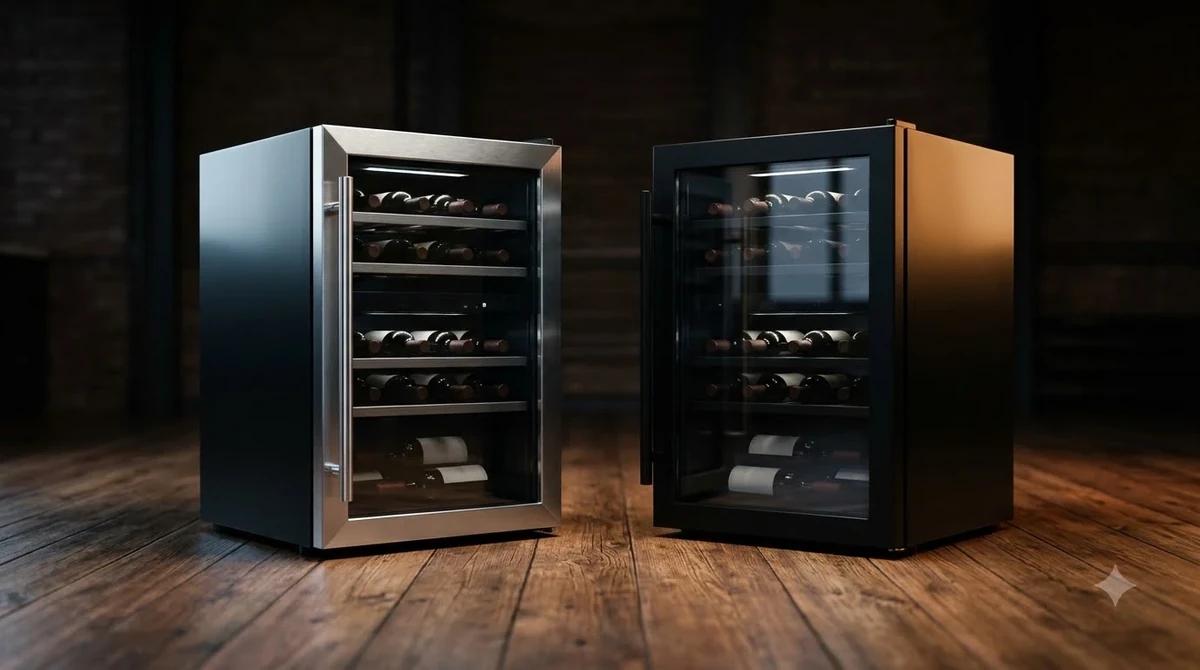
Dedicated drink storage is the main attraction. A beverage refrigerator separates frequently used drinks from ingredients and everyday food. This can be particularly helpful during gatherings, when guests repeatedly open the main kitchen refrigerator looking for refreshments. A separate unit in a family room or home bar reduces that inconvenience and provides a visible selection of drinks.
Danby’s published product range also offers meaningful flexibility. The DBC120BLS provides space for 120 standard cans, while larger configurations can accommodate 124 cans. The DBC051D1BSS is especially useful for people who want a separate wine compartment rather than arranging bottles among ordinary refrigerator shelves. According to Danby’s beverage center sizing guide, its product family also includes larger beverage storage options alongside dedicated wine cellars.
Glass doors and interior lighting
A glass-front beverage refrigerator makes it easier to see what remains inside without opening the door. This is a simple feature, but it is useful when organizing refreshments for a gathering or deciding which drinks need replenishing. Interior lighting also makes the appliance more attractive in a home bar, where the refrigerator may be visible rather than hidden inside a utility space.
Different Danby models use different lighting arrangements. The DBC120BLS has a door-activated interior light, while the DBC434A1BSSDD includes white LED illumination. Other configurations, including the DBC117A1BSSDB-6 listed by Costco, use blue LED lighting. Shoppers who care about the appearance of a home bar should compare the actual lighting specification rather than assuming the entire product family uses one color.
Flexible door arrangements
Reversible door hinges are another practical advantage. A refrigerator positioned beside a countertop, cabinet, or wall may need to open in a particular direction to provide convenient access. A reversible design allows the door swing to be adjusted to suit the room layout.
Some models also include integrated locks. The DBC120BLS, for example, has a key-operated lock, which can be helpful in a shared office or household environment. It is not a substitute for appropriate supervision or child-safety practices, but it adds a measure of control over access to the contents.
Useful temperature memory
Temperature memory is another feature worth comparing. Danby’s DBC051D1BSS manual explains that the control panel remembers the selected setting following a power interruption and resumes normal operation when power returns. This reduces the need to reprogram the appliance after every brief electrical outage.
For shoppers who want to compare available configurations, the best rated wine cooler options provide a useful starting point for distinguishing beverage refrigerators from appliances designed specifically for wine storage. The distinction becomes particularly important for people who intend to maintain a wine collection rather than simply keep a few bottles available for entertaining.
Common Complaints and Limitations
The biggest drawbacks to consider are model-dependent temperature limits, capacity compromises, installation restrictions, and the absence of a single specification shared across the entire Danby range. A beverage refrigerator may look suitable in a product photograph but still be unsuitable for a particular room or drink collection.
One important limitation is temperature range. The DBC120BLS operates between 43°F and 57°F, whereas the DBC434A1BSSDD reaches a specified minimum of 34°F. The dual-zone DBC051D1BSS has separate temperature ranges for wine and beverages. These differences can affect whether the refrigerator suits someone who prefers very cold soft drinks, beer, or sparkling water.
For wine enthusiasts, temperature control requires additional thought. A general beverage cooler is not necessarily a substitute for a dedicated wine refrigerator. The DBC120BLS, for instance, is designed primarily around can storage, while a dedicated wine appliance generally provides shelving intended to support bottles securely. Someone storing several bottles of wine alongside cans may prefer a dual-zone design, but someone maintaining a larger wine collection should investigate a purpose-built wine cellar.
Advertised capacity versus everyday capacity
Maximum can capacity is useful for comparing refrigerators, but it is not always a realistic description of how a household will use one. Manufacturers generally specify capacity using standardized beverage containers. A refrigerator advertised for 120 cans may hold fewer if its shelves are arranged around larger bottles, tall containers, or mixed beverages.
The same issue applies to wine storage. The DBC051D1BSS has a specified maximum of 27 standard 750 ml bottles, but its manual explains that the bottles must be positioned alternately across the upper six shelves to achieve the stated capacity. This is a reminder that maximum storage can require a specific arrangement rather than allowing every bottle to be placed wherever convenient.
Noise and installation concerns
Like other compressor-based refrigeration appliances, beverage centers can produce operating sounds. Danby identifies a 42 dB operating sound level for the DBC051D1BSS, but that figure should not automatically be applied to every model. Shoppers who plan to position a refrigerator beside a television, desk, or bedroom should consider its placement carefully. An uneven floor or improperly adjusted feet can also contribute to unnecessary vibration.
Danby’s DBC051D1BSS manual specifically explains that leveling helps minimize noise and vibration. The instructions recommend using the adjustable leveling leg to stabilize the appliance. This is a practical installation detail rather than evidence of a particular widespread defect.
Another potential disappointment involves fitting a freestanding refrigerator into cabinetry. A unit that appears compact enough to slide beneath a countertop is not automatically approved for built-in installation. Ventilation requirements and heat dissipation differ between appliances. Danby specifically lists built-in and freestanding configurations separately in its product catalog, so buyers should distinguish between the two before purchasing.
Limited independent owner-review evidence
There is also a distinction between manufacturer specifications and verified customer experience. Costco’s listing for the DBC117A1BSSDB-6 identifies its storage capacity, temperature range, glass door, and adjustable shelves, but the product page displayed no member-review count in the retrieved listing. Consequently, it would be misleading to claim that a particular compressor, shelf arrangement, or noise level is consistently praised by owners based on that page.
For a balanced assessment, compare the specifications with current retailer feedback for the exact model being considered. Look particularly for recurring comments about temperature stability, compressor cycling, door sealing, shelf strength, and customer service. A review of one Danby model should not automatically be applied to another model with a different cooling system.
Who Should Buy and Who Should Skip
A Danby beverage center makes the most sense for households that need extra drink storage and want an appliance designed around accessibility. The right model depends on whether the priority is can capacity, mixed wine and beverage storage, colder operating temperatures, or built-in installation.
Who should consider buying one
Home-bar owners are natural candidates. A dedicated beverage refrigerator can keep soft drinks, mixers, sparkling water, and other refreshments close to the serving area. A glass door makes the selection visible, while a reversible hinge can help accommodate different room layouts.
Apartment residents may also appreciate the smaller freestanding configurations. A 3.3 cu. ft. refrigerator such as the DBC120BLS can provide substantial beverage storage without requiring the space occupied by a full-size refrigerator. However, measuring the available floor area, door swing, and electrical outlet location remains essential.
Households that regularly entertain should consider models with higher capacity or mixed storage. The DBC051D1BSS is particularly interesting for people who want separate beverage and wine compartments. Its 64-can beverage side and 27-bottle wine side provide a more organized arrangement than a standard mini refrigerator.
People who want a built-in installation should investigate Danby’s purpose-designed under-counter models. The DBC057D1BSS, for example, is listed as a 5.7 cu. ft. built-in beverage center with a maximum capacity of 138 cans and 11 wine bottles. Its listed features include active cooling, touch controls, a through-door display, and a reversible door.
Who should skip one
People who need a refrigerator for a large wine collection should consider a dedicated wine cellar instead. Beverage centers are optimized for mixed drink storage, and their shelves may not offer the same bottle organization or storage configuration as a wine-specific appliance.
Shoppers who need precise storage conditions for valuable wines should also investigate dedicated wine refrigeration specifications. A general beverage refrigerator should not be assumed to provide the same storage environment as a wine cellar simply because it can accommodate several standard wine bottles.
Similarly, anyone who needs a very cold drink storage environment should avoid selecting a model based on appearance or capacity alone. The DBC120BLS has a minimum specified temperature of 43°F, while the DBC434A1BSSDD reaches 34°F. That is a meaningful difference for people who prefer drinks served particularly cold.
Finally, shoppers who want an appliance installed outdoors or in an uncontrolled garage should verify that the specific model is approved for those conditions. Household beverage centers should not automatically be treated as outdoor refrigerators.
Tip: Before choosing a Danby model, write down the available width, depth, and height, then compare those measurements with the appliance’s published dimensions and ventilation requirements. Also account for door clearance and the space needed to remove shelves. A refrigerator that fits physically but cannot open fully or release heat properly is not a good installation.
How Danby Compares to Alternatives
Danby’s main advantage is the variety of beverage storage arrangements available within one product family. However, shoppers should compare the intended use of each appliance rather than treating all beverage refrigerators as direct alternatives. A compact can refrigerator, a dual-zone wine and beverage center, and a built-in under-counter unit solve different storage problems.
For example, the DBC120BLS is a conventional freestanding beverage refrigerator with a 120-can capacity and mechanical temperature control. It is a relatively straightforward option for someone who primarily stocks canned drinks. The DBC434A1BSSDD offers a larger 4.3 cu. ft. interior, a colder temperature range, and fan-forced cooling. The DBC051D1BSS, meanwhile, is aimed at mixed collections that need separate temperature settings.
Freestanding beverage coolers
A freestanding refrigerator offers more flexibility in where it can be positioned, provided the room has adequate ventilation and the appliance’s installation requirements are followed. Danby’s DBC120BLS and DBC434A1BSSDD are examples of this type of configuration.
The key advantage is convenience. These units can be positioned in a home bar, entertainment room, or kitchen without requiring a specially designed cabinet opening. Their main disadvantage is that they occupy visible floor space and cannot automatically be substituted for an appliance specifically approved for built-in use.
Dual-zone beverage and wine refrigerators
A dual-zone refrigerator offers a more specialized solution. The DBC051D1BSS separates its beverage compartment from its wine compartment, with independent temperature adjustment. This makes it more versatile for households that regularly serve both wine and canned refreshments.
However, dual-zone storage generally involves a capacity trade-off. Its 64-can and 27-bottle arrangement is different from a single-compartment appliance holding 120 or 124 cans. Buyers should decide which storage arrangement is more useful before choosing.
Built-in beverage centers
Built-in refrigerators are designed around under-counter installation and are often a better fit for permanent home-bar projects. Danby’s DBC057D1BSS provides an example with 5.7 cu. ft. of capacity and specified storage for 138 cans and 11 wine bottles. Its published features include active cooling, three adjustable glass shelves, a through-door temperature display, and a reversible door.
Although built-in models can provide a more integrated appearance, installation needs more planning. Cabinet dimensions, electrical access, ventilation, and door clearance all matter. Buyers should follow the manufacturer’s installation requirements rather than relying on the dimensions of the refrigerator alone.
Dedicated wine refrigerators
A wine refrigerator is the more appropriate alternative for someone whose main priority is wine storage. Bottle-oriented shelves, appropriate storage arrangements, and wine-specific temperature controls are more important than maximum can capacity in this situation.
Wine also has different serving requirements depending on its style. Sparkling wines are generally served around 40°F to 50°F, light whites and rosé around 45°F to 50°F, and full-bodied whites around 50°F to 55°F. Light reds are commonly served around 55°F to 60°F, while fuller reds are generally served around 60°F to 65°F. A beverage center should therefore be selected according to the actual storage needs rather than the assumption that one temperature works for every bottle.
For shoppers who frequently prepare mixed drinks, keeping a dedicated supply of chilled mixers can also make hosting easier. A separate refrigerator near the serving area is convenient for preparing an Aperol Spritz recipe or keeping sparkling water and other ingredients accessible. Likewise, a kitchen beverage center can free refrigerator space for ingredients used in a chicken Marsala recipe and other meals.
Frequently Asked Questions
How long should a new Danby beverage refrigerator stand before being plugged in?
Danby’s product FAQ for the DBC120BLS recommends allowing the appliance to stand upright for six hours before plugging it in if it was transported on its side. Transportation conditions matter, so follow the instructions supplied with the particular model. This waiting period helps accommodate the compressor system after horizontal transportation.
Can a Danby beverage cooler be used in an unheated garage?
Not every Danby beverage center is designed for an unheated garage. Danby’s DBC051D1BSS product information specifically excludes uncontrolled environments such as garages, porches, and outdoor kitchens. Ambient temperatures outside the appliance’s intended operating conditions can affect cooling performance and warranty coverage.
Does a Danby beverage cooler automatically defrost itself?
Defrost arrangements depend on the specific appliance. Danby’s DBC026A1BSSDB product specifications identify a cycle-defrost system, but that feature should not be assumed across every beverage center. Check the model’s maintenance instructions to determine whether manual defrosting is necessary.
Can a Danby beverage refrigerator store opened wine bottles?
Yes, an opened bottle can be stored in an appropriate compartment if it fits securely and the compartment’s temperature is suitable. Use a proper closure to limit exposure to air, and keep the bottle upright to reduce the possibility of leakage. A dedicated wine refrigerator may offer a more convenient arrangement for households that frequently store partially consumed bottles.
Where can owners find replacement parts and model-specific support?
Danby provides product support resources through its official website. Searching with the complete model number helps identify the appropriate owner’s manual, specifications, and support information. Keep the original proof of purchase and appliance identification details available when requesting warranty assistance.
A Danby beverage cooler is a worthwhile option for shoppers who want dedicated drink storage, a glass-front design, and a choice of freestanding, dual-zone, and built-in configurations. The DBC120BLS suits households that mainly need can storage, the DBC051D1BSS accommodates separate wine and beverage collections, and the DBC434A1BSSDD offers a larger single-zone alternative with colder cooling capability. Compare the exact model’s temperature range, capacity, dimensions, and installation requirements before deciding. The best choice is the configuration that fits the room and the drinks being stored, not necessarily the one with the largest advertised capacity.
More in Model Reviews
 Magic Chef 44 Bottle Wine Cooler Review for Flexible StorageUpdated Nov 21, 2026
 Whynter 164 Bottle Wine Cooler Review: Capacity, Features, and FitUpdated Nov 21, 2026
 Insignia NS WC16BK6 Review: Compact 16-Bottle Wine StorageUpdated Nov 21, 2026
 Wine Enthusiast Electric Blue Omega Review: Opening, Pouring, and Preserving Made EasierUpdated Nov 21, 2026
 Koolatron 20 Bottle Wine Cooler Review: Features, Fit, and PerformanceUpdated Nov 21, 2026
 NewAir AWC 330E Review for Home Wine StorageUpdated Nov 21, 2026