

We may earn a commission when you buy through links on this page, at no extra cost to you. Learn more.
The cornas wine region is a small Northern Rhône appellation in France known for powerful, age-worthy red wines made entirely from Syrah. Its steep granite slopes, warm natural amphitheater, and single-grape rule give the wines a distinct identity. Expect deep color, firm tannins, dark fruit, pepper, and savory notes that become more complex with bottle age.
For readers exploring the Rhône, Cornas offers a concentrated expression of Syrah and a useful lesson in how slope, soil, and exposure shape a wine. It is a compact place with a demanding landscape, but its wines cover a wider range of texture and maturity than the word “powerful” alone suggests.
Where Cornas Sits in the Northern Rhône
Cornas is a red-wine appellation on the right bank of the Rhône River in the Ardèche department, across the water from Valence. Its vineyards occupy a steep amphitheater between Saint-Joseph to the north and Saint-Péray to the south, with slopes generally facing east and southeast.
The appellation is unusually compact: its geographic boundary is limited to the commune of Cornas rather than spread across a collection of villages. Inter Rhône places the vineyards at 125 to 400 meters above sea level, about 7 kilometers from Valence and 12 kilometers from Tournon. The combination of a southerly position in the Northern Rhône and a protective curve of hills gives the site a warmer feel than many nearby slopes. The climate is described as both semi-continental and Mediterranean, a useful way to understand why ripening can be relatively early while the wines still retain a clear northern Rhône character.
Cornas is one of the Northern Rhône crus, a category that identifies a named appellation rather than a grape variety or a particular producer. Its identity is straightforward: the appellation permits red wine only, and Syrah is the only authorized variety. This makes Cornas easier to identify than appellations where several grapes or wine colors can appear under the same name. For a broader introduction to appellations and regional naming, the site’s guide to Wine Regions explains how place names connect to production rules.
| Appellation detail | Official figure |
|---|---|
| Recognition as an AOC | 1938 |
| Production area | 162 hectares |
| Total production | 3,871 hectoliters |
| Average yield | 24 hectoliters per hectare |
| Export share | 28% |
The Rhône wine trade body lists 162 hectares of production area and 3,871 hectoliters of total production. The yield figure is an average, not a promise that every estate or parcel produces the same amount. The official Inter Rhône Cornas profile provides the appellation’s geography, history, and key figures.
Granite Slopes, Terraces, and Vineyard Conditions
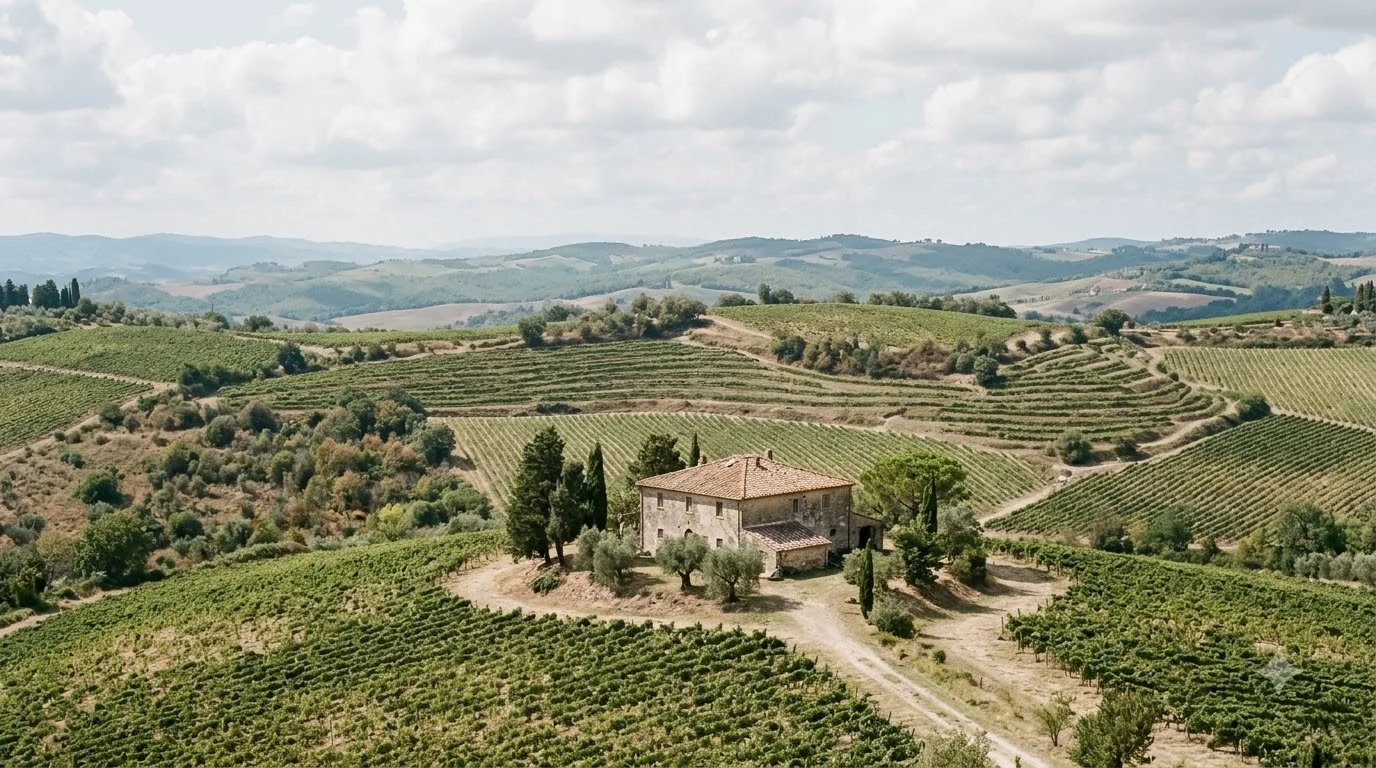
The physical landscape is central to Cornas: vines cling to steep east- and southeast-facing slopes cut into terraces, while decomposed granite forms much of the soil. The natural amphitheater shelters the vineyards from cold winds and creates a warm setting for Syrah to ripen.
Local growers call many of the narrow terraces “chaillées.” Their dry-stone retaining walls help hold soil on slopes where mechanized work is difficult, and some terraces are only wide enough for a few rows. Vineyard work is therefore labor-intensive, with access, slope, and erosion all influencing how a parcel can be farmed. The view may look dramatic, but the practical reality is a landscape that asks for careful work throughout the growing season.
Much of the bedrock is granite that has weathered into sandy, clay-rich material known locally as “gores.” The appellation also contains silt deposits, and limestone scree becomes more noticeable in the northern part of the area. These details matter because “granite soil” is not a single uniform surface: depth, clay content, fragments of rock, and position on the slope can vary over short distances. The AOC’s geological account describes the way the Rhône shaped the amphitheater and how granite breaks down into sand and clay that vines can root into.
Exposure and slope position can produce differences even within one small appellation. Higher ground may ripen more slowly and give tannins a more open feel, while the middle slopes are often associated with a firmer, more concentrated structure. Lower parcels with deeper soils can make wines with gentler tannins and a more approachable texture. Those are broad tendencies rather than fixed rules: vine age, farming choices, harvest decisions, and cellar practice all affect the final wine.
Syrah and the Signature Cornas Flavor Profile
Cornas is made exclusively from Syrah, and the wines are typically dark, full-bodied, and firm in tannin. Blackberry, violet, licorice, and spice are common markers, while age can bring smoke, leather, game, and earthy mushroom notes.
Young wines often show deep ruby or purple color with blackberry, black plum, and other dark berries. Pepper, licorice, and savory herbs add definition; mature examples can show roasted cocoa, leather, or smoke. These are common markers, not a checklist: vintage, parcel, and cellar practice change the balance.
Structure is a defining feature. Syrah grown in this warm, sheltered amphitheater can produce concentrated fruit, and Cornas commonly has substantial tannin. In a young wine, that tannin may feel dense, grippy, or angular, especially if the fruit has not yet integrated with the wine’s structure. Freshness is important too: acidity helps the dark fruit remain clear and gives the wine energy rather than allowing it to feel heavy. A good bottle balances ripe flavor, firmness, and lift.
Compared with neighboring Northern Rhône Syrah, Cornas often presents a muscular, direct style. Côte-Rôtie can be more perfumed and polished, while Hermitage can combine great concentration with a different range of site expressions. Cornas should not be reduced to a simple synonym for toughness, however. A careful producer can make a wine with precision and aromatic detail as well as power. For a regional contrast beyond the Rhône, the Savoie wine region offers a useful look at alpine vineyards and a very different mix of grapes and wine styles.
Producers and the Range of Cornas Styles
A small group of growers has helped define Cornas for wine drinkers, but the village does not produce one uniform house style. Domaine Clape is associated with a traditional, long-lived expression, while Domaine du Coulet and other estates show how concrete, parcel selection, and different approaches to tannin can broaden the range.
Domaine Clape is one of the names most closely tied to the appellation. Decanter describes the family as a cornerstone of Cornas and notes the estate’s traditional approach and old-vine parcels. The wines are known for concentration and firm structure, and top bottles can develop over decades. They are useful reference points for people trying to understand the more classic, tightly wound side of the appellation, though a young bottle may need patience and air before its details become easy to read.
Domaine du Coulet, led by Matthieu Barret, provides a different point of comparison. Decanter reports that the winery uses diamond-shaped concrete tanks rather than barrels and that its Cornas wines tend to have lighter tannins than many examples from the appellation. This does not make them light-bodied wines; it shows how a producer can work with the same grape and broad landscape while changing texture, aromatic detail, and the way the wine feels on the finish.
Domaine Alain Voge is another useful name to know. Decanter reports that Lionel Fraisse has guided the estate since Alain Voge’s death in 2020, and it highlights cuvées such as Vieilles Vignes and Les Vieilles Fontaines for their aging potential. Domaine A&E Verset is also worth recognizing: Alain Verset handed the estate to his daughter Emmanuelle, whose old-vine parcels include the Signature cuvée. These examples are not a ranking, but they give buyers a few distinct producers to look for when comparing Cornas bottles.
Vintage, Aging, and Cellaring Cornas
Many Cornas wines benefit from bottle age because their tannins and dark fruit need time to knit together. A broad cellar window of about 5 to 17 years is a useful starting point, while top wines from strong vintages may last considerably longer.

Decanter’s Rhône specialist Matt Walls emphasizes that young Cornas can have assertive tannins, but that good vintages combine freshness with the structure needed for long aging. As the wines mature, black fruit can take on more savory detail, including wild herbs, smoke, leather, game, and mushroom. Their acidity and a subtle saline impression can remain even as the tannins become smoother. This evolution is one reason mature Cornas can feel more layered than a young bottle, even when the basic dark-fruit character is still present.
Vintage examples show why there is no universal drinking date. Walls describes the 2016 wines as balanced and fresh, with a likely drinking horizon extending to around 2035. He characterizes 2010 as particularly long-lived, with the best examples potentially lasting to 2050 and beyond. The 2015 vintage produced very concentrated wines with substantial tannin, and the article suggests that the best bottles may need to wait until around 2028 or later. Those are vintage and producer observations, not guarantees for every bottle carrying the same year.
Storage conditions matter as much as the calendar. Keep bottles on their sides in a dark, stable place near 55 degrees Fahrenheit, away from sunlight, vibration, and temperature swings. Young, full-bodied Cornas often benefits from 30 to 60 minutes in a decanter, which can soften the first impression of firm tannin and make savory aromas easier to distinguish. For an older bottle, handle it gently and assess it as you pour; extended aeration may not help a wine that is already mature. Cornas can live for decades, but not every bottling is intended for extended cellaring. For a European contrast in altitude, climate, and grape traditions, see the Switzerland wine region overview; its growing conditions differ sharply from Cornas’s warm granite amphitheater.
Serving Cornas and Choosing Food Pairings
Serve Cornas slightly cool for a full-bodied red, around 60 to 65 degrees Fahrenheit, and pair its firm tannins with dishes that have savory depth, protein, and some fat. Slow-cooked beef, lamb, duck, and grilled sausages are reliable places to start.
For a young bottle, a 30- to 60-minute decant can help reveal the wine’s fruit and spice. Avoid serving it warm: heat can make alcohol feel more prominent and can exaggerate the impression of weight. A modest 5-ounce pour gives the wine room in the glass and leaves space to revisit it as it opens. A standard 750-milliliter bottle yields about five such glasses. Refrigerate any remaining still wine in a firmly closed bottle and plan to finish it within 3 to 5 days.
Rich meat dishes work because Cornas has enough structure to stand beside concentrated flavors. Braised short ribs, beef stew, roast lamb, grilled steak, and duck confit all make sensible matches. Salt and fat soften the perception of tannin, while browned or roasted surfaces echo the wine’s savory side. Rosemary, thyme, black pepper, and mushrooms can reinforce herbal and earthy notes without overwhelming the fruit. Not every pairing is a good one: strong tannin can clash with oily fish, and pronounced chili heat tends to magnify the wine’s alcohol and drying grip. If seafood is on the menu, a lighter white wine is usually a better choice than Cornas.
Tip: Open a young Cornas about an hour before dinner, serve it at 60 to 65 degrees Fahrenheit, and pair it with a savory dish such as braised beef or roast lamb. If the wine still feels firm after a short decant, give it more time in the glass rather than serving it warmer.
Frequently Asked Questions
What does the name Cornas mean?
The name is commonly explained as a Celtic expression meaning “burnt land,” a reference often connected with the warm local setting. The village name and the appellation name are the same, which reflects how tightly the wine’s identity is tied to one commune.
How far back does written evidence of Cornas winegrowing go?
The Rhône wine trade body cites a 10th-century account by the Canon of Viviers describing the church at Cornas as surrounded by vines. Documents from 1763 also refer to the powerful wines produced in the village, long before the appellation received formal recognition.
Were the Cornas vineyard terraces built in Roman times?
Inter Rhône says the earliest terraced plantings and supporting dry-stone walls were in all likelihood the work of the Romans. That attribution is presented as a strong possibility rather than a precisely dated construction record, so it is best understood as part of the area’s long vineyard history.
Does Cornas always harvest before Hermitage?
Cornas can begin harvest earlier because its warm, protected mesoclimate encourages early ripening. An official European description notes that harvest often starts about one week before Hermitage, even though Hermitage lies roughly 12 kilometers farther north.
Is Cornas the only Northern Rhône appellation made exclusively from Syrah?
The Cornas appellation authority describes it as the only Northern Rhône AOC in which the wine is produced solely from Syrah. That rule is a useful distinction from neighboring appellations whose red wines may follow different grape rules or whose appellations also permit white wines.
Cornas rewards readers who look beyond its reputation for power and pay attention to slope, producer, and vintage. Choose a bottle with the maturity that suits the occasion, give a young wine time to open, and serve it with food substantial enough to meet its structure.
More in Wine Regions
 Willcox Wine Trail: Discover Arizona’s High-Elevation Wine CountryUpdated Nov 20, 2026
 Yakima Valley Wine Region: Find the Best Styles to TryUpdated Nov 20, 2026
 Vosne Romanee Wine Tasting: Identify Aromas and Choose Better PairingsUpdated Nov 20, 2026
 Yakima Valley Wine Festival: Find the Best Seasonal Wine EventsUpdated Nov 20, 2026
 Wales Vineyards: Discover Cool-Climate Wines and Where to VisitUpdated Nov 20, 2026
 Yountville Wine Festival: Discover Napa Wines and Local FoodUpdated Nov 20, 2026