

We may earn a commission when you buy through links on this page, at no extra cost to you. Learn more.
The corkcicle wine tumbler is a well-made 12-ounce insulated stemless cup for relaxed wine drinking, especially outdoors, but its sliding lid should not be treated as a leakproof travel seal. Its triple-wall insulation is rated to keep drinks cold for up to 6 hours, and the grippy shape and silicone base make it comfortable on a patio or picnic table. The trade-off is that the lid and cleaning instructions deserve more attention than the colorful design suggests.
Corkcicle sells two closely related versions of its insulated stemless wine cup: Classic Stemless and Pure Taste Stemless. Both share the same basic capacity and insulation claims, while Pure Taste adds a ceramic-coated interior and publishes more detailed dimensions. This review looks at the useful distinctions, what independent testing found, and where the product is a less convincing fit.
Specs and Key Features
The main appeal is a portable 12-ounce cup with triple insulation, a sliding lid, and a flat-sided shape that is easier to grip than a smooth round vessel. Classic and Pure Taste are similar in size and intended use, but they are not identical in interior finish.

| Specification | Classic Stemless | Pure Taste Stemless |
|---|---|---|
| Capacity | 12 fl oz | 12 fl oz |
| Insulation | Triple insulated | Triple insulated |
| Manufacturer temperature claim | Up to 6 hours cold; up to 3 hours hot | Up to 6 hours cold; up to 3 hours hot |
| Interior | Stainless steel | Ceramic-coated interior |
| Lid and base | Sliding lid; stay-put silicone bottom | Sliding lid; stay-put silicone bottom |
| Shape | Easy-grip flat sides | Easy-grip flat sides |
| Published size and weight | Good Housekeeping lists 4.5 × 3.32 in and 7.1 oz for its tested tumbler | 3.5 × 3.31 × 4.5 in; 0.45 lb |
| Care listed by manufacturer | Dishwasher safe | Dishwasher safe |
The Classic Stemless product page describes a stainless-steel body, triple insulation, a shatter-proof sliding lid, an easy-grip profile, and a silicone base. It rates cold retention at up to 6 hours and hot retention at up to 3 hours. Those figures are manufacturer claims rather than a guarantee that every beverage will hold one exact serving temperature for the full period. The result will depend on the starting temperature, how often the lid is opened, the surrounding conditions, and the amount of liquid in the cup.
Pure Taste keeps the same 12-ounce volume and stated insulation times, but the ceramic-coated interior is its defining practical difference. Corkcicle says the coating is intended to prevent lingering flavors from affecting a later drink. The manufacturer lists the Pure Taste cup at 3.5 inches long, 3.31 inches wide, 4.5 inches high, and 0.45 pound. That weight is about 7.2 ounces, close to the 7.1-ounce weight Good Housekeeping recorded for its tested Corkcicle stemless tumbler. The published Pure Taste dimensions should not automatically be applied to every Classic color or production run.
There is one point to verify before choosing based on convenience: care information differs by source. Corkcicle’s current product listings mark both versions dishwasher safe, while Good Housekeeping’s test entry for its Corkcicle model lists the cup as not dishwasher safe. The pages do not explain whether that difference reflects a newer revision or a separate version. Follow the care instructions supplied with the exact cup you buy; hand-washing is the cautious option when the product-specific directions are unclear.
What Owners Like
The strongest points are straightforward: the 12-ounce format is easy to carry, the flattened sides give the hand a more secure purchase, and the silicone pad helps keep the cup steady on a smooth surface. Independent testing also found the body more resistant to dents than some buyers might expect from a lightweight drinkware piece.
Good Housekeeping included the Corkcicle Stemless Wine Tumbler in its comparison of 11 insulated wine tumblers. Its tester described the tapered profile and slightly flattened sides as comfortable to hold, and found the cup light enough to suit travel better than heavier alternatives. The transparent slider was also considered easy to open and close, while the small drinking opening made it possible to sip without much dripping or splashing. Those are practical advantages during a casual outdoor meal, where a stemmed wineglass may feel awkward or fragile.
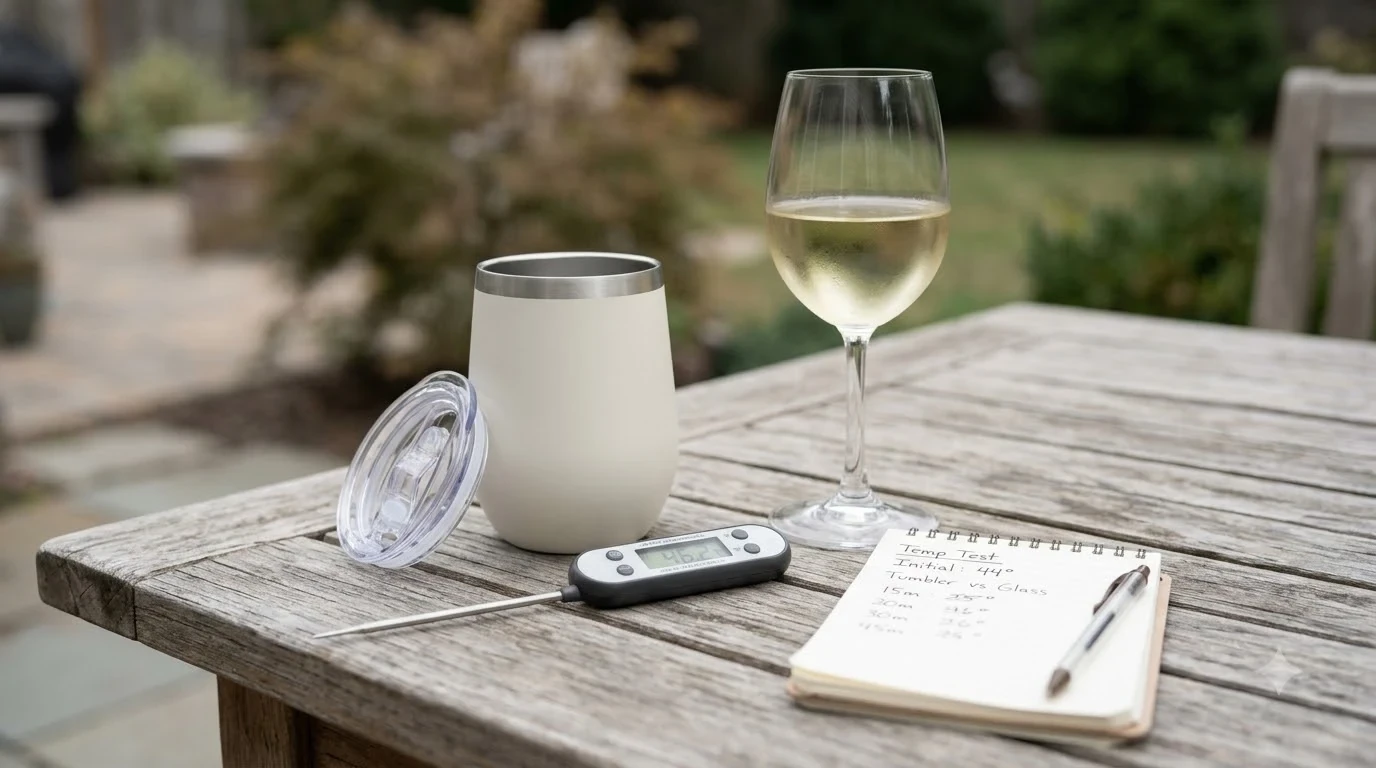
Temperature performance was respectable in that test, although it should be interpreted carefully. Good Housekeeping reported that ice water warmed by 13°F over 6 hours in its Corkcicle cup, a result it described as on par with many of the other products tested. That is a real measurement from one test setup, not a promise that red, white, and sparkling wine will all stay at a preferred serving temperature for six hours. It does support the broader case for insulation: the cup slows warming compared with an ordinary open glass.
Retailer comments show why buyers often choose the design. A SportChek purchaser praised the appearance and build quality and said beverages stayed hot or cold for hours. The same retailer page also contains complaints about the lid, so the positive comments are best read as evidence that owners appreciate the insulation and looks rather than proof of uniformly reliable spill control. For someone who wants a reusable cup for a backyard dinner, balcony, or campsite table, that combination of light weight, grip, and temperature retention is the product’s clearest draw.
Common Complaints
The main weakness is the lid: it is useful for slowing splashes and keeping debris out, but it is not a secure, bottle-style closure. A sliding drinking lid can be convenient while the cup stays upright; it is a different proposition from a leakproof cap that can safely travel inside a packed bag.
Good Housekeeping’s drop assessment illustrates the distinction. The Corkcicle cup resisted leaking through two drops, but its lid came off on the third; the stainless-steel body remained undamaged. In everyday use, that suggests the vessel itself can tolerate a knock, while the lid is the part most likely to limit rough handling. The clear slider is also a moving component that needs to be kept clean and correctly seated, rather than a threaded cap that locks down around the rim.
Owner feedback points in the same direction, although the available comments are a small sample rather than a representative survey. SportChek reviewers describe a lid that dripped or failed to seal reliably, with one buyer saying the cup began leaking after a short period of use. Another said the tumbler was attractive and kept drinks at temperature, but chose to use it without the lid. These comments do not establish that every unit will leak; they do make it sensible to regard the lid as splash control, not dependable leak protection.
Cleaning is the other qualification. As noted above, Corkcicle’s current Classic and Pure Taste listings say dishwasher safe, but Good Housekeeping’s tested version is marked hand-wash only. The difference matters because repeated heat and detergent exposure can affect finishes and plastic components on insulated drinkware. Use the instructions tied to the specific model rather than assuming that all Corkcicle stemless cups share the same care rules. Avoid forcing the slider or prying at its edges during routine cleaning.
Who Should Buy and Who Should Skip
The Corkcicle makes the most sense for a wine drinker who wants a reusable, insulated cup for a table, deck chair, picnic blanket, or campsite setup. Its 12-ounce capacity is large enough for a generous pour with a little headroom, and the insulated construction is more forgiving than thin glass in settings where a stem could be knocked over.
It is especially useful for chilled styles that are often served cool and can warm noticeably while sitting outside. Light whites and rosé are commonly served around 45–50°F, while fuller whites are often served around 50–55°F. Pouring wine at an appropriate temperature into an insulated cup can slow the warming process, although the six-hour cold claim should not be read as a precision temperature-control setting. The same logic can help with a lighter red served around 55–60°F; fuller reds are generally served warmer, around 60–65°F.
Think about how you intend to drink from it. A 5-ounce pour leaves room above the wine, but the cup’s straight-sided insulated form will not present the same aroma, bowl shape, or swirling room as a traditional wineglass. That is a meaningful trade-off for someone who spends time comparing Burgundy, Cabernet Sauvignon, or aromatic whites by nose. For casual sipping, the simpler vessel can be entirely adequate; for a formal tasting, a proper stemmed or stemless glass is a better tool. A separate wine tumbler with lid comparison can help clarify which lid style suits your routine, while a standard stemless wine tumbler may be the better choice if insulation is not essential.
Skip this model if your top requirement is a cup that can be tossed sideways into a tote, backpack, or car bag without leaking. It is also a weaker match for someone who wants a classic wineglass shape, a large bowl for swirling, or a clear view of the wine’s color. Buyers choosing a gift may prefer a wine tumbler personalized option, but should still prioritize a reliable lid and clear cleaning directions over decoration. For a wider look at drinkware and related options, browse our Accessory Brands section.
How It Compares to Alternatives
Corkcicle’s biggest competition is not one specific cup so much as a set of different priorities: insulation, spill resistance, weight, and stability. Good Housekeeping’s comparison names the RTIC Happy Hour Wine Tumbler, Contigo River North Stainless Steel Wine Tumbler, and Toadfish Non-Tipping 10-Ounce Wine Tumbler as alternatives, each relevant for a different reason.
For temperature retention, Good Housekeeping reported that the RTIC Happy Hour model performed better in its temperature-maintenance test than the triple-insulated Corkcicle, despite having double insulation. The publication also described RTIC as heavier than some competing cups. That makes RTIC worth comparing if keeping a cold drink cold is your highest priority and a little extra weight is acceptable. Corkcicle remains appealing if its tapered profile, flattened grip surfaces, and color range matter more than winning a single temperature test.
For spill resistance, the Contigo River North performed especially well in Good Housekeeping’s drop testing: the lid stayed in place, and the cup showed no leaks or dents in that assessment. The same review lists the Contigo as not dishwasher safe, so it does not remove every practical compromise. The Toadfish alternative is specifically named as a non-tipping 10-ounce wine tumbler, making it relevant for buyers whose main concern is a cup sliding or tipping on a table. Its smaller stated capacity is a clear difference from Corkcicle’s 12 ounces.
There is no universal winner across those priorities. Corkcicle balances portability, a comfortable shape, and good-enough insulation, but its lid is not the strongest reason to buy it. RTIC is worth a look for temperature retention, Contigo for the drop-tested lid performance reported by Good Housekeeping, and Toadfish for its non-tipping design. Before deciding, compare the actual capacity, lid mechanism, weight, and care instructions rather than relying on the number of insulation walls alone.
Frequently Asked Questions
These final details help with sizing, replacement parts, and choosing between the two Corkcicle versions. The standard cup holds 12 ounces, making capacity and lid compatibility useful details to understand before purchasing.
How many wine pours fit in the Corkcicle wine tumbler?
The listed capacity is 12 fluid ounces, or about 355 milliliters. Two standard 5-ounce pours total 10 ounces, leaving roughly 2 ounces of room below the rim. That is useful for sharing a serving, although filling it close to the top leaves less protection against splashes.
Does the Corkcicle wine tumbler include a warranty?
Corkcicle displays a one-year warranty on both its Classic Stemless and Pure Taste Stemless product listings. That is the advertised warranty period, not a description of every covered failure or the claim process. Review the warranty terms supplied at purchase and keep proof of purchase in case support requests it.
Can a standard Corkcicle tumbler lid replace the wine cup lid?
No. Corkcicle says its standard 12-ounce and 16-ounce tumbler lids, along with the larger standard lid sizes, are not compatible with the Stemless wine cup. The wine cup needs its own Stemless replacement lid, so check the product name before ordering a spare.
Can the Classic Stemless cup hold drinks other than wine?
Yes. Corkcicle describes the Classic Stemless as suitable for drinks of every kind, not wine alone. Its published hot-drink retention claim is up to 3 hours, which makes coffee, tea, or another warm drink within the stated use case.
What does the Pure Taste version add visually?
Along with its ceramic-coated interior, Corkcicle describes Pure Taste as having an exterior coating and a two-tone color palette. That makes it the more distinctive-looking option if coordinated color matters as much as the interior finish. The 12-ounce capacity and stated insulation times remain the same as Classic.
The Corkcicle wine tumbler is a sensible pick for casual wine service when insulation, grip, and a lightweight stemless shape matter more than a truly sealed lid. Choose between Classic and Pure Taste based on the interior finish and appearance, then confirm the care directions for the exact version you are buying.
More in Wine Accessories
 Zwilling Wine Stopper Review: Preserve Open Bottles LongerUpdated Nov 21, 2026
 Wine Enthusiast Wine Preserver Review: Features, Benefits and LimitationsUpdated Nov 21, 2026
 Wine Enthusiast Wine Stopper: An Easier Way to Reseal Open BottlesUpdated Nov 21, 2026
 Vintorio Wine Opener: Two-Step Cork RemovalUpdated Nov 21, 2026
 Zwilling Wine Aerator Review: Aerate, Pour, and Seal With One ToolUpdated Nov 21, 2026
 Zazzol Wine Opener Review: Features, Comfort, and Buying AdviceUpdated Nov 21, 2026