


We may earn a commission when you buy through links on this page, at no extra cost to you. Learn more.
The cokunst wine opener is a convenient electric corkscrew for people who want to remove traditional wine corks with minimal manual effort. COKUNST sells rechargeable Type-C and battery-operated versions, with features such as automatic extraction, a transparent housing, an LED indicator, and an included foil cutter. Its straightforward operation makes it appealing for home wine drinkers and casual entertaining, although buyers should distinguish between models before purchasing because their power requirements and specifications differ.
An electric wine opener can make opening a bottle easier, particularly during dinner parties, family gatherings, or evenings when several bottles need to be opened. Rather than twisting a traditional corkscrew by hand, an electric model uses a motorized spiral to grip and extract the cork. COKUNST offers several versions of this basic design, including a rechargeable KP3 and battery-operated KB1 models. Understanding those differences is essential because a rechargeable opener and a four-AA-battery opener have different charging, storage, and maintenance requirements. This review examines their features, practical advantages, limitations, and the situations in which another style of wine opener might make more sense.
Specs and Key Features
The COKUNST electric wine opener combines automatic cork extraction with a compact handheld design. Its most useful features are the powered corkscrew, separate extraction and release controls, and included foil cutter, although exact specifications depend on the model.
The rechargeable KP3 is particularly relevant for shoppers who prefer USB Type-C charging rather than disposable batteries. COKUNST describes its construction as stainless steel and ABS, with a black exterior, transparent viewing section, and blue LED indicator. The manufacturer also supplies a charging cable and foil cutter, so the basic accessories needed for opening a traditionally corked bottle are included.
The battery-operated KB1 family follows a similar operating concept but uses replaceable batteries. The KB1-602103 manual specifies four AA batteries, while the rechargeable KP3 manual describes an internal rechargeable power system. These are not interchangeable specifications. Buyers should identify the exact model before assuming that a particular charging cable, battery compartment, or accessory arrangement applies.
| Specification | Rechargeable KP3 | KB1-602103 |
|---|---|---|
| Power source | Internal rechargeable battery | 4 AA batteries |
| Charging connection | USB Type-C | Not applicable |
| Listed dimensions | 7.7 x 1.7 inches | 9.7 x 2 inches |
| Listed weight | 8 ounces | 272 grams |
| Exterior materials | ABS and stainless steel | ABS and stainless steel |
| Operating indicator | Blue LED | Model-specific indicator |
| Extraction time | Approximately 6–8 seconds | Approximately 6–8 seconds |
| Foil cutter | Included | Included |
These figures come from the respective product descriptions and instruction manuals. They should not be treated as specifications for every COKUNST opener. In particular, the KP3’s 7.7-inch length differs from the approximately 9.7-inch length listed for the KB1-602103. The difference matters if the opener will be stored in a narrow kitchen drawer or carried in a small travel bag.
Another important feature is the two-button operating arrangement. One control drives the corkscrew into the cork and pulls it upward. The other reverses the mechanism to release the extracted cork. This arrangement avoids the need to pull the cork manually out of the opener, making the process more convenient than some basic electric designs.
The transparent housing also has a practical purpose beyond appearance. It allows the user to see the corkscrew working and observe the cork as it moves through the extraction process. The blue indicator light provides a visible operating signal, particularly useful in a dimly lit dining area or home bar.
For additional information about the rechargeable version, the COKUNST rechargeable wine opener product description outlines its charging connection, accessories, and advertised operating features.
What Owners and Buyers May Like
The strongest appeal of the COKUNST design is convenience. Its motorized extraction process reduces the physical work involved in removing a cork, while its included foil cutter and straightforward controls make it suitable for everyday home use.
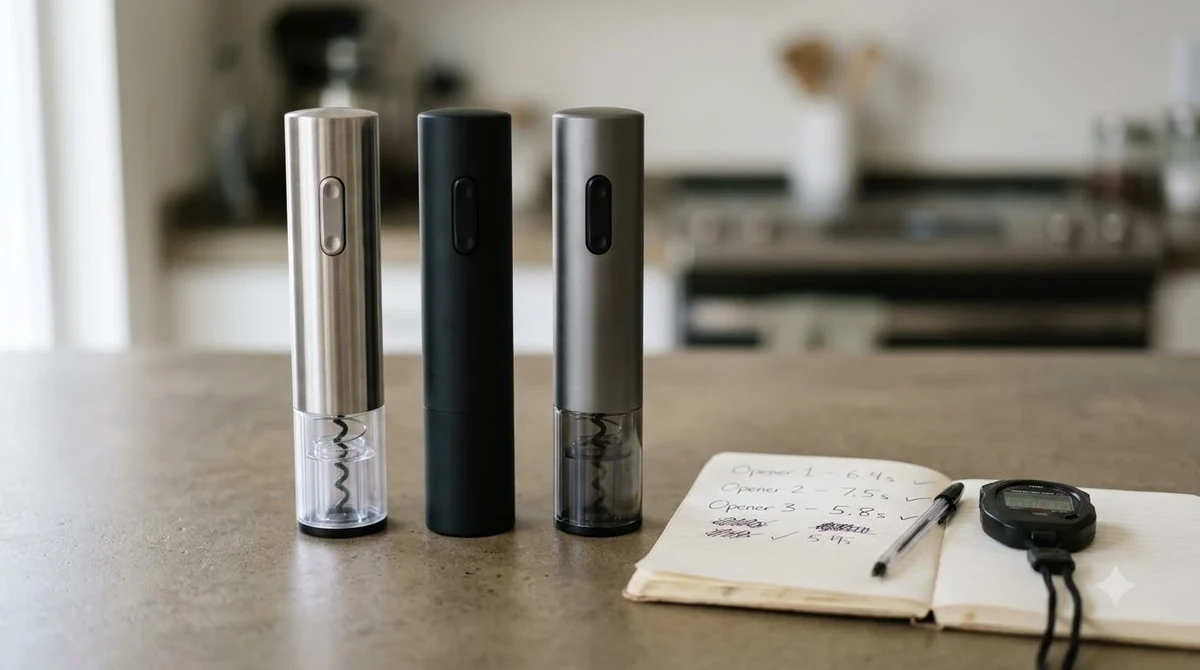
Simple operation is the primary advantage. A traditional corkscrew requires the user to position a spiral, twist it into the cork, and apply enough force to remove the cork without breaking it. An electric opener takes over most of that work. With the COKUNST design, the user positions the device over the bottle and activates the extraction button. The motor rotates the spiral and pulls the cork upward.
The process is especially appealing for anyone who regularly opens wine but does not enjoy using a manual corkscrew. It can also be helpful for people who find repeated twisting and pulling uncomfortable. Rather than requiring a coordinated combination of hand movements, the opener handles the main extraction action mechanically.
The foil cutter adds everyday convenience. Removing the foil capsule is an important preparation step before opening a traditional wine bottle. COKUNST includes a separate cutter with its electric openers, eliminating the need to purchase another accessory just to prepare the bottle. A dedicated cutter can also produce a cleaner opening than tearing the foil by hand.
The transparent body is another appealing design feature. Watching the cork rise through the housing gives the user a clear indication that the motor is operating. Combined with the LED light, this makes the extraction process easier to observe than with a completely enclosed mechanism.
The rechargeable KP3 reduces dependence on disposable batteries. Its Type-C connection offers a convenient charging arrangement for households that already use compatible USB charging equipment. The manufacturer describes a full charge as capable of opening more than 50 bottles, although actual performance depends on battery condition, cork resistance, and operating conditions.
For households that open wine regularly, recharging can be more convenient than keeping spare AA batteries available. The KP3 is also relatively compact according to its listed dimensions, making it easier to store alongside other wine accessories.
The battery-operated KB1 offers a different kind of convenience. Its four-AA-battery arrangement does not require a charging cable or a charging routine. Someone who stores an opener in a vacation property, guest room, or occasionally used entertaining space may prefer replaceable batteries because the device can be ready whenever fresh batteries are installed.
The overall design is also easy to understand. There is no complicated digital interface, temperature display, or collection of settings to learn. The extraction and release functions are handled through dedicated controls, which keeps the basic operation accessible to people who have never used an electric corkscrew before.
Finally, the included accessories make the opener a reasonable starting point for a small home wine setup. A foil cutter, corkscrew, and charging cable or battery compartment cover the basic opening requirements. A separate wine opener and preserver set may be more suitable for someone who also wants equipment for storing unfinished bottles, but COKUNST concentrates primarily on the opening task.
Common Complaints and Limitations
The main limitations to consider are model confusion, dependence on electrical power, compatibility with certain corks, and the need for careful positioning. An electric opener reduces manual work, but it does not eliminate the importance of using the correct technique.
Different models can create purchasing confusion. COKUNST sells both rechargeable and battery-powered products with similar appearances and overlapping descriptions. A shopper who expects a Type-C charging connection may accidentally select a KB1 version that requires four AA batteries. Conversely, someone who prefers replaceable batteries may purchase a rechargeable version that needs periodic charging.
This is more than a minor specification difference. It changes how the opener is prepared, maintained, and stored. Before ordering, confirm the model name, power source, included accessories, and product dimensions. Product photographs alone are not always sufficient to distinguish similar versions.
Power availability remains a limitation. The rechargeable KP3 needs sufficient battery charge to operate, while the KB1 needs working AA batteries. If either model loses power during a gathering, the automatic extraction function becomes unavailable until the power issue is resolved.
A manual corkscrew does not have this dependency. Keeping a basic backup opener in the kitchen is sensible for households that entertain frequently or prefer not to interrupt dinner when an electric accessory needs attention.
Cork compatibility deserves attention. The KB1-602103 instruction manual specifically advises against opening bottles with synthetic corks or champagne bottles. This is an important limitation for shoppers who regularly purchase sparkling wine or bottles sealed with alternative closures.
Traditional corkscrews are designed around a particular type of closure. A motorized spiral should not automatically be assumed to work with every stopper, regardless of the bottle’s shape or closure material. Sparkling wine also uses a different closure system and requires a different opening technique. An electric wine opener should not be used as a substitute for a proper sparkling-wine opening method.
Correct alignment is important. The instruction manuals recommend positioning the opener vertically, with its corkscrew centered above the cork. If the device is tilted or positioned off-center, the spiral may enter at an angle, increasing the chance of an unsuccessful extraction or a damaged cork.
Another limitation is the dependence on a motorized mechanism. A manual waiter’s corkscrew is mechanically simple and can be useful when an electric device becomes jammed or loses power. Electric components also require more care around liquids, cleaning products, and storage conditions.
Buyers should also approach advertised bottle-capacity claims realistically. COKUNST describes more than 50 openings per charge for the KP3, while other product descriptions mention different operating capacities for battery models. These are manufacturer claims rather than guaranteed results for every bottle and every battery condition.
Tip: Before a dinner party, charge the rechargeable KP3 or install fresh AA batteries in the appropriate KB1 model. Open one standard corked bottle beforehand if the opener is unfamiliar, and keep a manual corkscrew available as a backup.
There is also a practical durability consideration. A lightweight electric opener is convenient to handle, but it should not be treated like a heavy-duty bar appliance. Avoid dropping it, applying excessive sideways force, or attempting to force the mechanism through a cork that is not moving correctly.
Who Should Buy and Who Should Skip
The COKUNST electric wine opener makes the most sense for casual wine drinkers who value convenience and want a straightforward way to open traditionally corked bottles. It is less suitable for people who need a universal closure tool or prefer the simplicity of a manual corkscrew.
Who should consider buying it?
Regular home wine drinkers may appreciate the reduced effort involved in opening bottles. If a household opens wine several times a week, a motorized opener can make the routine more comfortable and predictable. The separate extraction and release controls also make it relatively easy to learn.
People who entertain at home may find the automatic mechanism useful when several bottles need to be opened during a dinner party. Rather than repeatedly twisting a manual corkscrew, the host can use the electric opener for standard still-wine bottles and spend more time serving guests.
People who prefer rechargeable accessories should look closely at the KP3. The Type-C connection removes the need to replace AA batteries regularly, and the compact listed dimensions make it a practical option for a kitchen drawer or home bar.
Occasional users who prefer replaceable batteries may find the KB1 more appropriate. It does not require a charging routine, although the user needs four suitable AA batteries. This arrangement can work well for a secondary home or a kitchen where the opener is used intermittently.
Gift shoppers may also consider the COKUNST design for someone who enjoys wine and appreciates practical kitchen accessories. The automatic operation, transparent exterior, and included foil cutter make it more distinctive than a basic manual corkscrew. However, confirming the recipient’s preference for rechargeable or battery-powered equipment is important before choosing a model.
Who should skip it?
People who frequently open sparkling wine should choose a suitable sparkling-wine tool and opening method instead. The KB1-602103 manual explicitly excludes champagne bottles, and the automatic extraction mechanism is intended for traditional still-wine closures.
Wine enthusiasts who regularly encounter synthetic corks should also examine compatibility carefully. A product description that broadly mentions wine bottles does not establish that every closure material is suitable. The specific KB1 manual cautions against synthetic corks, making a reliable manual alternative a better option for mixed bottle collections.
Professional wine servers who open large numbers of bottles throughout a working shift may prefer a durable, purpose-built professional corkscrew. A compact consumer electric opener is primarily a convenience accessory, not necessarily a replacement for equipment designed for continuous commercial service.
Travelers who want the lightest possible wine-opening tool may also prefer a small waiter’s corkscrew. It does not require batteries or charging equipment, occupies little space, and can be used independently of an electrical power supply.
Finally, people who enjoy the traditional process of opening wine may find the COKUNST unnecessary. A well-made manual corkscrew provides direct control over the extraction process without an electric motor or rechargeable battery.
How It Compares to Alternatives
The COKUNST electric wine opener occupies a middle ground between basic manual corkscrews and more elaborate wine accessory sets. Its main selling point is automatic extraction, while its rechargeable and battery-operated versions provide different approaches to power management.

A waiter’s corkscrew is the most straightforward alternative. This familiar tool uses a folding spiral and lever to extract the cork manually. It is compact, inexpensive to maintain, and does not depend on electricity. However, it requires more physical effort and some practice to use smoothly, especially with a tightly fitted cork.
A winged corkscrew is another common alternative. Its two side arms rise as the spiral enters the cork, and pushing the arms downward extracts the closure. This style provides mechanical leverage without needing batteries, making it suitable for many home kitchens. It is generally bulkier than a small waiter’s corkscrew, however, and requires a little more counter space during use.
An electric wine opener such as the COKUNST is more convenient for people who prefer a motorized extraction process. Its two-button design simplifies opening and releasing the cork, while the transparent housing lets the user observe the mechanism. Its disadvantage is that it needs a working power source and is less appropriate for certain closures.
| Opener type | Physical effort | Power required | Best use |
|---|---|---|---|
| COKUNST rechargeable | Low | Rechargeable battery | Regular home use |
| COKUNST battery-operated | Low | 4 AA batteries | Convenient occasional use |
| Waiter’s corkscrew | Moderate | None | Travel and traditional service |
| Winged corkscrew | Low to moderate | None | General household opening |
Another consideration is whether the opener is part of a larger wine accessory collection. Some COKUNST products are sold as sets that include a wine pourer, vacuum stopper, foil cutter, and storage base. These bundles serve a different purpose from the standalone KP3 or KB1 opener. Someone who already owns a stopper and wine aerator may have little reason to purchase duplicate accessories.
For a more complete entertaining area, a dedicated bar cart can provide organized storage for wine bottles, glassware, and opening accessories. The COKUNST opener can be stored alongside a foil cutter, stopper, and wine pourer, keeping the equipment together rather than scattered across kitchen drawers.
There is also a useful distinction between an opener designed for convenience and one designed for portability. The rechargeable KP3 avoids disposable batteries but needs charging. The battery-powered KB1 can operate with replacement batteries but requires the user to keep them available. A manual corkscrew avoids both requirements.
For most casual home users, the right choice depends on how often wine is opened and which closures are encountered most frequently. Someone who primarily drinks conventional still wines may find an electric opener useful. Someone who regularly opens bottles with synthetic closures, sparkling wine, or unusual bottle formats should prioritize compatibility and maintain a manual alternative.
Readers comparing other wine accessories can also browse our wine accessory brands and equipment coverage to understand which tools serve different home entertaining needs.
Frequently Asked Questions
Can the COKUNST wine opener be used on screw-cap bottles?
No. A screw-cap bottle does not have a cork that needs to be extracted, so an electric corkscrew is unnecessary. Simply twist the cap open by hand. Attempting to insert the electric spiral into a screw-cap closure is not an appropriate use of the appliance.
Can the COKUNST wine opener remove a cork that has broken inside the bottle neck?
A partially broken cork may not provide a stable surface for the motorized spiral to grip. Forcing the opener into a damaged cork can make the problem worse. A two-pronged cork puller or a suitable manual corkscrew is generally a more appropriate option for carefully removing a damaged closure.
Does the COKUNST wine opener preserve wine after the bottle is opened?
No. The standalone electric opener removes corks but does not provide a complete wine-preservation system. An opened bottle needs a separate closure to limit exposure to air. Sparkling wine also requires a stopper designed to retain carbonation rather than an ordinary corkscrew accessory.
Does the rechargeable COKUNST opener require a special Type-C charging adapter?
The KP3 manual describes charging through its Type-C connection using the supplied cable and a compatible USB power source. It identifies examples such as a computer USB port or a compatible wall adapter. The charging cable and connector should be checked before using replacement charging equipment.
Can the COKUNST opener be used by a left-handed person?
The basic extraction process uses buttons rather than a traditional twisting motion, so it does not depend on the same hand dominance as many manual corkscrews. However, the position of the controls and the shape of the housing may affect personal comfort. Holding the bottle securely and keeping the opener vertically aligned remain important regardless of which hand operates it.
The COKUNST wine opener is a practical electric corkscrew for households that want straightforward cork extraction without the repeated twisting required by manual tools. The rechargeable KP3 is the more suitable choice for shoppers who prefer Type-C charging, while the KB1 models suit people who would rather use replaceable AA batteries. Confirming the exact model and closure compatibility before buying will help ensure that the opener fits the household’s wine-drinking habits.
More in Wine Accessories
 Coravin Vs Vacu Vin: Choose the Right Wine Saver for Your BottlesUpdated Nov 21, 2026
 Zwilling Wine Stopper Review: Preserve Open Bottles LongerUpdated Nov 21, 2026
 Wine Enthusiast Wine Preserver Review: Features, Benefits and LimitationsUpdated Nov 21, 2026
 Wine Enthusiast Wine Stopper: An Easier Way to Reseal Open BottlesUpdated Nov 21, 2026
 Vintorio Wine Opener: Two-Step Cork RemovalUpdated Nov 21, 2026
 Zwilling Wine Aerator Review: Aerate, Pour, and Seal With One ToolUpdated Nov 21, 2026