


We may earn a commission when you buy through links on this page, at no extra cost to you. Learn more.
If your brookstone wine opener not working is the problem, start by checking its battery, charging connections, and corkscrew alignment before assuming the motor has failed. Most rechargeable Brookstone electric wine openers require approximately 6 to 8 hours to charge, and their charging indicator should illuminate when the unit is correctly seated on its base. A stuck cork, loose charging connection, or incorrect operating position can also interrupt normal operation. The right troubleshooting method depends on which Brookstone model you own.
A Brookstone electric wine opener can make opening a bottle considerably easier, but a rechargeable mechanism introduces a few potential problems that a traditional corkscrew does not have. The battery can lose its charge, the charging contacts can fail to connect, and cork fragments can interfere with the internal spiral. Even a slight operating angle can prevent some models from extracting a cork correctly.
This review-style troubleshooting guide explains the most common faults, what the manufacturer’s instructions recommend, and when replacing the opener makes more sense than attempting another repair. It also distinguishes between rechargeable Brookstone models and battery-powered versions, since their power systems and troubleshooting procedures are different.
Specs and Key Features of Brookstone Electric Wine Openers
Brookstone has sold several electric wine opener designs, so charging requirements and battery capacity are not identical across the product range. The rechargeable 606368 and APERTO models illustrate why identifying the model before troubleshooting is important.
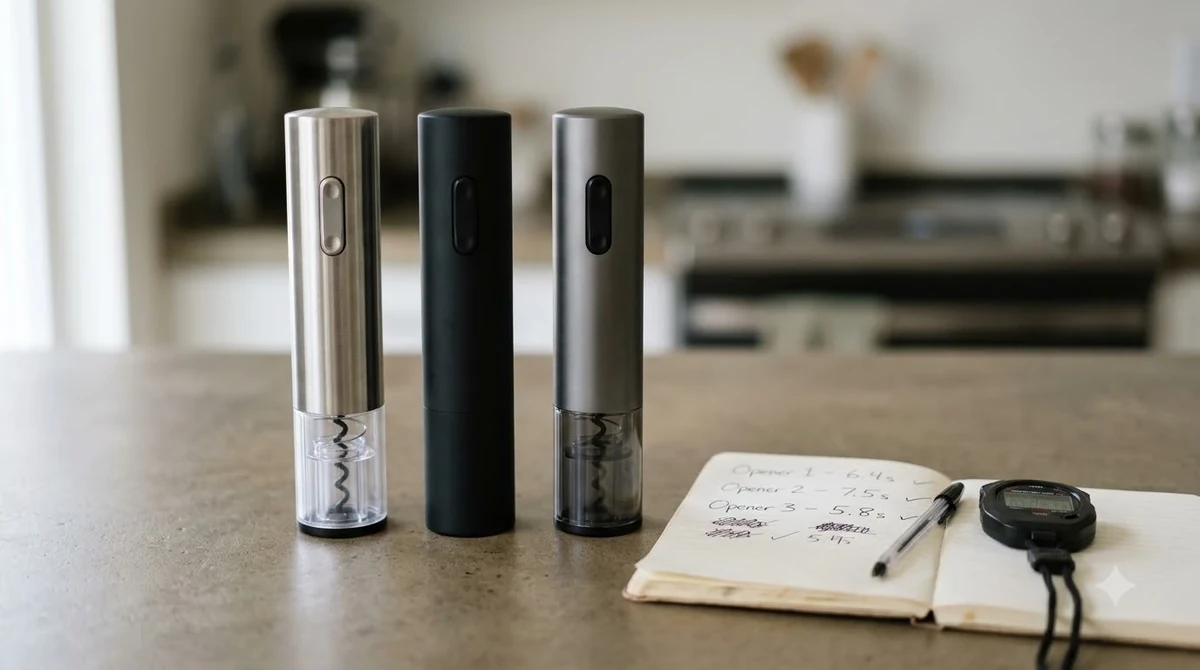
The 606368 Automatic Wine Opener uses a charging base and a two-direction switch. Its manual specifies a charging period of approximately 6 to 8 hours and a full-charge capacity of around 30 bottles. The APERTO has a different battery specification and is rated for approximately 60 bottles per charge. These figures are manufacturer specifications, not guaranteed results for an older unit with a deteriorating battery.
| Feature | Automatic Wine Opener 606368 | APERTO 314715 |
|---|---|---|
| Power system | Rechargeable battery | 3.6 V, 700 mAh NiMH |
| Charging time | Approximately 6–8 hours | Approximately 8 hours |
| Rated bottle capacity | Approximately 30 bottles | Approximately 60 bottles |
| Charging equipment | Charging base and adapter | Charging base and adapter |
| Operating controls | Upper and lower switch positions | Automatic sensing and cork-release mechanism |
| Foil removal | Separate foil cutter on charging base | Removable foil cutter |
| Additional setup | Normal charging and operation | Initial activation using supplied reset tool |
The specifications matter because an opener that takes 8 hours to charge should not be judged defective after a short charging session. Similarly, a unit rated for 30 bottles per charge should not be expected to match the capacity of another model rated for 60. Age, storage conditions, charging habits, and battery condition can also reduce actual performance.
For the 606368 model, the lower switch position turns the corkscrew clockwise to extract the cork. The upper position reverses the spiral to release it. The APERTO instead uses an automatic sensing arrangement that releases the cork when the opener is flipped over. Confusing these operating systems can make a perfectly functional opener appear defective.
For exact component identification, the Brookstone Automatic Wine Opener operating manual provides the relevant controls, charging instructions, specifications, and troubleshooting procedures.
What Owners Appreciate About the Brookstone Design
Brookstone electric wine openers offer straightforward powered cork extraction, compact countertop storage, and dedicated mechanisms for removing and releasing corks. Their appeal is particularly clear for people who regularly open traditional cork-finished bottles and prefer not to operate a manual corkscrew.
The first useful feature is the two-direction mechanism found on several rechargeable models. Instead of pulling a cork out manually, the user positions the opener over the bottle and activates the extraction control. The spiral enters the cork clockwise and gradually pulls it upward. A separate reverse operation then releases the cork from the mechanism.
This arrangement reduces the amount of physical effort required to remove a cork. It can also make the process more consistent when the opener is positioned vertically and the bottle is held securely. The automatic stopping action helps indicate when extraction is complete, so the user does not need to estimate how far the spiral should travel.
The second advantage is the charging base. Rather than requiring a fresh set of batteries for every period of use, the rechargeable models can return to their dedicated base after opening a bottle. The base also gives the opener a designated storage position, making it easier to keep the appliance and its accessories together.
The APERTO has another useful design feature: its automatic cork-release operation. According to its manual, an internal switch activates the release mechanism when the opener is turned upside down. A slight clicking sound during this movement can therefore be normal rather than evidence of a broken component.
The foil cutter is another practical accessory. Removing the capsule before extraction allows the corkscrew to engage the cork without interference from the foil covering. A dedicated cutter is particularly useful when opening several bottles for a dinner gathering or tasting event.
However, these advantages depend on having a working battery, properly aligned charging contacts, and an unobstructed corkscrew. An electric opener is not maintenance-free, and its convenience decreases considerably when the battery stops accepting a charge.
Common Complaints and Why the Opener Stops Working
The most common problems involve charging, interrupted cork extraction, trapped cork pieces, and incorrect positioning. These symptoms can look similar from the outside, but they usually require different solutions.
1. The charging light does not illuminate
This is one of the first symptoms to investigate when an opener will not operate. Brookstone’s rechargeable models rely on electrical contact between the opener and its charging base. If the unit is not fully seated, the charging circuit may not engage.
Check that the adapter is firmly connected to the charging base and that the other end is plugged into a working electrical outlet. Then reposition the opener so that its charging contacts meet the corresponding connectors on the base. The LED should illuminate during charging on models whose manuals specify this indicator.
If the light remains off, test the outlet with another appliance and inspect the adapter cable for visible damage. A damaged cable, defective adapter, or failed charging base can prevent charging even if the opener itself is still functional.
2. The opener charges but stops working quickly
A charging indicator does not necessarily prove that the battery can still retain its original capacity. Rechargeable batteries gradually lose performance through repeated use and aging. An older opener may appear to charge normally but stop halfway through removing a cork.
Give the unit the full charging period specified for its model. The 606368 requires approximately 6 to 8 hours, while the APERTO specifies approximately 8 hours. If the opener repeatedly stops after a complete charging session, battery deterioration or a charging-system fault becomes more likely.
3. The corkscrew spins without extracting the cork
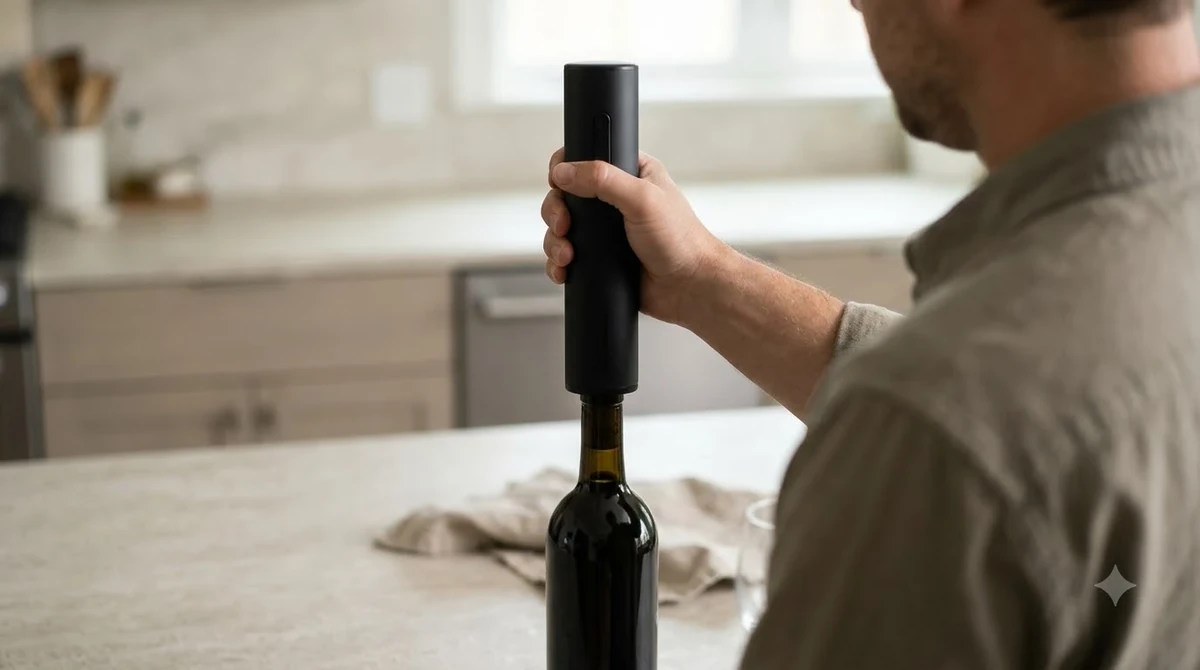
Incorrect positioning is a common explanation for poor extraction. Brookstone instructs users to keep the opener as upright as possible over the bottle. If the unit tilts, the spiral can enter the cork at an angle and fail to remove it properly.
Another possibility is that the corkscrew has not engaged the cork sufficiently. Remove the foil completely, center the opener over the cork, and hold the bottle firmly. Do not push excessively or try to force the motor to operate faster than its intended speed.
4. The cork is stuck inside the opener
Sometimes the opener successfully extracts the cork but cannot release it afterward. This can happen if cork fragments remain around the spiral or if the reverse mechanism is not operating correctly.
On models with a dedicated upper release button, the manufacturer recommends activating that control to reverse the spiral and dislodge trapped cork pieces. The APERTO has a different release mechanism, so its automatic reversal and reset instructions should be followed instead.
5. The controls do not respond
Unresponsive controls can indicate insufficient battery power, an obstructed mechanism, or an electrical fault. Before assuming that a switch has failed, make sure the unit has completed a full charging session and that the corkscrew is not trapped in a previous operating cycle.
If a switch appears physically damaged, feels unusually loose, or activates unpredictably, stop using the appliance. Brookstone’s safety instructions specifically warn against operating the opener when its switch is not functioning correctly.
How to Troubleshoot a Brookstone Wine Opener Step by Step
A systematic check is more useful than repeatedly pressing the buttons or placing the opener on its charging base. Work through the following steps in order, starting with the simplest causes and moving toward possible internal faults.
-
Identify the model.
Look for the model number on the product label, packaging, or original instruction booklet. Determine whether your unit uses a rechargeable charging base, the APERTO automatic sensing mechanism, or replaceable AA batteries. Do not apply one model’s reset or charging procedure to another model.
-
Inspect the power equipment.
Examine the adapter, charging cable, and base for visible damage. Confirm that the adapter is connected securely and that the electrical outlet works. Do not use a frayed cable or a charging accessory that appears damaged.
-
Check the charging contacts.
Position the opener firmly on its charging base. Make sure the charging connectors are properly aligned and that the unit is not sitting at an angle. Look for the charging LED. If the light does not illuminate, the charging connection has not been confirmed.
-
Complete the required charging session.
Allow approximately 6 to 8 hours for the 606368 model or approximately 8 hours for the APERTO. These are different model specifications. Avoid repeatedly interrupting charging to test the motor before the full period has elapsed.
-
Remove the bottle foil.
Use the supplied foil cutter to remove the capsule around the bottle opening. The cork should be fully accessible before operating the opener. Keep loose foil away from the corkscrew mechanism.
-
Position the opener correctly.
Place the unit directly over the cork and keep it vertical. Hold the bottle firmly with one hand and the opener with the other. Activate the appropriate extraction control according to the model instructions.
-
Clear an interrupted extraction safely.
If the battery runs out while the spiral is inside the cork, do not pull or force the opener away. Rotate the unit counterclockwise to back the corkscrew out of the cork, following Brookstone’s instructions for the applicable model. Recharge before trying again.
-
Investigate a stuck cork-release mechanism.
Use the designated reverse control on models that have one. For the APERTO, consult the reset instructions and use its supplied reset tool if appropriate. Never insert fingers or improvised metal objects into the corkscrew opening.
Tip: The charging LED is an especially useful diagnostic clue. If it does not illuminate when a rechargeable Brookstone opener is correctly positioned on its base, investigate the adapter, outlet, and charging contacts before blaming the motor. Never force the corkscrew or disassemble the appliance to investigate a charging problem.
Once these checks are complete, try opening a bottle with a conventional cork while keeping the opener upright. If the mechanism still fails despite a confirmed full charge and correct positioning, the problem may involve the internal battery, motor, switch, or control circuitry.
Who Should Buy and Who Should Skip a Brookstone Electric Wine Opener
A Brookstone electric wine opener makes the most sense for someone who values convenient cork removal and has a suitable place to store and recharge the appliance. It is less attractive for buyers who prefer simple mechanical equipment or do not want to depend on an aging rechargeable battery.
Who should consider keeping or buying one?
People who open wine regularly can appreciate the powered extraction mechanism. The two-button design on rechargeable models provides a simple sequence: extract the cork with the lower control and release it with the upper control. This is practical for home entertaining, family dinners, and occasions when several traditionally cork-finished bottles are opened.
People who already own a functioning charging base and adapter also have a reason to keep their existing opener. If the problem is simply poor contact between the unit and the base, restoring the connection may be considerably easier than replacing the appliance.
The design can also suit people who prefer a countertop accessory that combines charging and storage. A dedicated base keeps the opener accessible alongside other wine accessories rather than requiring a separate drawer for every component.
Who should skip it?
Buyers who frequently travel or open wine outdoors may prefer a manual corkscrew. A rechargeable Brookstone opener requires access to its compatible charging equipment, while a manual opener does not depend on a battery or electrical connection.
People who want minimal maintenance may also prefer a traditional corkscrew. A mechanical opener has fewer electrical components and does not require charging-contact troubleshooting or battery-capacity monitoring.
Another reason to skip an older electric unit is the possibility of limited replacement-part availability. If the motor, battery, charging base, or proprietary adapter has failed, repairing the appliance may be impractical. A unit with repeated charging failures and an unreliable operating switch is not a good candidate for continued use.
How Brookstone Compares to Alternative Wine Openers
Brookstone’s electric designs are only one way to open a traditionally cork-finished bottle. Manual corkscrews, lever openers, and rechargeable opener-and-preserver combinations offer different advantages depending on storage space, frequency of use, and maintenance preferences.
Manual corkscrew
A traditional corkscrew is the simplest alternative. It does not require charging, an adapter, or an internal motor. Its main limitation is that the user must supply the force needed to extract the cork.
A compact manual model is particularly useful as a backup when an electric opener runs out of power. A wine bottle opener keychain can also provide a small, portable manual option for occasional use, although it generally requires more effort than a full-size opener.
Lever-style opener
A lever corkscrew uses mechanical leverage to reduce the effort involved in removing a cork. It is a practical choice for someone who wants a more assisted opening process without depending on a rechargeable motor.
Its larger structure may require more storage space than a compact electric opener, but the lack of a charging base can be an advantage for users who prefer fewer accessories on the countertop.
Electric opener and preserver combination
A combined opener-and-preserver set provides two related wine accessories in one package. The opener handles cork extraction, while the preserver is designed to help close an opened bottle between servings.
For someone building a coordinated home wine setup, a wine opener and preserver set may be more useful than purchasing an opener alone. However, the preserver does not solve a failed battery or damaged extraction motor.
Choosing a replacement
Before replacing a Brookstone unit, compare its power system, charging requirements, control layout, and storage footprint with the alternatives. Also consider whether the replacement includes a dedicated charging base and whether its operating instructions are available.
A well-organized bar cart can accommodate an electric opener, manual backup, foil cutter, and bottle-preserving accessories together. If you are comparing other accessory manufacturers, the Accessory Brands category provides another starting point for evaluating wine-related equipment.
The most sensible replacement is not necessarily the most complicated one. A simple manual opener may be more dependable for occasional use, while an electric model can remain attractive for frequent bottle opening.
Frequently Asked Questions
Can a Brookstone wine opener work with synthetic corks?
Some Brookstone electric opener instructions describe compatibility with both natural and synthetic corks. Synthetic corks can behave differently because they do not expand like traditional natural cork. If one remains attached to the spiral, use the normal reverse-release procedure rather than pulling it out by force.
Why does my Brookstone APERTO make a clicking sound?
The APERTO manual explains that an internal switch activates the cork-release mechanism when the opener is turned upside down. A slight click can therefore be part of normal operation. A repeated grinding noise or a mechanism that remains activated unexpectedly is a different symptom and warrants stopping use.
Does the Brookstone APERTO need resetting before its first use?
Yes. Its instructions specify an initial activation procedure using the supplied reset tool. Remove the foil cutter, insert the tool into the designated reset hole, allow the corkscrew to activate briefly, and replace the foil cutter. This initial activation requirement is specific to the APERTO design.
Can I leave my Brookstone wine opener plugged in indefinitely?
Follow the charging and storage instructions supplied with the particular model rather than assuming every Brookstone charging base has identical charging behavior. The APERTO manual describes an indicator that turns off when charging is complete. Keep the appliance away from moisture and unplug its adapter during extended periods when it is not being used.
Can I replace the rechargeable battery inside a Brookstone wine opener?
Battery specifications and internal construction vary between models. The APERTO manual identifies a 3.6 V, 700 mAh nickel-metal hydride battery and includes battery disposal guidance, but it does not establish a general user-replacement procedure. Do not open the housing or attempt an improvised battery replacement because the manufacturer warns against disassembly and identifies no user-serviceable internal parts.
A Brookstone wine opener that stops working does not necessarily need immediate replacement. Start with the model-specific charging requirements, inspect the electrical connections, and check for a stuck cork or incorrect operating position. If a fully charged unit still has an unreliable motor, battery, or switch, replacement is generally more sensible than attempting an unauthorized internal repair. Keeping a manual corkscrew nearby also ensures that a charging problem never prevents you from opening your next bottle.
More in Wine Accessories
 Coravin Vs Vacu Vin: Choose the Right Wine Saver for Your BottlesUpdated Nov 21, 2026
 Zwilling Wine Stopper Review: Preserve Open Bottles LongerUpdated Nov 21, 2026
 Wine Enthusiast Wine Preserver Review: Features, Benefits and LimitationsUpdated Nov 21, 2026
 Wine Enthusiast Wine Stopper: An Easier Way to Reseal Open BottlesUpdated Nov 21, 2026
 Vintorio Wine Opener: Two-Step Cork RemovalUpdated Nov 21, 2026
 Zwilling Wine Aerator Review: Aerate, Pour, and Seal With One ToolUpdated Nov 21, 2026