


We may earn a commission when you buy through links on this page, at no extra cost to you. Learn more.
Brookstone wine opener instructions depend on the model, but most rechargeable automatic versions require charging the unit, removing the bottle foil, holding the opener upright, and pressing the lower button to extract the cork. The upper button reverses the corkscrew and releases the removed cork on models with separate controls. Some Brookstone openers use a manual lever instead, so identifying your model before operating it is essential. The instructions below explain the main electric and manual designs, charging procedures, common problems, and proper maintenance.
A Brookstone wine opener can make opening a bottle considerably easier, particularly when several bottles are being served during dinner or a gathering. However, the brand has sold different opener designs, and their controls, charging arrangements, and operating procedures are not interchangeable. Understanding which version you own helps prevent unnecessary force, incomplete cork extraction, and avoidable battery problems. This review focuses on the documented operating characteristics of Brookstone automatic and manual openers, with practical guidance for choosing and maintaining the right accessory.
Specs and Key Features
Brookstone wine openers fall into two main categories: rechargeable automatic models and manual lever-operated designs. The electric versions use a motorized corkscrew, while the manual Compact Wine Opener uses a handle and arm to extract corks through mechanical leverage.
The exact specifications depend on the model. For example, Brookstone’s 606368 Automatic Wine Opener has a charging time of approximately 6–8 hours and an estimated capacity of 30 bottles per full charge. The separate 902256 model specifies approximately six hours of charging and an estimated 50 openings. These figures should not be treated as interchangeable specifications for every Brookstone opener.
| Model or feature | Documented specification |
|---|---|
| 606368 automatic opener | Approximately 6–8 hours charging |
| 606368 battery capacity | Approximately 30 bottles per charge |
| 902256 automatic opener | Approximately 6 hours charging |
| 902256 battery capacity | Approximately 50 bottles per charge |
| 324366 Compact Wine Opener | Manual lever operation |
| 324366 dimensions | Approximately 3.1 x 2.1 x 11.72 inches |
| 324366 weight | Approximately 1.29 pounds |
| 606368 warranty | One-year limited warranty |
One useful feature of the automatic versions is their relatively straightforward two-direction operation. The lower switch or button generally controls extraction, while the upper control reverses the spiral to release the cork. The mechanism does most of the physical work, leaving the user responsible for keeping the opener correctly positioned and holding the bottle securely.
Foil removal is another practical consideration. Depending on the model, the foil cutter may be attached to the charging base or integrated into the main opener. The 606368 model has a foil cutter on the back of its charging base, whereas the 902256 design uses a separate foil-cutting accessory.
The manual Compact Wine Opener is a different proposition. Its lever, handle, shaft, and cutting wheels provide mechanical control without the need to charge a battery. This distinction matters when identifying replacement parts, finding instructions, or deciding whether a particular Brookstone accessory suits your kitchen.
What Owners Like About the Brookstone Design
The main appeal of Brookstone’s automatic wine opener is the reduced physical effort required to remove a cork. Its motorized mechanism handles insertion and extraction, while a separate reverse operation releases the cork from the spiral.
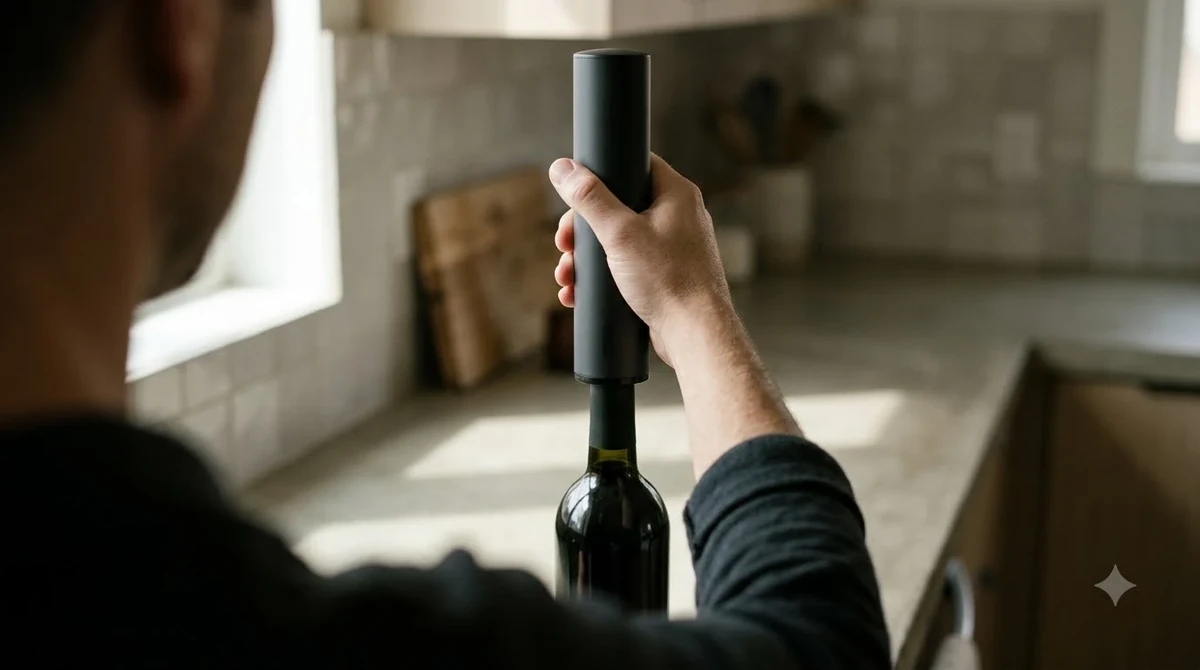
This arrangement can be particularly useful for people who open several bottles in one sitting. Instead of repeatedly twisting a traditional corkscrew, the user positions the device over the bottle and activates the motor. The electric mechanism performs the extraction at its intended speed, without requiring the user to manually rotate a handle through several turns.
The charging base also provides a convenient place to keep the opener between uses. The 606368 model uses its base both as a charging station and as a storage location, with a separate foil cutter attached to the back. Keeping the accessories together makes it easier to prepare a bottle without searching through kitchen drawers for individual tools.
Another practical advantage is the reverse-button arrangement. Removing a cork from the opener can be awkward with a conventional spiral corkscrew, especially when the cork is tightly fitted. Brookstone’s electric models use reverse rotation to move the cork off the spiral after extraction. This makes the complete opening process more straightforward.
The upright operating position is also a useful design consideration. When the opener is correctly centered on the bottle, the spiral can enter the cork more consistently. The instruction to hold the device upright is repeated in Brookstone’s automatic opener documentation, indicating that positioning is an important part of its intended operation.
Manual versions have their own advantages. The Compact Wine Opener does not depend on battery capacity or a charging station. Its lever mechanism offers a direct mechanical alternative, and its replaceable corkscrew design provides an additional maintenance option documented in Brookstone’s instructions.
For people assembling a home wine-serving area, an automatic opener can fit naturally alongside a decanter, wine glasses, and preservation accessories. A dedicated bar cart can provide a practical location for the charging base and other frequently used serving equipment.
Nevertheless, convenience should be considered alongside maintenance and model identification. An automatic opener is useful only when its battery is charged and its charging connections work correctly. A manual model avoids that particular dependency but requires more physical participation during extraction.
Common Complaints and Troubleshooting
The most important problems to understand are incomplete charging, interrupted cork extraction, incorrect positioning, and cork fragments inside the mechanism. Brookstone’s documented troubleshooting instructions address these situations, although the precise controls can differ between versions.
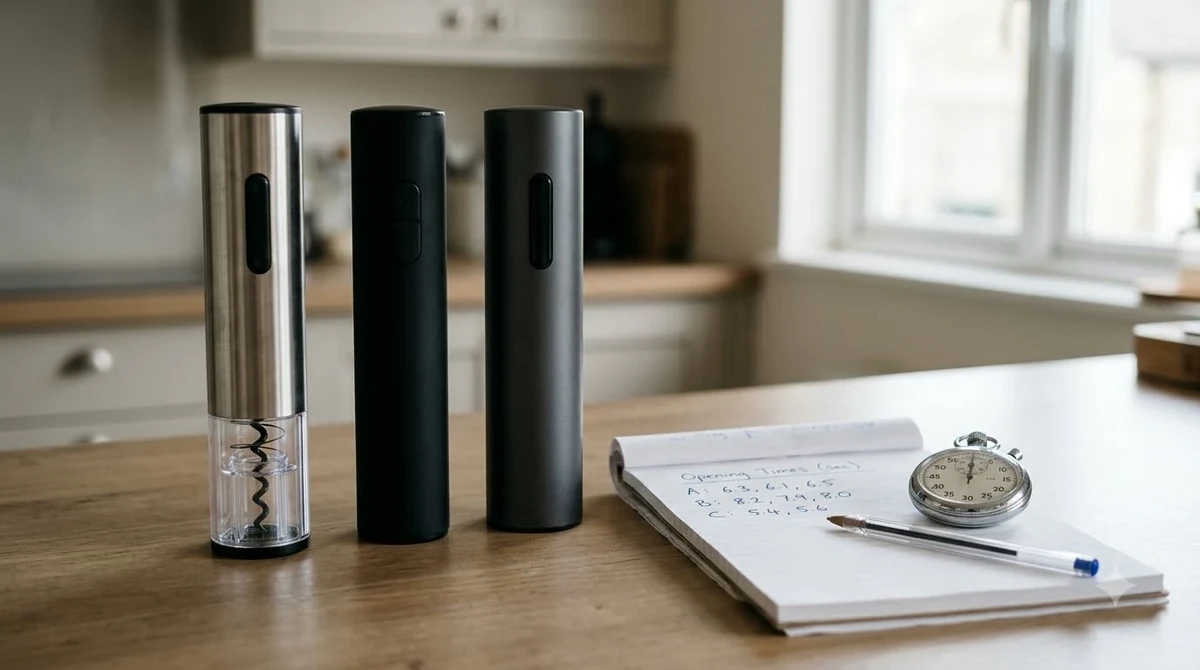
Problem: The opener does not charge. Start by checking whether the charging LED illuminates when the unit is placed on its base. On the 606368 model, Brookstone explicitly identifies the illuminated LED as confirmation that the charging connection is engaged. If the light does not come on, reposition the opener so its charging contacts meet the connectors on the base.
Next, confirm that the adapter is connected to the correct input on the charging base and that the power outlet is working. Remove the opener, check that it sits properly in the base, and position it again. Do not assume that the battery is charging simply because the opener appears to be resting on the station.
Problem: The opener stops halfway through removing a cork. This can happen when the battery becomes depleted during extraction. Brookstone specifically warns against forcing the cork out of the bottle. Instead, rotate the opener counterclockwise to back the corkscrew out of the cork, then return the unit to its charging base.
Problem: Cork pieces remain inside the opener. The automatic opener manual recommends using the switch to dislodge trapped cork fragments. On a model with separate upper and lower buttons, the upper button is the release control. Keep your hands away from the exposed spiral while the mechanism operates.
Problem: The cork does not come out cleanly. Check the opener’s alignment before trying again. Brookstone instructs users to keep the automatic unit upright because even a slight angle can interfere with proper cork extraction. Hold the bottle and opener firmly, and allow the motor to complete its operation without pushing or twisting aggressively.
Tip: If your Brookstone electric opener stops with the cork still in the bottle, do not pull the device upward or force the cork out. Follow the model’s counterclockwise withdrawal procedure, recharge the unit, and resume only after the mechanism is ready.
Problem: The cork remains attached to the spiral. Make sure you are using the release control rather than the extraction control. The extraction mechanism turns clockwise to remove the cork from the bottle, while the reverse operation turns counterclockwise to release it. Pressing the wrong control can make the process confusing, particularly if the buttons are not clearly labeled.
Repeated failures deserve closer attention. If the charging indicator works but the motor cannot turn the corkscrew, inspect the exterior for visible damage and consult the instructions for that particular model. Brookstone’s electric opener documentation warns against disassembling the motor housing or attempting internal repairs because the unit does not contain user-serviceable internal parts.
For additional troubleshooting details, the official Brookstone 606368 automatic wine opener manual explains charging indicators, cork extraction, safety precautions, and battery-related interruptions.
Who Should Buy and Who Should Skip
A Brookstone automatic wine opener makes the most sense for people who value convenience and regularly open traditionally cork-finished bottles. Its motorized extraction and reverse-release functions reduce the amount of manual work involved in serving wine.
It is especially suitable for a household that keeps wine accessories in one place and can return the opener to its charging base after use. The 606368 model’s estimated 30 openings per full charge may be sufficient for many household routines, while the documented 902256 specification of approximately 50 openings provides a different capacity benchmark. These estimates are model-specific rather than universal promises.
People who entertain frequently may also appreciate the speed of a motorized mechanism. When several guests are waiting for a bottle of Cabernet Sauvignon, Pinot Noir, or Chardonnay, an automatic opener avoids repeated manual twisting. Its charging arrangement can also reduce countertop clutter compared with keeping several separate opening tools around.
However, a rechargeable opener may not be the right choice for every wine drinker. Anyone who regularly forgets to charge small appliances may prefer a manual corkscrew. The automatic mechanism also requires a compatible charging base and adapter, which can be inconvenient if either component is lost or damaged.
The Compact Wine Opener is worth considering for someone who prefers mechanical operation. Its lever system does not require a charging cycle, and the documented 324366 design includes a built-in foil cutter with two cutting wheels. Its approximate weight of 1.29 pounds is another consideration for people who want a substantial handheld tool rather than a small electric cylinder.
There are also situations where neither design is particularly suitable. A restaurant or busy commercial wine service may need equipment specifically designed for frequent professional use, with readily available replacement components and an established service arrangement. The consumer-oriented Brookstone instructions do not establish commercial-duty performance.
For occasional wine drinkers, a conventional waiter’s corkscrew may be a more economical and compact choice. It does not require an electrical connection or dedicated storage station. A wine bottle opener keychain can serve as a portable backup, although a small accessory should not be confused with a full-size electric opener.
The right decision depends on opening frequency, physical preferences, available storage space, and willingness to maintain a rechargeable appliance. The convenience of automation is valuable, but it is not essential for every household.
How It Compares to Alternatives
Brookstone’s automatic opener is best understood as a convenience-oriented electric accessory rather than a replacement for every type of wine tool. Its closest practical alternatives include manual lever corkscrews, traditional waiter’s corkscrews, and rechargeable openers from other manufacturers.
Compared with a manual waiter’s corkscrew, the Brookstone automatic design requires less repeated hand movement. The motor inserts and extracts the cork, and the reverse control releases it. A traditional corkscrew, by contrast, depends on the user inserting the spiral and applying leverage through a handle.
A manual lever opener offers a different balance. The Brookstone Compact Wine Opener uses a handle and arm to provide mechanical assistance. It does not need charging, but the user must raise and lower the arm correctly and secure the bottle neck in the shaft.
The electric design is therefore more convenient for someone who wants button-operated extraction, while the manual design is more appropriate for someone who wants to avoid battery maintenance. Neither is automatically better in every situation.
It is also useful to compare the opener with a wine preservation accessory. An opener removes the cork, but it does not independently preserve the remaining wine. A wine opener and preserver set combines opening and storage-related tools, making it a practical alternative for households that frequently save unfinished bottles.
For a broader selection of serving equipment and related accessories, the Accessory Brands collection can help readers explore different types of wine tools rather than limiting their decision to one opener design.
When comparing alternatives, consider the complete ownership experience. A cordless electric opener depends on battery condition, charging contacts, and its supplied adapter. A manual model avoids those electrical components but requires more user involvement. A traditional corkscrew is usually simpler to store and carry, although it may require greater hand strength or technique.
Replacement-part availability is another meaningful consideration. Brookstone’s Compact Wine Opener documentation describes a replacement corkscrew and gives a customer-care contact for obtaining one. That is a useful distinction when comparing a model with a fixed mechanism or a design for which replacement parts are difficult to identify.
Before buying an older or previously owned Brookstone opener, inspect the charging base, adapter, switch, corkscrew, and foil cutter. A complete accessory set is generally more useful than an electric unit without the equipment required to charge it. For manual models, check that the lever moves correctly and that the corkscrew is not bent or damaged.
The Brookstone 902256 quick-start manual provides another useful comparison, documenting a separate two-button arrangement, approximately six-hour charging time, and an estimated 50 openings per charge.
Care, Maintenance, and Storage
Proper maintenance helps preserve the opener’s mechanical parts and charging connections. Brookstone recommends wiping the Compact Wine Opener with a damp cloth and specifically warns against submerging it in water. The same cautious approach is appropriate for electric models because their housings contain electrical components.
After opening a bottle, remove any visible cork fragments from the exterior and clean the housing with a slightly damp cloth. Avoid pouring water into the corkscrew opening, around the buttons, or into the charging contacts. Never immerse the electric opener or its charging base in a sink.
Keep the corkscrew clean and free of sticky wine residue. If small pieces of cork remain in the mechanism, follow the release instructions for the specific model rather than inserting knives, forks, or other sharp objects into the housing. Brookstone’s documentation specifically cautions users against touching or adjusting the exposed corkscrew mechanism during operation.
For rechargeable models, return the opener to its charging base after use if the supplied instructions recommend doing so. The 606368 manual describes this as a way to keep the unit charged and protected while it is not being used. Make sure the LED indicates that the charging contacts are properly engaged.
Storage conditions also matter. Keep the charging base and adapter on a dry indoor surface, away from sinks, direct heat, and areas where liquid may spill. Avoid placing heavy objects on the power cable or bending it sharply around the base.
Before storing the opener for an extended period, inspect the charging equipment and ensure that the device is clean and dry. Keep the foil cutter with its corresponding opener, and store the components somewhere they cannot fall or become damaged. For manual models, retract or position the lever according to its instructions and keep the cutting wheels protected from accidental contact.
Finally, retain the original model information and purchase documentation. Brookstone’s documented 606368 warranty specifies one year of limited coverage for qualifying defects under normal use. Warranty conditions and service arrangements should be checked against the documentation supplied with the particular product rather than assumed to apply to every Brookstone accessory.
Frequently Asked Questions
Can a Brookstone electric wine opener open synthetic corks?
The manuals discussed here do not provide a universal compatibility guarantee for every synthetic cork. Synthetic materials can differ in density, friction, and resistance, so performance may vary between bottles. Use the opener only as directed and stop if the motor struggles or the cork does not move normally.
Can you use a Brookstone electric wine opener on sparkling wine bottles?
Brookstone’s documented automatic opener instructions are intended for ordinary corked wine bottles and do not establish compatibility with sparkling wine closures. Sparkling wine bottles contain pressure that changes how their closures should be handled. Follow the sparkling wine producer’s opening guidance rather than applying an ordinary electric corkscrew to a pressurized closure.
Does a Brookstone wine opener require a special charging adapter?
The rechargeable models are documented with a supplied adapter and matching charging base. The electrical connector and charging requirements should be matched to the exact model rather than replaced with an arbitrary adapter. The manual also warns against using an alternative charging arrangement.
Can you replace the corkscrew on a Brookstone manual opener?
Brookstone’s Compact Wine Opener model 324366 manual describes a removable corkscrew and replacement procedure. The procedure involves raising the arm, removing the corkscrew cap, turning the old spiral counterclockwise, and installing the replacement. This feature should not be assumed to apply to the brand’s automatic electric models.
What should you do if your Brookstone wine opener is missing its manual?
Identify the model number printed on the product, packaging, or original documentation before searching for replacement instructions. Brookstone’s published manuals distinguish models with different charging times, battery capacities, and control layouts. Matching the manual to the actual model is more reliable than following instructions for an opener that merely looks similar.
Brookstone wine openers can be convenient accessories, but correct operation depends on identifying the model and following its specific charging and cork-release procedures. Keep the opener clean, maintain its charging equipment, and avoid forcing a stuck cork. With the correct instructions and basic care, the device can remain a useful part of a home wine-serving setup.
More in Wine Accessories
 Coravin Vs Vacu Vin: Choose the Right Wine Saver for Your BottlesUpdated Nov 21, 2026
 Zwilling Wine Stopper Review: Preserve Open Bottles LongerUpdated Nov 21, 2026
 Wine Enthusiast Wine Preserver Review: Features, Benefits and LimitationsUpdated Nov 21, 2026
 Wine Enthusiast Wine Stopper: An Easier Way to Reseal Open BottlesUpdated Nov 21, 2026
 Vintorio Wine Opener: Two-Step Cork RemovalUpdated Nov 21, 2026
 Zwilling Wine Aerator Review: Aerate, Pour, and Seal With One ToolUpdated Nov 21, 2026