

We may earn a commission when you buy through links on this page, at no extra cost to you. Learn more.
How to organize a wine cellar starts with dividing bottles into logical categories, assigning each bottle a permanent location, and maintaining an accurate inventory. The most practical systems combine organization by country, region, grape variety, and drinking window, depending on the collection. Keep frequently opened wines accessible, protect valuable bottles in suitable storage positions, and use labels or digital records to identify everything without moving bottles unnecessarily.
A wine cellar should make storing, finding, and enjoying wine easier. Whether you have a compact collection of 30 bottles or several hundred bottles spread across custom racks, a consistent organizational system prevents forgotten purchases, misplaced vintages, and bottles being opened before or after their best drinking periods. The key is to establish a structure that works with your buying habits while protecting the wine’s quality. Start with the storage environment, divide the collection into manageable sections, and build an inventory that stays accurate as bottles enter and leave the cellar.
Prepare the Wine Cellar Before Arranging Bottles
Before deciding where individual wines belong, prepare the cellar so that every storage section provides suitable conditions. A well-organized collection is not useful if bottles are exposed to heat, sunlight, excessive vibration, or damaging humidity fluctuations. Temperature and environmental stability should take priority over decorative arrangements.
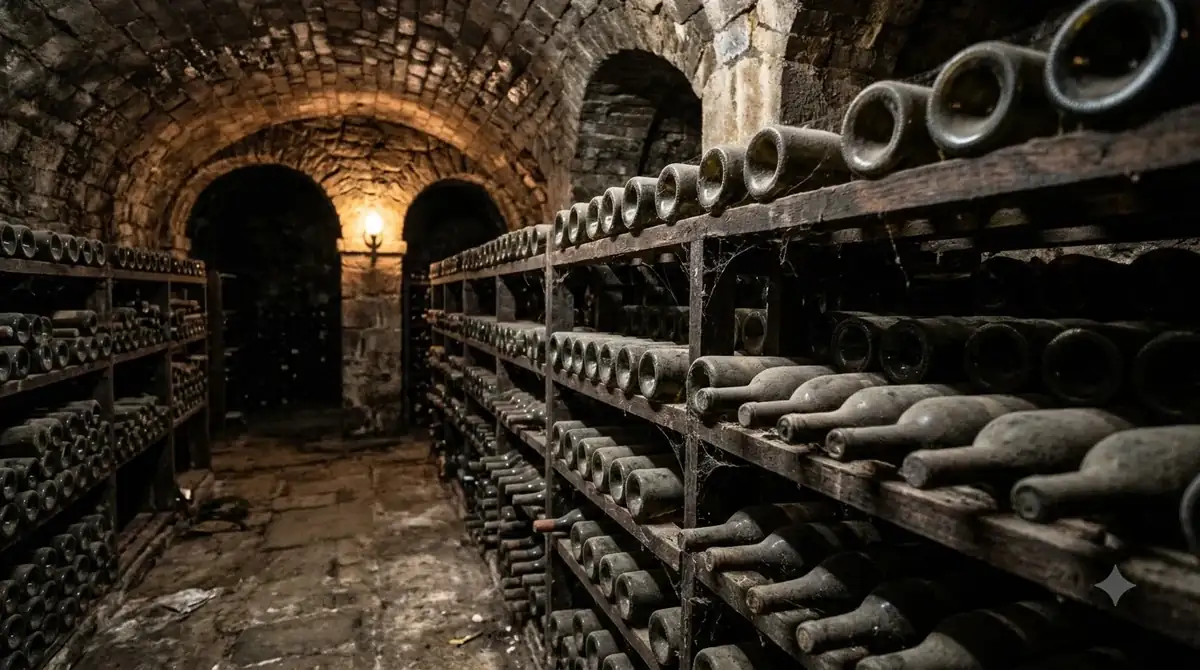
Start by measuring the available space, including wall dimensions, ceiling height, door clearance, and the depth of existing shelving. Consider how many bottles the cellar currently holds and how many additional bottles you expect to purchase. Leave some unoccupied rack space for new arrivals instead of filling every available position immediately. A collection that grows by 12 bottles every few months needs a different layout from one that remains relatively stable.
For long-term storage, approximately 55°F is a practical target. Wine Enthusiast identifies this temperature as suitable for red, white, sparkling, and fortified wines. Maintaining a relatively consistent temperature matters more than creating separate storage environments based solely on wine color. A thermometer with a temperature-history feature can help identify changes that might otherwise go unnoticed.
Humidity also deserves attention. A general storage range of 50-80% is commonly recommended, while Decanter’s fine-wine storage specialist identifies 65-70% as a particularly suitable target. Excessively dry conditions can contribute to cork deterioration, while prolonged humidity above 80% can encourage mold and damage paper labels.
For additional guidance on storage humidity, temperature, and cork protection, consult Decanter’s explanation of ideal wine-cellar humidity. Its storage specialist also discusses why stable temperatures around 12-13°C are important for fine wine.
Protect the collection from direct sunlight and unnecessary movement. Ultraviolet light can damage wine, while repeated vibration can disturb sediment and interfere with the wine’s development. Avoid positioning racks beside washing machines, noisy mechanical equipment, or frequently used doors. Keep cleaning chemicals, paint, gasoline, and other strongly scented materials outside the cellar.
Inspect the storage equipment before loading bottles. Check that shelves are secure, racks are level, and heavier sections have adequate support. Freestanding wine refrigerators may require approximately 2-3 inches of clearance for ventilation, depending on their design. Confirm the manufacturer’s installation requirements rather than assuming every appliance can fit tightly against a wall.
Finally, clean the space before organizing the collection. Remove cardboard debris, dust the shelves, and check for signs of water infiltration or mold. If the room has a cooling system, inspect its filters, drainage, and ventilation. Addressing these details first makes it easier to maintain an organized cellar over time.
Choose a Logical System for Grouping Wine Bottles
The best cellar organization system reflects how you actually choose wine. Some collectors begin with a country or region, while others look for a particular grape variety, producer, vintage, or occasion. Choose one primary structure and use smaller categories within it to make individual bottles easier to locate.
For collections containing wines from several countries, organization by country is an effective starting point. Allocate separate sections to France, Italy, Spain, the United States, Australia, and other countries represented in the collection. Divide larger national sections into their principal wine regions.
For example, a French wine section could contain separate areas for Bordeaux, Burgundy, Rhône, Loire, and Languedoc. Italian wines might be divided into Tuscany, Piedmont, Veneto, Sicily, and other represented regions. This structure makes it easier to find bottles without remembering their exact rack positions.
Within each region, arrange wines by producer, grape variety, or vintage. A Burgundy section, for example, might separate Pinot Noir-based red wines from Chardonnay-based white wines. A Bordeaux section could distinguish Left Bank and Right Bank producers before grouping bottles by vintage.
Collectors with smaller collections may find grape-based organization more useful. Separate Cabernet Sauvignon, Merlot, Pinot Noir, Syrah, Chardonnay, Sauvignon Blanc, Riesling, and sparkling wines into identifiable sections. This approach is especially practical for people who regularly select wine according to a meal or personal preference rather than a specific geographic origin.
Vintage organization becomes particularly useful when a collection contains multiple bottles from different harvest years. Grouping Bordeaux 2009, Bordeaux 2010, and subsequent vintages together allows collectors to compare bottles and track their expected drinking periods. The same method works for Burgundy, Barolo, Napa Valley Cabernet Sauvignon, and other wines where vintage differences matter.
There is no requirement to use every possible category. Too many subdivisions can make a small cellar unnecessarily complicated. If you own only 40 bottles, dividing them into six major groups may be easier than creating 20 tiny sections that constantly change as you buy and drink wine.
For a growing collection, a useful structure looks like this:
| Organization level | Example | Purpose |
|---|---|---|
| Country | France | Identifies the broad origin |
| Region | Bordeaux | Narrows the geographic location |
| Subregion | Pauillac | Identifies a more specific appellation |
| Producer | Individual château | Distinguishes the winery |
| Vintage | 2009 or 2010 | Tracks harvest year |
| Drinking window | Drink now or hold | Supports bottle selection |
This hierarchy provides a useful framework without requiring every collector to maintain a complicated classification system. You can stop at the level that suits the size of your collection and use inventory records for additional information.
Wine Enthusiast provides further practical examples of regional grouping, vintage arrangement, and color-coded tags in its article on organizing a wine collection. These approaches can be adapted to both small home collections and larger cellars.
Create Storage Zones for Different Drinking Priorities
Separating wines according to when you plan to drink them makes a cellar considerably easier to use. A bottle intended for next weekend’s dinner should not be buried behind a collection of wines that will remain untouched for another decade. Establishing drinking-priority zones helps prevent unnecessary handling and makes everyday selections quicker.

Begin with three practical categories: ready to drink, approaching maturity, and long-term storage. These categories do not require completely different temperature conditions. They are organizational distinctions that help you locate the appropriate bottle at the appropriate time.
The ready-to-drink section should contain wines intended for regular meals, casual entertaining, and near-term occasions. Everyday Chianti, young Sauvignon Blanc, accessible Chardonnay, and fresh rosé are examples of wines that may belong here, depending on their individual characteristics and intended drinking periods.
Keep this section close to the cellar entrance or at a convenient rack height. If you frequently serve sparkling wine, reserve a clearly identified area for Champagne, Cava, and Prosecco. This makes it easier to prepare for gatherings without searching through the entire collection.
The approaching-maturity section should contain bottles that are nearing their expected drinking windows. These wines may include aged Bordeaux, Barolo, Burgundy, or Napa Valley Cabernet Sauvignon. Record the estimated opening period in your inventory and update it when you learn more about a particular vintage or producer.
The long-term storage section is for bottles you intend to hold for several more years. Keep these bottles in stable positions where they will not need to be moved frequently. Avoid stacking everyday purchases in front of them or using their rack space as temporary storage.
For additional convenience, establish a separate special-occasion section. This could include Champagne for celebrations, vintage Port for holidays, or particularly meaningful bottles reserved for birthdays and anniversaries. Keep these wines identifiable without separating them from their necessary storage conditions.
A practical drinking-priority arrangement can look like this:
- Drink now: Wines intended for consumption within the next 12 months.
- Drink soon: Bottles approaching their preferred drinking periods over the next one to three years.
- Hold: Wines intended for longer aging, with a recorded review date.
- Special occasions: Bottles reserved for specific celebrations or events.
These timeframes are organizational guidelines rather than universal aging rules. Many wines are produced for early consumption and do not improve through extended cellaring. A young, fresh Pinot Grigio and an age-worthy Barolo should not automatically receive the same storage schedule.
When you purchase a wine intended for aging, record the recommended drinking window using reliable producer information or a suitable wine reference. Revisit those dates periodically instead of assuming that every bottle will improve indefinitely.
Arrange Wine Racks for Easy Identification and Safe Access
Rack placement should make the collection accessible without compromising bottle security. The most effective arrangement uses consistent rack labels, stable horizontal positions for cork-sealed wines, and enough space to remove individual bottles without disturbing neighboring rows.
Start by numbering the major rack sections. You might identify them as A, B, C, and D, then number individual shelves from the bottom upward. A bottle location such as B-03-04 could identify rack B, shelf 3, position 4. This simple address system becomes especially useful when your inventory contains dozens or hundreds of bottles.
Keep the most frequently accessed bottles in convenient positions. Wines intended for immediate consumption can occupy middle shelves where they are easy to reach. Long-term bottles can remain in less frequently accessed sections, provided those positions are secure and suitable for their storage requirements.
Horizontal storage is generally appropriate for bottles sealed with natural corks because it helps maintain contact between the wine and cork. This supports cork moisture and helps reduce the risk of premature oxidation. Screw-cap bottles do not require the same cork-moisture consideration, although horizontal storage can still make rack arrangements more consistent.
Pay attention to bottle dimensions. Standard 750 ml Bordeaux bottles are relatively straightforward to accommodate, but Burgundy bottles, Champagne bottles, and some specialty formats have different shapes and widths. A rack designed around narrow bottles may not safely accommodate wider sparkling bottles.
Do not force oversized bottles into unsuitable slots. Instead, designate a separate section for Champagne, large-format bottles, or unusual packaging. This prevents damaged labels, unstable stacks, and difficulty retrieving individual bottles.
Heavy bottles should be placed in racks designed to support their weight. Follow the rack manufacturer’s loading instructions, distribute bottles evenly, and avoid concentrating a large number of heavy bottles in one small area. If your cellar uses sliding shelves, extend only one shelf at a time when the manufacturer specifies that restriction.
Label orientation also matters. In display racks, position bottles consistently so that the visible labels can be read without excessive handling. In traditional racks where the bottle neck faces outward, use neck tags to identify the contents.
For a large cellar, avoid mixing unrelated categories within a single rack unless the inventory system clearly identifies their locations. Keeping a Bordeaux section together is more useful than spreading individual Bordeaux bottles across five different shelves simply because space is available.
Use Bottle Tags and Inventory Records Together
Physical labels and digital records serve different purposes. Bottle tags provide immediate identification inside the cellar, while an inventory system preserves more detailed information about each wine, its quantity, purchase history, location, and expected drinking period.
Start with a simple bottle tag. Include the producer, wine name, region, vintage, and grape variety where relevant. If the label already displays most of this information, use a shorter tag that identifies the producer and vintage clearly.
Color coding can make the system easier to understand. For example, assign green tags to wines intended for near-term consumption, yellow tags to wines approaching maturity, and red tags to bottles intended for longer storage. The colors are entirely your choice; consistency is what matters.
Make sure the tag colors have documented meanings. If green means drink soon, that definition should remain the same throughout the cellar. Changing the meaning of colors between rack sections creates confusion rather than improving organization.
For inventory tracking, a spreadsheet is a practical starting point. It can be sorted by producer, vintage, country, grape variety, drinking window, or rack location. Wine Enthusiast also identifies dedicated inventory applications such as CellarTracker, VinCellar, Vivino, and VinoCell.
A useful inventory should contain the following fields:
- Wine name: The full producer and wine designation.
- Country and region: The wine’s geographic origin.
- Vintage: The harvest year or NV designation.
- Grape variety: The principal grape or blend where known.
- Quantity: The number of bottles currently held.
- Rack location: The exact shelf and bottle position.
- Drinking window: The estimated period for opening.
- Purchase date: When the bottle entered the collection.
- Notes: Producer recommendations, provenance, or personal observations.
For example, an inventory entry might identify a 2010 Bordeaux as a French red wine stored in rack B, shelf 3, position 4, with three bottles remaining. Another entry could identify a 2021 Marlborough Sauvignon Blanc in rack A, shelf 1, position 2, intended for near-term consumption.
Use one inventory entry for each distinct wine and vintage, then record its quantity. If you own six bottles of the same wine, the inventory should show six rather than creating six identical entries unless you need individual bottle-level tracking.
More valuable collections may benefit from individual bottle records. This is particularly useful when different bottles have different purchase dates, provenance information, or opening histories. A digital record can also preserve tasting notes after a bottle has been consumed.
Tip: Update your cellar inventory immediately after purchasing or opening a bottle. Recording a new purchase and removing a consumed bottle takes only a moment, while reconstructing an inaccurate inventory months later can take considerably longer. Include the rack location whenever a bottle enters the cellar.
Consider maintaining a backup of your spreadsheet or using an inventory application that synchronizes your collection across devices. A printed copy of the rack map can also help household members locate bottles if they do not use your digital system.
Separate Wine Types Without Creating Unnecessary Temperature Zones
Different wine styles can share the same long-term storage environment. Red, white, rosé, and sparkling wines do not require separate cellars simply because they are served at different temperatures. Organize them into distinct rack sections for convenient selection while maintaining a consistent storage temperature.
A cellar temperature around 55°F works well as a general target for mixed collections. Wine Enthusiast’s storage guidance explains that red and white wines, along with sparkling and fortified styles, can share approximately the same long-term storage temperature even though their serving temperatures differ.
Serving temperature should therefore influence how you organize the collection, but it should not dictate completely different long-term storage conditions. Keep the bottles grouped by style so you can find them easily, then chill or warm individual bottles before serving.
The following serving temperatures provide a useful reference when planning those sections:
| Wine style | Typical serving temperature | Suggested cellar grouping |
|---|---|---|
| Sparkling wine | 40-50°F | Champagne and other sparkling wines |
| Light white wine | 45-50°F | Sauvignon Blanc, Pinot Grigio |
| Rosé | 45-50°F | Still rosé wines |
| Full-bodied white wine | 50-55°F | Chardonnay and similar styles |
| Light-bodied red wine | 55-60°F | Pinot Noir and lighter reds |
| Full-bodied red wine | 60-65°F | Cabernet Sauvignon and Syrah |
| Sweet white wine | 43-50°F | Dessert wines and sweet whites |
These are serving temperatures, not separate long-term cellar settings. A bottle of Cabernet Sauvignon stored at approximately 55°F does not need to occupy a warmer section than a bottle of Riesling. Instead, adjust the temperature before serving.
For collectors who use a wine refrigerator, a single-temperature unit is often sufficient for long-term storage. Dual-zone models can be useful when one compartment is intended for bottles ready to serve and another for longer-term storage. However, dividing the appliance into two temperature zones may reduce the number of bottles it can accommodate.
Keep sparkling wines together if you regularly serve them for celebrations. Group Champagne, Cava, and Prosecco within a clearly marked section. You can further divide this area according to producer, sweetness level, or intended occasion.
Fortified wines such as Port and Sherry can occupy their own section. This makes them easier to locate and helps distinguish them from still table wines. If your collection includes vintage Port, maintain the same careful inventory practices used for age-worthy red wines.
For more information about the characteristics of different styles, consult the site’s Wine Basics resources. Understanding grape varieties, regional styles, and wine structure can make your cellar categories more meaningful.
Maintain the Cellar With Regular Inventory and Storage Checks
A cellar organization system only works if it remains accurate. New purchases, opened bottles, changing drinking windows, and equipment maintenance can gradually make an initially excellent layout difficult to use. A short monthly review and a more detailed seasonal inspection help keep the collection in good order.
Start with inventory reconciliation. Compare the bottles physically present in each rack with the digital or written records. Correct quantities, update locations, and remove bottles that have been consumed. If you discover an unexpected bottle, identify it and add it to the inventory before returning it to storage.
Next, review drinking windows. A wine that was originally intended for long-term aging may now be approaching maturity. Move its inventory status from hold to approaching maturity when appropriate, and update its physical tag if your cellar uses color coding.
Do not automatically assume that a bottle is ready simply because it has reached a particular age. Producer guidance, vintage conditions, storage history, and personal preferences all influence the appropriate drinking period. Treat estimated dates as useful reminders rather than guarantees.
Inspect the storage environment regularly. Check the thermometer and humidity monitor, look for unusual condensation, and make sure the cooling system is operating correctly. If your cellar has a drip tray, Wine Enthusiast recommends checking it every few months to prevent excessive water accumulation.
Cooling equipment also needs maintenance. Replace filters according to the manufacturer’s instructions, inspect drainage tubes, and clean exposed condenser coils approximately once a year where applicable. Excessive moisture, blocked drainage, and poor ventilation can reduce equipment performance and create conditions for mold.
Check rack stability during the same inspection. Look for loose supports, damaged shelves, and bottles that have shifted out of their intended positions. Keep heavier bottles securely supported and avoid rearranging the entire collection unless the layout genuinely needs improvement.
It can also help to maintain a small cellar activity log. Record significant purchases, bottles opened, changes to storage conditions, and maintenance work. This provides a useful history when investigating missing bottles or unexpected changes in the cellar environment.
As the collection grows, periodically review whether the current organization still makes sense. A cellar that began with 40 bottles and eventually holds 200 may need additional regional sections, better rack labeling, or a dedicated inventory application.
If you are planning a new storage area rather than simply reorganizing an existing one, consider the practical requirements before purchasing equipment. Read about how to make a wine cellar in a closet if you are working with limited space, or explore how much it costs to build a wine cellar before committing to a larger project.
Frequently Asked Questions
How many bottles should a beginner wine cellar hold?
There is no minimum bottle count required to start a wine cellar. A collection of 12 to 24 bottles can benefit from basic rack labels and an inventory just as much as a larger collection. The important consideration is whether the storage space can maintain suitable conditions and accommodate the bottles securely.
Should wine cellar records include bottle provenance?
Yes, provenance records can be valuable for collectible wines. Record the original retailer, purchase date, previous storage information when available, and any ownership documentation. These details help establish a bottle’s history and can be particularly important for wines acquired through auctions or private collectors.
Can wine bottles be stored in their original wooden cases?
Yes, original wooden cases can be useful for keeping matching bottles together, particularly when storing complete cases from the same producer and vintage. Make sure the cases are clean, dry, stable, and suitable for the cellar environment. Record the case location and bottle quantity so individual wines remain identifiable.
Should collectible wine bottles have insurance records?
Collectors with valuable bottles may benefit from maintaining insurance documentation alongside their inventory. Useful records include purchase receipts, photographs, professional valuations, and detailed bottle descriptions. Keeping these records outside the physical cellar also provides a backup if the storage area is damaged.
What should happen to wine bottles with damaged labels?
Do not discard an identifiable bottle simply because its paper label has deteriorated. Record the producer, wine name, vintage, and any available identifying details in your inventory, then attach a replacement storage tag. Photographs taken before labels deteriorate can also help preserve identification information for older bottles.
A well-organized wine cellar combines suitable storage conditions, clearly defined rack sections, reliable bottle identification, and accurate inventory records. Start with a straightforward system based on how you select wine, then introduce additional categories as your collection grows. With regular maintenance and consistent recordkeeping, finding the right bottle becomes easier while your collection remains protected and ready to enjoy.
More in Wine Basics
 Which Rose Is Best for Your Taste, Budget, and Food PairingsUpdated Nov 21, 2026
 Is Cheap Wine Bad? How to Find Bottles Worth DrinkingUpdated Nov 21, 2026
 What To Write On A Wine Gift Tag: Thoughtful Messages For Every OccasionUpdated Nov 21, 2026
 Which Wine Is Best For Weight Loss? Compare Lower-Calorie ChoicesUpdated Nov 21, 2026
 What Is The Best Wine For Mimosas? Choose Bubbly That Balances Orange JuiceUpdated Nov 20, 2026
 Which Prosecco Is Best for Your Taste and OccasionUpdated Nov 20, 2026