

We may earn a commission when you buy through links on this page, at no extra cost to you. Learn more.
To learn how to open a wine bottle with a broken cork, stop twisting, assess the piece left in the neck, and choose a slow extraction with a corkscrew or two-prong opener; push it inside only when careful removal is no longer practical and the wine is still. A broken cork usually does not mean the wine has spoiled. The aim is to remove the remaining cork without grinding it into crumbs, then strain any fragments before serving.
A cork can split halfway through an ordinary opening, crumble on an older bottle, or slip below the rim before the corkscrew catches it. Each situation calls for a slightly different response. Set the bottle on a stable surface, keep it upright, and work slowly rather than trying to win a tug-of-war with the cork.
Assess the cork and bottle before choosing a method
Start by looking at the neck, the remaining cork, and the bottle itself. A firm piece that still fills most of the opening may be recoverable with a waiter’s corkscrew; a soft, old, or ragged cork is usually a better candidate for an ah-so, also called a two-prong opener. If the cork has fallen completely into a bottle of still wine, extraction is no longer necessary: the practical task is to keep fragments out of the pour.
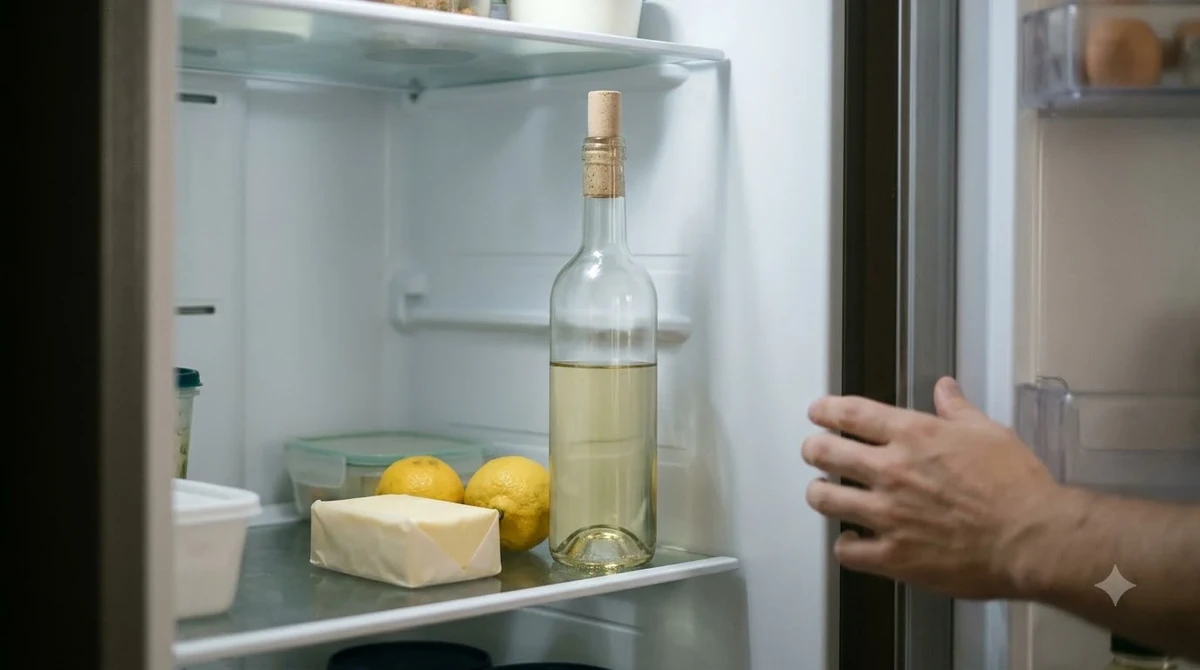
Keep the bottle upright while you decide what to do. Tilting or shaking it can send loose crumbs into the wine and make them harder to catch. Do not put a finger, knife, or other sharp object into the neck to fish out the fragment. The glass opening is narrow, the cork can shift suddenly, and a slipping tool can injure your hand or chip the rim. Clear loose crumbs from the outside of the neck and from the corkscrew before another attempt.
Look at how the cork broke. If a substantial section remains above the wine and still feels compressed against the glass, it may be possible to grip it. If the surface is powdery or comes apart with a light touch, another screw hole is likely to make the problem worse. Stop and switch tools rather than repeating the same pull.
Age matters, but it is not the only clue. Old bottles are more likely to have fragile corks, while poor storage can leave them dry and brittle. A younger bottle can also have a damaged cork or a worn opener. Choose the method based on the cork’s condition, not just its vintage.
| What remains | Best next step | Useful detail |
|---|---|---|
| A firm cork piece in the neck | Re-seat a waiter’s corkscrew | Tilt the bottle about 30 degrees and pull slowly instead of twisting the fragment out |
| A soft or older cork | Use an ah-so opener | Work 2 prongs down opposite sides, then twist and lift gently |
| A stubborn but solid fragment | Try one controlled pull | Apply slow, firm pressure for 10 seconds, then reassess |
| A cork too crumbly to grip | Push it into still wine and filter | Use a blunt wooden handle and strain through a clean coffee filter or fine cloth |
Use an ah-so opener for a fragile or older cork
An ah-so is often the gentlest option when the cork is still in the neck but has become delicate. Its two thin prongs slide between cork and glass, gripping the sides instead of drilling into the cork’s center. For an old bottle or a cork that is already splitting, that outside grip can preserve more of the cork’s structure.
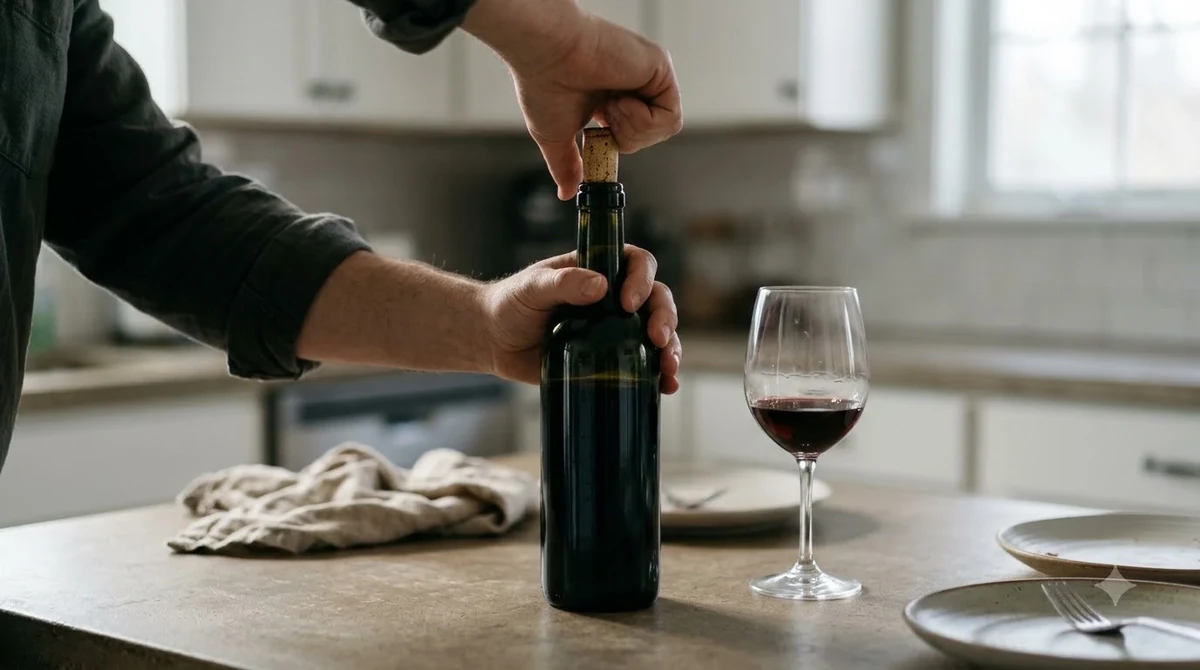
Hold the bottle steady on a flat surface. Start the longer prong between the cork and the inside wall of the neck, then work the shorter prong down on the opposite side. Use a small side-to-side rocking motion rather than forcing either blade straight down. Move a little at a time until both prongs sit as far alongside the cork as the opener allows. If the cork is very brittle, pause when you feel resistance instead of levering harder.
Once the prongs have a secure hold, rotate the handle gently while drawing upward. The goal is a gradual, controlled lift, not a sudden yank. Keep the opener aligned with the bottle neck and avoid pulling sideways against the rim. A slow rocking action can help the cork rise in small increments; if the cork begins to crumble around the prongs, stop before the opening fills with fragments.
A combination tool such as the Durand pairs a waiter’s corkscrew with two prongs for particularly fragile corks. It is designed for bottles where a conventional worm may tear the cork but the outside grip can help keep it together. Most households do not need a specialist tool for every bottle, but people who regularly open mature wines may find an ah-so useful to keep beside a standard waiter’s key.
Re-seat a corkscrew in a firm remaining fragment
If the cork is relatively young and a firm piece remains in the neck, a waiter’s corkscrew may still remove it. The important adjustment is to secure the worm in solid cork and pull with control; repeatedly twisting through the damaged center can break the remnant into smaller pieces.
First remove any loose cork dust from the rim and the spiral. Check that the worm is straight, clean, and firmly attached to the handle. Position the tip over the strongest part of the remaining cork, often just off the damaged hole rather than directly inside it. Turn slowly and keep the worm as straight as the cork allows. Do not drive it through the bottom of the cork, where it can push the fragment down into the wine.
Once the worm has a firm hold, stop turning and draw the cork upward gradually. A sommelier quoted by VinePair recommends tilting the bottle to about 30 degrees and carefully dragging the cork out rather than trying to screw it out. This is a controlled pull, not a forceful lever against the glass. If the fragment shifts, bends, or starts shedding crumbs, stop and use an ah-so or move to the push-and-filter method for still wine.
Some corks need a moment under steady pressure before they move. Wine director Laura Staley, quoted by Wine Enthusiast, advises applying slow, firm pressure for 10 seconds when a cork is stubborn. Treat that as one measured attempt, not a reason to keep pulling indefinitely. If the cork does not respond, release the pressure, reassess the grip, and switch approaches. For more on standard openers and bottle handling, see the site’s Wine Basics section. An improvised fork method for an intact bottle is separate from retrieving a broken fragment trapped in the neck.
Push the cork into a bottle only as a last resort
Pushing the broken cork into the bottle can be the most practical choice when the remaining piece is too crumbly to grip. This is a rescue method for still wine, not the first choice for a bottle whose cork can still be removed cleanly. Never push a cork into a sparkling-wine bottle: pressure inside the bottle makes that a different and potentially hazardous situation.
Before pushing, remove loose pieces sitting on the rim and place the bottle in a sink or on a surface that can handle a small spill. Keep the opening pointed away from faces and clothing. Use the broad, blunt handle of a clean wooden spoon to press the cork straight down in one controlled motion. Avoid a sharp skewer, knife, or narrow metal object; it can slip, damage the cork further, or strike the glass. Expect a little wine to rise, so press slowly and keep a towel nearby. Once the cork drops below the neck, stop; the aim is to clear the opening, not break the cork into smaller pieces. If it begins to bind, do not add force.
After the cork is inside, pour the wine through a clean filter into a decanter or jug. If you want to read the separate step-by-step method, see how to push a cork into a wine bottle. Keep in mind that this method trades cork extraction for filtration: it solves the blocked opening, but the cork will remain in the bottle and should not be allowed to escape into a glass.
Filter cork fragments without damaging the wine
Small pieces of cork floating in wine are unpleasant to drink but do not automatically make the wine faulty. Catch them with a fine, clean filter as you pour: a fine-mesh strainer, coffee filter, or very thin, odor-free cloth can work. Place cloth over a funnel so the wine flows into a clean decanter or jug. Pour slowly; pause if a large fragment approaches the neck, and do not squeeze or wring the filter. Use a fresh filter without detergent or food odor, and avoid a paper towel that may tear when wet. Check the decanter for visible fragments before serving.
For a young, sturdy wine, transferring the bottle into a decanter is usually straightforward. For an older, delicate wine, extra air and a second transfer can speed oxidation and cause fragile aromas to fade. Decanter’s advice is to filter only until the cork pieces reach the cloth, then gently return the wine to the bottle, or filter directly into each glass. For one or two servings, a small fine-mesh strainer may be less disruptive; for a group, a decanter makes one controlled transfer easier. Do not shake the bottle to gather the fragments, especially if an older red wine also has natural sediment.
Tip: For a crumbly cork in still wine, stop trying to extract it after one careful attempt with the right tool. Push it in with a blunt wooden handle, then pour through a clean coffee filter or fine cloth rather than creating more cork dust with repeated twists.
Prevent another broken cork on the next bottle
A little preparation reduces the odds of another break. Before opening, check that the corkscrew’s worm is straight and sharp enough to enter cleanly, and make sure its hinge and lever move smoothly. If the tool is bent, rusty, loose, or unusually difficult to operate, replace it rather than applying extra force to compensate. Wine Enthusiast notes that recurring breakage in younger bottles can point to a worn or rusty opener.
Choose the opener for the bottle. A standard waiter’s key with a long worm is suitable for many younger wines with sound corks. For an older bottle with a fragile closure, an ah-so can grip from the sides without piercing the cork. A Durand combines the two approaches and can be useful for particularly delicate corks. Keep the bottle upright while opening and work the spiral slowly; inserting the worm off-center or driving it too deep can weaken the cork.
Long-term storage also affects cork condition. According to Decanter’s advice on broken corks, a bottle stored horizontally keeps wine in contact with the cork’s inner surface, helping it remain hydrated and flexible. A cork left upright for a long time in dry conditions can lose moisture, become brittle, and crumble more readily. Store bottles on their sides in a cool, suitably humid place rather than beside a radiator, in direct sunlight, or in a very dry cupboard. Move older bottles gently, let sediment settle, cut the capsule below the rim, and wipe the neck before inserting the worm. For a particularly old bottle, have an ah-so or combined opener ready before opening.
Frequently Asked Questions
These five answers cover common follow-up concerns, from cork taint to old-bottle sediment and the difference between a broken closure and a wine fault. They also clarify what to do after the cork has moved inside the bottle.
Does a broken cork mean the wine is corked?
No. A cork that breaks during opening is a physical problem, while cork taint is a separate wine fault commonly associated with the compound TCA. Tainted wine can smell like damp cardboard, a musty cellar, or wet newspaper, even when the cork comes out in one piece.
Can I drink wine if a few cork crumbs get into the glass?
Yes, a stray fragment is generally a texture nuisance rather than a sign that the wine has become spoiled. Remove larger pieces with a clean spoon or pour the glass through a small tea strainer; the cork does not dissolve into the wine like sugar.
Should I decant an old red wine after the cork breaks?
Not automatically. Mature red wines can contain natural sediment made up of coloring matter and tannins that have formed deposits over time, so a broken cork is not a reason to splash the wine into a wide decanter. Keep the bottle upright, pour slowly, and stop when the sediment approaches the shoulder.
Can I put the broken cork back into the bottle after opening?
Do not try to rebuild a cork from loose pieces or force a fragment back into the neck. If the original cork is intact enough to rest loosely in the opening, it may serve as a temporary cover, but a fitted wine stopper is more reliable for resealing a still-wine bottle.
What should I do if the broken cork is in a sparkling-wine bottle?
Do not push the cork into the bottle or point the opening toward anyone. Sparkling wine is pressurized, so keep the bottle pointed away from people and breakables, hold the remaining closure securely with a towel, and seek help from someone experienced with sparkling-wine service if it will not release safely.
A broken cork is usually manageable if you stop, identify what is still gripping the neck, and choose a method that matches its condition. Pull a firm fragment slowly, use an ah-so for a fragile one, or push and filter when careful extraction is no longer possible with still wine. A calm approach protects both the bottle and the wine inside it.
More in Wine Basics
 Which Rose Is Best for Your Taste, Budget, and Food PairingsUpdated Nov 21, 2026
 Is Cheap Wine Bad? How to Find Bottles Worth DrinkingUpdated Nov 21, 2026
 What To Write On A Wine Gift Tag: Thoughtful Messages For Every OccasionUpdated Nov 21, 2026
 Which Wine Is Best For Weight Loss? Compare Lower-Calorie ChoicesUpdated Nov 21, 2026
 What Is The Best Wine For Mimosas? Choose Bubbly That Balances Orange JuiceUpdated Nov 20, 2026
 Which Prosecco Is Best for Your Taste and OccasionUpdated Nov 20, 2026