


We may earn a commission when you buy through links on this page, at no extra cost to you. Learn more.
White wine sulfites occur naturally during fermentation, and winemakers may add more sulfur dioxide to protect the wine from oxidation and spoilage. The words “Contains Sulfites” on a U.S. bottle mean the wine has at least 10 parts per million (ppm) of total sulfur dioxide; they do not tell you the exact amount. White wines often need more sulfite protection than reds because they have fewer tannins and skin-derived phenolic compounds to help guard against oxidation.
Sulfites are a routine part of modern winemaking, not a feature unique to inexpensive bottles or a particular grape variety. Understanding where they come from, why white wines may contain more, and what U.S. labeling rules actually say makes it easier to compare bottles without relying on vague claims.
What Sulfites Are in White Wine
Sulfites are sulfur dioxide (SO₂) and related sulfiting agents used in wine as preservatives. A small amount also forms naturally as yeast ferments grape juice, which means a wine made without added sulfur dioxide can still contain sulfites.
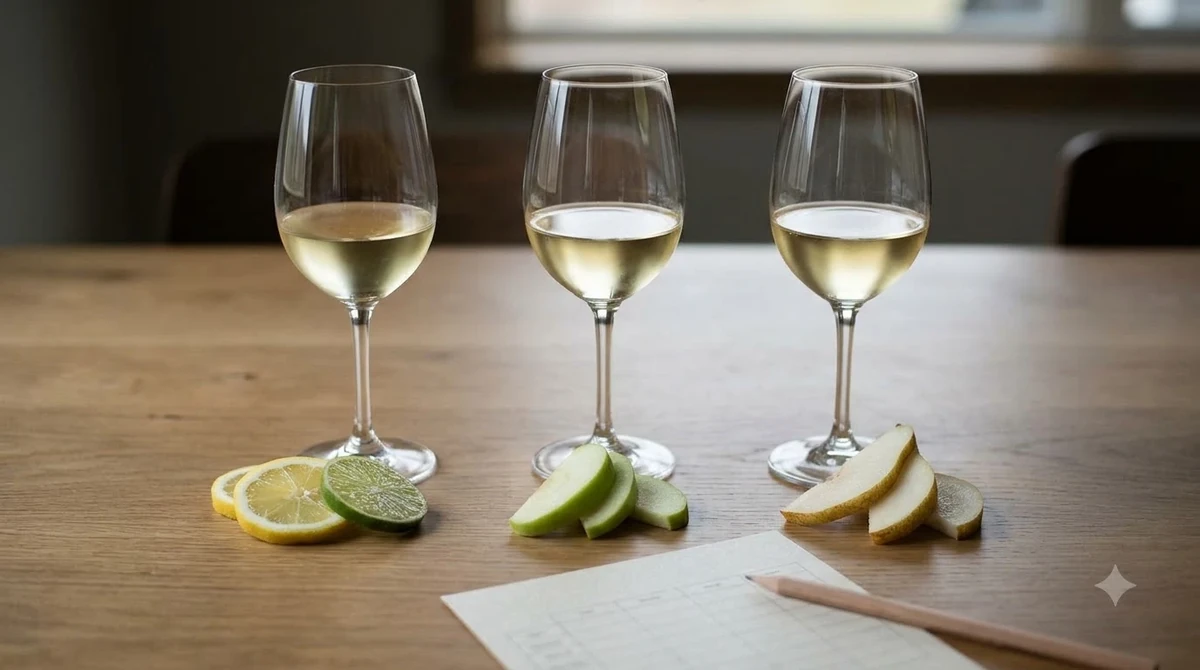
During fermentation, yeast converts grape sugar into alcohol and releases several byproducts, including sulfur dioxide. Winemakers may also add sulfur dioxide directly, commonly as a gas or through potassium metabisulfite, to manage oxidation and unwanted microbial activity. The naturally produced amount varies with the yeast and fermentation conditions; there is no single natural level shared by every bottle.
The terms can be confusing because people use “sulfur,” “sulfur dioxide,” “sulfites,” and “sulfides” as though they mean the same thing. They do not. Elemental sulfur is used in vineyards to control powdery mildew, while sulfur dioxide is the compound commonly used in the winery. Sulfides, including hydrogen sulfide and mercaptans, are a separate group of volatile compounds associated with certain wine faults and aromas such as rotten egg or rotten vegetables.
In practical wine-label language, “sulfites” is a broad term that covers sulfur dioxide and sulfiting agents. The amount in a finished white wine is a combination of what fermentation produced and what the winemaker chose to add. This is why “no added sulfites” and “contains no sulfites” are not interchangeable descriptions.
Why White Wines May Need More Sulfites Than Red Wines
White wines often contain more sulfites than red wines because their production usually involves less contact with grape skins, where tannins and other phenolic compounds provide some antioxidant protection. Sweet wines can require more protection still, since residual sugar can make microbial stability more challenging.
Consider a crisp Sauvignon Blanc or unoaked Chardonnay alongside a red Cabernet Sauvignon. The white wines are generally pressed away from their skins before fermentation, while many red wines ferment with skins for an extended period to extract color, tannin, and flavor. Those skin-derived compounds contribute to the red wine’s natural antioxidant capacity. That difference helps explain why producers may use more sulfur dioxide in a white wine, although it does not mean every white bottle has a higher measured level than every red bottle.
Style matters as much as color. A dry Pinot Noir may need less added sulfur dioxide than a delicate white, while a sweet Riesling can need more protection than a dry Sauvignon Blanc. Rosé generally sits closer to white wine in this comparison because it usually has limited skin contact. Production choices, pH, fruit condition, oxygen exposure, and the intended time before drinking all affect a winemaker’s decisions.
Decanter explains that tannins and phenolics in red wines help protect them, while white and rosé wines often rely more heavily on sulfur dioxide. That is a useful broad pattern, not a strict rule for ranking bottles. Two Chardonnay producers can use different cellar practices, and a skin-fermented white can have a different protective structure from a conventionally pressed white made from the same grape.
How Winemakers Use Sulfur Dioxide During White Wine Production
Winemakers can manage sulfites at several stages, from grape processing through bottling. In white wine production, an early addition can protect freshly pressed juice, while a later adjustment can help keep the finished wine stable in the bottle.
One common opportunity comes during pressing. After grapes arrive at the winery and are pressed, some producers add sulfur dioxide gas or potassium metabisulfite to limit spoilage microbes and slow the juice’s exposure to oxygen. Other producers wait until fermentation is complete before deciding whether an addition is needed. The choice depends on fruit condition, the winery’s sanitation, the intended style, and the producer’s approach.
After fermentation, the winemaker can assess the wine and make further adjustments during maturation or before bottling. White wine is particularly vulnerable to oxygen during transfers from tank to barrel and from the winery’s holding vessel to the bottle. Oxidation can diminish fresh fruit character and cause unwanted browning, while microbes can create faults. Sulfur dioxide helps reduce both risks when used at an appropriate level.
The process is not simply a matter of adding as much as possible. Winemakers monitor the wine, consider its acidity and composition, and aim for enough protection without unnecessary additions. A white wine made from clean, healthy fruit and handled carefully may need less added sulfur dioxide than one exposed to more oxygen or microbial pressure. The production sequence described in Wine Enthusiast’s explanation of white wine production shows how pressing, fermentation, maturation, and bottling create several points at which the winemaker can make those decisions.
Tip: Treat “white wine” as a broad style category, not a sulfite measurement. A dry, stainless-steel Sauvignon Blanc, an oak-aged Chardonnay, and a late-harvest Riesling can have very different production needs even though all three are white wines.
What “Contains Sulfites” Means on a U.S. Wine Label
In the United States, wine must carry a sulfite declaration when it contains 10 ppm or more of total sulfur dioxide. The rule applies to white, red, rosé, and sparkling wine alike, so the warning is not a special designation for white wine.
The Alcohol and Tobacco Tax and Trade Bureau (TTB) measures the threshold as total sulfur dioxide, not only the free portion that remains active in the wine. The required statement is commonly printed as “Contains Sulfites.” The TTB explains that the declaration is intended to alert consumers who may be sensitive to sulfur dioxide, and its wine sulfite labeling guidance sets out the threshold and format requirements.
A sulfite statement is a threshold notice, not a numerical analysis of the bottle. It does not say whether a wine contains 10 ppm, 30 ppm, or a higher amount. Two bottles carrying the same statement can therefore contain different total amounts, and the statement alone cannot be used to rank their sulfite levels.
| U.S. labeling detail | Number or threshold | What it means |
|---|---|---|
| Declaration trigger | 10 ppm or more | A “Contains Sulfites” statement is required when total sulfur dioxide reaches this level. |
| Wine below the trigger | Less than 10 ppm | The declaration is not required when the low level is supported by the required TTB laboratory analysis, with a limited exception for agricultural wine. |
| Container larger than 187 mL | 2 mm minimum type | The sulfite statement must meet this minimum letter height. |
| Container 187 mL or smaller | 1 mm minimum type | The smaller container has a lower minimum type size. |
The TTB also requires the statement to be legible under ordinary conditions, set against a contrasting background, and separate from or more conspicuous than surrounding descriptive text. It may appear on the back label, where many consumers first notice it. A bottle without the statement is not automatically proof of zero sulfites; for most wine, the producer or importer needs the specific laboratory evidence required by the TTB to omit the declaration.
“No Added Sulfites” Is Not the Same as “Sulfite-Free”
“No added sulfites” describes a winemaking choice: the producer did not intentionally add sulfur dioxide or sulfiting agents. It does not mean that fermentation produced no sulfites, and it does not guarantee that a finished wine has zero detectable sulfur dioxide.
Yeast can produce sulfur dioxide as part of fermentation, even when the winemaker adds none. A low-intervention white wine can therefore contain naturally occurring sulfites. The exact level depends on the fermentation and production conditions rather than on the front-label style name or the grape variety alone.
In the U.S., the TTB does not permit broad claims such as “sulfite free,” “free of sulfites,” or “contains no sulfites.” Where analysis supports it, the agency allows narrower statements such as “contains less than 10 ppm sulfites” or “no sulfites detected.” The distinction matters: “no sulfites detected” describes a laboratory result, while “no added sulfites” describes what the winemaker did or did not add.
Wines made without added sulfur dioxide can be more vulnerable to oxidation, microbial spoilage, bottle variation, and premature development, particularly if handling and storage are not carefully controlled. That does not make every no-added-sulfites wine faulty; skilled producers can make sound examples. It does mean that omitting sulfur dioxide shifts more of the preservation work onto healthy fruit, careful cellar hygiene, and tight oxygen management. Organic certification and low-intervention language are also not synonyms for zero sulfites: standards and allowed practices differ by certification program and country, so a word such as “organic” is not enough to infer a specific laboratory result. The clearest approach is to distinguish a farming or certification description from an explicit statement about additions and measured sulfur dioxide.
How to Compare Sulfites Across White Wine Styles
There is no reliable sulfite ranking based only on grape variety, region, or sweetness label. A bottle’s total level reflects the producer’s choices and the wine’s condition, so compare specific production claims rather than assuming all Chardonnay or all Riesling is made the same way.
For example, a stainless-steel Sauvignon Blanc is often made to preserve bright citrus and green-fruit character, while a barrel-fermented Chardonnay may spend more time maturing in contact with oak and lees. A sweet Riesling has a different preservation challenge from a dry Sauvignon Blanc. None of those style descriptions, by itself, tells you the final sulfite concentration.
Sparkling wines add another point of comparison. Champagne undergoes a second fermentation in the bottle, while Prosecco is generally made using a tank method; both can contain naturally formed and added sulfites. The production method does not remove the U.S. 10-ppm labeling trigger. For the category-specific details, see our pages on champagne sulfites and prosecco sulfites. Pinot Noir offers a useful red-wine comparison: it has low-to-medium tannin and typically higher acidity, while most still white wines have little or no tannin from extended skin contact. Even so, a particular Pinot Noir is not automatically lower in total sulfur dioxide than a particular white wine; production method, fruit condition, residual sugar, and bottling choices can change the comparison. Our article on pinot noir sulfites looks at the red-wine side of that question, and Wine by Type explains how broader style differences affect what ends up in the glass.
When choosing a bottle, use the producer’s specific information where it is available. A technical sheet may list total sulfur dioxide, free sulfur dioxide, or a “no added sulfites” claim; those details describe different things. When the only information is the standard U.S. warning, it tells you that the wine meets the labeling threshold, not how it compares numerically with another bottle bearing the same phrase.
Frequently Asked Questions
These answers address details that a standard “Contains Sulfites” statement does not explain, including how sulfite measurements can vary between wine lots and why food comparisons require context.
Can a private lab report replace TTB sulfite testing for a label waiver?
No. For a U.S. sulfite-labeling waiver, the TTB accepts testing performed by its Beverage Alcohol Laboratory, not an analysis from a private lab or from a TTB-certified export chemist. The agency requests one 750 mL bottle of finished wine for its analysis.
Why can two batches from the same winery have different sulfite levels?
The TTB notes that naturally occurring sulfite levels can vary between batches, production cycles, and vintages. Changes in how a wine is made can also affect its final level, so a result from one bottle does not establish the level in every later batch.
Can dried apricots contain more sulfites than wine?
Yes. Wine Enthusiast cites USDA information that dried apricots can contain more than 2,000 ppm sulfur dioxide. The comparison is about concentration in different products, not the amount consumed in a typical serving.
What does a winemaker mean by free sulfur dioxide?
Free sulfur dioxide is the unbound portion that remains available to react with oxygen or unwanted microbes. Bound sulfur dioxide has already reacted with other substances in the wine, and the two portions together make up total sulfur dioxide.
Can a white wine be made without commercial yeast?
Yes. Native yeasts already present on grapes and in winery environments can start fermentation without a selected commercial yeast strain. Those native yeasts can still produce sulfur dioxide during fermentation, so native-yeast fermentation does not mean sulfite-free wine.
White wine sulfites are best understood as part of the winemaking process: some form naturally, and some may be added to preserve freshness and stability. The U.S. label tells you when total sulfur dioxide reaches 10 ppm, but it does not reveal the bottle’s exact amount or whether the sulfites were added. For a more useful comparison, look for a producer’s specific sulfite analysis or a clearly explained “no added sulfites” statement rather than judging a wine by color alone.
More in Wine Types & Grapes
 Zinfandel Sugar Content: Dry Red vs. White Zinfandel GramsUpdated Nov 21, 2026
 Best Zinfandel Substitute Options for Sipping and CookingUpdated Nov 21, 2026
 Zweigelt Food Pairing: Best Dishes, Cheeses, and Serving TipsUpdated Nov 21, 2026
 Zinfandel Tannins Explained: How Structure Shapes Every BottleUpdated Nov 21, 2026
 Zinfandel Sweetness Level: Dry Red vs. Sweet White Zin ExplainedUpdated Nov 21, 2026
 Xinomavro Food Pairing: Best Dishes, Styles, and Serving TipsUpdated Nov 21, 2026