


We may earn a commission when you buy through links on this page, at no extra cost to you. Learn more.
The best slim wine fridge for most kitchens is a 15-inch built-in front-venting compressor unit, which slides flush into standard base cabinetry while holding roughly 26 to 34 bottles at rock-steady temperatures. Shoppers working with ultra-narrow 12-inch gaps or open apartment corners should look at freestanding narrow-footprint models instead, while collectors who drink both crisp whites and full-bodied reds on the same evening benefit most from a slim dual-zone design.
Standard 24-inch wine coolers assume you have a spare cabinet bay or generous floor space to sacrifice. Slim wine refrigerators—typically measuring between 10 and 15 inches wide—solve that problem by slipping into a former trash-compactor slot, the dead zone beside a kitchen island, or a tight dining nook without turning your bottles over to the dry, vibrating interior of a standard kitchen fridge.
Quick Comparison
Narrow wine coolers trade raw bottle count for footprint flexibility, so choosing the right architecture comes down to ventilation, cooling hardware, and temperature zones.
| Slim Wine Fridge Type | Typical Width | Bottle Capacity | Ventilation & Placement | Cooling System | Best Use Case |
|---|---|---|---|---|---|
| 15-Inch Built-In Undercounter | 14.8–15 in. | 26–34 bottles | Front-venting; flush cabinetry or freestanding | Compressor with fan circulation | Kitchen remodels and standard undercounter bays |
| Ultra-Narrow 12-Inch Cooler | 10–12 in. | 12–21 bottles | Front- or rear-venting; tight gaps | Compressor or thermoelectric | Sliver gaps beside islands, desks, or wet bars |
| Slim Dual-Zone Cooler | 12–15 in. | 18–30 bottles | Front-venting; undercounter or bar | Compressor (occasionally thermoelectric) | Serving whites and reds simultaneously |
| Quiet Thermoelectric Slimline | 10–14 in. | 12–18 bottles | Rear/side-venting; freestanding only | Peltier thermoelectric module | Open-concept living rooms, bedrooms, and offices |
| Slim Wine & Beverage Center | 15 in. | 16–20 bottles + 30–50 cans | Front-venting; undercounter or patio bar | Compressor with adjustable racks | Households chilling wine alongside seltzer and beer |
Best for Built-In Kitchen Cabinetry
A 15-inch front-venting compressor cooler is the gold standard for kitchen installations because it replaces a standard narrow base cabinet with zero side clearance required. You get maximum bottle density in a slim profile along with enough cooling muscle to handle warm kitchen ambient air.
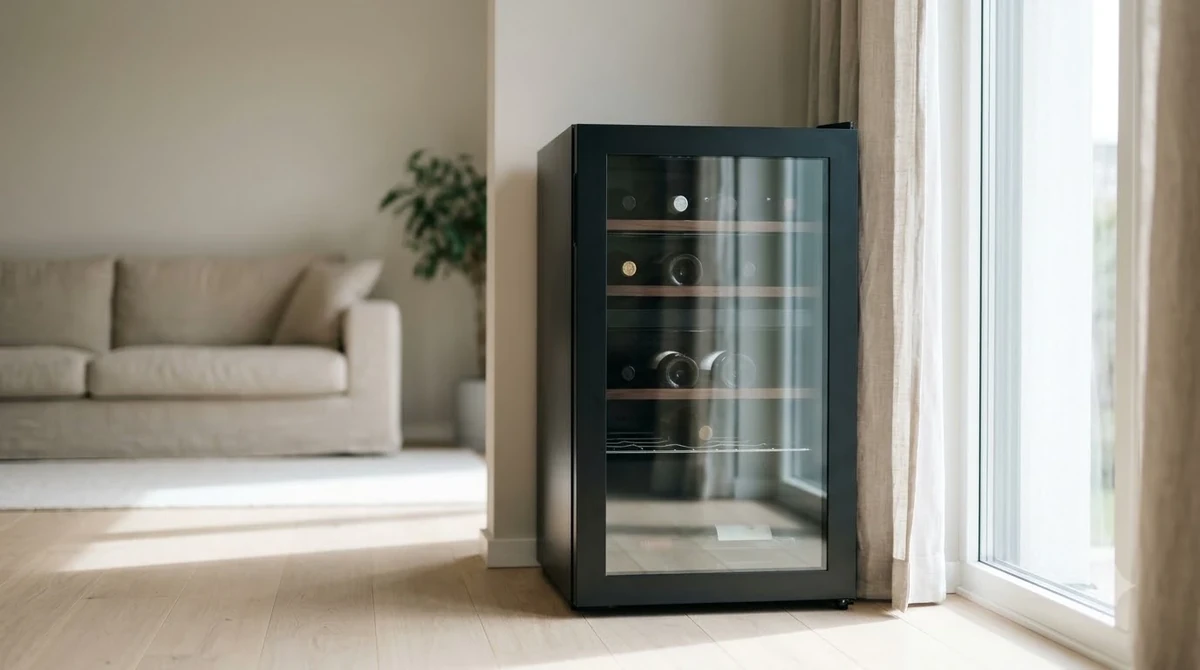
Why it stands out: Because the exhaust grille sits at the bottom toe-kick rather than the back panel, air circulates cleanly even when the cabinet is boxed in on three sides by millwork and countertops. As Wine Enthusiast’s buying guide notes, front-venting built-in models are specifically engineered for tight cabinetry, whereas rear-venting units overheat if pushed flush against a wall. Most 15-inch built-in models also include reversible doors, UV-blocking double-pane glass, and slide-out beechwood or stainless-trimmed racks that prevent you from digging to the back row.
Keep in mind and best for: Compressor fans produce a soft hum—usually around 38 to 42 decibels—and require a 24-hour upright rest before plugging in so refrigerant oils settle. This style is best for homeowners renovating a kitchen, replacing a dated trash compactor, or building a dedicated wet bar who want a permanent, built-in appliance that stores two to three cases of wine safely.

- Capacity
- 12 bottles
- Cooling
- Compressor with fan
- Zones
- Single zone
- Install
- Freestanding
Cabinetry builds need clearance planning, and this unit is sold as freestanding, so treat it as a standalone piece beside the cabinets. Inside, six removable racks hold 12 bottles, with a compressor and fan keeping the temperature steady regardless of room heat. Touch controls, soft LED lighting and a UV-resistant double-paned glass door round out a single-zone cooler.
Pros & ConsView
- Compressor cooling is unaffected by outside heat
- Six removable racks flex for bottle sizes
- UV-resistant double-paned glass door
- Freestanding design, not made for cabinet installation
- Single zone only
Best for Ultra-Tight Gaps and Small Apartments
When even 15 inches is too wide, ultra-slim 10- to 12-inch wine coolers squeeze into narrow crevices between a refrigerator and a wall or beside a freestanding bar cart. Despite their slender frame, modern 12-inch compressor models still hold 18 to 21 standard Bordeaux bottles stacked two deep.
Why it stands out: Reviewers at VinePair highlight that narrow 12-bottle and slim-profile coolers tuck neatly into city-sized kitchen nooks without dominating floor space. At roughly a foot wide, these units fit inside pantry closets, studio apartment corners, and narrow hallway alcoves where a small wine fridge of standard width would block a walkway or cabinet door swing.
Keep in mind and best for: Narrow cavities leave minimal room between shelves, which means wider Burgundy, Pinot Noir, or Champagne bottles often force you to remove a rack and sacrifice three or four slots of stated capacity. Choose this type if you live in an apartment or condo, drink primarily standard 750 mL Bordeaux-shaped bottles, and need a footprint closer to a sheet of printer paper than a full appliance.

- Capacity
- 12 bottles
- Cooling
- Compressor
- Controls
- Digital touch, °C/°F
- Lock
- Key lock
A narrow, freestanding wine-cellar-style cabinet that holds 12 standard bottles and can sit on a floor or table. A digital display with soft-touch controls handles the temperature and the °C or °F selection, while LED lights show off the shelves. The built-in door handle keeps the front smooth, so it slides next to other furniture without snagging. A key lock is fitted.
Pros & ConsView
- Narrow stainless design holds 12 bottles
- Digital touch controls with °C or °F
- Built-in handle keeps the front smooth
- Exact slim dimensions are not listed
- Compressor models can hum in very quiet spaces
Best for Serving Reds and Whites Together
A slim dual-zone wine fridge divides a 12- or 15-inch cabinet into two independently controlled climate chambers separated by an insulated baffle. You can chill Sauvignon Blanc and sparkling wine at 42°F to 46°F in the upper compartment while holding Cabernet Sauvignon or Pinot Noir at 55°F to 60°F below.
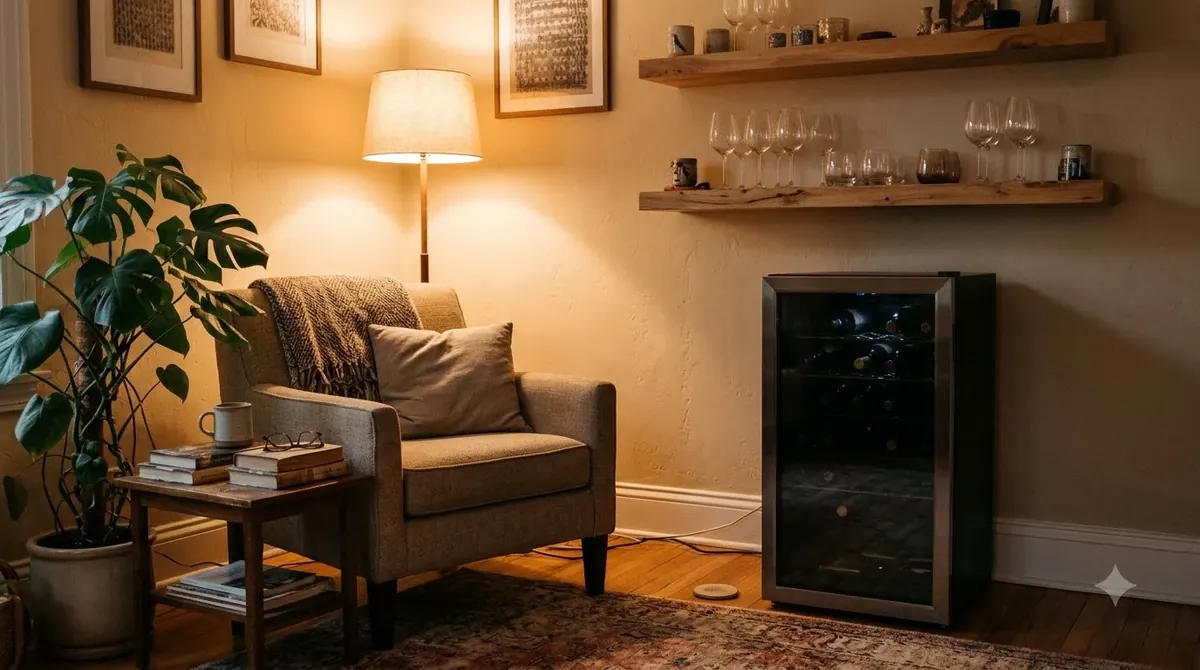
Why it stands out: In a single-zone cooler, you have to compromise around 50°F to 55°F—too warm for crisp whites to taste refreshing straight out of the cabinet and slightly too brisk for bold reds. Dual-zone engineering eliminates counter-chilling and ice-bucket guesswork so every bottle is ready to pour at dinner. Look for models with digital touch controls mounted on the divider bar so you can check both temperatures through the glass without letting cold air escape.
Keep in mind and best for: The internal divider and second evaporator fan eat up roughly four to six bottles of total capacity compared to a single-zone cabinet of identical exterior dimensions, and the two zones usually have fixed minimum and maximum ranges (for example, upper zone capped at 54°F). This type is best for couples and hosts who regularly open both red and white bottles on the same night and want true ready-to-serve precision.

- Capacity
- 1.3 cu ft
- Storage
- Wine bottles or cans
- Door
- Reversible, glass
- Defrost
- Manual
Reds and whites can share this 1.3 cubic foot cooler, which stores either type on horizontal racking, and it also takes canned beer and beverages. The reinforced glass door has an airtight seal, the door swing is reversible, and two front legs level the cabinet. At 35.8 pounds and about 16.5 inches deep, it fits a counter or sideboard.
Pros & ConsView
- Stores red, white or canned drinks
- Reversible glass door with airtight seal
- Two front legs level the cabinet
- Manual defrost needs periodic attention
- A single shelf limits stacking layouts
Best for Quiet Living Rooms and Home Offices
Slimline thermoelectric wine coolers swap mechanical compressors for solid-state Peltier heat pumps, eliminating moving refrigerant coils and compressor vibration entirely. Measuring 10 to 14 inches wide and holding 12 to 18 bottles, they sit unobtrusively next to a credenza, dining sideboard, or home office desk.
Why it stands out: According to Wine Enthusiast, thermoelectric units run virtually silently and avoid micro-vibrations that can disturb bottle sediment over time. Without a heavy compressor block in the rear base, these coolers are also lightweight enough for one person to carry up apartment stairs or reposition whenever furniture layouts change.
Keep in mind and best for: Thermoelectric modules rely on ambient room temperature and typically cool only about 20°F below the surrounding air, meaning a 78°F room will prevent the cabinet from reaching crisp white-wine temperatures in the low 40s. They also require three to five inches of open air around the back and sides and cannot be built into cabinetry. Pick this style for air-conditioned living spaces, bedrooms, or studies where whisper-quiet operation matters more than deep chilling.

- Capacity
- 18 bottles
- Temp Range
- 41°F to 64°F
- Cooling
- Compressor
- Controls
- Digital touch panel
Meant for living rooms and home offices, this narrow 18-bottle unit pairs a compressor with features aimed at quiet running: polished chrome racks, a glass door with an airtight seal and an ultra-quiet claim from the maker. Touch buttons adjust the 41°F to 64°F range and switch on the light. Six racks across two sections organize standard bottles of red and white.
Pros & ConsView
- Holds 18 standard bottles in a narrow body
- Touch panel sets 41°F to 64°F
- Airtight glass door and chrome racks
- Compressor hum may be noticeable in silent rooms
- Larger body than 12-bottle slim models
Best for Mixed Wine and Canned Beverages
A 15-inch slim wine and beverage center pairs scalloped wine racks with flat tempered-glass or wire shelves designed to hold soda, sparkling water, and craft beer cans upright. Instead of dedicating an entire appliance solely to corked bottles, you get a narrow entertaining hub that covers every guest’s drink preference.
Why it stands out: Standard wavy wine racks cause cans and stubby beer bottles to tip over or roll, while regular mini fridges lack the cradle geometry and UV-filtered glass needed to protect wine labels and corks. Hybrid slim coolers solve both issues with convertible shelving and compressor cooling that drops down to 38°F or 40°F—cold enough for canned drinks while still adjustable upward for wine.
Keep in mind and best for: Because aluminum cans need temperatures near 38°F to 40°F, single-zone wine-and-beverage hybrids run colder than ideal cellar conditions for red wine unless you dedicate the unit to whites, sparkling wine, and cans—or step up to a dual-zone hybrid. If you are still weighing different cabinet layouts, our broader guide to wine fridges by type breaks down how hybrid beverage centers compare to dedicated cellars. This category is best for busy households, game rooms, and casual entertainers who want one slim undercounter unit for weeknight seltzers and weekend bottles alike.

- Capacity
- 12 bottles
- Cooling
- Thermoelectric
- Temp Range
- 46°F to 66°F
- Size
- 10" x 20.4" x 24.9"
Listed for wine only, this 12-bottle thermoelectric chiller suits households that keep a small collection rather than a stock of cans. It measures 10 by 20.4 by 24.9 inches, weighs 28.3 pounds and uses five full-length chrome racks. The digital controls cover 46°F to 66°F, and a mirrored solid door blocks UV light. The cooling method is described as quiet and energy efficient.
Pros & ConsView
- Narrow 10-inch width at 28.3 pounds
- Five full-length chrome removable racks
- Mirrored door blocks UV light
- Listed for wine bottles, not canned drinks
- Temperature range stops at 46°F
How to Choose
Measure the cutout and door swing twice: A “15-inch” wine fridge usually measures 14.75 to 14.9 inches wide so it slides into a 15-inch cabinet opening, but protruding towel-bar handles can add two inches to total depth. Check whether the door has a zero-clearance hinge; otherwise, a hinge placed right against a wall or adjacent cabinet face may stop the door at 90 degrees and block the shelves from sliding out.
Match ventilation to installation style: Never slide a rear-venting freestanding cooler into an enclosed undercounter bay. Trapped heat forces the cooling system to run nonstop, spikes electricity bills, and burns out the motor early. Only front-venting models with a slotted lower grille belong inside cabinetry.
Account for real-world bottle shapes: Manufacturers calculate maximum bottle counts using slim 750 mL Bordeaux bottles arranged neck-to-base. If your collection leans toward sloped-shoulder Pinot Noir, Rhône, or sparkling wine bottles, subtract 15 to 25 percent from the advertised capacity—or shop for removable shelves with adjustable spacing. When you only keep four to eight bottles on hand at a time, a countertop mini wine fridge may be easier to place than a tall slim tower.
Check glass tint, lock, and upright storage: Look for double-pane tempered glass with UV protection if the fridge sits near a sunny kitchen window, and consider a keyed lock if curious kids have easy access to low undercounter handles. A few slim models also include a vertical or tilted rack specifically shaped to keep opened bottles upright without leaking, which pairs nicely with knowing how long wine lasts after opening so midweek pours stay fresh.
Tip: Before committing to a built-in spot, tape the exact width and depth of the fridge—plus the full arc of the open door—onto your kitchen floor with painter’s tape to make sure you can pull shelves out cleanly without hitting an island or dishwasher handle.
Frequently Asked Questions
How wide is a slim wine fridge?
Most slim wine fridges measure between 10 and 15 inches wide, compared to 24 inches for a standard full-width undercounter wine cooler. Twelve-inch models fit narrow freestanding gaps and hold roughly 12 to 21 bottles, while 15-inch built-in units match standard narrow kitchen base cabinets and store 26 to 34 bottles.
Can you put a slim wine fridge under the counter?
Yes, as long as you choose a front-venting model designed for built-in installation. Front-venting coolers expel warm air through a grille beneath the door, allowing flush placement against side and back cabinet walls, whereas rear-venting freestanding models need several inches of open clearance on all sides to avoid overheating.
Do slim wine fridges fit Pinot Noir and Champagne bottles?
They can, though wider Burgundy, Pinot Noir, and sparkling wine bottles reduce total capacity because stated bottle counts assume slim 750 mL Bordeaux bottles. Look for a slim cooler with removable or adjustable wood racks so you can take out one shelf to create extra vertical clearance for wider bottles.
Is a compressor or thermoelectric slim wine fridge better?
Compressor models are better for kitchens, built-in cabinetry, and warm rooms because they hold steady temperatures down to 40°F regardless of ambient heat. Thermoelectric models are quieter and vibration-free, making them ideal for air-conditioned living rooms or offices where low noise matters more than deep chilling.
Choosing the right narrow wine cooler comes down to matching the cooling engine and vent placement to the exact gap in your floor plan. Once you confirm whether you need flush undercounter integration, dual-zone serving flexibility, or whisper-quiet freestanding placement, a 12- to 15-inch footprint gives your bottles proper cellar protection without sacrificing valuable kitchen real estate.
More in Wine Fridges by Type
 Best White Wine Fridge for Reliable Chilling and StorageUpdated Nov 20, 2026
 Best Smart Wine Fridge for Steady Temperatures and Remote ChecksUpdated Nov 18, 2026
 Best Black Under Counter Wine Fridge Options for Kitchens and IslandsUpdated Nov 18, 2026
 Best Black Slim Wine Fridge for Narrow Gaps and Dark KitchensUpdated Nov 18, 2026
 Best Built In Dual Zone Wine Fridge Options by Kitchen LayoutUpdated Nov 18, 2026
 Best Slim Built in Wine Cooler: 5 Space-Saving Styles for Tight KitchensUpdated Nov 18, 2026