

We may earn a commission when you buy through links on this page, at no extra cost to you. Learn more.
The best wine bottle holder for your home depends on how many bottles you keep on hand, how long you plan to age them, and where you have spare surface or wall space. Compact countertop cradles work well for a small rotation of weeknight bottles, while wall-mounted racks free up floor space and turn labels into visual decor. If you buy by the case or enjoy larger-format bottles, stackable modular grids and sturdy freestanding floor racks give you room to expand without crowding your kitchen.
Even if you do not own a dedicated basement cellar, keeping wine in a proper rack prevents bottles from rolling, clinking, or sitting upright in warm kitchen light. Storing bottles horizontally keeps natural corks in steady contact with the wine so they stay swollen and airtight, protecting what is inside from premature oxidation. From slim metal cradles made for a bar cart to expandable wooden cubes built for a pantry closet, choosing the right structure comes down to matching bottle capacity, slot diameter, and placement with your daily drinking habits.
Quick Comparison
Different bottle holder designs solve very different storage problems, ranging from single-bottle tabletop presentation to high-capacity closet organization.
| Holder Type | Typical Capacity | Best Placement | Bottle Orientation | Expansion Potential |
|---|---|---|---|---|
| Countertop Cradle & Tabletop Rack | 1 to 12 bottles | Kitchen counter, sideboard, or bar cart | Horizontal or slightly angled | Low (fixed footprint) |
| Wall-Mounted Label-Forward Rack | 6 to 36 bottles | Dining room wall, pantry, or hallway | Horizontal (label facing out) | Moderate (add adjacent rails) |
| Stackable Modular Cube & Grid | 12 to 100+ bottles | Closet, basement, or pantry floor | Horizontal (cork-forward) | High (stackable units) |
| Under-Cabinet & Hanging Stemware Rack | 4 to 10 bottles | Under upper kitchen cabinets or islands | Horizontal with glass rails below | Low (constrained by cabinet width) |
| Portable Tote & Insulated Carrier | 1 to 6 bottles | Car trunk, picnic blanket, or dinner party | Upright with padded dividers | None (fixed travel compartments) |
Best for Compact Kitchens and Countertops
Low-profile countertop racks and sculptural single-bottle stands keep a small selection of weeknight favorites tidy and accessible without requiring drills, wall anchors, or extra floor space.

Countertop holders excel when your collection stays under a dozen bottles and turns over quickly. According to storage guidance from Wine Enthusiast, keeping a small six-bottle rack within reach makes sense for everyday drinkers, provided you position it well away from heat-generating appliances like ovens, stoves, and refrigerators. Open geometric wire frames, wave-shaped wood cradles, and interlocking bamboo tiers all cradle bottles horizontally while letting air circulate freely around the glass.
Keep in mind that open kitchen counters are rarely ideal for long-term aging because room temperatures fluctuate and overhead fixtures or windows expose bottles to light. Reserve countertop holders for bottles you plan to open within a few weeks or months, and double-check the base footprint so the unit sits flat without wobbling when you pull a bottle from the top row. This style is best for apartment dwellers, casual hosts, and anyone who wants three to twelve go-to bottles organized on a sideboard or dining console.
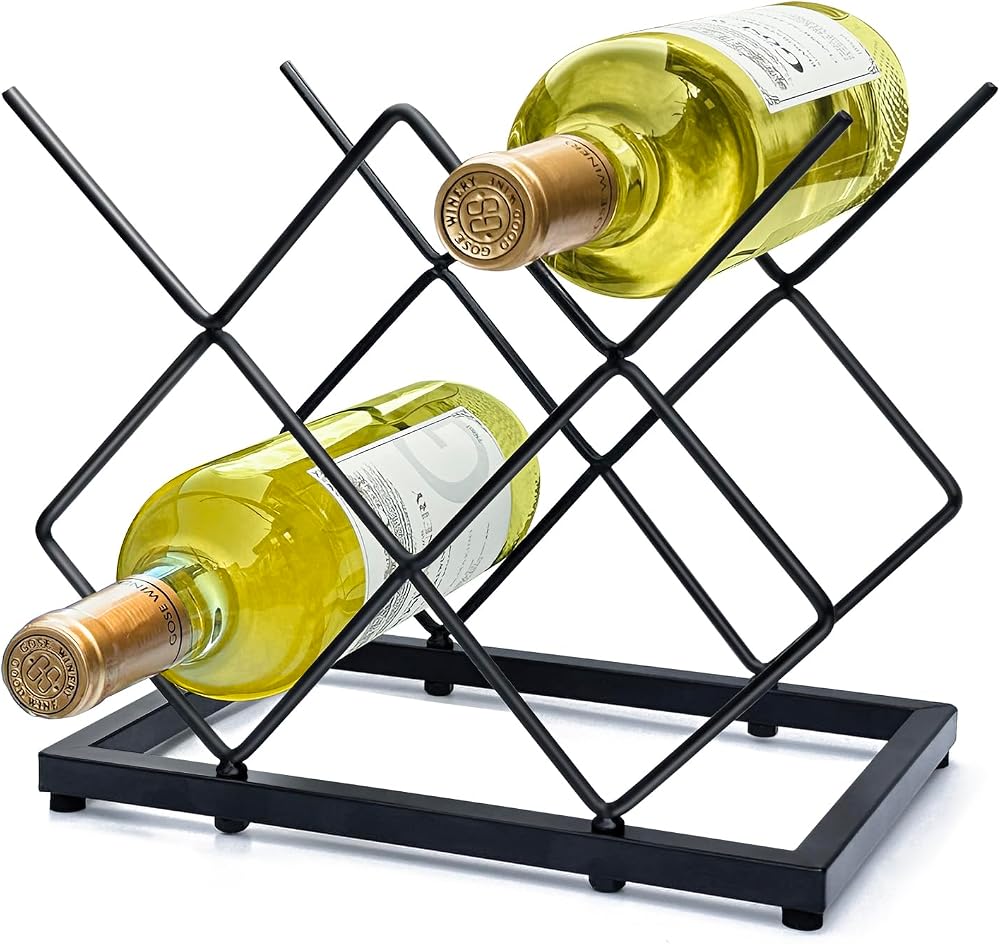
- Capacity
- 5 bottles
- Material
- Iron, powder coated
- Size
- 10 x 7.28 x 9 in
- Weight
- 1.5 lb
For small collections, this black iron rack keeps five bottles on a kitchen counter, in a pantry or inside a cabinet. The frame is described as steady, with no wobbling or tilting, and the rust-resistant finish wipes down with a damp cloth. It goes together without tools, so a few favorites can be on display within minutes.
Pros & ConsView
- Five-bottle capacity fits small collections
- No tools needed for assembly
- Rust-resistant finish wipes clean
- Too small for a growing collection
- Single fixed layout, no expansion
Best for Small-Space Wall Display
Wall-mounted metal rails and peg systems lift bottles off crowded surfaces and turn empty vertical wall space into an accessible, label-forward wine display.
Vertical wall holders stand out because they store bottles parallel to the wall rather than cork-first, letting you read every label at a glance without pulling bottles out and disturbing sediment. Wine storage specialists note that clear label visibility makes it much easier to separate bottles meant for immediate drinking from bottles you want to hold back for a special dinner. Powder-coated steel rails and individual aluminum wall pegs also maintain a slim profile, projecting only a few inches into a hallway, dining nook, or pantry wall.
Before committing to a wall-mounted holder, check your wall construction and stud spacing, since loaded 750-milliliter glass bottles weigh roughly three pounds each. You will also want to choose an interior wall away from direct afternoon sunlight and heating vents, because UV rays and warmth speed up aging. This design is best for homeowners and renters with stud access who want clean, modern storage that doubles as dining-room wall art.

- Material
- Alloy steel, reclaimed wood
- Set Size
- Set of 2
- Each Size
- 16.92 x 5.9 x 0.7 in.
- Care
- Wipe with dry cloth
Home bars and dining rooms gain a vintage look from this pair of wall-mounted racks, built from sturdy steel with a baked reclaimed-wood finish. They hang flutes, mugs, or small decor, and move easily when the layout changes. Instructions are included for installation, and the dark brown tone suits both classic and modern spaces alike.
Pros & ConsView
- Steel frame with reclaimed wood finish
- Two racks per set
- Instructions included for quick installation
- Wall mounting means drilling into the wall
- Dry-cloth wiping is the only listed care
Best for Growing Collections and Closets
Stackable wooden cubes, interlocking pin-and-rail kits, and freestanding bin grids offer high-density storage that scales smoothly as your bottle count grows from one case to several.
Modular floor racks shine when you buy mixed cases, collect bottles from wine clubs, or need to organize a spare closet or basement corner. Industry pros interviewed by Wine Enthusiast emphasize that a sturdy rack protects resting wine from subtle floor vibrations that can stir up sediment, while also letting you group bottles systematically by region, varietal, or red versus white. Solid hardwood frames and diamond-shaped bin dividers distribute weight evenly across the floor and prevent stacks from shifting.
Keep in mind that dense cork-forward grids hide the front labels, so you may want to add simple neck tags to identify vintages without sliding bottles in and out. Measure your closet depth carefully as well, because standard Bordeaux bottles need roughly 12 to 13 inches of depth so necks do not protrude past a swinging door. This category is best for budding collectors, club members, and anyone converting an under-stairs nook or cool pantry into organized storage.
Best for Entertaining and Glassware Pairing
Combination bottle-and-stemware holders mount under cabinets or sit atop a buffet, pairing horizontal bottle slots with inverted tracks that suspend wine glasses safely by their bases.
Combo holders stand out for streamlining hosting, keeping both your wine and your stemware in one dedicated station rather than scattered across high kitchen shelves. Wine storage editors point out that hanging glasses upside down by the foot prevents rims from knocking against mugs or tumblers inside cramped cabinets, while freeing up cupboard space for plates and serving bowls. Many tabletop and wall-hung versions hold four to eight bottles along an upper shelf with three or four stemware channels directly underneath.
Keep in mind that stemware track spacing matters: extra-wide crystal Burgundy bowls or tall Champagne flutes may rub together if the rails sit too close, and ultra-delicate hand-blown stems with thin rims are often safer stored upright on a flat shelf. Always check the clearance below upper kitchen cabinets so hanging glasses do not interfere with coffee makers or countertop prep. This option is best for frequent hosts, small-condo kitchens, and anyone building a compact drink station alongside other essentials from our Accessories Library.

- Capacity
- 8 bottles
- Material
- Acacia wood
- Max Diameter
- 3.15 in
- Layout
- 2 sizes, 3 wine styles
A good display piece for a small rotation of bottles, this acacia wood rack doubles as a water bottle organizer. It can be arranged three ways for wine and adjusted to two sizes for taller or shorter bottles, and it sits on a counter or in a cabinet. Bottles must stay under 3.15 inches in diameter, so check wider ones first.
Pros & ConsView
- Two-in-one wine and water bottle rack
- Adjustable in two sizes, three wine layouts
- Natural acacia wood finish
- Bottle diameter limited to 3.15 inches
- Two tiers hold only eight bottles
Best for Travel, Picnics, and BYOB Dinners
Padded wine totes, structured canvas carriers, and insulated bottle sleeves keep glass bottles upright, cushioned, and temperature-stable when you leave the house.
Travel bottle holders solve the exact opposite problem of home racks: instead of cradling bottles sideways on a stationary shelf, they use padded internal dividers and reinforced bases to stop bottles from clanking together in a car trunk or over a shoulder. Insulated neoprene and thermal-lined carriers also slow down temperature swings on warm afternoons, keeping chilled whites crisp and reds from overheating on the way to a park concert or friend’s dinner table. Many multi-bottle totes include collapsible dividers so you can carry two bottles alongside a corkscrew and cloth napkins.
Keep in mind that soft-sided carriers are built for short-term transport rather than multi-week home storage, and extra-wide sparkling wine or Pinot Noir bottles can be snug inside rigid cylindrical sleeves. Check stitching around the handle straps if you plan to carry four or six full bottles at once, as six bottles easily top 18 pounds. This style is best for picnickers, BYOB restaurant diners, and gift-givers bringing a few bottles to a holiday gathering.
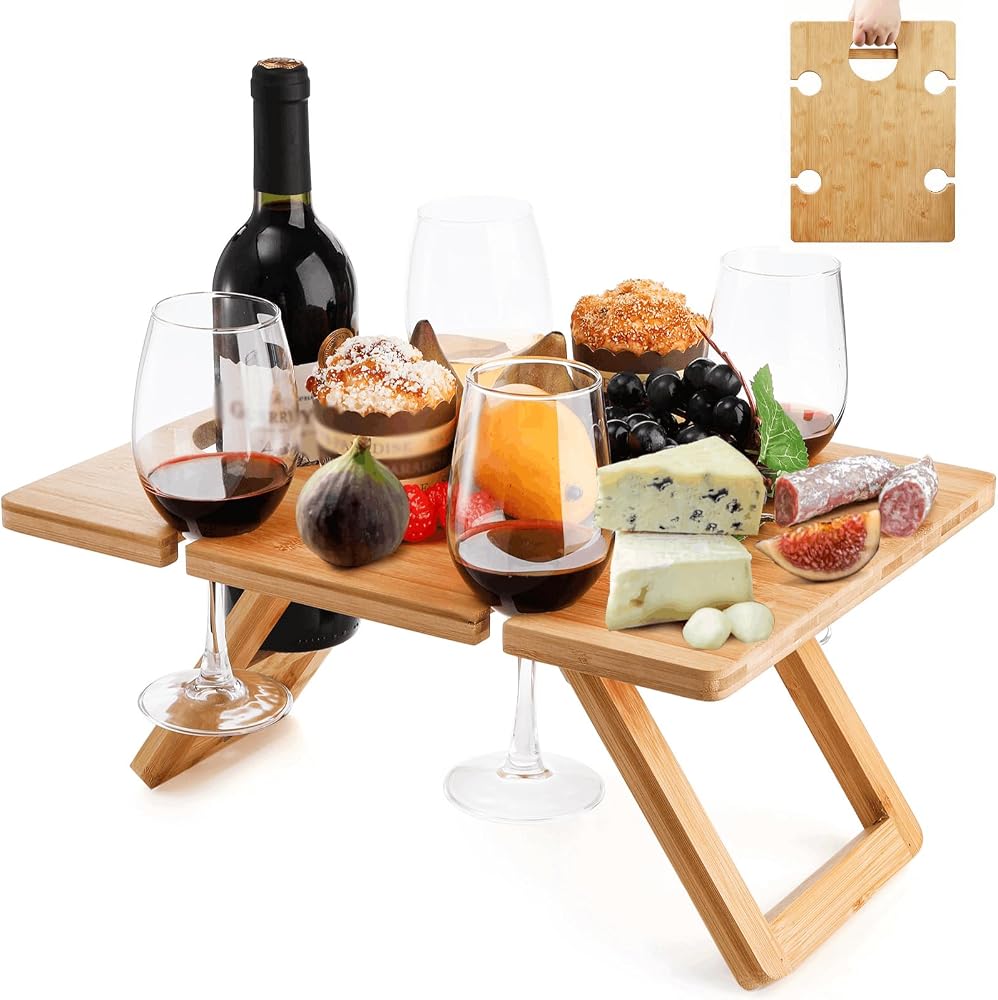
- Material
- Bamboo
- Size
- 15.6 x 11.7 x 7.5 in
- Holes
- 1 bottle, 4 glasses
- Weight
- 2.9 lb
A foldable bamboo tray table for picnics, beach days and BYOB dinners. One large hole secures the bottle and doubles as a handle, while four small holes hold glasses or cans. The legs fold flat for carrying, and the surface leaves space for snacks. At 2.9 pounds and 15.6 by 11.7 inches, it packs easily for parks, camping and boating.
Pros & ConsView
- Legs fold flat for carrying
- Five holes secure one bottle and four glasses
- Bamboo build weighs just 2.9 pounds
- Low 7.5-inch height means sitting on the ground
- Compact 15.6 by 11.7 inch top limits food space
How to Choose
Measure slot diameter for diverse bottle shapes. Standard 750-milliliter Bordeaux bottles are slim and straight-sided, whereas Burgundy, Pinot Noir, Rhône, and Champagne bottles have wider shoulders and bases. Reviewers at Wine Enthusiast recommend looking for openings between roughly 3 and 3.5 inches wide if you regularly buy sparkling wine or Pinot Noir, so heavier bottles slide in without scraping labels or wedging tight.
Match capacity to your real buying pace. Count how many bottles you typically keep at home—including seasonal samplers like a wine advent calendar or holiday case—and add 25 to 30 percent extra room so you are not forced to stack loose bottles on top of a full rack.
Prioritize stability and material durability. Solid hardwoods like mahogany, walnut, and bamboo resist warping in humid spaces, while powder-coated steel and heavy-gauge wrought iron resist rust and support heavy loads without flexing. Avoid thin, unbraced wire frames for tall freestanding units, as top-heavy racks can tip on carpet or uneven floorboards.
Scout the environment before you buy. Even the sturdiest rack cannot protect wine from a sunny windowsill or a warm spot next to the dishwasher. Aim for a dim, vibration-free corner with steady room temperatures—ideally between 45 and 65 degrees Fahrenheit for longer holds—and choose a rack footprint that fits naturally into that cooler zone.
Tip: Before ordering any freestanding or wall-mounted rack, grab your widest Champagne or Burgundy bottle and measure its base diameter; testing your single widest bottle against the manufacturer’s slot specs prevents frustrating returns later.
Frequently Asked Questions
Do all wine bottles need to be stored horizontally in a holder?
Bottles sealed with natural corks benefit most from horizontal or slightly angled storage because keeping wine in contact with the cork prevents it from drying out, shrinking, and letting oxygen seep in. Bottles closed with screw caps or crown caps do not need moisture to maintain their seal, so you can store them upright or on their sides based on whatever saves space.
Where is the worst place in a kitchen to put a countertop wine bottle holder?
Avoid placing a wine holder directly next to your stove, oven, dishwasher, or refrigerator exhaust, as steady appliance heat accelerates aging and dulls fresh fruit flavors. Windowsills and spots under bright under-cabinet task lights are also poor choices because UV rays and heat degrade wine quickly.
How much weight should a wall-mounted wine bottle holder support?
A full 750-milliliter glass wine bottle typically weighs between 2.6 and 3.3 pounds, meaning a 12-bottle wall rack holds roughly 35 to 40 pounds before you even count the weight of the metal frame. Always anchor wall-mounted holders directly into wood studs or use heavy-duty toggle bolts rated well above the fully loaded weight.
How many bottles should my first wine rack hold if I entertain occasionally?
A 12- to 24-bottle rack is a practical starting size for casual hosts, giving you enough room to keep a mix of reds, whites, and sparkling bottles ready without taking over a closet. Knowing how many glasses in a bottle of wine—roughly five standard pours per 750-milliliter bottle—also helps you estimate how many slots to keep stocked for dinner parties.
Choosing the right wine bottle holder comes down to pairing your available space with how you actually buy and open wine. Start by picking a cool, shaded spot away from kitchen heat, measure your widest bottles against the rack’s slot dimensions, and leave a little extra room for new favorites to accumulate.
More in Wine Accessories
 Coravin Vs Vacu Vin: Choose the Right Wine Saver for Your BottlesUpdated Nov 21, 2026
 Zwilling Wine Stopper Review: Preserve Open Bottles LongerUpdated Nov 21, 2026
 Wine Enthusiast Wine Preserver Review: Features, Benefits and LimitationsUpdated Nov 21, 2026
 Wine Enthusiast Wine Stopper: An Easier Way to Reseal Open BottlesUpdated Nov 21, 2026
 Vintorio Wine Opener: Two-Step Cork RemovalUpdated Nov 21, 2026
 Zwilling Wine Aerator Review: Aerate, Pour, and Seal With One ToolUpdated Nov 21, 2026