

We may earn a commission when you buy through links on this page, at no extra cost to you. Learn more.
Looking at pinot grigio carbs, a standard 5-ounce glass of dry Pinot Grigio has about 3 grams of carbohydrates, zero grams of fat, and roughly 0.1 grams of protein. Most of those carbohydrates come from unfermented grape sugar left over after winemaking, known as residual sugar, while the roughly 122 calories in a glass come primarily from alcohol rather than carbohydrates. Regional styles and sweetness levels can shift that total slightly, with crisp Italian bottles landing on the lower end and richer Alsace Pinot Gris styles sometimes holding a bit more.
Because US wine labels rarely print a full nutrition panel, tracking macros on wine night can feel like guesswork. Understanding how grapes turn into alcohol, why serving sizes matter so much, and how different winemaking regions treat this grape makes it easy to estimate what is actually in your glass.
Pinot Grigio Carbs and Nutrition by Serving Size
A standard 5-fluid-ounce pour of Pinot Grigio contains 3.0 grams of total carbohydrates and 122 calories, according to USDA FoodData Central figures. Scaling that pour up or down changes your carb intake proportionally, which matters when restaurant glasses or home pours run larger than five ounces.
When you measure wine by the fluid ounce rather than by the glass, the math stays simple and predictable. Every single fluid ounce of standard dry Pinot Grigio contributes roughly 0.6 grams of carbohydrates and about 24 calories. If you share a standard 750-milliliter bottle, which holds roughly 25.4 fluid ounces or five standard pours, the entire bottle adds up to approximately 15 grams of carbs and 610 calories. Over a long dinner, pouring even one extra ounce per glass quietly adds 1.2 grams of carbs across two glasses.
| Serving Size | Weight | Total Carbs | Calories | Protein | Fat |
|---|---|---|---|---|---|
| 1 fluid ounce | 29.3 g | 0.6 g | 24 kcal | 0.1 g | 0 g |
| 4 fluid ounces (small pour) | 117.6 g | 2.4 g | 97 kcal | 0.1 g | 0 g |
| 5 fluid ounces (standard glass) | 147 g | 3.0 g | 122 kcal | 0.1 g | 0 g |
| 6 fluid ounces (generous pour) | 176.4 g | 3.6 g | 146 kcal | 0.1 g | 0 g |
| 750 ml bottle (about 25.4 fl oz) | 745 g | 15.2 g | 610 kcal | 0.5 g | 0 g |
Looking closely at the macro breakdown reveals a common point of confusion on nutrition databases. Standard macronutrient calculators attribute four calories to each gram of carbohydrate and protein, and nine calories to each gram of fat. Because Pinot Grigio has 0 grams of fat, 0.1 grams of protein, and 3 grams of carbs, those three numbers only account for around 12 calories. The remaining 110 calories in a 5-ounce glass come directly from ethanol, which is about 15.7 grams of alcohol per serving. Treating Pinot Grigio as a low-carb drink is accurate, yet overlooking alcohol calories can still throw off daily energy targets.
Where the Carbs in Pinot Grigio Come From
Carbohydrates in Pinot Grigio come almost entirely from residual sugar, which is the natural fructose and glucose from the grape juice that yeast did not convert into alcohol during fermentation. Trace amounts of unfermentable carbohydrates from grape skins and pulp make up the tiny remainder.
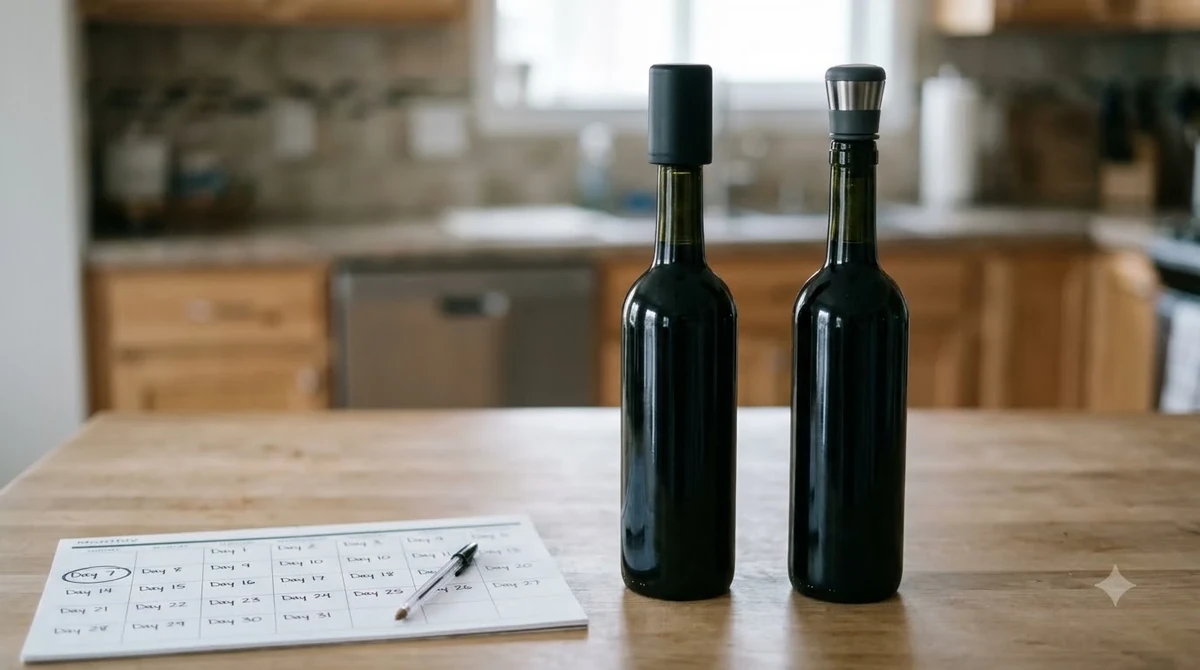
Every bottle of wine begins as sweet grape must packed with natural fruit sugars. During alcoholic fermentation, winemakers introduce yeast that consumes those sugars and produces ethanol and carbon dioxide as byproducts. As explained in Wine Folly’s guide to carbs in wine, dry wines are fermented until almost all of the grape sugar is gone, leaving behind less than 2 grams of residual sugar per liter in many classic examples. Even in a completely dry fermentation, tiny traces of unfermented sugars and non-fermentable plant compounds like glycerol and trace polysaccharides remain in solution, which is why the USDA database records 3 grams of total carbohydrate per 5-ounce glass even when added sugar is zero.
Winemakers control the final carb count by deciding when to stop fermentation. If a producer chills or filters the wine early before the yeast finishes eating the sugar, the resulting wine tastes softer and carries more residual sugar and lower alcohol. Conversely, letting the yeast ferment nearly to completion yields a crisp, bone-dry white with higher alcohol by volume and minimal carbs. Understanding whether Pinot Grigio is sweet or dry helps explain why two bottles with the same grape on the front label can feel noticeably different on the palate.
How Region and Style Affect Carb Counts
While classic Italian Pinot Grigio is fermented dry and stays right around 2 to 3 grams of carbs per glass, richer Pinot Gris styles from regions like Alsace, Oregon, or New Zealand can carry slightly higher residual sugar and higher carb counts. Same grape, very different cellar choices.

Pinot Grigio and Pinot Gris are the exact same pinkish-gray grape variety, known in France as Pinot Gris and in Italy as Pinot Grigio. In northeastern Italy—particularly across Delle Venezie, Friuli-Venezia Giulia, and Alto Adige—winemakers typically harvest the grapes early to preserve brisk acidity and ferment the juice completely dry in stainless steel tanks. Reviewers at Decanter highlight how northern Italian examples from Friuli and Alto Adige show crisp green apple, lemon, and stony mineral notes with alcohol levels commonly sitting between 12.5 and 13.5 percent ABV, keeping residual sugar and carbs very low.
When you move to Alsace in eastern France or parts of New Zealand, producers often let the grapes hang on the vine longer to build riper orchard fruit flavors, honeyed aromatics, and richer body. According to Decanter’s Pinot Grigio and Pinot Gris tasting notes, several top-scoring bottles from Alsace and Alto Adige reach 14 percent ABV with supple, honeyed textures, while certain New Zealand expressions sit around 9.5 percent ABV with noticeable residual sugar balanced by zesty acidity. Oregon’s Willamette Valley generally lands in the dry middle ground, fermented clean with bright pear and melon flavors and roughly 13 percent ABV. If keeping carbs strictly around 3 grams per glass is your priority, sticking to dry northern Italian or Oregon bottles is the safest bet.
How Pinot Grigio Compares to Other White Wines
Pinot Grigio sits squarely in the low-carb tier of white wines, matching dry Sauvignon Blanc and Brut Champagne while containing far fewer carbohydrates than off-dry Riesling or sweet Moscato. Most dry table whites hover within a narrow 2 to 4 gram range per standard pour.
Because fermentation mechanics work the same way across white grape varieties, any crisp white fermented to dryness will deliver a very similar nutrition profile. Sauvignon Blanc, Pinot Blanc, and un-oaked Chardonnay all typically fall between 2 and 4 grams of carbs per 5-ounce glass, with alcohol levels dictating minor differences in total calories. Exploring what Pinot Grigio tastes like next to Sauvignon Blanc shows that flavor intensity comes from aromatic compounds and acidity rather than extra sugar—Sauvignon Blanc simply packs louder herbal and citrus aromatics into the same low-carb footprint.
The biggest jumps in carbohydrate content happen when you step out of the dry table wine category into intentionally sweet or fortified styles. Off-dry German Kabinett Riesling halts fermentation early to preserve vibrant fruit sweetness, pushing carbohydrates higher while lowering alcohol. Moscato d’Asti stops fermentation even earlier, resulting in a lightly sparkling, sweet wine with noticeably more sugar per ounce. If you are browsing broader wine types for a low-carb table option, dry Pinot Grigio remains one of the most consistent choices on any restaurant list.
Tip: Check the alcohol percentage on the back label when comparing two bottles of Pinot Grigio. A bottle around 12.5 to 13.5 percent ABV has usually fermented nearly all of its grape sugar into alcohol, whereas an unusually low 9 or 10 percent ABV often signals leftover residual sugar.
How to Spot a Lower-Carb Bottle Without a Nutrition Label
Even without a nutrition facts panel on the back of the bottle, three simple label clues—alcohol by volume, regional origin, and winery tech sheets—let you gauge residual sugar before you pull the cork. Knowing how to read those cues takes the guesswork out of shopping.
Start by scanning the front and back labels for the alcohol by volume percentage and the regional appellation. Under European wine laws, bottles labeled Delle Venezie DOC, Alto Adige DOC, or Friuli DOC follow strict regional production rules that favor dry, crisp winemaking. Avoid bottles carrying terms like “sweet,” “semi-sweet,” “dolce,” or “moelleux,” as well as casual blended white table wines that do not list a specific region, since entry-level commercial blends sometimes leave a touch of residual sugar to round out sharp acidity.
For exact numbers, search the wine’s name and vintage alongside the words “tech sheet” on your phone. Most quality-focused wineries publish free technical sheets for trade and consumers that list exact residual sugar in grams per liter, total acidity, and pH. To convert grams per liter into carbs per 5-ounce glass, divide the residual sugar number by 6.75—for example, a bottle with 2 grams per liter of residual sugar holds well under half a gram of pure sugar per glass, plus roughly 2 grams of non-sugar wine carbohydrates.
Serving Temperature and Practical Pouring Tips
Serving Pinot Grigio properly chilled sharpens its natural acidity, making a dry, low-carb bottle taste vibrant and refreshing rather than lean or austere. Warm temperatures mute citrus notes and can make alcohol feel heavier on the palate.
Refrigerating your bottle for about two hours before serving brings it into the ideal crisp white wine window, and knowing whether Pinot Grigio should be chilled helps keep its bright orchard fruit and mineral snap intact from the first sip to the last. When wine is served well chilled, subtle fruit aromas shine without needing residual sugar to create a pleasant mouthfeel.
Portion control is the other practical habit that keeps carb counts accurate. Standard stemmed white wine glasses often hold 12 to 14 ounces to the brim, which makes a true 5-ounce pour look surprisingly small—usually filling only about a third of the bowl. Measuring 5 ounces of water into your favorite wine glass once at home gives you a reliable visual benchmark so every future pour stays right around 3 grams of carbs.
Frequently Asked Questions
How many net carbs are in a glass of Pinot Grigio?
A standard 5-ounce glass of dry Pinot Grigio contains about 3 grams of net carbs. Because wine contains 0 grams of dietary fiber, total carbohydrates and net carbohydrates are identical.
Does Pinot Grigio have added sugar?
Traditional dry Pinot Grigio does not contain added table sugar. The small amount of sugar present comes naturally from unfermented grape juice, though inexpensive flavored wine coolers or spritzers made with Pinot Grigio may add sweeteners.
Is Pinot Grigio lower in carbs than Chardonnay?
Dry Pinot Grigio and dry Chardonnay have virtually the same carbohydrate count, both averaging around 3 grams per 5-ounce pour. Chardonnay can occasionally carry slightly higher calories because fuller-bodied styles often reach higher alcohol levels.
Why do some nutrition apps list 2 grams of carbs and others list 4 grams?
Differences usually come down to serving size rounding and slight variations in residual sugar between vintages. A 4-ounce pour logs at roughly 2.4 grams of carbs, while a 5-ounce pour lands at 3 grams and a generous 6-ounce pour approaches 3.6 to 4 grams.
With roughly 3 grams of carbohydrates per 5-ounce glass, dry Pinot Grigio remains one of the easiest white wines to fit into a carb-conscious routine. Stick to crisp, dry regional styles, watch your glass pour size, and check the ABV on the label whenever you explore a new bottle.
More in Wine Types & Grapes
 Zinfandel Sugar Content: Dry Red vs. White Zinfandel GramsUpdated Nov 21, 2026
 Best Zinfandel Substitute Options for Sipping and CookingUpdated Nov 21, 2026
 Zweigelt Food Pairing: Best Dishes, Cheeses, and Serving TipsUpdated Nov 21, 2026
 Zinfandel Tannins Explained: How Structure Shapes Every BottleUpdated Nov 21, 2026
 Zinfandel Sweetness Level: Dry Red vs. Sweet White Zin ExplainedUpdated Nov 21, 2026
 Xinomavro Food Pairing: Best Dishes, Styles, and Serving TipsUpdated Nov 21, 2026