

We may earn a commission when you buy through links on this page, at no extra cost to you. Learn more.
The best 16 bottle wine rack for most homes is a freestanding wood or metal cube rack that fits a counter corner, bar nook or floor space near the kitchen. Sixteen bottles is a mid-sized collection: enough for a few cases of rotating reds and whites, but not so large that the rack dominates a room. The right choice depends on the space you have, whether the rack should look like furniture, and how long the bottles will stay in place.
A 16 bottle wine rack sits between the smaller 6 and 12 bottle models and the larger 20 bottle designs. It suits people who buy a case or two at a time, drink through the stock within a few months, and want the bottles within easy reach. This guide compares the main rack layouts, explains what to measure before buying, and answers the questions buyers ask most often about size and storage.
Quick Comparison of 16 Bottle Wine Rack Types
Most 16 bottle racks fall into a few families. The main differences are the footprint, how easy it is to reach a bottle in the middle of the stack, and whether the rack can handle bottles of unusual shapes. The table below summarizes the trade-offs in plain terms.
| Rack type | Footprint | Access to bottles | Best setting |
|---|---|---|---|
| Stacked cube | Compact, roughly square | Good for the top layers, harder for the bottom | Counter corner, pantry shelf |
| Diagonal or staggered cube | Slightly wider than a stack | Easy to see each bottle | Dining room or living room display |
| Wall-mounted shelf | Low depth, takes wall space | Fair, bottles sit at eye level | Narrow hallway or bar wall |
| Cabinet insert | Fits a set cabinet opening | Good, pull-out or open front | Kitchen or bar cabinet |
| Wood floor rack with feet | Freestanding, larger base | Strong overall, heavy to move | Cellar corner, storage room |
Best for Small Kitchens and Counter Corners
A compact cube rack is the most common shape for sixteen bottles. It stacks bottles in a tight grid, so the footprint stays small while the rack still holds a useful number of wines. Reviewers of wine storage products often describe this layout as the simplest way to add capacity without moving other appliances.
Why it stands out: A square base fits most corners, and the stacked design keeps the total depth low. Many models use plain wood or metal, which blends with standard cabinet finishes.
Keep in mind: In a tight stack, the bottom bottles are the hardest to reach. Buy a rack with a slight tilt or open front if you plan to pull bottles often.
Best for: Households that want a tidy way to store a rotating supply of everyday wines.

Best for Bars and Cabinet Spaces
When space is measured inside a cabinet or along a bar wall, the best 16 bottle wine rack is often a cabinet insert or a low, wide shelf unit. These designs are built to match an opening rather than sit in open floor space, which keeps the bottles out of sight when guests are not around.
Why it stands out: A rack that fits a set opening uses space that would otherwise go unused. Pull-out or open-front versions make bottles easy to reach without disturbing the rest of the stack.
Keep in mind: Measure the opening height and depth before buying, including the lip of the cabinet door. Bottles with wide shoulders need extra clearance.
Best for: Kitchens with an unused cabinet, or home bars where bottles should stay near the glasses.
Best for Dining Rooms and Display
Some buyers want the rack to be part of the room. A staggered or diagonal cube layout shows each bottle label, which suits a dining room or living room where the wine collection is part of the decor. The bottles are still stored on their side, which is the usual method for keeping corks moist during longer storage.
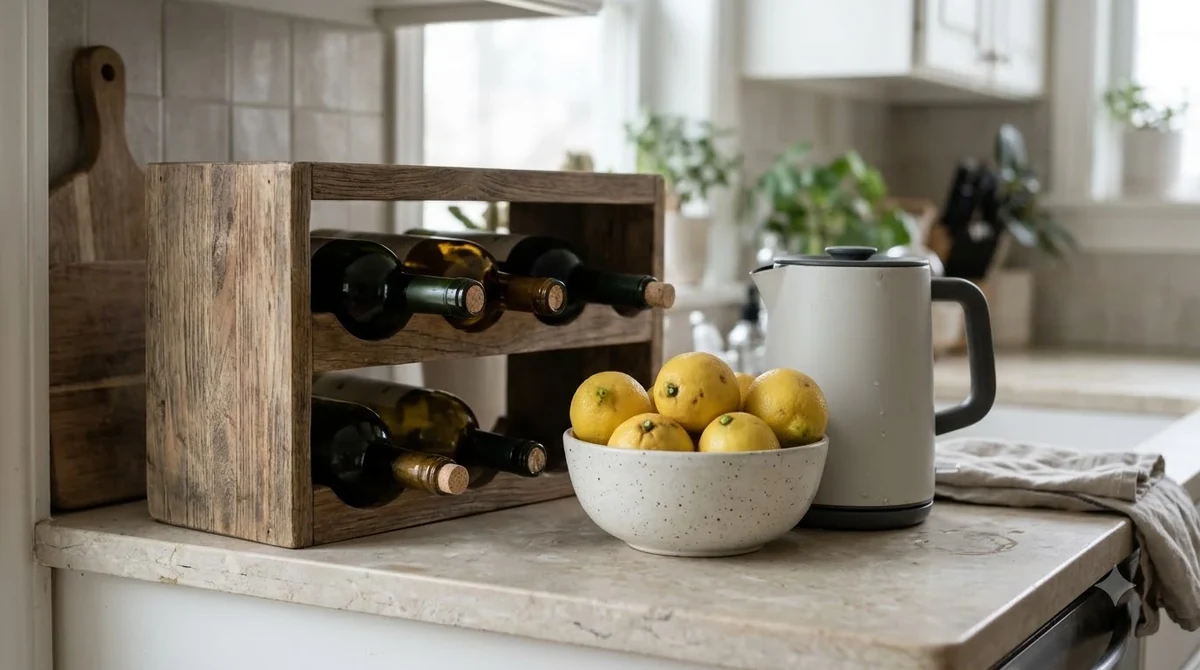
Why it stands out: Visible labels make it easy to choose a bottle for dinner. Finishes such as walnut, oak or painted metal can match existing furniture.
Keep in mind: Display racks are more exposed to light and to dust. Keep them away from direct sun and heat sources such as radiators, ovens and windows that get afternoon sun.
Best for: Dining areas and living rooms where guests see the rack often.
Best for Long-Term Storage
If the bottles are meant to age rather than be opened within a few months, the rack matters less than the room it sits in. The wine cellar article on Wikipedia describes a storage temperature range of 7 to 18 °C (45 to 64 °F), with 13 °C (55 °F) cited as ideal for both short-term storage and long-term aging. Large day-to-day temperature swings are the bigger risk, so a rack placed in a stable, cool room is usually the better choice than one placed in a warm kitchen.
Why it stands out: A sturdy wood floor rack carries weight well and can be placed in a cellar, storage closet or unheated room with stable temperatures.
Keep in mind: Heavy racks are harder to move, so choose the final location before filling the rack. A full sixteen-bottle load of standard 750 ml wine adds considerable weight to the base.
Best for: Collectors who keep bottles for months or years and have a cool, dark room available.
Best for Gifts and Wine-Lover Spaces
A 16 bottle rack also works as a gift for someone who already keeps a collection. Designs with a decorative finish or a tidy, finished look suit a home office, a basement bar or a corner that the recipient already uses for wine.
Why it stands out: A rack gives a practical present that can grow with the recipient’s collection, and it fits the way many people already display bottles.
Keep in mind: Check the recipient’s space first. A rack that is too wide or too deep for the planned corner will be returned or left in its box.
Best for: Gift buyers who know the recipient’s space and wine habits.
How to Choose a 16 Bottle Wine Rack
Start with the space. Measure the width, depth and height of the planned location, and leave a few inches of clearance so bottles can be inserted and removed without knocking the stack. Next, decide how often you will reach into the rack. Frequent use favors an open front or a staggered layout, while a rarely opened collection can sit in a tighter stack.
Material is the next choice. Wood is the most common option and comes in many finishes. Metal and stainless steel suit kitchens and bars because they clean easily. Wrought iron is durable and often used for decorative designs, although many of these racks are built for one or a few bottles rather than a full set of sixteen.
- Confirm the footprint against the actual location, not the product photo.
- Check that the rack is built for standard 750 ml bottles, which most racks are designed to hold.
- Choose wood, metal or stainless based on the room’s style and cleaning needs.
- Plan the location for stable temperature and low light before loading the rack.
Frequently Asked Questions
How many bottles are in a case of wine?
Most wine is sold in cases of 12 standard 750 ml bottles. A 16 bottle rack can therefore hold one full case plus four extra bottles, which is a useful way to plan how much space you need. For a fuller breakdown, see how many bottles are in a case of wine.
Can a 16 bottle rack hold magnums?
Most racks are built for standard 750 ml bottles. A magnum holds 1.5 liters, which is twice the volume, and the extra length and weight can make a standard cube rack unstable or too tight. Check the product’s bottle dimensions before buying if you plan to store large-format bottles.
Does a wine rack keep wine at the right temperature?
A rack holds bottles but does not control temperature. Storage guidance describes a range of 7 to 18 °C, with stable conditions more important than hitting one exact number. A cool, dark room with small temperature changes is a better location than a rack in a warm kitchen.
Should I buy a 16 bottle rack or a larger one?
Choose sixteen bottles if the collection is steady and the space is limited. A larger rack suits people who expect to grow the collection or buy in bulk. If you are between sizes, compare the footprint of the larger option first, because a rack that does not fit the planned location will be hard to use.
A 16 bottle wine rack is a practical middle size for most homes. Measure the space, decide how often you will reach for bottles, and choose a material that matches the room. If you need more capacity later, a 12 bottle wine rack or a larger model can fit beside the same storage plan, and the wine racks library lists other sizes and layouts.
For background on bottle sizes and how racks are built, the Wikipedia article on wine racks describes common materials and designs, and the Wikipedia article on wine cellars covers the temperature and humidity conditions that matter for storage.
More in Racks & Storage
 Best Wine Barrel Racks for Distinctive Bottle StorageUpdated Nov 20, 2026
 Best Wine Storage Tower: Sizing, Protection and Room LayoutUpdated Nov 18, 2026
 Best Pyramid Wine Rack: Materials, Sizes and Where It FitsUpdated Nov 18, 2026
 Best Kitchen Cabinet Wine Rack Insert for Built-In Bottle StorageUpdated Nov 18, 2026
 Best 48 Bottle Wine Rack Options for Cellars, Kitchens, and Tight SpacesUpdated Nov 18, 2026
 Best 30 Bottle Wine Rack Styles for Large CollectionsUpdated Nov 18, 2026