


We may earn a commission when you buy through links on this page, at no extra cost to you. Learn more.
Waring wine opener instructions for the WWO120 are straightforward: charge the opener, remove the bottle foil, position the opener upright over the cork, and hold the down-arrow button until the cork comes out. The up-arrow button reverses the mechanism to release the cork from the opener. This rechargeable electric model includes a stainless steel housing, charging base, removable foil cutter, and replacement auger. Correct positioning, adequate battery charge, and proper cleaning help keep the opener working reliably.
The Waring WWO120 is designed for repeated bottle opening in restaurants, catering environments, and home wine service. Its controls are simple, but the charging indicator, two-direction motor, and removable accessories deserve a closer look before the first use. This review explains how to operate the opener, what its specifications mean, what owners report, and how to decide whether this model suits your wine setup.
Specs and Key Features
The Waring WWO120 combines a rechargeable motor with a stainless steel body and a compact charging base. Its most useful features are the reversible auger, removable foil cutter, and included replacement auger.
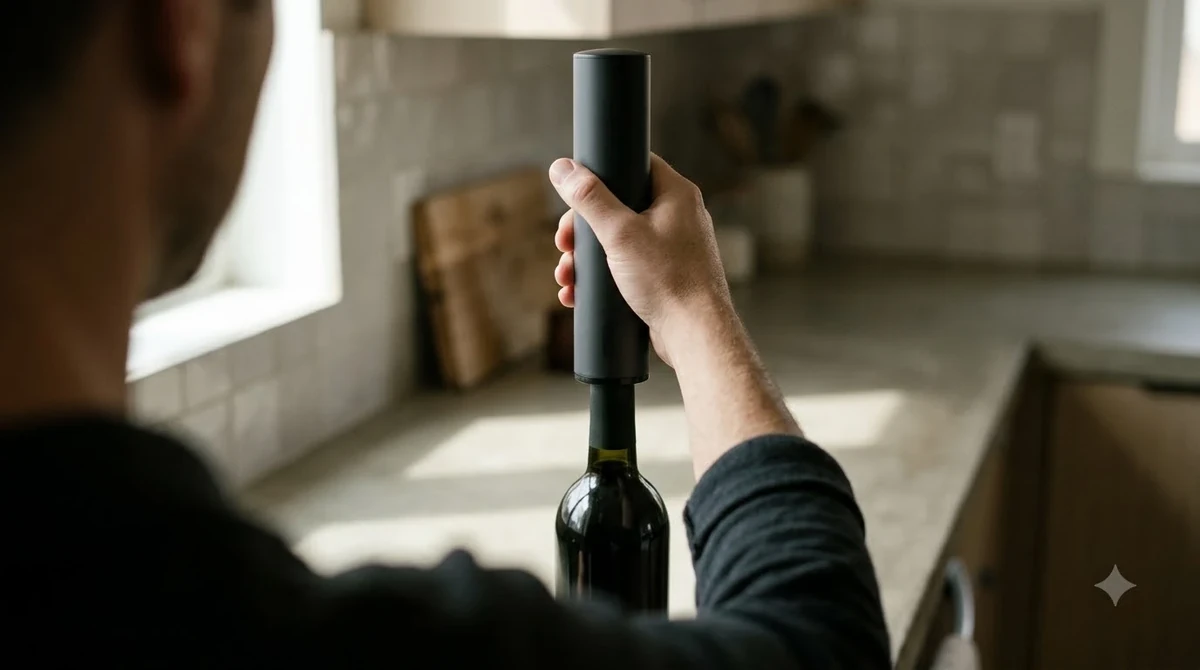
Waring identifies the WWO120 as a portable commercial electric wine opener. The motor operates in forward and reverse directions, allowing users to extract a cork and then release it without manually pulling the cork from the mechanism. The rechargeable NiMH battery eliminates the need to connect the opener directly to an outlet while opening each bottle.
The charging base serves two purposes: it recharges the opener and provides a dedicated storage position. The foil cutter is stored with the base, making it easier to keep the accessories together. A replacement auger and an auger replacement tool are also identified in the manufacturer’s instruction booklet.
| Specification | Waring WWO120 |
|---|---|
| Product type | Portable electric wine opener |
| Model | WWO120 |
| Housing | Stainless steel |
| Battery | Rechargeable NiMH |
| First charging recommendation | At least 10 hours |
| Initial charging estimate | Approximately 8–10 hours |
| Estimated full-charge capacity | Approximately 120 corks |
| Motor operation | Forward and reverse |
| Voltage | 120 volts |
| Plug type | NEMA 5-15P |
| Width | 5.5 inches |
| Height | 12 inches |
| Depth | 4 inches |
| Included accessories | Charging base, foil cutter, replacement auger |
| Warranty | Limited one-year warranty |
These specifications come from Waring’s official product listing and instruction booklet. The charging figures deserve particular attention. The manual recommends a first charge of at least 10 hours and describes an initial charging period of approximately 8–10 hours. Treat the longer recommendation as the practical preparation target rather than assuming that a brief connection is sufficient.
The estimated 120-cork capacity is a manufacturer specification, not a guarantee that every battery will achieve the same result under every operating condition. Battery condition, charging habits, and the resistance of individual corks can affect practical performance.
Another important detail is electrical compatibility. The WWO120 is specified for 120-volt power and a NEMA 5-15P plug. Buyers outside the United States should pay particular attention to the electrical requirements before purchasing or connecting the charging base. A plug adapter does not change the voltage supplied by an electrical outlet.
For the complete technical description, see the official Waring WWO120 product specifications.
What Owners Like
The WWO120’s strongest selling points are its rechargeable operation, reversible motor, stainless steel construction, and integrated accessory storage. These features make it especially interesting for people who open several bottles during a service period.
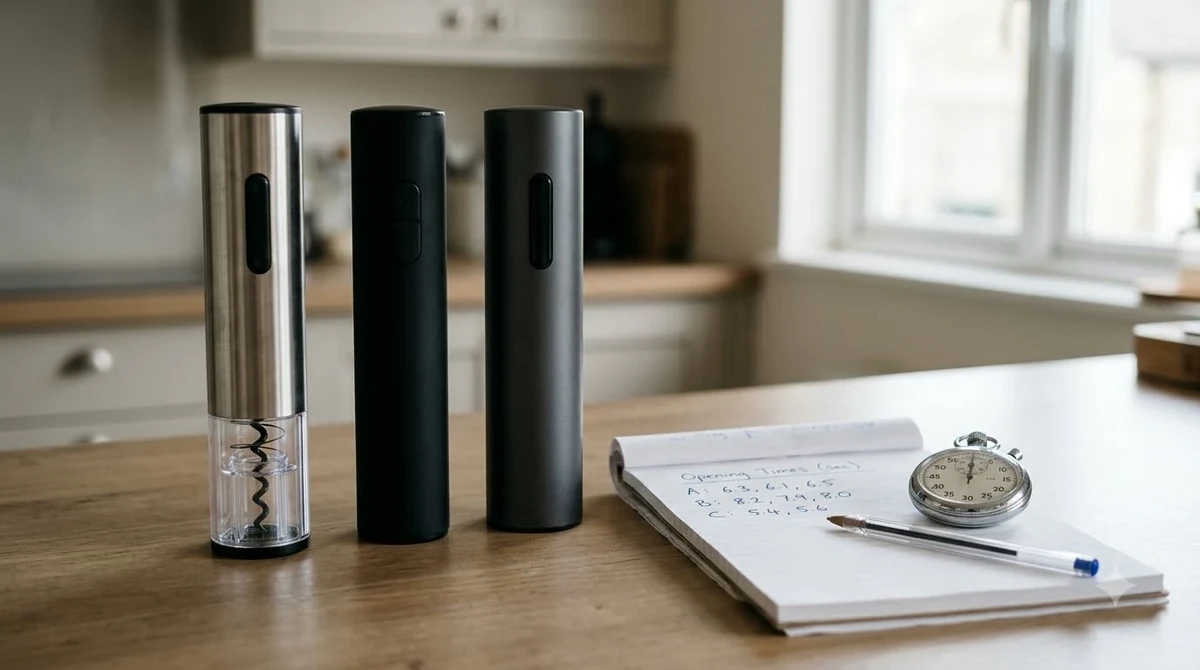
One practical advantage is the two-direction control. Instead of twisting a manual corkscrew repeatedly, the user operates the motor with a button. The lower control extracts the cork, while the upper control releases it afterward. Once the operating sequence becomes familiar, opening bottles involves relatively few steps.
The stainless steel housing also gives the opener a more substantial appearance than many lightweight plastic alternatives. Its 12-inch height provides a long housing that is easy to grip, while the charging base keeps the opener standing in a designated location between uses.
Accessory organization is another useful feature. The removable foil cutter sits with the charging base rather than requiring a separate drawer or storage container. This arrangement is particularly convenient behind a bar, where small tools can easily become separated from the main equipment.
The replacement auger is a further practical inclusion. The corkscrew mechanism is a working component, so having a replacement part available is useful for an establishment that depends on its opener. It also gives owners a clearer idea of how the appliance can be maintained beyond ordinary exterior cleaning.
Advantages in a busy wine service area
For catering staff and restaurant servers, rechargeable operation can reduce the need to repeatedly reach for a manual opener. Waring’s stated capacity of approximately 120 bottles per full charge is intended to support repeated use. Actual results will depend on the condition of the battery and the bottles being opened.
The charging base also creates a predictable place to return the appliance after each service period. This is a small organizational advantage, but it can matter in a working bar where the opener, foil cutter, and other accessories need to remain accessible.
For a home wine station, the benefits are slightly different. Someone who regularly entertains guests may appreciate the electric mechanism, especially when opening multiple bottles for a dinner party. A coordinated setup with a bar cart can provide a convenient place for glassware, wine accessories, and serving equipment.
Customer feedback available through KaTom is mixed but useful. One reviewer reported satisfactory operation, while another described a unit that struggled to remove even one cork. Those contrasting experiences suggest that individual product condition and proper operation matter; they do not establish a universal performance result.
Common Complaints
The main considerations with the WWO120 are its dependence on battery charging, the need for correct vertical alignment, and its specialized electrical requirements. Customer feedback also indicates that performance may not be identical across individual units.
The first potential frustration is charging. Unlike a manual corkscrew, the WWO120 needs a charged battery before it can operate. Forgetting to return the opener to its base after use may leave it unavailable when another bottle needs opening. This is especially inconvenient during a dinner party or a busy restaurant service.
The second issue is alignment. The manufacturer specifically instructs users to keep the opener as upright as possible over the bottle. An angled position can prevent the auger from entering the cork correctly and may cause the extraction process to become difficult.
Some users may also find the appliance less convenient than expected because of its dimensions. At 12 inches tall, it requires more vertical storage space than a compact manual wine key. Its charging base also occupies counter space, even though the base combines charging and storage functions.
Battery and performance concerns
The advertised capacity of approximately 120 corks is attractive, but it should not be interpreted as a promise of identical results in every situation. A worn battery, incomplete charging connection, or demanding cork can affect operation.
The KaTom customer feedback illustrates this distinction. One reviewer reported that the opener struggled with a bottle, while another described it as working well. Neither individual account is enough to establish a general failure rate, but the contrasting experiences make it sensible to inspect a newly purchased unit and confirm that its charging and operating functions work properly.
There is also a model-identification issue. Waring has produced different electric wine openers with different controls and charging recommendations. The CRS50, for example, has separate REMOVE and EJECT switches and a different first-charge recommendation. Instructions for that model should not be substituted for the WWO120 procedure.
Finally, the 120-volt electrical specification limits where the charging equipment can be used directly. International buyers should establish electrical compatibility before connecting the supplied adapter. Using an unsuitable power supply is not a substitute for following the manufacturer’s electrical specifications.
Tip: If your WWO120 stops during cork removal, do not immediately force the housing downward or manipulate the auger. Release the control, check that the opener is upright, confirm that the battery is charged, and inspect the bottle opening before trying again. Never touch the moving corkscrew mechanism.
Who Should Buy and Who Should Skip
The Waring WWO120 is best suited to users who value electric cork removal and regularly open multiple bottles. It is less suitable for people who prefer a compact, maintenance-free manual opener or cannot accommodate its charging requirements.
Restaurant staff, caterers, event organizers, and people who entertain frequently are the most natural audience. The rechargeable design avoids a direct electrical connection during each opening, while the charging base provides a consistent storage location. The reversible motor also simplifies the process of extracting and releasing corks.
Home users who regularly serve several wines at a gathering may appreciate the same features. For example, a dinner party featuring sparkling wine, Chardonnay, and Cabernet Sauvignon may involve opening several different bottles throughout the evening. The WWO120 can handle the cork-removal portion of that preparation without requiring repeated manual twisting.
However, the opener is not necessary for every wine drinker. Someone who opens one bottle occasionally may find a traditional waiter’s corkscrew easier to store and maintain. Manual openers do not require a charging base, rechargeable battery, or electrical compatibility checks.
When the WWO120 makes sense
- You regularly open several wine bottles during a single event.
- You prefer push-button cork removal over a manual twisting mechanism.
- You have room for a 12-inch appliance and its charging base.
- You can provide the specified 120-volt electrical connection.
- You value a stainless steel housing and included replacement auger.
When another opener may be better
- You open wine only occasionally and want a simple manual tool.
- You need an opener that fits inside a small kitchen drawer.
- You do not want to maintain a rechargeable battery.
- Your available electrical supply is incompatible with the WWO120 adapter.
- You prefer an appliance without a dedicated charging station.
Wine enthusiasts who want a compact backup tool can consider a wine bottle opener keychain. It will not provide the same electric operation, but its small size makes it useful for travel or occasional bottle opening.
Another option is a wine opener and preserver set for people who want several wine-service functions in one collection. The right choice depends on whether convenience, portability, or preservation equipment matters most.
How It Compares to Alternatives
The WWO120 occupies the rechargeable electric category, rather than competing directly with every type of manual corkscrew. Its closest comparison is another Waring electric opener, the CRS50, which uses a different control arrangement and charging procedure.
The distinction between these models matters because their operating instructions are not interchangeable. The WWO120 uses one two-direction Up/Down switch. The CRS50 uses two separately labeled controls: REMOVE and EJECT.
The CRS50 manual also recommends an initial charge of at least 12 hours, compared with the WWO120’s recommendation of at least 10 hours. This is a useful example of why owners should identify the model number before following instructions found online or in an older booklet.
| Comparison | Waring WWO120 | Waring CRS50 |
|---|---|---|
| Product type | Rechargeable electric opener | Electric wine opener |
| Control arrangement | Combined Up/Down switch | Separate REMOVE/EJECT switches |
| First-charge recommendation | At least 10 hours | At least 12 hours |
| Removal control | Lower down-arrow section | REMOVE switch |
| Cork release control | Upper up-arrow section | EJECT switch |
| Charging arrangement | Dedicated charging base | Dedicated charging base |
| Housing description | Stainless steel | Stainless steel |
The WWO120 is a sensible choice for someone who already owns that model or wants its particular combination of a reversible motor and integrated accessory storage. The CRS50 may appeal to someone familiar with separate removal and ejection controls, but its charging and operating instructions need to be followed independently.
Neither electric model should automatically be considered superior for every user. A manual corkscrew has fewer electrical components and can be stored almost anywhere. An electric opener is more convenient for repeated bottle opening but introduces battery and charging considerations.
For readers comparing different equipment categories, the Accessory Brands collection offers another starting point for understanding the range of tools used in wine service.
Frequently Asked Questions
These answers address practical questions about the Waring electric opener, including its charging indicators, compatibility, accessories, and model-specific operation.
Can the Waring WWO120 open synthetic corks?
Yes. Waring describes the WWO120 as capable of removing both natural and synthetic corks. Synthetic closures can differ in firmness and resistance, so the opener should remain upright and operate without being forced. The manufacturer does not promise identical performance with every closure.
What does the POWER light on the Waring charging base indicate?
The charging base has separate POWER and CHARGE indicators. They identify different functions of the base rather than representing two stages of cork extraction. The operating booklet’s charging instructions specifically use the green CHARGE indicator to communicate battery charging status.
Can the WWO120 battery be replaced?
The instruction booklet identifies a removable NiMH battery and explains battery replacement. However, Waring advises against removing it unless there is a power problem and the battery is not charging correctly. Battery handling and disposal should follow the manufacturer’s safety instructions rather than improvised repair methods.
Does the Waring WWO120 include a replacement corkscrew?
Yes. Waring lists a replacement auger and an auger replacement tool among the supplied components. These parts are distinct from the removable foil cutter, which is used before cork extraction. Keep the accessories together so they are available if maintenance becomes necessary.
Is the Waring WWO120 intended for commercial use?
Yes. The instruction booklet identifies the appliance as intended for commercial use, and Waring describes it for catering, banquets, restaurant staff, and behind-the-bar service. Its commercial positioning does not remove the need to follow the stated electrical requirements and safety precautions.
The Waring WWO120 is a capable rechargeable wine opener with a useful reversible mechanism, stainless steel housing, and practical accessory storage. Following the correct charging, foil-removal, extraction, and cork-release procedures is essential to getting the intended performance from the appliance. For frequent bottle opening, it offers a convenient alternative to manual corkscrews, provided its charging and electrical requirements fit your setup.
More in Wine Accessories
 Coravin Vs Vacu Vin: Choose the Right Wine Saver for Your BottlesUpdated Nov 21, 2026
 Zwilling Wine Stopper Review: Preserve Open Bottles LongerUpdated Nov 21, 2026
 Wine Enthusiast Wine Preserver Review: Features, Benefits and LimitationsUpdated Nov 21, 2026
 Wine Enthusiast Wine Stopper: An Easier Way to Reseal Open BottlesUpdated Nov 21, 2026
 Vintorio Wine Opener: Two-Step Cork RemovalUpdated Nov 21, 2026
 Zwilling Wine Aerator Review: Aerate, Pour, and Seal With One ToolUpdated Nov 21, 2026