


We may earn a commission when you buy through links on this page, at no extra cost to you. Learn more.
The vinturi wine preserver is a convenient argon-gas preservation system designed to protect opened bottles of red, white, and rosé wine from oxidation for weeks. Sold as zzysh by Vinturi, it replaces the air inside a sealed bottle with food-grade argon rather than using a conventional vacuum pump. Its quick operation and reusable stopper make it appealing for people who enjoy a glass at a time, although the continuing need for replacement cartridges is an important ownership consideration.
Finishing an entire bottle of wine in one evening is not always practical. A bottle opened for dinner might still contain several glasses the following afternoon, and ordinary stoppers cannot prevent oxidation as effectively as a dedicated preservation system. The Vinturi-branded zzysh system takes a different approach by introducing argon gas into the bottle after each opening. This review examines its design, operating process, advantages, limitations, and suitability for different wine-drinking habits. It also explains the distinction between the Vinturi aerators that made the brand familiar and the separate preservation equipment sold under the zzysh partnership.
Specs and Key Features
The Vinturi Wine Preserver is a handheld, cartridge-powered preservation device that works with a dedicated bottle stopper. Its defining feature is the use of food-grade argon to displace the air above the remaining wine instead of extracting air through a vacuum pump.
The product is more accurately identified as the zzysh Wine Preserver by Vinturi. The Legacy Companies announced a partnership with Swiss preservation specialist zzysh to distribute its technology in North America under the Vinturi brand. This distinction matters because Vinturi is also associated with its original handheld wine aerators, which introduce oxygen during pouring. The preserver performs the opposite practical task: it helps protect wine from unwanted oxygen exposure after the bottle has been opened. The North American distribution partnership announcement explains the relationship between the two companies.
The operating process is straightforward. After pouring a serving, the user fits the dedicated stopper into the bottle opening, attaches the handheld device, and presses down for approximately 3 to 5 seconds. According to the manufacturer’s instructions, the device replaces the air inside the bottle with food-grade argon. The stopper then helps maintain the protected environment between servings. The official zzysh still-wine product information provides the operating instructions and cartridge details.
| Specification | Vinturi zzysh Wine Preserver |
|---|---|
| Product identity | zzysh Wine Preserver by Vinturi |
| Preservation technology | Food-grade argon gas |
| Vacuum operation | No vacuum created |
| Operating time | Approximately 3–5 seconds |
| Wine compatibility | Red, white, and rosé |
| Cartridge package | Five refill cartridges |
| Applications per cartridge | Up to 8 |
| Stopper colors | Black, white, and pink |
| Still-wine preserver model | ZZYSWP1 |
| Wine cartridge model | ZZYSWC5 |
These specifications distinguish the system from basic bottle stoppers and manual pumps. The cartridge supplies the preservation gas, the handheld unit controls its delivery, and the stopper provides the seal. The manufacturer lists a five-cartridge refill package, with each cartridge providing up to eight applications. That makes cartridge availability an important part of the ownership decision rather than an optional accessory detail.
The stopper is designed for most conventional wine bottle closures, including natural cork, plastic cork, glass cork, and screw-cap bottles. However, the manufacturer acknowledges that unusually wide bottle necks can create compatibility problems. A dedicated stopper is essential because an ordinary wine stopper cannot provide the same intended connection between the bottle and gas-delivery device.
One other distinction deserves attention: the still-wine preserver is not the same product as the Zzysh Champagne Preserver. The latter uses an argon-and-carbon-dioxide gas mixture to maintain pressure and carbonation in sparkling wine. Buyers should select the appropriate system rather than assume that the still-wine cartridge and stopper will preserve every wine category.
What Owners Like
The strongest appeal of the Vinturi system is its convenience for people who regularly open bottles without finishing them. Its short operating cycle and argon-based preservation method make it a practical alternative to repeatedly inserting the cork or using a manual vacuum pump.
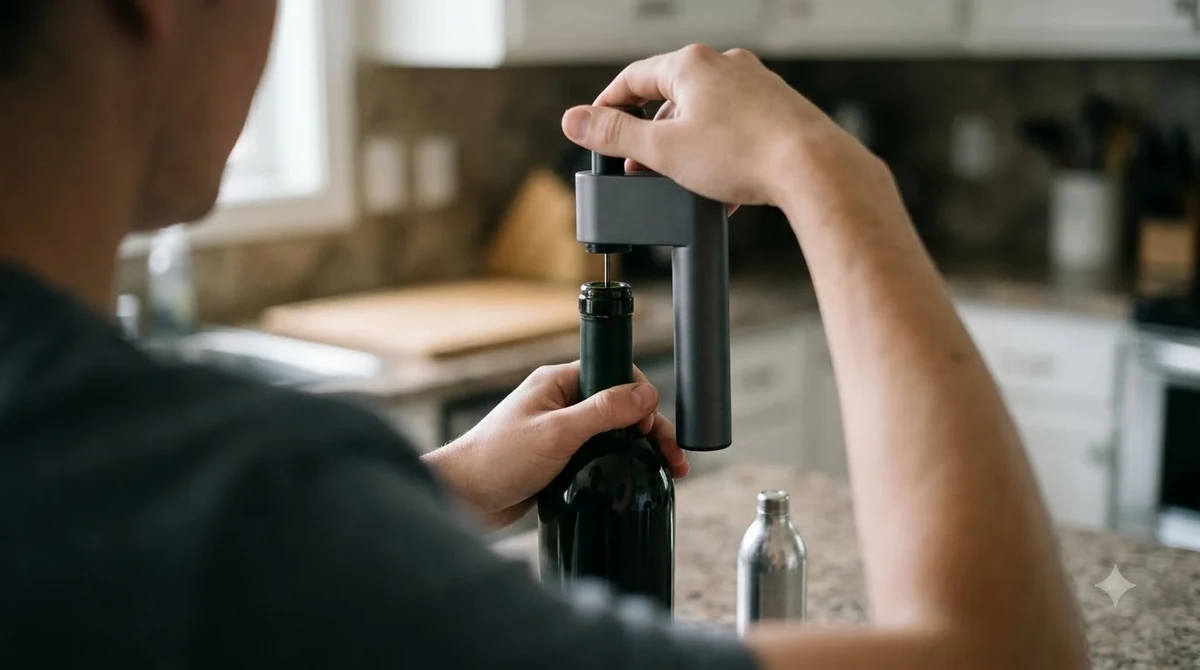
Simple operation between servings. The 3-to-5-second preservation process does not require a complicated setup. Pour a glass, fit the stopper, attach the device, and activate the gas delivery. This routine is especially attractive during dinner parties, small gatherings, or quiet evenings when several different wines might be opened but only partially consumed.
The conventional pouring experience also remains intact. Unlike some dispensing systems, the Vinturi device does not require wine to be poured through a complicated serving mechanism. The user can remove the stopper, pour directly from the bottle, and repeat the preservation procedure afterward. That familiar routine helps make the product accessible to people who do not want a complicated wine-service appliance.
Protection without vacuum extraction. Some wine drinkers prefer argon preservation because the system replaces the air rather than attempting to remove it mechanically. According to the manufacturer, food-grade argon is nonreactive with wine and helps protect the remaining liquid from oxidation. This approach is particularly relevant for wines whose aromas and delicate flavor characteristics matter to the drinker.
For example, someone who opens a bottle of Pinot Noir for a single glass may want to retain its fresh red-fruit character for another evening. A bottle of Sauvignon Blanc might also be opened for one meal and saved for a second occasion. The Vinturi system is designed to support this kind of intermittent consumption across red, white, and rosé styles.
Potentially useful for more delicate bottles. The manufacturer’s product information specifically identifies older and more delicate wines among the wines its technology is intended to preserve. This is an appealing feature for collectors who occasionally open bottles that they would rather not finish immediately. However, preservation should not be confused with indefinite aging after opening. The system is intended to slow deterioration, not reverse changes that have already occurred.
Compact equipment. The preserver is a handheld device rather than a large countertop dispenser. It can fit into a kitchen storage area or wine-accessory drawer without requiring the space occupied by a dedicated serving machine. Additional stoppers can also make it easier to manage multiple opened bottles, provided each bottle has a compatible closure.
The interchangeable visual details are another small advantage. The official US product page lists black, white, and pink stopper options. This gives buyers some flexibility when organizing their accessories or purchasing additional stoppers for different bottles.
These strengths make the system particularly interesting for households that appreciate variety. Someone who enjoys Cabernet Sauvignon with dinner, a glass of Chardonnay later in the week, and rosé on another occasion can use one still-wine preservation system rather than buying a separate preservation appliance for every color of wine.
For a coordinated home serving area, the preserver can sit alongside a wine opener and preserver set. Combining the tools makes opening, serving, and storing bottles more convenient without requiring a large collection of equipment.
Common Complaints
The main drawbacks are the dependence on proprietary gas cartridges, the need for a dedicated stopper, and the possibility of bottle-compatibility problems. The system is convenient, but it involves more ongoing equipment management than a simple reusable bottle stopper.

Replacement cartridges are unavoidable. The Vinturi system cannot perform its intended preservation process without its compatible argon cartridge. The official manufacturer information rates each cartridge for up to eight applications, which gives buyers a useful planning figure. However, actual usage depends on how frequently bottles are opened and preserved.
Consider a household that preserves one bottle after each of four separate drinking occasions during a typical week. At that rate, a cartridge rated for eight applications could be consumed relatively quickly. Someone who opens wine only once or twice a month may find the refill schedule much less demanding.
The important point is that the purchase does not end with the starter set. Refill availability, storage, and replacement expenses all belong in the long-term ownership calculation. Before committing to a cartridge-powered system, buyers should establish whether compatible refills are readily obtainable through their preferred retailer.
Compatibility is not universal. The manufacturer says the dedicated stopper fits most bottles with natural, plastic, or glass corks, as well as screw caps. However, it also acknowledges that some larger bottle necks may prevent a suitable fit. This qualification matters for anyone who regularly buys unusual bottle shapes or wines from producers using nonstandard packaging.
A poor stopper fit can undermine the entire process. The gas-delivery device depends on the dedicated stopper to establish the intended connection. Buyers should not assume that every bottle sold in a standard 750 ml format necessarily has identical neck dimensions. Bottle capacity alone does not guarantee stopper compatibility.
The system requires several coordinated components. A basic stopper is simpler to store and operate. With Vinturi, the user must keep the preserver, compatible cartridge, and stopper available. This is not especially difficult, but it introduces more components that can be misplaced or need replacement.
There is also a small learning curve. Although the manufacturer describes a short 3-to-5-second operating cycle, users still need to seat the stopper correctly and connect the preserver properly. Someone who expects a single push-on stopper to work without additional steps may prefer a simpler solution.
Long preservation claims need realistic expectations. The manufacturer advertises protection for weeks, but the actual condition of an opened wine depends on more than the preservation device. Wine style, bottle condition, storage temperature, remaining volume, and handling all influence how a bottle develops after opening.
A delicate older Pinot Noir may respond differently from a young, concentrated Cabernet Sauvignon. Similarly, a bottle left on a warm kitchen counter will not necessarily retain its freshness as effectively as one stored in a refrigerator. The manufacturer’s claim should therefore be understood as a description of the intended technology, not a guarantee that every wine will taste identical after several weeks.
Finally, the dedicated sparkling-wine system can create confusion. The regular wine preserver is intended for still wines, while sparkling wine requires a separate device that maintains pressure using an argon-and-carbon-dioxide mixture. Buyers who frequently open Champagne or Prosecco should factor that distinction into their decision.
Who Should Buy and Who Should Skip
The Vinturi Wine Preserver makes the most sense for regular wine drinkers who frequently leave bottles unfinished and value a preservation method that does not rely on vacuum extraction. It is less compelling for occasional drinkers who rarely have leftover wine or people who prefer equipment with no consumable components.
Who should consider buying it
People who drink wine by the glass. If a household regularly opens a bottle but serves only one or two glasses at a time, the system addresses a genuine everyday problem. It provides a repeatable preservation routine after each serving and helps make opening different wines more practical.
Wine enthusiasts who enjoy variety. A person who likes alternating between red, white, and rosé wines may appreciate having one preservation method for all three. The ability to open a bottle without feeling pressured to finish it immediately can make wine selection more flexible during the week.
Hosts who serve several wines. Dinner parties sometimes involve multiple open bottles. Guests may prefer different grapes, regions, or styles, leaving several partially consumed bottles at the end of the evening. A dedicated preservation system can be useful in this situation, particularly when combined with additional compatible stoppers.
People who dislike manual vacuum pumps. The argon method is an alternative for buyers who would rather replace the air in a bottle than extract it with repeated pumping. It also provides a relatively quick operating routine after pouring.
Who should skip it
Infrequent wine drinkers. If an opened bottle is a rare occurrence, the cost and availability of replacement cartridges may outweigh the practical advantages. A conventional stopper and appropriate refrigerator storage may be sufficient for occasional short-term preservation.
Budget-conscious buyers seeking a one-time purchase. The Vinturi system involves ongoing cartridge consumption. Someone who wants to purchase one accessory and use it indefinitely without buying replacement supplies may find a reusable mechanical stopper more attractive.
Champagne and sparkling-wine drinkers. The regular still-wine version should not be treated as a universal sparkling-wine preserver. Champagne and Prosecco require the separate sparkling-wine product designed to maintain pressure and carbonation.
Collectors with unusual bottle formats. The dedicated stopper fits most conventional bottles, but the manufacturer does acknowledge exceptions involving larger neck openings. Buyers with an assortment of unusual bottles should consider compatibility before relying on the device as their primary preservation tool.
It is also useful to consider the overall serving setup. Someone already organizing a home wine station may find the preserver a natural addition to a bar cart. On the other hand, a person who opens only a bottle for special occasions may not need another specialized accessory.
How It Compares to Alternatives
The Vinturi system occupies a different category from basic stoppers and vacuum pumps because it uses argon gas rather than mechanical air extraction. Its closest alternatives include reusable vacuum pumps, inert-gas preservation sprays, and ordinary bottle closures.
Compared with a vacuum wine pump: A vacuum pump uses a mechanical action to remove some of the air from an opened bottle. The bottle is then closed with a compatible stopper. Vinturi instead introduces argon into the bottle and seals it with its dedicated stopper. Both approaches aim to reduce the impact of oxygen, but they operate differently.
A manual pump may appeal to someone who wants a straightforward, reusable accessory without a gas cartridge. It can be stored in a drawer and used whenever a bottle is opened. However, the Vinturi approach may appeal more to someone specifically seeking gas-based preservation instead of vacuum extraction.
Compared with inert-gas sprays: Gas-preservation sprays are another option for people who want to protect unfinished wine. They generally involve introducing an inert gas into the bottle before resealing it with a suitable closure. Vinturi packages the gas-delivery mechanism into a dedicated handheld tool and stopper combination.
The convenience difference is largely about workflow. A spray can be useful for someone who wants a simple gas application without maintaining a specialized device. Vinturi provides a more structured routine, although it requires compatible cartridges and its own stopper.
Compared with an ordinary wine stopper: A conventional stopper is the simplest and least complicated option. It closes the bottle and helps prevent spills, but it does not actively replace the air already present inside. Vinturi adds a gas-delivery step to address the oxygen exposure that occurs after opening.
For someone who finishes a bottle over dinner and stores only a small amount overnight, an ordinary stopper may be all that is needed. Someone who regularly saves multiple glasses for later occasions has a stronger reason to consider a dedicated preservation system.
| Preservation method | How it works | Main advantage | Main limitation |
|---|---|---|---|
| Vinturi zzysh | Replaces air with argon | Gas-based preservation without vacuum extraction | Requires compatible cartridges and stopper |
| Manual vacuum pump | Extracts some bottle air | Reusable mechanical operation | Requires manual pumping |
| Inert-gas spray | Introduces protective gas | Simple application without a dedicated pump | Requires separate spray supplies |
| Ordinary stopper | Closes the bottle opening | Simple and reusable | Does not replace the air in the bottle |
There is no universal winner because the best method depends on drinking frequency and preservation expectations. Vinturi is most interesting for people who appreciate an argon-based process and are comfortable purchasing compatible refills. A mechanical pump is more appropriate for someone who prioritizes reusable equipment, while a conventional stopper is reasonable for short-term storage after a casual meal.
Buyers comparing wine accessories should also consider the wider selection of wine accessory brands and the difference between products designed for serving, opening, aerating, and preserving wine. These functions can overlap in a home setup, but they should not be confused when choosing equipment.
Tip: After preserving a still-wine bottle, store it upright in the refrigerator whenever practical. Vinum Design specifically recommends upright, refrigerated storage for the zzysh system. Keep in mind that preservation slows deterioration rather than restoring wine that has already oxidized.
Frequently Asked Questions
Is Vinturi the original manufacturer of the zzysh preservation technology?
No. The Vinturi-branded system originated through a partnership with Swiss company zzysh, whose founder Manfred Jüni established the company in 2009. The Legacy Companies subsequently brought the technology to North America under the zzysh by Vinturi name. Vinturi’s original identity is closely associated with its handheld venturi-driven wine aerators.
Does argon gas change the alcohol content of wine?
The manufacturer’s preservation description focuses on replacing air and protecting wine from oxidation, not changing its alcoholic strength. Argon is an inert gas rather than an ingredient intended to alter the wine’s alcohol content. The preservation process is designed to protect the remaining wine between servings.
Can the Vinturi Wine Preserver be used with screw-cap bottles?
Yes. The manufacturer lists screw-cap bottles among the closure types that its dedicated stopper is designed to accommodate. The stopper replaces the original closure after opening, although unusually wide bottle necks can still present a compatibility issue.
Is the argon gas cartridge refillable?
The official product information describes the cartridges as replacement consumables supplied in a five-cartridge package. It does not describe a consumer refill procedure for empty cartridges. Buyers should use compatible replacement cartridges rather than attempting to refill or modify a depleted cartridge themselves.
Does preserving wine stop all changes in its aroma and flavor?
No preservation method can guarantee that an opened wine will remain completely unchanged. Even when oxygen exposure is reduced, wine continues to be influenced by its composition, storage conditions, and time after opening. The system is intended to slow oxidation and retain quality, not freeze the wine in its original condition indefinitely.
The Vinturi Wine Preserver is an interesting choice for people who regularly enjoy wine by the glass and want an argon-based alternative to conventional vacuum pumps. Its quick operating cycle, dedicated stopper, and compatibility with red, white, and rosé wines are meaningful advantages, although proprietary cartridges add an ongoing ownership consideration. For frequent wine drinkers who value flexibility and are comfortable maintaining the refill supply, the zzysh by Vinturi system is a worthwhile preservation option to consider.
More in Wine Accessories
 Coravin Vs Vacu Vin: Choose the Right Wine Saver for Your BottlesUpdated Nov 21, 2026
 Zwilling Wine Stopper Review: Preserve Open Bottles LongerUpdated Nov 21, 2026
 Wine Enthusiast Wine Preserver Review: Features, Benefits and LimitationsUpdated Nov 21, 2026
 Wine Enthusiast Wine Stopper: An Easier Way to Reseal Open BottlesUpdated Nov 21, 2026
 Vintorio Wine Opener: Two-Step Cork RemovalUpdated Nov 21, 2026
 Zwilling Wine Aerator Review: Aerate, Pour, and Seal With One ToolUpdated Nov 21, 2026