


We may earn a commission when you buy through links on this page, at no extra cost to you. Learn more.
The waring corkscrew is a rechargeable electric wine opener designed to remove natural and synthetic corks quickly, with the Waring Commercial WWO120 offering approximately 120 bottle openings per full charge. Its stainless steel construction, reversible motor, charging base, and included foil cutter make it particularly suitable for restaurants, bars, catering operations, and frequent wine service. However, its commercial-oriented design and dedicated charging station may be more equipment than an occasional home wine drinker needs.
The Waring WWO120 takes a different approach from the familiar handheld waiter-style corkscrew. Rather than requiring repeated manual twisting, it uses a rechargeable motor and an auger to extract corks with the push of a switch. That makes it an interesting option for anyone opening numerous bottles during a shift or hosting regular events.
There are important differences between a commercial electric opener and a compact home corkscrew, though. Charging requirements, counter space, replacement parts, and operating technique all deserve attention before choosing this model. This review examines its specifications, practical advantages, potential drawbacks, and the types of wine service where it makes the most sense.
Specs and Key Features
The Waring WWO120 is built around rechargeable operation, a stainless steel body, and a reversible motor. Its advertised capacity of approximately 120 bottles per charge is one of its most distinctive specifications, particularly for professional settings where opening several bottles in succession is routine.
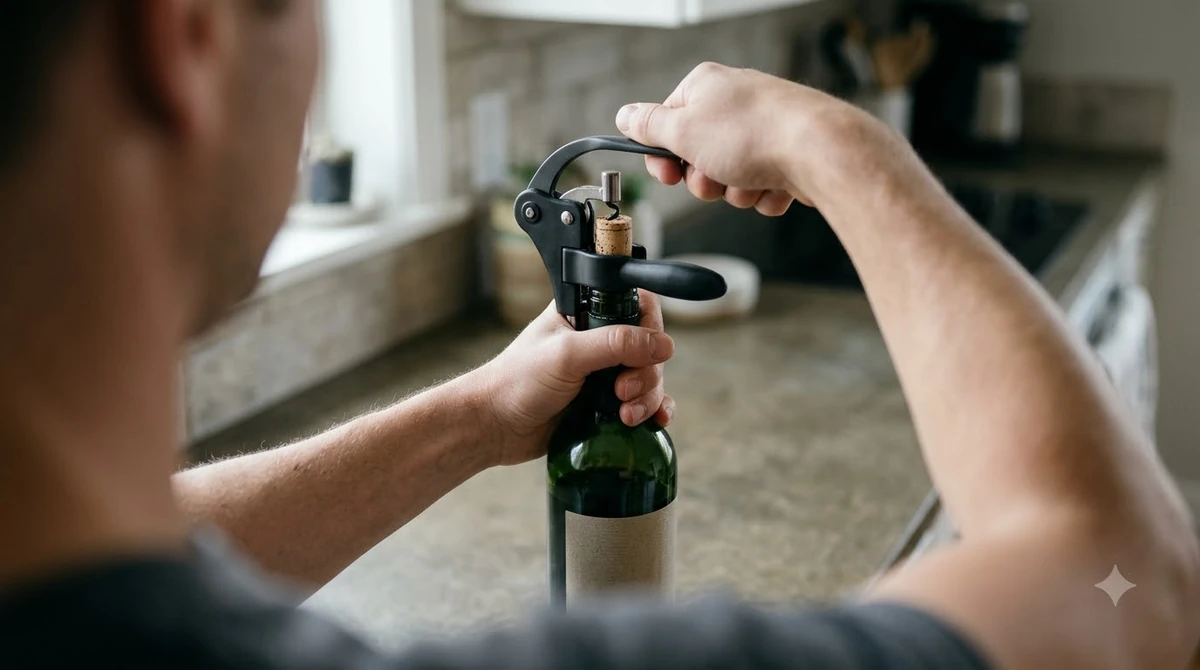
The following specifications come from Waring’s manufacturer product information and instruction booklet. They provide a useful starting point for comparing the WWO120 with other electric wine openers.
| Specification | Waring WWO120 |
|---|---|
| Product type | Portable electric wine opener |
| Model number | WWO120 |
| Motor | Forward and reverse operation |
| Battery | Rechargeable NiMH |
| Advertised capacity | Approximately 120 bottles per charge |
| Housing | Polished stainless steel |
| Width | 5.5 inches |
| Height | 12 inches |
| Depth | 4 inches |
| Electrical supply | 120 volts |
| Plug | NEMA 5-15P |
| Included accessories | Charging base, foil cutter, replacement auger, and auger replacement tool |
| Certifications | ETL Sanitation and NSF approvals listed by Waring |
| Warranty | Limited one-year warranty |
The capacity figure deserves particular attention. Waring advertises approximately 120 cork removals from a full charge, which is substantially more relevant to busy service environments than the needs of someone opening a single bottle on Friday night. Actual results can depend on battery condition, cork characteristics, and operating conditions, so the figure is best understood as the manufacturer’s stated capacity rather than a guarantee for every situation.
The stainless steel housing gives the opener a professional appearance that fits restaurant equipment and dedicated beverage stations. Its listed height of 12 inches also means it needs vertical clearance when stored upright. The charging base provides a designated location for the opener, while the included foil cutter and replacement auger make the package more complete than a basic electric corkscrew.
Waring describes the motor as quiet and commercial-grade. The forward-and-reverse arrangement performs two separate jobs: extracting the cork from the bottle and releasing it from the auger afterward. This distinction matters because a powered corkscrew needs a reliable way to eject the cork before the next bottle is opened.
The manufacturer provides additional specifications and documentation on its official Waring WWO120 product page. For buyers comparing electrical equipment, the listed 120-volt supply and NEMA plug should be checked against the intended installation rather than assumed to suit every international outlet.
What Owners Like About the Waring Corkscrew
The strongest appeal of the Waring WWO120 is its combination of high advertised battery capacity, straightforward controls, and commercial-oriented construction. These features address the repetitive work involved in opening multiple wine bottles, especially during restaurant service, catered events, and large gatherings.
The 120-bottle capacity is a major practical advantage. A busy bar may need to open multiple bottles throughout an evening, and an opener that can handle a substantial number of corks between charging cycles reduces interruptions. It also means staff do not have to connect the unit to an outlet every time they need to open another bottle.
The rechargeable battery makes the opener portable during normal service. Although the charging base needs an electrical connection, the handheld unit can be lifted and used at a serving station away from that base. This is useful for banquet tables, hospitality areas, and wine stations where moving a bottle to a fixed appliance would be inconvenient.
Another attractive feature is compatibility with natural and synthetic corks. These closures can behave differently during extraction, and synthetic corks sometimes feel more resistant than traditional natural cork. Waring specifically describes the motor as capable of removing both types, making the opener suitable for a wider range of standard wine bottles.
The reversible motor also simplifies the sequence. One switch direction extracts the cork, while the other releases it from the auger. There is no separate manual twisting motion required to free the cork after extraction. For someone working through a line of bottles, reducing these repeated steps can make the service process more consistent.
Useful accessories in the package
The charging base doubles as a storage location and holds the removable foil cutter. That arrangement helps keep an accessory that is easy to misplace close to the opener itself. The replacement auger and its replacement tool are further advantages because the spiral mechanism is an essential working component.
The polished stainless steel finish is another point in its favor. It suits professional beverage equipment and is visually consistent with many stainless steel appliances found behind bars. The body can be wiped clean after service, although the electrical components require careful handling.
Commercial equipment buyers may also appreciate the manufacturer’s stated ETL Sanitation and NSF approvals. These listings are relevant when evaluating equipment for food-service environments, where procurement requirements can differ from those for ordinary household appliances.
For readers organizing a dedicated beverage station, the Waring’s upright charging base may fit naturally into a larger bar cart or service counter arrangement. The important consideration is leaving enough vertical clearance and access to a suitable outlet.
Wasserstrom also describes the WWO120 as equipment intended for restaurant staff, catering operations, banquets, and bar service. Those applications align with the model’s high advertised opening capacity and portable rechargeable design.
Common Complaints and Limitations
The Waring WWO120 has several advantages, but its commercial design introduces compromises. The charging base, dedicated storage requirements, and powered operating mechanism may be unnecessary for occasional household use.
Its first limitation is the need for a charging routine. The instruction booklet recommends an initial charge of at least ten hours and describes an approximately eight-to-ten-hour first charging period. That is a substantial preparation period if the opener arrives shortly before a dinner party or event. Buyers should plan to charge it before relying on it for service.
The manufacturer advertises approximately 120 openings per full charge, but this does not eliminate battery maintenance. Rechargeable batteries gradually age, and the performance of an older unit may differ from that of a new one. The WWO120 uses a NiMH battery pack, so prospective buyers should consider the availability and replacement cost of compatible battery components over the product’s working life.
Another consideration is counter space. Although the handheld opener is portable, its charging base needs a permanent or semi-permanent location. The manufacturer lists dimensions of 5.5 inches wide, 12 inches high, and 4 inches deep for the opener specifications. A compact kitchen drawer or crowded home bar may not be the most convenient place for this arrangement.
The WWO120 is also not completely maintenance-free. The auger is a working component, and Waring supplies a replacement auger for that reason. Owners need to understand the replacement procedure and avoid touching the sharp spiral during normal use. A powered opener still requires sensible handling and occasional inspection.
Operating alignment matters
The instruction manual specifically emphasizes keeping the opener straight and upright on the bottle. Holding it at an angle can interfere with proper cork extraction. This is a relevant limitation for people expecting an electric mechanism to compensate for poor positioning automatically.
Users also need to remove the foil before extraction. The included cutter makes this step easier, but it remains a separate part of the opening process. The opener does not eliminate every preparation task associated with serving wine.
Noise expectations should also be realistic. Waring describes the motor as quiet, but a powered motor is not silent. Buyers who prefer the near-silent feel of a manual waiter’s corkscrew may still prefer a traditional tool, particularly when opening one bottle at a quiet dinner table.
Finally, the WWO120 is specified for 120-volt electrical supply. Buyers outside the United States and Canada should pay particular attention to electrical compatibility, charging equipment, and local warranty arrangements. A plug adapter alone does not convert voltage.
Tip: Charge the WWO120 before a large gathering, confirm that its indicator shows a completed charge, and keep the charging base in a dry, accessible location. The manual recommends returning the opener to its base between uses to help maintain its charge.
Who Should Buy and Who Should Skip the Waring WWO120
The Waring WWO120 makes the most sense for buyers who open wine frequently and value repeatable electric operation. Restaurants, catering businesses, banquet venues, and professional bar teams are closer to its intended audience than occasional home users.
For a restaurant, the advertised 120-bottle capacity is particularly appealing. Staff can move between bottles without repeatedly stopping to recharge the opener. The reversible motor also provides a consistent removal-and-ejection sequence, which is useful during periods of concentrated service.
Caterers may find the portable design especially useful. A charging base can remain at a designated preparation station while the opener moves between different serving locations. This arrangement is practical for events where bottles are opened at multiple tables or beverage stations.
Wine enthusiasts who regularly host larger gatherings may also appreciate the convenience. Someone who opens several bottles during a dinner party, wine club meeting, or family celebration may prefer the motorized mechanism to repeated manual operation. The stainless steel finish also looks appropriate on a dedicated home beverage counter.
Who should consider another option?
Occasional wine drinkers may not benefit enough from the WWO120’s high capacity to justify its dedicated charging station. Someone opening one or two bottles each week can usually get by with a conventional corkscrew that requires no battery, charging routine, or electrical storage space.
Travelers should also consider a smaller manual opener. Although the WWO120 is portable in the sense that its handheld unit can move around a service area, the full arrangement includes a charging base and power adapter. It is not as compact or independent as a basic waiter-style corkscrew.
Buyers who want a fully automatic countertop appliance should examine the actual operating method before purchasing. The WWO120 uses a handheld powered unit that must be positioned upright and operated with its switches. It is not a machine into which a bottle is simply inserted for an entirely automated opening cycle.
Those who enjoy traditional wine-opening tools may prefer a manual lever corkscrew. A quality manual opener can be stored in a drawer, used without charging, and maintained with relatively few replacement components.
Anyone comparing different lever-style mechanisms can also explore our best Rabbit corkscrew recommendations. These offer a useful comparison for shoppers who want mechanical leverage rather than rechargeable electric operation.
How It Compares to Alternatives
The Waring WWO120 competes with several different approaches to opening wine rather than just one directly equivalent product. Its most useful comparisons are manual waiter-style corkscrews, lever corkscrews, and smaller rechargeable electric openers.
A waiter-style corkscrew is the simplest alternative. It typically combines a folding spiral, a small foil-cutting blade, and a lever that rests against the bottle neck. It does not require a battery or charging base, and its small size makes it suitable for travel. However, extracting corks requires more physical effort and practice than using an electric opener.
A Rabbit-style lever opener takes a different mechanical approach. Instead of relying on a motor, the user positions the corkscrew over the bottle and operates a lever to extract the cork. This can be convenient for frequent home use because the mechanism provides leverage without needing electrical power. For shoppers researching that category, our Rabbit corkscrew reviews provide another useful point of comparison.
Smaller rechargeable electric openers are another alternative. Many are designed for household counters and include a charging stand, but their battery capacities and accessories vary considerably. The Waring stands out because its manufacturer specifically advertises approximately 120 openings per full charge and positions the WWO120 for commercial service.
Choosing the right opening mechanism
The following comparison focuses on the practical differences between the categories rather than assigning specifications to competing models without manufacturer documentation.
| Opener type | Power source | Best application | Main consideration |
|---|---|---|---|
| Waring WWO120 | Rechargeable NiMH battery | Restaurants, bars, and catering | Charging base and storage space |
| Waiter’s corkscrew | Manual operation | Travel and occasional use | Requires manual leverage |
| Lever corkscrew | Manual operation | Frequent household wine service | Requires room for the mechanism |
| Compact electric opener | Rechargeable battery | Convenient home use | Battery capacity varies by model |
The Waring is the more specialized choice for repeated service. Its commercial positioning, replacement auger, and high stated battery capacity make it different from an ordinary household electric opener. A manual Rabbit-style model may be more appropriate for a household that wants leverage without managing rechargeable components.
Before choosing, consider the number of bottles opened during a typical week, whether the opener will remain at one station, and how much storage space is available. These practical details are more useful than comparing the appearance of two corkscrews alone.
Buyers exploring other equipment from the manufacturer can also browse our Accessory Brands coverage for additional context on wine-serving accessories and related equipment.
Operating, Charging, and Maintaining the Waring WWO120
Correct operation is important for both convenience and the long-term condition of the mechanism. Waring’s instruction booklet explains a simple sequence involving foil removal, upright positioning, cork extraction, and cork ejection.
The initial charging procedure deserves attention. Waring recommends at least ten hours of charging before first use and describes an initial charging period of approximately eight to ten hours. During charging, the green indicator flashes; once the battery is fully charged, the indicator becomes solid green.
Step-by-step operation
- Prepare the charging station. Place the charging base on a stable, dry counter near a suitable electrical outlet. Connect the supplied adapter to the base and charge the opener before its first use.
- Check the charging indicator. Look for the solid green light that indicates charging is complete. If the indicator continues flashing, allow additional charging time.
- Remove the bottle foil. Take the removable foil cutter from its storage position in the base. Hold the bottle securely and rotate the cutter around the neck to expose the cork.
- Position the opener. Place the Waring upright over the bottle opening. Keep its body aligned with the bottle rather than tilting it to one side.
- Activate cork removal. Hold the bottle and opener firmly, then press and hold the lower switch. The auger rotates counterclockwise and gradually extracts the cork.
- Lift the opener away. Once the mechanism stops and the cork has been extracted, lift the opener vertically away from the bottle.
- Release the cork. Press and hold the upper switch to reverse the auger and release the cork from the opener.
- Return the unit to its base. Place the opener back into its charging station after use so it is protected and ready for the next serving session.
This process is relatively straightforward once the switch positions become familiar. The main operating habit to develop is maintaining a vertical position during extraction. Forcing the unit or attempting to speed up the mechanism is unnecessary and contrary to the manufacturer’s safety instructions.
Cleaning and routine maintenance
The stainless steel housing is designed for simple surface cleaning. Waring recommends disconnecting the appliance from the electrical outlet before cleaning and wiping the housing with a clean, damp cloth. Allow the components to become clean and dry before storing the unit.
Do not immerse the opener, battery, charging base, or power adapter in water or other liquids. The manufacturer also prohibits placing the electrical components in a dishwasher. This is particularly important in busy restaurant environments, where staff may be accustomed to washing food-service tools alongside other equipment.
Inspect the auger periodically for signs of damage or unusual operation. The package includes a replacement auger and an auger replacement tool, allowing the working spiral to be replaced according to the supplied instructions. The auger is sharp, so it should never be handled carelessly.
Battery maintenance is another important consideration. The manual states that, when charging instructions are followed, the battery should last for the lifetime of the opener. It also explains how to replace the removable battery if charging problems require replacement. Use the specified replacement component and follow the manufacturer’s procedure rather than attempting to modify the battery assembly.
The instruction booklet also provides a limited one-year warranty for qualifying commercial products used in the United States and Canada. Coverage is subject to the manufacturer’s conditions, including proper use and restrictions on damage caused by misuse or unauthorized servicing. International buyers should confirm warranty responsibility with the local importer or distributor.
Frequently Asked Questions
Can the Waring WWO120 open bottles with screw caps?
No, the WWO120 is designed around a cork-extraction auger rather than a screw-cap mechanism. A bottle with a threaded metal closure should be opened by unscrewing the cap manually. Using the electric corkscrew on a screw cap is unnecessary and may damage the closure or appliance.
Can the Waring WWO120 be used with sparkling wine bottles?
It is not intended to remove the wire cage or natural mushroom-shaped closure from a traditional sparkling wine bottle. Champagne and similar sparkling wines use a different closure system that requires careful manual handling. The WWO120 is intended for conventional cork-closed wine bottles.
Can the Waring WWO120 be used while it is charging?
The manufacturer’s instructions describe charging the handheld opener in its dedicated base and operating it after lifting it away from the station. They do not describe an in-use, connected-to-base operating mode. The appropriate procedure is to charge the unit first and use it independently of the charging station.
Does the Waring WWO120 have a removable battery?
Yes. The instruction booklet identifies a removable battery compartment and provides a replacement procedure. Waring advises against removing the battery unless a power problem develops and the battery is not charging correctly. Battery disposal should follow local waste-management requirements.
Where can owners get service for the Waring WWO120?
Waring identifies its service center at 314 Ella T. Grasso Avenue, Torrington, Connecticut 06790, and provides a United States and Canada customer service telephone number of 800-492-7464 in the instruction booklet. Owners should have the model number and purchase documentation available when requesting assistance. Authorized service is preferable to attempting internal electrical repairs.
The Waring WWO120 is a specialized electric corkscrew with a clear advantage for frequent bottle opening: its rechargeable design and advertised 120-bottle capacity suit professional wine service better than occasional home use. Its stainless steel construction, reversible motor, replacement auger, and included foil cutter make it a well-equipped commercial option, although its charging requirements and dedicated base are meaningful considerations. For restaurants, catering operations, and serious hosts who regularly open numerous bottles, it deserves consideration; casual wine drinkers may be better served by a simpler manual corkscrew.
More in Wine Accessories
 Coravin Vs Vacu Vin: Choose the Right Wine Saver for Your BottlesUpdated Nov 21, 2026
 Zwilling Wine Stopper Review: Preserve Open Bottles LongerUpdated Nov 21, 2026
 Wine Enthusiast Wine Preserver Review: Features, Benefits and LimitationsUpdated Nov 21, 2026
 Wine Enthusiast Wine Stopper: An Easier Way to Reseal Open BottlesUpdated Nov 21, 2026
 Vintorio Wine Opener: Two-Step Cork RemovalUpdated Nov 21, 2026
 Zwilling Wine Aerator Review: Aerate, Pour, and Seal With One ToolUpdated Nov 21, 2026