

We may earn a commission when you buy through links on this page, at no extra cost to you. Learn more.
If your oster wine opener not working problem involves a motor that will not turn, a charging light that stays off, or a cork that will not come out, start by checking the power supply, charging connection, and cork alignment. Many operating problems can be traced to an insufficient charge, incorrect positioning, or a difficult cork rather than a completely failed appliance. If the opener still will not operate after basic troubleshooting, the battery, motor, or switch may need professional attention or replacement.
An electric wine opener should make opening a bottle easier, but charging problems and mechanical failures can turn a simple dinner preparation task into a frustrating experience. Oster has produced several electric wine opener designs, including rechargeable silver models and battery-operated wine kits. Their power systems and troubleshooting procedures are not identical, so identifying the model is the first step toward finding the right solution.
Specs and Key Features of Oster Electric Wine Openers
Oster electric wine openers are designed around a motorized corkscrew, a simple control switch, and a housing that fits over a standard wine bottle neck. Rechargeable models use a charging base, while certain older wine kits operate with replaceable AA batteries.
That distinction matters because a charging problem on one model may require a completely different solution. The following comparison covers specifications published by Oster for representative electric opener models and the older FPSTBW8050 wine kit.
| Feature | Silver Electric | Silver With Chiller | FPSTBW8050 Kit |
|---|---|---|---|
| Model | FPSTBW8207-S-AMZ | 004208-FFP-000 | FPSTBW8050-033 |
| Power source | Rechargeable | Rechargeable | 4 AA alkaline batteries |
| Charging base | Included | Included | Not required |
| Published charging time | 6–8 hours | Rechargeable design | Not applicable |
| Published capacity | Up to 30 bottles per charge | Up to 30 bottles per charge | Not specified |
| Foil cutter | Included | Included | Included |
| Warranty | 1 year limited | 3 years limited | 1 year guarantee |
These specifications come from Oster’s product information and instruction booklets. The Silver Electric model FPSTBW8207-S-AMZ is advertised with cordless operation, a recharging base, and capacity for up to 30 bottles on a charge. Oster also lists a 6–8-hour charging period for this model. The 004208-FFP-000 adds a double-walled stainless-steel wine chiller and carries a separately stated three-year limited warranty.
The older FPSTBW8050-033 is particularly important for troubleshooting because it does not use the same rechargeable power system. Its manual specifies four AA alkaline batteries. If this model stops operating, replacing the batteries with the correct type is a reasonable first step rather than looking for a charging dock.
For more information about the accessories that accompany these products, the Accessory Brands collection provides additional context for choosing wine-related equipment.
What Owners Like About the Oster Electric Wine Opener
Oster electric wine openers appeal to people who want a straightforward way to remove corks without repeatedly turning a manual screw. The cordless design, push-button operation, and included foil cutter are useful features for regular home entertaining.
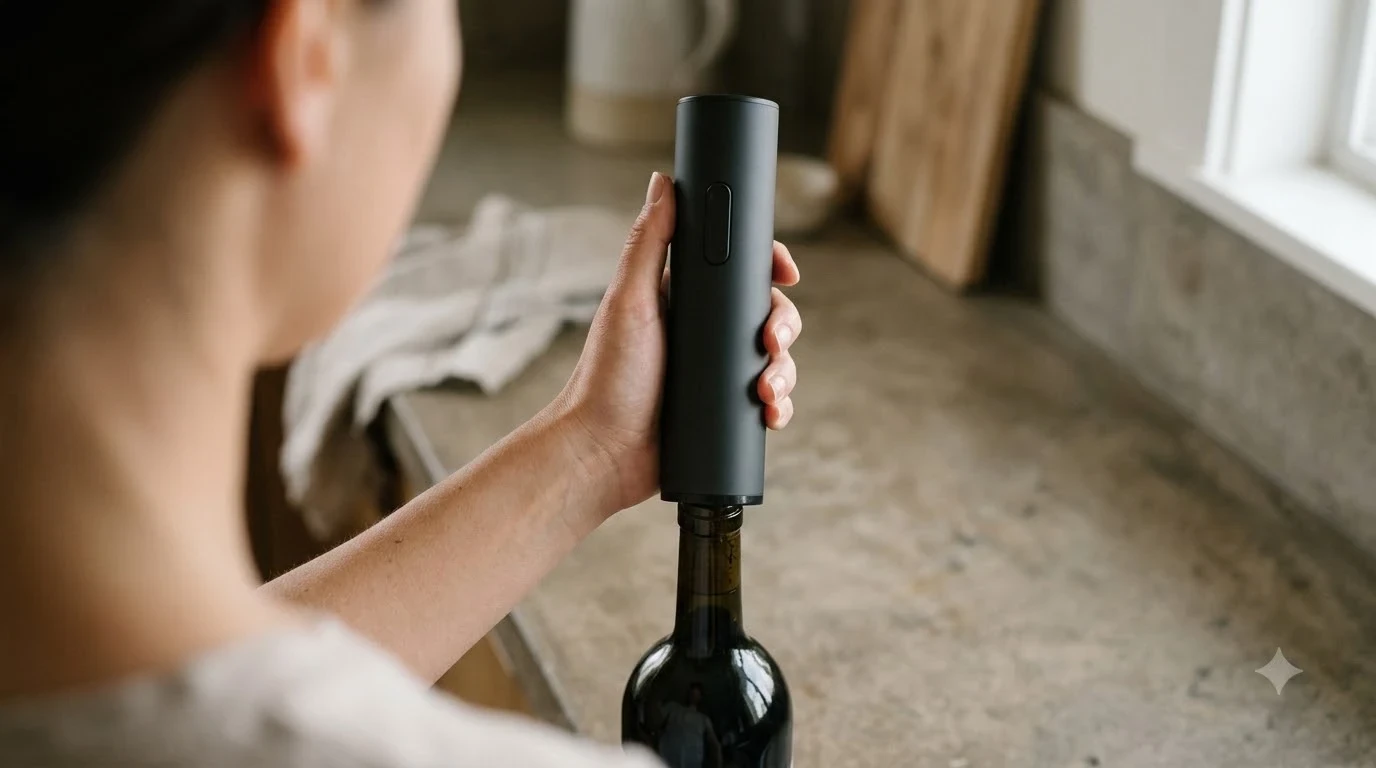
One of the most convenient features is the simple operating sequence. The opener sits vertically over the bottle, and the motor drives the corkscrew into the cork. A second switch direction reverses the mechanism to release the cork after extraction. This avoids the repeated twisting and pulling associated with many traditional corkscrews.
Oster also advertises capacity of up to 30 bottles on a single charge for its Silver Electric models. That specification makes the rechargeable version suitable for households that occasionally open several bottles during gatherings. However, the stated capacity should be understood as a manufacturer specification rather than a guarantee that every older or heavily used unit will achieve the same result.
The soft-grip handle is another practical feature. It gives the user a more secure hold while positioning the opener over the bottle. This is particularly useful when the mechanism starts operating because keeping the opener straight helps the screw enter the center of the cork.
Oster’s product lineup also includes wine accessories. The chiller version includes a stainless-steel cooler, while certain wine kits include a pourer, vacuum stopper, and foil cutter. These extras make a coordinated wine accessory collection more convenient for entertaining.
Some owners appreciate the simplicity of the controls and the convenience of returning the opener to its charging stand between uses. The charging base also provides a dedicated storage position, which can help keep the opener accessible on a kitchen counter.
Still, positive experiences do not mean every Oster model is equally reliable. Battery condition, frequency of use, cork type, and the age of the mechanism all influence performance. An opener that works consistently when new may become less dependable as its rechargeable battery loses capacity.
Common Complaints and Why Oster Openers Stop Working
The most important recurring problems involve batteries that no longer hold a charge, charging indicators that fail to illuminate, weak motors, and corks that become trapped inside the opener. Identifying the symptom helps distinguish a temporary operating problem from a component failure.

1. The opener will not turn on
If pressing the operating switch produces no movement, begin with the power source. On rechargeable models, check that the charging adapter is firmly connected to the outlet and base. Then make sure the opener is positioned correctly in the stand so its charging contacts can connect.
For the FPSTBW8050 battery-operated model, inspect the battery compartment instead. Its manual specifies four AA alkaline batteries installed according to the positive and negative markings. Mixing old and new batteries or reversing their polarity can prevent the motor from operating correctly.
2. The charging base lights up, but the opener does not
This is a particularly confusing problem because the red indicator on the charging base can make the unit appear to be charging normally. However, the base indicator and the charging indicator on the opener are not necessarily showing the same thing.
Oster Consumer Care states that the indicator on the top of the Silver Electric opener should illuminate red during charging. If the base shows a red light but the opener’s own indicator remains dark, check the seating position and connection first. If the problem continues, Oster recommends contacting its support team.
3. The motor runs but cannot remove the cork
A motor that starts but stops before extracting the cork may have insufficient power. Oster recommends fully charging the affected Silver Electric opener for 6–8 hours. A battery that has lost capacity may still activate the motor but fail to provide enough power to complete the extraction.
Incorrect positioning can create a similar symptom. If the opener is tilted, the corkscrew may enter at an angle rather than following the center of the cork. The mechanism then has to work harder, increasing the likelihood of incomplete removal.
4. The cork remains stuck inside the opener
A cork trapped inside the transparent lower section can prevent the opener from being used again. First, switch the appliance off. If the cork can be removed without touching the sharp spiral, Oster’s support guidance allows gentle manual removal. Avoid twisting, forcing, or pulling aggressively against the mechanism.
If the opener has enough power, use the reverse direction specified in the instructions for your particular model. This should move the corkscrew in the opposite direction and release the cork. Keep your fingers and other objects away from the spiral while it operates.
5. The screw appears bent or damaged
A bent corkscrew can cause poor alignment, slipping, and incomplete cork removal. Oster’s instructions also emphasize that the spiral is sharp and should be handled carefully. Stop operating the opener if the screw appears visibly bent, loose, or damaged. Continuing to use a damaged spiral can make the problem worse.
Some owner complaints also describe charging failures after extended use and openers that become too weak to remove corks. These reports are useful indicators of potential concerns, although individual experiences cannot establish the expected lifespan of every unit.
Who Should Buy and Who Should Skip an Oster Wine Opener
An Oster electric wine opener can be a convenient choice for households that value push-button operation and a compact countertop charging stand. It is less appealing to buyers who prioritize replaceable rechargeable batteries, simple mechanical construction, or long-term repairability.
For occasional wine drinkers, the convenience of a cordless motorized opener may outweigh the possibility of battery deterioration over time. A household that opens a few bottles each month can benefit from the simple operating controls and included foil cutter without needing a complicated accessory setup.
The Silver Electric model is particularly suitable for people who want a rechargeable appliance with a published capacity of up to 30 bottles per charge. The chiller version may make more sense for someone who also wants a stainless-steel bottle cooler for entertaining. However, the added accessory does not change the basic electric opening mechanism.
When a different opener makes more sense
Buyers who want to avoid battery-related failures should consider a manual corkscrew. A traditional waiter’s corkscrew has no charging contacts, internal motor, or rechargeable cell. It can also be easier to store in a kitchen drawer or wine accessory case.
People who frequently open bottles with synthetic corks should pay particular attention to the corkscrew design. Oster’s older wine kit manual specifically acknowledges that some synthetic and undersized corks can cause extraction difficulties. A manual alternative can be useful when the electric mechanism struggles with these closures.
For people who want an opener that travels easily, a wine bottle opener keychain offers a compact alternative for occasional use. It does not provide the push-button convenience of an electric model, but it avoids dependence on a charging base.
Another option is a wine opener and preserver set. This type of collection can provide both an opening tool and accessories for closing partially consumed bottles. It is a sensible choice for households that want a more complete wine-serving setup.
How It Compares to Alternative Wine Openers
The most useful comparison is between Oster’s rechargeable electric design, its older battery-operated kit, and a conventional manual corkscrew. Each approach solves the opening task differently, with different maintenance requirements and failure points.
Oster’s rechargeable Silver Electric model is convenient because it can be returned to its charging stand between uses. The battery-operated FPSTBW8050 instead relies on four AA alkaline batteries. Neither system should be confused with a manual opener, which requires no electrical power at all.
| Comparison | Rechargeable Oster | AA-Battery Oster Kit | Manual Corkscrew |
|---|---|---|---|
| Power source | Rechargeable battery | 4 AA alkaline batteries | None |
| Charging required | Yes | No | No |
| Motorized operation | Yes | Yes | No |
| Battery replacement | Not user-serviceable on specified models | Yes | Not applicable |
| Primary maintenance | Charging and exterior cleaning | Battery replacement and cleaning | Cleaning and mechanical inspection |
| Power failure risk | Battery or charging connection | Depleted or incorrectly installed batteries | None |
| Best application | Convenient home entertaining | Battery-powered convenience | Everyday backup |
A manual corkscrew is often the simplest backup because it does not depend on an internal power system. It also provides more direct control over the extraction process. However, it requires the user to apply physical force and maintain a steady turning motion.
The rechargeable Oster has an advantage in convenience, especially when opening several bottles during a dinner party. Its charging base keeps the opener accessible, while its motor reduces the effort required to remove a cork. The disadvantage is that a failed rechargeable battery can make the entire unit unusable if the battery is not designed for user replacement.
The AA-powered FPSTBW8050 offers another practical distinction. When its batteries become depleted, they can be replaced with four new AA alkaline batteries. This makes its power maintenance more straightforward than that of a sealed rechargeable model, although the motor and corkscrew can still experience mechanical wear.
For a complete entertaining setup, consider the available space on your bar cart before choosing between a countertop charging stand and a smaller manual tool. A rechargeable opener may be convenient when it has a dedicated storage position, while a compact manual corkscrew is easier to keep in a drawer.
Warranty, Support, and Replacement Considerations
Warranty coverage depends on the specific Oster model rather than the general product category. The Silver Electric model FPSTBW8207-S-AMZ lists a one-year limited warranty, while Oster lists a three-year limited warranty for the 004208-FFP-000 Silver Electric Wine Opener with Chiller.
These differences are important when deciding whether to seek service or replace an opener that has stopped working. A unit with a recent purchase date may still qualify for warranty assistance, while an older appliance with a failing internal battery may not be economical to repair.
Before contacting customer support, locate the model number on the opener and gather the original purchase receipt. Describe the exact symptom rather than simply reporting that the appliance is broken. For example, explain whether the base indicator illuminates, whether the opener’s own charging light turns red, and whether the motor runs when the switch is pressed.
Oster’s official support information provides a contact number of 1-800-334-0759 for US customers. Its published support guidance also directs customers to the online contact form and LiveChat. The stated telephone support hours for the Silver Electric product are Monday through Friday, 9 a.m. to 5 p.m. Eastern Time.
For model-specific operating instructions, consult the Oster 4207 electric wine opener instruction manual. The manual explains the operating controls and safety precautions, including the instruction not to open the appliance because its internal parts are not user-serviceable.
It is important not to open the housing to investigate an internal battery or motor fault. Oster’s 4207 instruction manual explicitly says that the opener and charging unit have no user-serviceable parts. It also warns against operating a unit with a malfunctioning switch or damaged electrical components.
Cleaning is another area where following the correct instructions matters. Turn the appliance off and unplug the charging equipment before cleaning. Wipe the exterior with a soft, damp cloth, and never immerse the motor unit or charging base in water. The corkscrew is sharp, so avoid touching the spiral while cleaning or handling the opener.
Tip: Keep the original receipt, model number, and charging adapter together. If the opener stops charging, these details help Oster support identify the correct manual, warranty period, and replacement or service options without confusing rechargeable models with older AA-powered kits.
Frequently Asked Questions
Why does my Oster wine opener make a clicking sound but not move?
A clicking sound can indicate that the switch is activating without the motor completing its normal movement. A loose internal connection, damaged gear, or mechanical obstruction may be responsible. Stop using the appliance if the sound continues without normal operation, and contact Oster support rather than opening the housing.
Does an Oster electric wine opener work with screw-cap wine bottles?
No motorized corkscrew is needed for a screw-cap bottle because the closure twists off directly. An electric wine opener is designed for bottles with removable cork-style closures. Using the mechanism on a screw-cap closure will not provide the intended opening action.
Can an Oster wine opener damage a wine cork?
Yes, a cork can crumble or split if it is brittle, damaged, or poorly centered during extraction. Older natural corks may be particularly fragile after extended bottle storage. A two-pronged cork puller or careful manual corkscrew technique may be more appropriate for a fragile closure.
Why does my Oster opener work on one bottle but not another?
Different bottles can have different cork materials, lengths, and levels of resistance. Natural cork, synthetic cork, and undersized closures do not always respond identically to a motorized spiral. Oster’s wine kit manual specifically identifies some synthetic and undersized corks as potential sources of difficulty.
Is an Oster electric wine opener suitable for sparkling wine bottles?
Traditional sparkling wine bottles use pressure-resistant closures secured by a wire cage rather than the standard cork arrangement found on still wines. Follow the sparkling wine producer’s opening instructions and do not use an electric corkscrew to remove a pressurized closure. Keep the bottle pointed away from people and fragile objects during opening.
An Oster wine opener that stops working does not always need immediate replacement. Charging checks, correct positioning, and careful cork removal can resolve some common operating problems, but persistent battery, motor, or switch failures require a more cautious approach. If your model has an internal fault or has reached the end of its useful life, compare its warranty options with a simpler manual corkscrew before choosing your next wine-opening tool.
More in Wine Accessories
 Coravin Vs Vacu Vin: Choose the Right Wine Saver for Your BottlesUpdated Nov 21, 2026
 Zwilling Wine Stopper Review: Preserve Open Bottles LongerUpdated Nov 21, 2026
 Wine Enthusiast Wine Preserver Review: Features, Benefits and LimitationsUpdated Nov 21, 2026
 Wine Enthusiast Wine Stopper: An Easier Way to Reseal Open BottlesUpdated Nov 21, 2026
 Vintorio Wine Opener: Two-Step Cork RemovalUpdated Nov 21, 2026
 Zwilling Wine Aerator Review: Aerate, Pour, and Seal With One ToolUpdated Nov 21, 2026