


We may earn a commission when you buy through links on this page, at no extra cost to you. Learn more.
Newair vs Whynter: Newair is the stronger choice if you prioritize a longer advertised warranty and a slightly larger storage volume, while Whynter offers quieter published operation and useful monitoring features. Both brands offer 46-bottle dual-zone compressor wine refrigerators with built-in and freestanding installation options. The Newair AWR-460DB and Whynter BWR-462DZ are particularly useful comparison points because their capacities and intended applications are similar. Your best choice depends on temperature settings, installation measurements, noise expectations, and the importance of warranty coverage.
Choosing a wine refrigerator involves more than comparing bottle counts. A cabinet that fits your kitchen but cannot accommodate your preferred bottles, or one that runs louder than expected, can become an expensive inconvenience. Newair and Whynter both offer established options for home wine storage, but their specifications reveal meaningful differences. This comparison examines two comparable 46-bottle models to help you decide which manufacturer deserves your attention before buying.
| Comparison | Newair AWR-460DB | Whynter BWR-462DZ |
|---|---|---|
| Advertised capacity | 46 bottles | 46 bottles |
| Storage volume | 5.3 cu. ft. | 5.1 cu. ft. |
| Cooling system | Compressor | Compressor |
| Upper zone | 40–50°F | 40–55°F |
| Lower zone | 50–66°F | 50–65°F |
| Published noise level | 39 dB | Below 38 dB |
| Width | 23.4 inches | 23.5 inches |
| Height | 33 inches | 32.5 inches |
| Depth without handle | 22.4 inches | 22.5 inches |
| Shelves | Removable wood shelves | Five removable wood-faced shelves |
| Installation | Built-in or freestanding | Built-in or freestanding |
| Door security | Locking door | Security lock and key |
| Published warranty | 2 years advertised | 1-year limited warranty |
The comparison uses the manufacturers’ published specifications for the AWR-460DB and BWR-462DZ. The two appliances are close in overall size, but Newair has a small advantage in stated internal volume, while Whynter has a lower published noise figure and additional monitoring features. Individual model specifications matter more than assuming that every refrigerator from either brand shares the same features.
Cooling Performance and Temperature Control
Both manufacturers use compressor cooling and independent temperature zones, making these refrigerators suitable for households that keep red and white wines together. Newair offers a narrower upper-zone range, while Whynter allows a slightly warmer setting for the upper compartment.
The Newair AWR-460DB has an upper compartment adjustable from 40°F to 50°F and a lower compartment adjustable from 50°F to 66°F. This arrangement gives the cooler a distinct division between colder white and sparkling wine storage and warmer red wine storage. For a household that regularly serves Sauvignon Blanc, Chardonnay, Cabernet Sauvignon, and Pinot Noir, the separate settings provide useful flexibility.
The Whynter BWR-462DZ offers a 40°F–55°F upper zone and a 50°F–65°F lower zone. Its wider upper range provides more flexibility if you prefer to keep certain fuller-bodied white wines slightly warmer. The lower zone also accommodates reds at temperatures appropriate for serving rather than the excessively warm room-temperature conditions sometimes found in heated homes.
Neither set of temperature ranges should be interpreted as a guarantee that every bottle will reach its selected temperature immediately. Cabinet temperature, room conditions, door openings, loading patterns, and air circulation all influence cooling performance. A compressor refrigerator also needs sufficient ventilation to remove heat from its cooling system.
For everyday wine service, useful temperature targets include 40–50°F for sparkling wines, 45–50°F for light whites and rosé, and 50–55°F for fuller-bodied whites. Light reds generally benefit from 55–60°F, while fuller-bodied reds are commonly served around 60–65°F.
These recommendations explain why dual-zone storage is practical. A household serving sparkling wine alongside Cabernet Sauvignon does not need to compromise by keeping both styles at the same temperature. For cocktail gatherings, colder sparkling wine can also be ready for an Aperol Spritz recipe without requiring the red wine collection to occupy the same temperature setting.
Newair has a modest advantage for owners who want a dedicated upper compartment capped at 50°F. Whynter is more flexible for people who prefer to experiment with slightly warmer white-wine storage. The difference is not enormous, but it can matter if your collection includes several wine styles with different serving preferences.
Storage Capacity and Interior Organization
Newair and Whynter both advertise 46-bottle capacities, but their stated internal volumes and shelf arrangements are not identical. Newair lists 5.3 cubic feet, while Whynter lists 5.1 cubic feet, giving Newair a small numerical advantage in total cabinet volume.
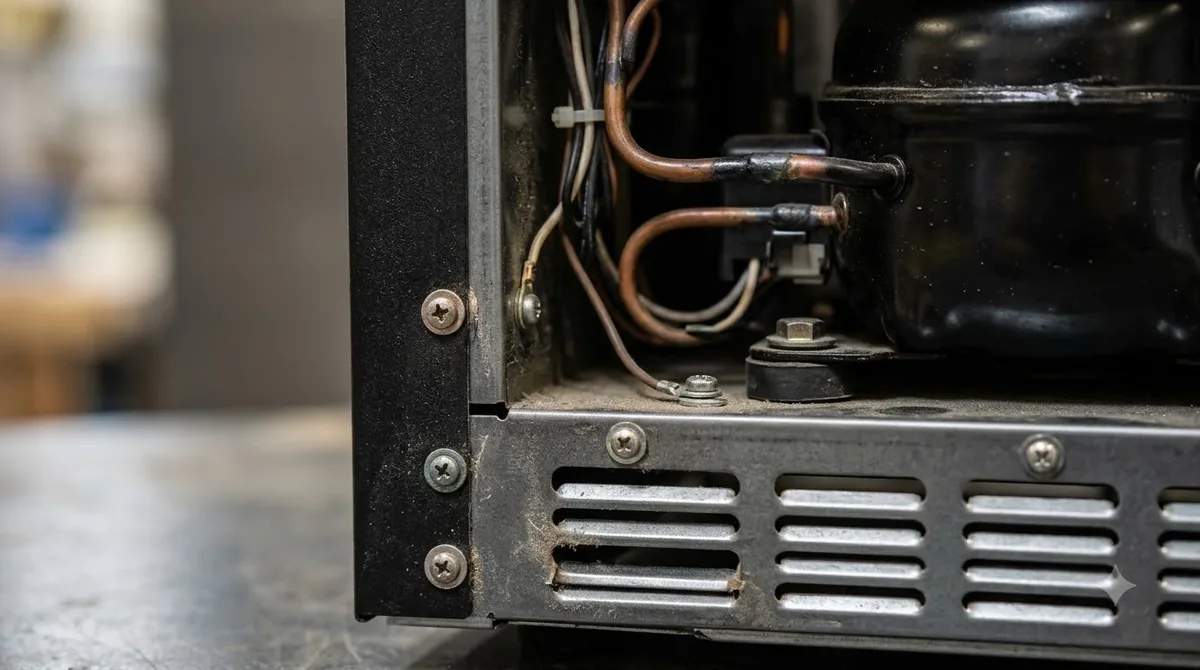
The Newair AWR-460DB uses removable beechwood shelves and provides a locking door. Its advertised capacity is based on standard wine bottles, which is an important distinction for buyers who regularly purchase Champagne, Burgundy, or larger-format bottles. A bottle with wider shoulders or a larger diameter may require removing a shelf or rearranging the available storage space.
Whynter divides its 46-bottle capacity into 16 bottles in the upper compartment and 30 in the lower compartment. Its five removable slide-out roller wood-faced shelves make access convenient, particularly when bottles are arranged in a collection that includes different producers and vintages.
The Whynter arrangement makes the division between the two zones particularly clear. Buyers can plan for 16 bottles of sparkling or white wine above and 30 bottles of red wine below, although the exact arrangement will depend on bottle dimensions. Newair also supports two-zone storage, but buyers should inspect the shelf layout and model documentation before assuming an identical arrangement.
Neither manufacturer’s advertised capacity should be treated as a promise that 46 unusually shaped bottles will fit simultaneously. Standard 750 ml Bordeaux-style bottles are the conventional reference. Wider Champagne bottles, Burgundy bottles, and bottles with unusual shoulders can reduce the practical count.
Tip: Before purchasing, measure the diameter and height of your largest regularly purchased bottles. If your collection includes Champagne or Burgundy, allow extra shelf flexibility rather than planning storage around the advertised maximum capacity.
Another consideration is how often you retrieve bottles. Slide-out shelves can make a refrigerator easier to organize, but frequently moving loaded shelves is not ideal. Arrange wines by grape, producer, or drinking occasion so that the bottles you reach for most often remain accessible.
For collectors who maintain a mixed collection of reds, whites, and sparkling wines, both manufacturers provide a reasonable starting point. Newair’s additional 0.2 cubic feet is a small advantage, but Whynter’s clearly specified 16-and-30-bottle arrangement makes capacity planning straightforward.
Noise Levels, Electrical Requirements, and Everyday Operation
Whynter has the numerical advantage on published noise specifications, listing operation below 38 dB compared with Newair’s 39 dB. Both use compressor systems, so the actual sound in a kitchen or dining area can vary according to installation, flooring, room acoustics, and compressor cycling.
The difference between the listed figures is small. A one- or two-decibel specification gap should not be treated as proof that one refrigerator will be dramatically quieter in every home. The Whynter figure is also expressed as less than 38 dB rather than a precise measured operating value.
Newair specifies 90 watts, 120 volts, and 1.2 amps for the AWR-460DB. Whynter lists 100 watts, 115 volts, and 0.8 amps for the BWR-462DZ. These are manufacturer-listed electrical specifications, not complete measurements of annual electricity consumption.
It would be misleading to calculate yearly operating costs by multiplying the listed wattage by 24 hours and 365 days. Compressor refrigerators cycle on and off instead of necessarily drawing their maximum rated power continuously. Ambient temperature, ventilation, thermostat settings, and door openings also influence actual energy consumption.
For a kitchen near a living room, the published noise difference deserves consideration, but proper installation may matter just as much. An uneven floor, contact with surrounding cabinetry, or inadequate ventilation can contribute to unwanted vibration and sound.
Both models use digital temperature controls, making it easier to set separate compartments than with a basic single-zone refrigerator. Newair provides a digital temperature readout, while Whynter includes temperature memory and a malfunction warning system. Those extra features can be useful when the appliance is part of a frequently used entertaining area.
Neither model should be purchased on the assumption that compressor operation will be completely silent. A refrigeration system needs to move heat, and occasional operating sounds are part of normal appliance use. Buyers particularly sensitive to sound should consider the location of the refrigerator before selecting either manufacturer.
Installation Dimensions and Kitchen Compatibility
Both the Newair AWR-460DB and Whynter BWR-462DZ are designed for built-in or freestanding installation, making them suitable candidates for a home bar, kitchen renovation, or dedicated wine-storage area. Their dimensions are close enough that cabinet measurements and ventilation requirements deserve more attention than the brand name alone.
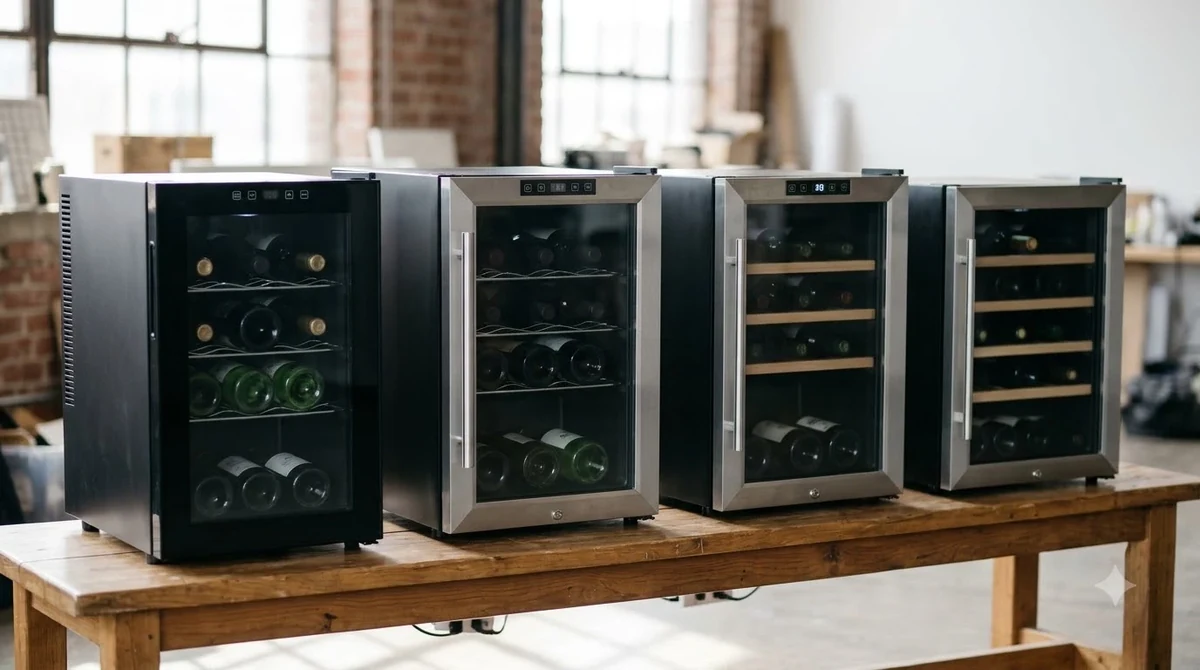
Newair measures 23.4 inches wide, 33 inches high, and 22.4 inches deep without the handle. Whynter measures 23.5 inches wide, 32.5 inches high, and 22.5 inches deep without the handle. These differences are small, but a half-inch height difference can matter when a refrigerator is being installed below a fixed countertop.
Handle depth also needs consideration. Newair lists an overall depth of 24 inches with the handle, while Whynter lists 24.25 inches with the handle installed. A refrigerator that appears to fit according to its cabinet depth may protrude farther into a walkway after installation.
Both models use front-venting designs intended to support under-counter placement. This is an important feature because an ordinary freestanding refrigerator may need open space around its sides or rear and may not be suitable for enclosed cabinetry.
However, front ventilation does not eliminate the need to follow the manufacturer’s installation instructions. The ventilation grille must remain unobstructed, and the cabinet opening must provide the clearances specified for the particular appliance. Buyers should also consider the direction in which the door opens and whether it can be fully extended without hitting nearby cabinets.
Whynter provides a reversible door, which is useful when the kitchen layout requires a different opening direction. Its manual also calls for a grounded three-prong outlet and advises against using an extension cord. The manual specifies an installation environment above 60°F and below 90°F for the BSR-046DW.
Newair’s product information also identifies built-in and freestanding installation options. Its recessed kickplate is intended to support under-counter placement. For a renovation, it is sensible to obtain the current installation diagram before finalizing cabinet dimensions, especially if the appliance will be fitted between fixed panels.
For either refrigerator, check the electrical outlet location, door clearance, ventilation opening, floor level, and delivery route. The Newair weighs 104 pounds according to its specification sheet, while Whynter lists a net weight of 121 pounds. Both may require assistance during positioning, particularly in a tight kitchen.
Whynter is slightly shorter, which may help in some installations. Newair is slightly narrower and shallower without the handle. Neither dimension difference is large enough to make one model universally easier to install, so the available cabinet opening should determine the choice.
Warranty Coverage, Reliability, and Owner Feedback
Newair has an advantage in advertised warranty duration for the compared models, listing a two-year warranty. Whynter’s BWR-462DZ documentation specifies a one-year limited warranty, so buyers should compare the written coverage and service terms before deciding which purchase offers better long-term value.
Warranty length is useful, but it does not establish the expected lifespan of an appliance. Coverage can also differ according to the component, purchase channel, registration requirements, and whether the refrigerator is used in a residential or commercial environment.
For Newair, Best Buy owner feedback identifies temperature control, quiet operation, and dual-zone functionality among the features customers appreciate. Some feedback also raises concerns about shelf quality, compressor operation, and the practical accuracy of the advertised bottle capacity.
These observations are worth considering because they point to the areas buyers should inspect after delivery. Shelves should slide correctly, the door should close evenly, and the cabinet should maintain its selected temperature after the initial cooling period.
Whynter’s BWR-462DZ has more limited review material on the Home Depot listing. The available comments include positive observations about its wood shelving, appearance, and quiet operation. One purchaser also described receiving a damaged first delivery before the replacement unit arrived successfully.
That shipping report does not establish a manufacturing defect, but it illustrates why inspecting a large refrigerator immediately after delivery matters. Photograph visible damage, retain packaging until the appliance has been checked, and follow the retailer’s delivery-damage reporting procedure.
Neither manufacturer should be judged entirely by a small collection of individual comments. Owner experiences can vary because of shipping conditions, installation quality, maintenance, and differences between production batches. Review patterns are useful for identifying potential questions, not for predicting exactly how an individual refrigerator will perform.
For buyers who place a high value on warranty duration, Newair has the clearer published advantage in this comparison. For shoppers who prioritize the Whynter’s lower stated noise level and monitoring features, that shorter warranty may still be an acceptable trade-off.
Before purchasing, verify the warranty document supplied with the exact model and seller. You can review Newair’s AWR-460DB specifications and product information and Whynter’s BWR-462DZ official product specifications for the manufacturer’s stated features.
Which Should You Pick: Newair or Whynter?
Newair is the more appealing choice for buyers who want a longer advertised warranty, a slightly larger cabinet volume, and an upper compartment that stays within a colder 40°F–50°F range. Whynter is more attractive for shoppers who prioritize a lower published noise figure, reversible-door flexibility, and additional operating alerts.
Choose the Newair AWR-460DB if your household regularly stores both red and white wines and you prefer a colder upper zone. Its 46-bottle capacity, 5.3-cubic-foot volume, removable beechwood shelves, and two-year advertised warranty make it a competitive option for a kitchen or home bar.
Newair also makes sense if you value a slightly narrower cabinet. Its listed width is 23.4 inches compared with Whynter’s 23.5 inches. That difference is modest, but it can be relevant when planning an installation with limited clearance.
Choose the Whynter BWR-462DZ if you want the lower published noise specification and a more extensively documented set of monitoring features. Its malfunction alarm, temperature memory function, reversible door, and security lock are useful details for buyers who want additional control over their wine storage.
Whynter is also worth considering if the installation requires a slightly shorter refrigerator. At 32.5 inches high, it is half an inch shorter than the comparable Newair model. Its 16-bottle upper compartment and 30-bottle lower compartment also make the storage arrangement easy to understand.
There is no universal winner because the specifications favor different priorities. The Newair advantage is primarily warranty duration, volume, and colder upper-zone control. The Whynter advantage is published noise level, door flexibility, and monitoring features.
For buyers who entertain frequently, the decision may also depend on what they serve. A collection centered on sparkling wine and crisp Sauvignon Blanc may benefit from Newair’s colder upper-zone limit, while someone storing a broader selection of white wines may appreciate Whynter’s additional upper-zone temperature flexibility.
Whichever model you select, consider your collection’s actual bottle dimensions rather than relying entirely on a 46-bottle headline. A practical refrigerator that fits your largest bottles and kitchen opening is more useful than one that only looks attractive on a specification sheet. For more appliance comparisons, browse our Versus comparison guides.
Frequently Asked Questions
Can either refrigerator store Champagne bottles?
Both refrigerators are designed around standard 750 ml wine bottles, but Champagne bottles often have wider bodies than conventional Bordeaux bottles. You may need to remove or reposition a shelf to accommodate them. The exact number of Champagne bottles that fit depends on the shelf arrangement and bottle dimensions.
Do these refrigerators need to be left upright after delivery?
Compressor refrigerators should be transported and positioned according to their individual manuals. If a unit has been tilted during transportation, the manufacturer’s instructions should determine how long it must stand upright before being powered on. This helps avoid problems associated with compressor oil movement during transport.
Can these wine coolers be used in an unheated garage?
Garage suitability depends on the appliance’s approved ambient operating range. Whynter’s BSR-046DW manual specifies an installation environment above 60°F and below 90°F. A garage that regularly falls outside the manufacturer’s permitted range is not an appropriate location without confirming model-specific operating requirements.
Are these refrigerators suitable for long-term wine aging?
Both provide compressor-based temperature-controlled storage, but a serving-temperature wine cooler is not automatically equivalent to a dedicated long-term wine cellar. Long-term storage also depends on stable conditions, suitable humidity, limited vibration, and protection from light. Collectors aging valuable bottles for many years should evaluate those factors before purchasing.
Should a wine refrigerator run continuously?
A wine refrigerator is designed to remain connected to power so its thermostat can maintain the selected temperature. Its compressor cycles according to cooling demand rather than necessarily running continuously. Repeatedly switching the appliance off can cause unwanted temperature changes inside the cabinet.
Newair and Whynter both offer capable 46-bottle dual-zone refrigerators, but their strengths differ in meaningful ways. Newair is the stronger match for warranty-conscious buyers, while Whynter deserves attention for quieter published operation and additional monitoring features. Measure your installation space, consider your bottle collection, and compare the written warranty before making the final purchase.
More in Versus
 EdgeStar Vs Whynter Wine Coolers for Smarter StorageUpdated Nov 21, 2026
 Kalamera Vs Newair: Choose the Right Wine Cooler for Your HomeUpdated Nov 21, 2026
 Danby Vs Vinotemp: Choose the Right Wine Cooler for Your SpaceUpdated Nov 21, 2026
 Dual Zone vs Single Zone Wine Fridge: Choose the Right Storage SetupUpdated Nov 21, 2026
 Danby vs Magic Chef: Choose the Right Wine Cooler for Your CollectionUpdated Nov 21, 2026
 Ca Lefort Vs Wine Enthusiast: Choose the Right Wine CoolerUpdated Nov 21, 2026