

We may earn a commission when you buy through links on this page, at no extra cost to you. Learn more.
The haier wine and beverage center is a dual-zone wine refrigerator designed to store up to 44 standard wine bottles while keeping two collections at independently adjustable temperatures. The QWR04DGRGB model combines wooden sliding shelves, a triple-pane glass door, compressor cooling, and digital temperature controls. Its main strengths are generous wine capacity and separate temperature zones, although its discontinued status and freestanding installation requirements deserve attention before buying.
Haier’s QWR04DGRGB is particularly interesting for households that keep both red and white wine ready to serve. It has a compact exterior compared with many larger wine cabinets, but its advertised capacity comes with specific bottle-loading requirements. This review examines its specifications, owner feedback, installation considerations, and practical limitations to help determine whether it belongs in your home.
Specs and Key Features of the Haier QWR04DGRGB
The QWR04DGRGB is a 44-bottle, dual-zone wine refrigerator with a 4.00-cubic-foot interior and a compressor-based cooling system. Its 41°F to 61°F temperature range, wooden shelving, and triple-pane glass door make it suitable for households that want separate storage conditions for different wine styles.

Haier designed this model around wine storage rather than general-purpose beverage refrigeration. The distinction matters: the product specifications identify it as a wine refrigerator, not a mixed beverage cooler. Despite occasional descriptions of it as a wine and beverage center, this particular model should not be purchased as a refrigerator for cans, soft drinks, or perishable food.
| Specification | Haier QWR04DGRGB |
|---|---|
| Product category | Wine refrigerator |
| Model number | QWR04DGRGB |
| Advertised capacity | 44 standard wine bottles |
| Interior capacity | 4.00 cubic feet |
| Cooling zones | 2 independent zones |
| Temperature range | 41°F–61°F |
| Cooling system | Compressor |
| Shelving | 4 wooden shelves: 3 full-width and 1 half-width |
| Door | Triple-pane glass |
| Interior lighting | Recessed LED lighting |
| Controls | Electronic capacitive-touch controls |
| Defrost | Automatic |
| Door alarm | Audible |
| Overall dimensions | 32.3 H × 19.6 W × 23 D inches |
| Net weight | 87 pounds |
| Electrical requirements | 120V, 60Hz |
| Refrigerant | R600a |
| Installation type | Freestanding |
These specifications are based on Haier’s manufacturer information. Buyers can review the official Haier QWR04DGRGB product specifications for the complete model details. The dimensions are particularly important because a narrow exterior does not automatically mean the appliance will fit every cabinet opening. Allow for the specified ventilation space, electrical access, and door movement before choosing a location.
Understanding the 44-bottle capacity
The advertised 44-bottle capacity needs a little explanation. Haier’s owner’s manual specifies that the refrigerator accommodates 44 regular bottles measuring 3 inches (76 mm) in diameter using a particular stacking arrangement with the bottom shelf removed.
That means the headline capacity is not necessarily the number of bottles that will fit with every shelf configuration in place. Larger bottles, including Champagne bottles, wide-bodied Pinot Noir bottles, and magnums, can reduce the usable capacity. Collectors who regularly purchase nonstandard bottle shapes should plan around their actual collection rather than the maximum advertised figure.
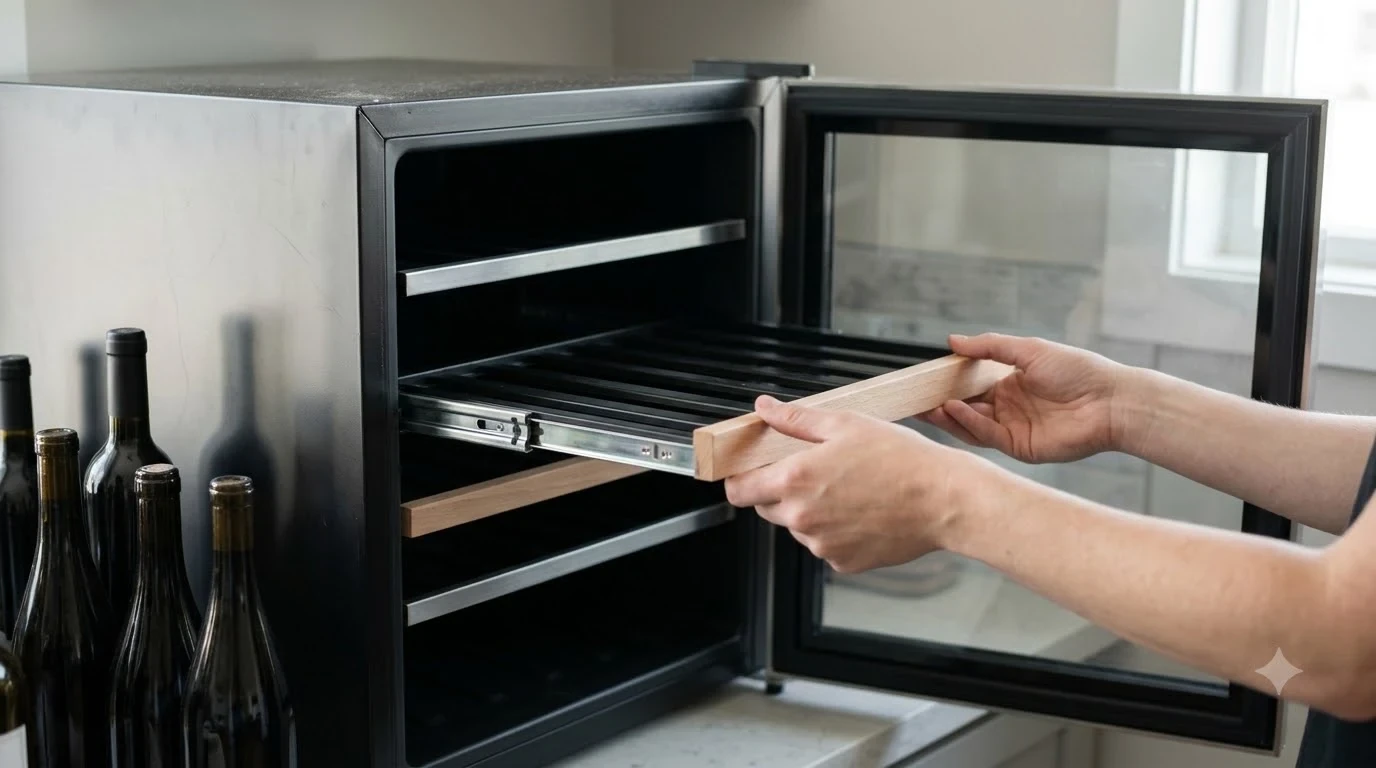
The three upper wooden shelves slide out and accommodate bottles two deep, with bottle necks alternating front to back. The lower area can accommodate larger bottles when loaded with their necks facing left or right. This gives the cabinet some flexibility, although it does not eliminate the space limitations of a relatively narrow appliance.
Dual-zone cooling and temperature control
The two independently controlled zones are among the most useful features. Each operates within the manufacturer’s specified range of 41°F to 61°F, allowing different wine styles to occupy separate temperature settings.
For example, a household might set one zone around 48°F for Sauvignon Blanc and Riesling while keeping lighter reds closer to 57°F. These are useful serving-oriented settings, not universal long-term storage targets. Wine intended for extended aging generally benefits from a more consistent storage environment near 55°F.
The electronic controls allow adjustments in one-degree increments. Users can select the upper or lower compartment before changing its setting, which makes it easier to maintain separate conditions without repeatedly adjusting the entire cabinet.
The triple-pane glass door is another notable feature. Haier describes the construction as improving temperature stability, reducing condensation, and enhancing energy efficiency compared with a double-pane glass door. It also provides visibility into the collection without opening the refrigerator.
What Owners Like About This Wine Refrigerator
Owner feedback highlights the QWR04DGRGB’s appearance, quiet operation, dual-zone flexibility, and practical storage capacity. These characteristics make it appealing to households that want a dedicated wine cabinet rather than another full-size kitchen refrigerator.
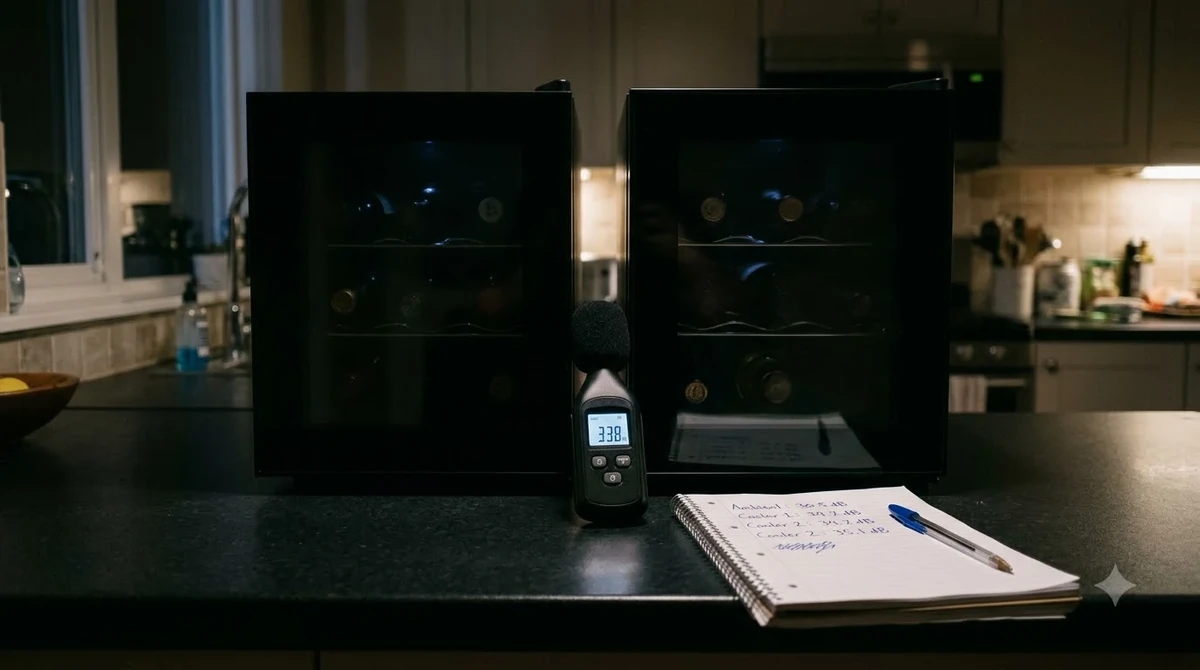
The glass-front design gives the appliance a more furniture-like appearance than an ordinary compact refrigerator. Its black finish, integrated handle, and wooden shelves create a relatively understated look that can complement a home bar, dining room, or kitchen entertainment area.
Quiet operation and everyday convenience
Several owners describe the refrigerator as quiet during normal operation. This is useful for people who plan to place it near a dining area, living room, or home bar rather than in a separate utility room.
However, compressor refrigeration is not completely silent. Haier’s manual explains that the compressor may operate for extended periods and can produce humming or pulsating sounds. These sounds are part of normal operation and should not automatically be interpreted as a mechanical problem.
The sliding wooden shelves also receive positive attention. Being able to pull out a shelf makes it easier to identify a bottle, retrieve a particular vintage, or rearrange a collection without unloading the entire compartment.
Interior LED lighting provides another practical advantage. The lights gradually increase in brightness when activated, helping users see bottle labels without relying on overhead room lighting.
Separate temperatures for different wine styles
Dual-zone refrigeration is particularly helpful for households that drink several wine styles throughout the week. Red and white wines have different serving requirements, and keeping them in separate compartments reduces the need to repeatedly move bottles between storage locations.
For example, a household might keep Chardonnay in one section at approximately 50°F and Pinot Noir in another at approximately 57°F. Sparkling wine, however, generally benefits from colder serving temperatures around 40°F to 50°F, so the lower end of the Haier’s adjustment range is useful for that purpose.
For a dinner party, this arrangement can make serving more convenient. A chilled white wine can accompany seafood or roast chicken while a lighter red is ready for a separate course. A chicken Marsala recipe, for instance, provides an opportunity to serve Pinot Noir or another medium-bodied red at an appropriate temperature.
Useful features without excessive complexity
The QWR04DGRGB focuses on practical refrigeration features instead of a large collection of entertainment-oriented extras. The digital touch controls, automatic defrost, reversible door, audible alarm, and leveling legs address everyday storage and installation needs.
The door alarm is especially useful in busy households. Haier’s manual states that the alarm sounds if the door remains open for more than one minute. This helps alert users when the door has not closed properly after retrieving a bottle.
The appliance also includes Sabbath Mode. This provides an additional operating option for households that need the function, although it is not a feature every wine collector will use.
Common Complaints and Limitations
The most important drawbacks are the difference between advertised and practical bottle capacity, installation restrictions, and the uncertainty associated with buying a discontinued model. These concerns do not necessarily make the refrigerator unsuitable, but they should influence the purchasing decision.
The advertised capacity requires careful loading
The 44-bottle figure assumes regular bottles measuring approximately 3 inches in diameter and a specific loading configuration. The manufacturer’s instructions require removing the bottom shelf to achieve the maximum advertised capacity.
This matters because wine bottles are not standardized in every dimension. Champagne and sparkling wine bottles can be wider than conventional Bordeaux bottles. Some Burgundy bottles also have broader shoulders and bodies that occupy additional room.
Owners commenting on Lowe’s have specifically mentioned that the refrigerator holds fewer bottles than the advertised maximum when using larger 750 ml bottle shapes. This is a practical limitation rather than necessarily a defect, but buyers should account for it before expecting to store a full 44-bottle collection.
Installation is not as simple as the exterior dimensions suggest
Haier identifies the QWR04DGRGB as a freestanding refrigerator. Its installation instructions specify 2 inches of clearance at the top, 2 inches at the rear, and 1 inch at each side.
The manufacturer’s product marketing discusses undercounter placement, but the actual model specifications identify freestanding installation. Buyers should not assume that it is a conventional front-venting built-in appliance suitable for a fully enclosed cabinet installation.
The door also needs adequate space to open and allow the shelves to slide out. Haier’s installation manual specifies a factory door swing of 105 degrees. In a corner installation, it recommends at least 1 inch of hinge-side clearance for a 90-degree opening or 8 inches for the full opening.
Measuring only the appliance width is therefore insufficient. Check the surrounding cabinetry, wall position, electrical outlet, and door-swing clearance before arranging delivery.
Temperature separation requires attention during setup
One owner review on Lowe’s mentions difficulty fitting the gasket between the upper and lower compartments. The reviewer questioned whether the missing or poorly fitted component could affect temperature stability.
This deserves attention because the gasket is part of the installation process, not an optional decorative accessory. Haier’s manual explains that the center-rail gasket helps temperature performance and provides instructions for fitting it.
Anyone purchasing an unused unit should verify that the gasket and other supplied installation components are present. Buyers of secondhand refrigerators should inspect the center rail, door seals, and temperature controls before committing to a purchase.
Discontinued status changes the buying decision
Haier’s product page identifies the QWR04DGRGB as no longer being manufactured. GE Appliances’ support page lists its manufacturing period as July 2021 through July 2024.
This does not mean that every existing unit is unreliable or unusable. It does mean that buyers may have fewer opportunities to purchase a new appliance directly through conventional retail channels. Availability of replacement parts and service should also be considered before purchasing an older or previously owned unit.
For additional context on other appliances in this category, the wine refrigerator model reviews collection can help compare different storage formats and features.
Tip: Before purchasing a used QWR04DGRGB, ask the seller to demonstrate both temperature zones, inspect the center-rail gasket, check the door alarm, and confirm that all four wooden shelves are included. Allow the refrigerator 24 hours to stabilize after installation before judging its temperature performance.
Who Should Buy the Haier QWR04DGRGB and Who Should Skip It
This Haier refrigerator makes the most sense for wine drinkers who want separate red and white storage in a relatively compact appliance. It is less suitable for people who need a true mixed-beverage refrigerator, a fully integrated built-in installation, or a guaranteed new model with current manufacturer availability.
Who should consider buying it?
Households with mixed wine collections: The two independent temperature zones make the QWR04DGRGB useful for people who regularly drink Cabernet Sauvignon, Pinot Noir, Chardonnay, Sauvignon Blanc, and sparkling wine. Rather than keeping everything at one compromise temperature, users can create separate settings for different styles.
Collectors with moderate storage needs: The advertised capacity of 44 standard bottles provides useful space for a growing household collection. The wooden shelves and separate lower storage area also offer more flexibility than many small countertop wine refrigerators.
Home bar owners: The black glass door, recessed lighting, and integrated handle give the appliance a finished appearance. It can work well in a dedicated home bar or entertainment area where wine storage is a visible part of the room.
Buyers who find a well-maintained existing unit: Discontinuation does not automatically eliminate the model’s usefulness. A properly functioning unit with intact shelves, door seals, and controls may still suit someone who understands its installation and capacity limitations.
Who should look elsewhere?
People who primarily store canned drinks: This is a wine refrigerator, not a general beverage cooler. Its specifications do not identify can-storage capacity, so beer cans, soda cans, and other packaged drinks are not the intended storage format.
Buyers who need a built-in appliance: The manufacturer’s installation instructions describe a freestanding unit with specified surrounding clearances. Anyone planning a cabinet installation should prioritize a refrigerator explicitly designed and certified for that installation style.
Collectors with many oversized bottles: The advertised 44-bottle capacity depends on standard bottle dimensions and removal of the bottom shelf. A collection dominated by Champagne, magnums, or unusually wide bottles will occupy more space.
Buyers who want a current product with straightforward retail support: The QWR04DGRGB is discontinued. If new-product availability, a current product lineup, or a longer purchasing horizon is important, comparing currently manufactured alternatives is the more sensible approach.
How It Compares to Alternative Wine Storage Options
The Haier QWR04DGRGB occupies a middle ground between small countertop wine refrigerators and larger dedicated wine cabinets. Its 44-bottle capacity and dual-zone controls are attractive, but the right alternative depends on whether storage capacity, installation style, or general beverage cooling matters most.
Haier versus a small countertop wine refrigerator
A countertop wine refrigerator is usually intended for a smaller collection and limited available floor space. These appliances can be useful for people who only keep a few bottles ready for occasional meals or entertaining.
The Haier is substantially more suitable for a collection that includes multiple bottles of different grape varieties and producers. Its four wooden shelves and two temperature zones offer more organizational flexibility than a compact single-compartment appliance.
However, the Haier requires dedicated floor space, ventilation clearances, and careful positioning. A countertop model may be the better choice for an apartment kitchen or a household with very limited available space.
Haier versus a single-zone wine refrigerator
A single-zone wine refrigerator maintains one general temperature throughout the cabinet. This arrangement can be perfectly practical for people who primarily collect one type of wine or want to store their entire collection under similar conditions.
The Haier’s dual-zone configuration is more flexible for households that regularly serve both red and white wine. For example, Chardonnay can be kept around 50°F while Pinot Noir is held closer to 57°F.
The trade-off is that dual-zone refrigeration adds another set of temperature settings to manage. Someone who only drinks red wine and stores the entire collection at a consistent temperature may not benefit enough from the additional compartment to justify choosing this type of appliance.
Haier versus a dedicated beverage center
A dedicated beverage center is designed for packaged drinks such as cans and bottles of beer, soda, sparkling water, and other refreshments. Its shelves and interior dimensions are usually arranged around mixed beverage storage rather than horizontal wine-bottle organization.
The QWR04DGRGB should not be treated as an equivalent substitute. Its 44-bottle rating refers to standard wine bottles, and its specifications identify it as a wine refrigerator rather than a general beverage cooler.
For households that frequently entertain guests with a mixture of wine, beer, and soft drinks, two specialized appliances may be more practical than expecting one wine refrigerator to perform both jobs.
Choosing the right temperature arrangement
Wine storage should reflect the way the collection will be used. Serving temperatures differ by wine style, and the Haier’s 41°F to 61°F range provides a reasonable range for many ready-to-drink bottles.
These are useful general serving guidelines:
- Sparkling wine: 40°F to 50°F.
- Light white wine and rosé: 45°F to 50°F.
- Full-bodied white wine: 50°F to 55°F.
- Light-bodied red wine: 55°F to 60°F.
- Full-bodied red wine: 60°F to 65°F.
- Sweet white wine: 43°F to 50°F.
Because the Haier’s maximum setting is 61°F, it cannot reach the upper end of the recommended serving range for some full-bodied reds. Those bottles can be removed from the refrigerator and allowed to warm slightly before serving.
For a casual gathering, the appliance can also support a cocktail-oriented selection of sparkling wine and chilled white wine. A bottle stored at an appropriate temperature can be ready for an Aperol Spritz recipe or a refreshing Hugo Spritz recipe, although the finished cocktails still require their own ice and ingredients.
Frequently Asked Questions
Is the Haier QWR04DGRGB suitable for long-term wine aging?
It can provide refrigerated wine storage, but its manual does not establish it as a specialized long-term aging cellar. The cabinet also has slight temperature variation between different locations within each zone. Collectors aging valuable bottles for many years may prefer a dedicated cellar with more specialized storage controls.
How long should the Haier refrigerator run before loading wine?
Haier’s installation instructions recommend allowing 24 hours for the temperature to stabilize after installation. This initial period gives the refrigeration system time to reach its operating conditions. It is also a useful opportunity to confirm that both displays respond correctly to adjustments.
Can the Haier QWR04DGRGB store magnum bottles?
Yes, the manufacturer’s loading instructions identify the bottom shelf area as suitable for larger bottles, including magnums. The bottles should be positioned with their necks facing left or right. Larger formats will reduce the total number of bottles the cabinet can accommodate.
Does the Haier QWR04DGRGB have a control lock?
Yes. The manufacturer’s operating instructions describe a control lockout feature that prevents unwanted temperature changes. The controls can be locked or unlocked by holding the designated button for three seconds.
Can the Haier wine refrigerator operate in a garage?
Its installation manual specifies an acceptable surrounding temperature range of 55°F to 90°F. An unconditioned garage that regularly falls outside that range is therefore not a suitable installation location. Direct sunlight and exposure to water should also be avoided.
The Haier QWR04DGRGB remains an interesting option for households seeking 44-bottle wine storage, separate temperature zones, and an attractive glass-front design. Its discontinued status, freestanding installation requirements, and standard-bottle capacity assumptions are important limitations, particularly for buyers considering a secondhand unit. For the right wine-focused household, however, its combination of practical shelving and dual-zone cooling can still make it a worthwhile model to consider.
More in Model Reviews
 Magic Chef 44 Bottle Wine Cooler Review for Flexible StorageUpdated Nov 21, 2026
 Whynter 164 Bottle Wine Cooler Review: Capacity, Features, and FitUpdated Nov 21, 2026
 Insignia NS WC16BK6 Review: Compact 16-Bottle Wine StorageUpdated Nov 21, 2026
 Wine Enthusiast Electric Blue Omega Review: Opening, Pouring, and Preserving Made EasierUpdated Nov 21, 2026
 Koolatron 20 Bottle Wine Cooler Review: Features, Fit, and PerformanceUpdated Nov 21, 2026
 NewAir AWC 330E Review for Home Wine StorageUpdated Nov 21, 2026