

We may earn a commission when you buy through links on this page, at no extra cost to you. Learn more.
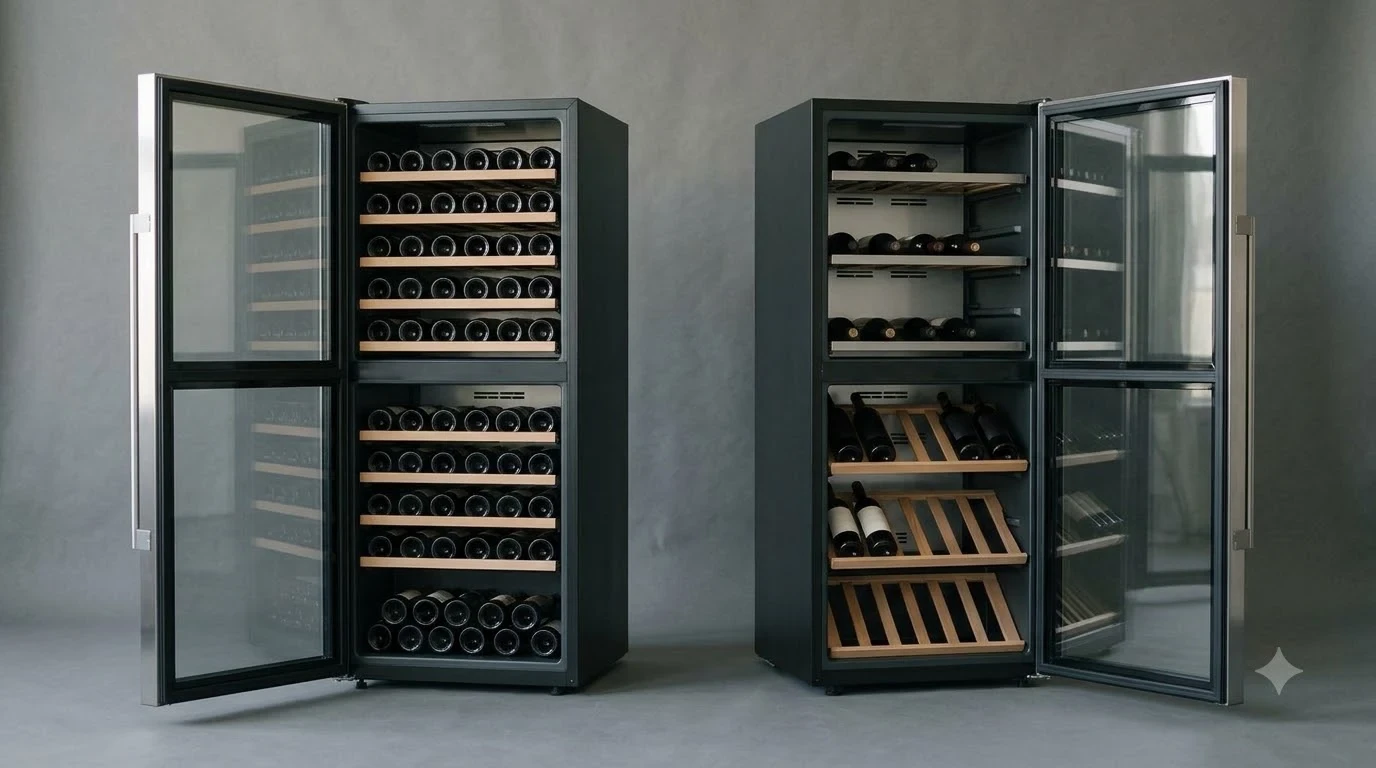
The cuisinart dual zone wine fridge is the Cuisinart CWC-1200DZ, a discontinued 12-bottle cooler with separate temperature controls for two compartments. Its compact split-zone layout is useful for keeping reds and whites apart, and its 39°F to 68°F setting range is broad on paper. The main reservation is practical rather than cosmetic: this is a thermoelectric unit whose actual cooling depends heavily on room temperature, and Cuisinart no longer sells it.
The CWC-1200DZ makes the most sense as a small, freestanding wine station for a home that regularly keeps a few bottles of each color ready to pour. Its strengths are straightforward controls, dual compartments, and a modest footprint; its limits are capacity, bottle fit, warm-room performance, and discontinued-product support. This review focuses on that 12-bottle model and separates its documented specifications from owner observations.
Specs and Key Features
The CWC-1200DZ is a compact two-compartment cellar designed around a dozen bottles rather than a large collection. The manufacturer lists independent thermoelectric cooling for each side, a 39°F to 68°F control range, six contoured chrome racks, and a limited three-year warranty.
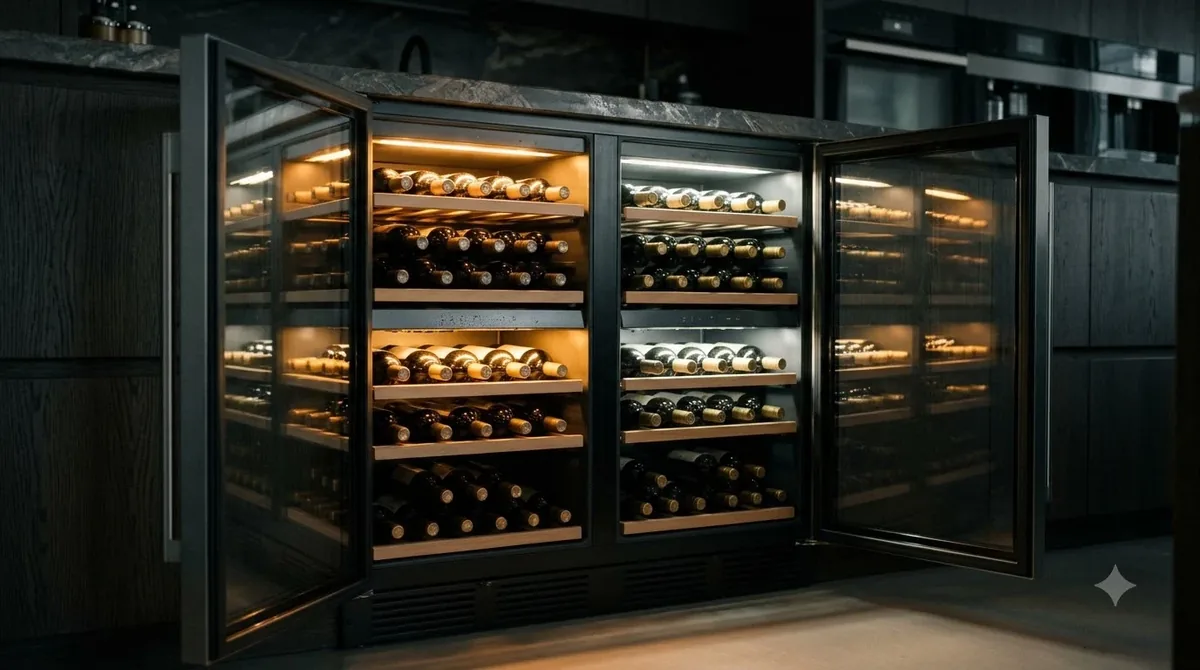
At the center of the design are two separate doors and temperature zones. Cuisinart describes a dual-fan arrangement with an individual thermoelectric cooling unit for each zone, allowing a red-wine compartment and a white-wine compartment to operate at different set points. The touchpad uses plus and minus controls, with the selected temperature shown on a blue LED display. Soft interior lighting can be switched on or off separately for each zone, and the double-pane tinted windows let the bottles remain visible without opening the doors.
The six chrome contoured racks are intended to hold 750 ml bottles, and the manufacturer also lists 1,500 ml bottle compatibility. That capacity description deserves care: total capacity is 12 bottles, and bottle shape affects how efficiently the racks can be loaded. A broad-shouldered bottle, sparkling-wine bottle, or larger-format bottle may not fit in the same way as a standard Bordeaux-style 750 ml bottle. Owner feedback also mentions that some wider bottles do not fit without removing a rack, so treat the advertised capacity as a standard-bottle figure rather than a guarantee for every bottle style.
| Specification | Cuisinart CWC-1200DZ |
|---|---|
| Maximum capacity | 12 bottles |
| Temperature setting range | 39°F to 68°F |
| Cooling system | Two independent thermoelectric cooling units with dual fans |
| Storage layout | Two temperature zones; double-door compartments |
| Racks | Six contoured chrome racks |
| Viewing doors | Double-pane tinted windows |
| Interior lighting | Separate soft-light controls for each zone |
| Warranty stated by Cuisinart | Limited three years |
| Product status | Discontinued; listed out of stock |
The key specification to interpret correctly is the difference between a displayed setting and the temperature the cabinet can actually maintain. The manual explains that thermoelectric cooling is most effective in an ambient room below 70°F. It gives a useful illustration: at a 77°F room temperature, the lowest cabinet temperature may be about 46°F to 48°F, while at 70°F ambient the cabinet may reach roughly 39°F to 41°F. Those are meaningful constraints for anyone hoping to chill Sauvignon Blanc or sparkling wine in a warm kitchen. For the official feature list and current product-status wording, see Cuisinart’s CWC-1200DZ product page; the listing identifies the model as discontinued, so a used or remaining-stock purchase should be evaluated differently from a current appliance with active retail distribution.
What Owners Like
The most useful part of the CWC-1200DZ is its simple division of wine by serving temperature. Owners commenting on the model describe the appeal of being able to set two different temperatures while keeping the appliance small enough for a limited kitchen or dining area.
That split is practical for households that buy both red and white wine but do not need a full-size cellar. A lighter white such as Pinot Grigio or Sauvignon Blanc can sit in the cooler zone, while a softer red such as Merlot can occupy the warmer side. Lowe’s owner comments include praise for the dual-temperature function and the compact form. This is the core benefit to judge: separate compartments solve a more specific problem than a single-temperature beverage refrigerator, even though the total capacity is only 12 bottles.
The controls are also uncomplicated. Each side has its own plus and minus temperature adjustment, the blue display makes the set point easy to read, and the lighting can be controlled independently. There is no app setup, Wi-Fi connection, or complicated program to learn. For someone who wants to divide a small collection between red and white wine, assign a separate setting to each compartment, and leave the cooler to do its work, the feature set is easy to understand.
Several design choices suit a visible living space. Cuisinart specifies tinted double-pane viewing windows, chrome contoured racks, and soft lighting, while the two separate doors make the split-zone idea clear. It can be useful near a dining area where a chilled bottle is selected often, rather than hidden in a pantry. A chilled bottle of sparkling wine for an Aperol Spritz recipe or a crisp white alongside seafood can be ready without changing the temperature of the red-wine compartment.
Common Complaints
The main limitation is the thermoelectric cooling system’s sensitivity to ambient heat. The control panel can accept a 39°F setting, but that does not mean the cabinet will reach 39°F in every room; the manual’s 77°F example puts the minimum closer to 46°F to 48°F. That gap matters if the goal is to serve sparkling wine at 40°F to 50°F or a light white at 45°F to 50°F during a hot summer.
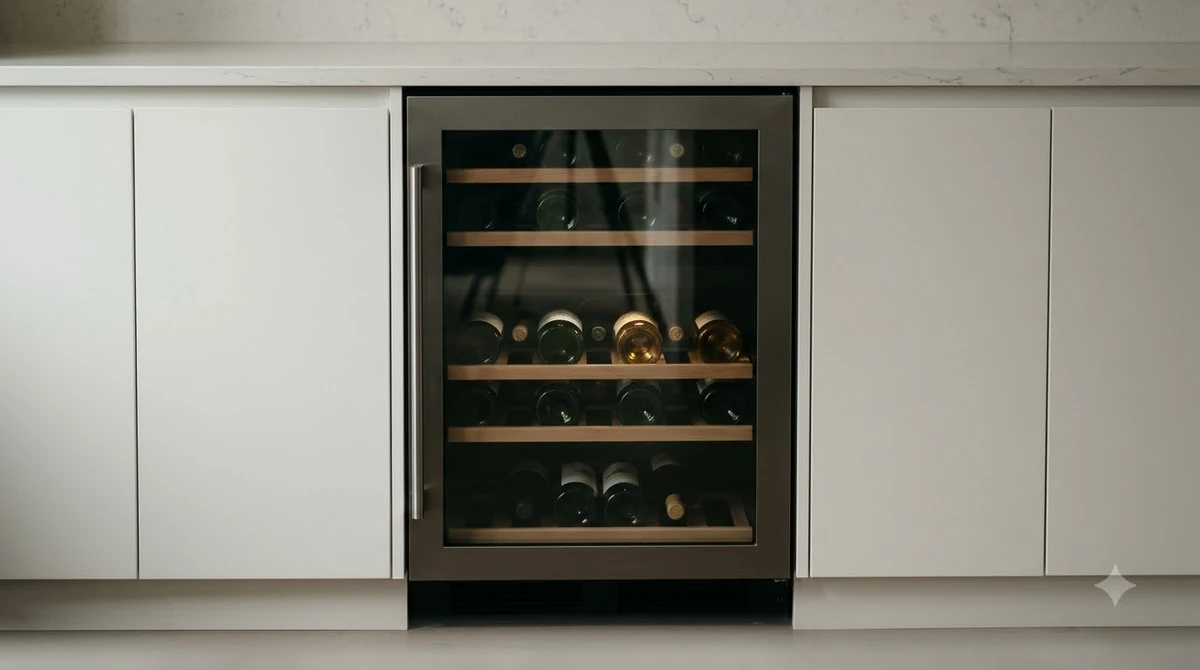
This is not a cooler to squeeze into a warm garage, beside an oven, or into a tightly enclosed cabinet. Cuisinart’s manual calls for an operating environment below 70°F for efficient thermoelectric performance and recommends open ventilation around the unit. It specifies 5 inches of clearance on the right side and 3 inches on the left and rear. The appliance is freestanding only, not designed for a built-in installation, and the doors need room to open fully. Those requirements may rule it out for a narrow under-counter cavity even if the exterior dimensions appear suitable. Noise and bottle fit add further compromises: one Lowe’s reviewer described a quiet fan sound similar to a personal computer, while another reported that wider bottles may need a rack removed. The nominal 12-bottle capacity therefore assumes bottles that fit the racks as intended; a collection heavy on Champagne bottles, broad-shouldered Rhône bottles, or large formats may have less usable space than the headline figure suggests.
Finally, the discontinued status changes the ownership equation. A Lowe’s customer described a unit that had operated for a decade or more before it stopped working and reported difficulty finding replacement parts. That is one person’s experience, not proof of a common failure pattern, but it illustrates the risk of buying an older appliance with uncertain repair options. A used unit may look clean and power on at inspection yet still have age-related cooling, fan, display, or door-seal issues.
Who Should Buy and Who Should Skip
The CWC-1200DZ suits a buyer who wants a small, clearly divided wine cooler and has a cool, ventilated place to put it. Its 12-bottle capacity, two separate temperature settings, and compact freestanding format are most useful for someone who keeps a few bottles of red and white ready for meals rather than aging a large collection.
It can be a reasonable secondhand option when its condition accounts for the age and discontinued status, the seller can demonstrate both zones cooling, and the buyer can check the door seals, fans, controls, and lighting before purchase. Test each compartment separately rather than assuming that a lit display means the thermoelectric system is working well. Leave enough time for the cabinet to stabilize, then compare the actual internal temperature with the selected set point using a separate refrigerator thermometer. The manual warns that ambient conditions affect the temperature the cabinet achieves, so a quick demonstration in a cool room may not predict performance in a warmer home.
Wine drinkers can get useful separation from the two zones by setting one side for light whites and the other for reds that benefit from a slightly warmer serving temperature. For example, light whites and rosé are generally served around 45°F to 50°F, while light reds are better around 55°F to 60°F. Full-bodied reds are often served closer to 60°F to 65°F, so the unit’s broad set-point range provides flexibility if the room is cool enough. For a dinner pairing, the cooler side can hold a white wine for fish while the other side holds a red for a chicken Marsala recipe.
Skip this model if you need reliable cold storage in a room that regularly gets above 70°F, want a built-in appliance, or plan to store many nonstandard bottle shapes. It is also a poor fit for anyone who expects a modern manufacturer’s parts pipeline or wants to buy new with straightforward retail availability. Because Cuisinart lists the CWC-1200DZ as discontinued and out of stock, buying it now usually means considering old inventory or a secondhand unit, not choosing from an actively stocked product line.
Tip: Before buying a used CWC-1200DZ, run both zones long enough to see whether they cool independently, measure the cabinet temperature instead of trusting the LED set point, and confirm that your widest everyday bottle fits with the racks installed.
How It Compares to Alternatives
The closest same-brand comparison is Cuisinart’s CWC-1800DZTS, a separate 18-bottle dual-zone model. It offers six more bottle positions than the CWC-1200DZ and keeps the same advertised 39°F to 68°F control range, making it a better fit on paper for someone who needs more room without giving up separate red and white compartments.
The CWC-1800DZTS uses two independent cooling compartments and a thermoelectric system, according to Cuisinart. Its listed details include nine contoured chrome racks designed for 750 ml or 1,500 ml bottles, touchscreen controls on the door, blue temperature display, soft blue interior lighting, natural wood shelf trim, stainless exterior trim, and adjustable feet. Those finish and rack details make it a more styled option, but the same broad caveat applies: a thermoelectric cooler is affected by room temperature, and a nominal set-point range does not by itself prove that a cabinet will hold the lowest setting in a hot room.
The trade-off is that the 18-bottle model is also marked discontinued by Cuisinart, so it is not a simple current-generation upgrade with guaranteed availability. A buyer comparing the two should prioritize condition, verified cooling, and parts or warranty support over the extra six-bottle capacity or appearance. The 12-bottle CWC-1200DZ is more compact; the CWC-1800DZTS provides more stated capacity and has a touchscreen rather than the smaller model’s touchpad controls. Neither should be selected without checking the precise model number and testing the separate compartments. Compared with a single-zone wine cooler, the CWC-1200DZ has a genuine functional advantage when red and white wine are both kept ready to serve: a single-zone cabinet cannot keep a white wine at 46°F while holding a light red closer to 58°F at the same time. If nearly all bottles are one style, however, the dual-zone feature may be wasted; if a household regularly serves sparkling wine, crisp whites, and reds, independent temperature settings are more useful.
For additional appliance comparisons, browse our model reviews. The practical takeaway is that the CWC-1200DZ has a clear use case, but the discontinued status and warm-room limits matter more than the blue display or stainless-look finish. A well-maintained used unit in a cool room can still serve a small collection; a buyer who needs dependable high-volume storage should compare current-production models before committing.
Frequently Asked Questions
These answers cover setup details that are easy to miss in a short product description, from the 48-hour first-use adjustment to the 120-volt, 15-amp outlet requirement. They are useful when evaluating a secondhand CWC-1200DZ or choosing where to install it.
How long should the CWC-1200DZ run before its first use?
The instruction booklet says to allow at least 48 hours for the internal temperature to adjust properly on first use. It also advises placing 1 to 3 bottles in each chamber during this initial period. This is a setup instruction, not a promise that every room will let the cooler reach its lowest displayed setting.
What electrical outlet does the CWC-1200DZ require?
The manual specifies a properly grounded 120-volt, 15-amp outlet. It also says not to share the outlet with a refrigerator or microwave. Do not remove the grounding prong or use an unsuitable adapter to make the plug fit.
Does the wine cooler have a condensation tray?
Yes. The manual describes a water tray that receives condensation drained from the interior. The collected water is intended to evaporate, so the booklet says it does not need to be emptied manually during normal operation.
Can the interior lights remain on continuously?
The manual says the display-light button leaves the interior lights on until the button is pressed again. It also recommends leaving the lights off during normal operation. The lighting is intended for viewing the bottles, rather than as a permanent display feature.
Should the bottles stay inside when moving the cellar?
No. Cuisinart’s instruction booklet explicitly says to remove all bottles before moving the wine cellar. Emptying it first reduces the load on the shelves and helps prevent bottles from shifting while the appliance is being carried.
The Cuisinart CWC-1200DZ is a practical small dual-zone concept, not a worry-free modern purchase: its independent settings and 12-bottle layout are appealing, but thermoelectric performance depends on a cool room and the model is discontinued. Buy only after confirming both compartments work, the cabinet suits your bottle shapes, and the seller can explain the unit’s service history.
More in Model Reviews
 Magic Chef 44 Bottle Wine Cooler Review for Flexible StorageUpdated Nov 21, 2026
 Whynter 164 Bottle Wine Cooler Review: Capacity, Features, and FitUpdated Nov 21, 2026
 Insignia NS WC16BK6 Review: Compact 16-Bottle Wine StorageUpdated Nov 21, 2026
 Wine Enthusiast Electric Blue Omega Review: Opening, Pouring, and Preserving Made EasierUpdated Nov 21, 2026
 Koolatron 20 Bottle Wine Cooler Review: Features, Fit, and PerformanceUpdated Nov 21, 2026
 NewAir AWC 330E Review for Home Wine StorageUpdated Nov 21, 2026