

We may earn a commission when you buy through links on this page, at no extra cost to you. Learn more.
The newair 12 bottle wine fridge is a compact freestanding wine refrigerator designed to keep a small collection organized, chilled, and accessible without taking up much floor space. The current stainless steel model, NWC012SS00, offers compressor cooling, a digital temperature display, removable racks, and double-pane glass. Its narrow 9.92-inch width is particularly attractive for apartments and small home bars, although buyers should investigate its conflicting published temperature specifications and consider whether 12 standard bottles provide enough practical capacity.
A dedicated wine refrigerator can make everyday entertaining easier by keeping bottles organized and closer to their intended serving temperatures. Newair’s 12-bottle lineup has included different designs and cooling technologies, so identifying the precise model matters before purchasing. This review focuses on the current stainless steel NWC012SS00, while distinguishing it from the older AW-121E thermoelectric model to avoid mixing specifications and owner experiences from different appliances.
Specs and Key Features of the Newair 12-Bottle Wine Fridge
The NWC012SS00 combines a slim freestanding cabinet with compressor cooling, adjustable storage, and a double-pane glass door. Its 9.92-inch width and 12-bottle capacity make it particularly relevant to wine drinkers who want dedicated storage without installing a full-size cellar.
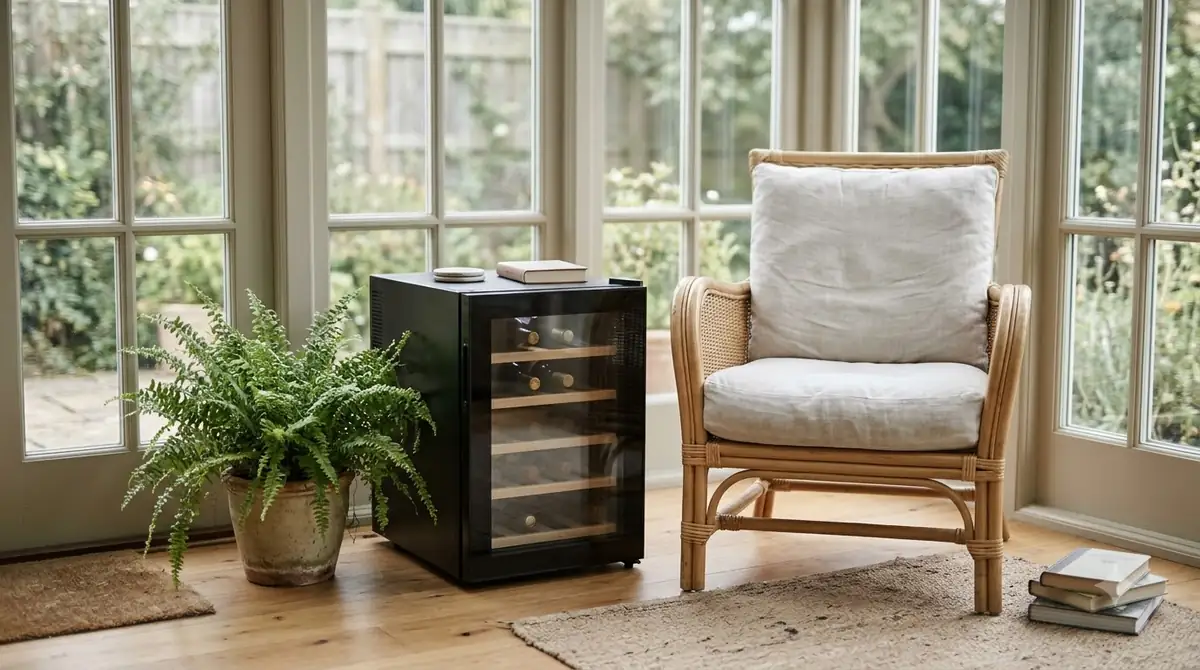
According to Newair’s product specifications, the stainless steel refrigerator measures 17.72 inches deep, including its handle, and stands 31.18 inches tall. It has an internal volume of 1.2 cubic feet and weighs 37.48 pounds. The narrow cabinet is its most distinctive physical characteristic, allowing it to occupy a relatively small footprint while offering upright, dedicated wine storage.
| Specification | Newair NWC012SS00 |
|---|---|
| Manufacturer | Newair |
| Model number | NWC012SS00 |
| Rated capacity | 12 bottles |
| Internal volume | 1.2 cubic feet |
| Width | 9.92 inches |
| Depth with handle | 17.72 inches |
| Height | 31.18 inches |
| Weight | 37.48 pounds |
| Cooling technology | Compressor with built-in fan |
| Temperature zones | Single zone |
| Advertised operating range | 41°F–64°F |
| Power consumption | 95 watts |
| Electrical requirements | 110–120 volts, 60 Hz |
| Published noise level | 43 dB |
| Door construction | Double-pane tempered glass |
| Interior lighting | LED |
| Shelf construction | Metal, removable racks |
| Refrigerant | R600A |
| Certification | ETL/cETL |
One specification deserves particular attention. Newair’s product description advertises a 41°F to 64°F temperature range, and its feature list repeats that range. However, the specification table on the same product page lists 61°F to 90°F. A Newair customer service response published through Lowe’s confirms the 41°F to 64°F range for the NWC012SS00. Nevertheless, this inconsistency should be resolved with the manufacturer before ordering, particularly if the appliance will be used primarily for white wine or sparkling wine. The Newair temperature clarification on Lowe’s provides useful additional context.
The compressor and built-in fan are meaningful features because they circulate cooled air throughout the cabinet. The digital display makes temperature adjustments easier to monitor, while the soft LED illumination helps identify bottles without relying on bright room lighting. Newair also includes removable and adjustable metal racks, giving owners some flexibility when accommodating different bottle shapes.
The glass door has two tempered panes intended to improve insulation and reduce exposure to external heat and UV light. This is useful for a refrigerator that may sit in a kitchen or home bar where room lighting is frequently switched on. The stainless steel appearance also coordinates with common kitchen appliances, although the manufacturer’s specifications identify the door itself as something other than stainless steel.
Newair lists a two-year warranty for this product. The appliance is freestanding, has one temperature zone, and does not include a locking door or dedicated stemware storage. Those omissions are understandable for a compact refrigerator, but they matter when comparing it with larger wine cabinets.
What Owners Like About Newair’s Compact Wine Coolers
Archived customer feedback for Newair’s older 12-bottle AW-121E highlights the advantages of a compact cabinet, straightforward controls, and convenient bottle access. These comments offer useful context about the 12-bottle format, but they should not be mistaken for verified reviews of the newer NWC012SS00 compressor model.
On Best Buy’s archived AW-121E review page, owners repeatedly mention the convenience of having a separate place for wine instead of filling ordinary refrigerator shelves. Several describe the compact dimensions as suitable for apartments, kitchens, and home bars. The small capacity is enough for a modest assortment of everyday bottles without requiring a large appliance or dedicated wine room.
Temperature adjustment is another recurring positive. One reviewer describes using the front controls to raise or lower the set temperature and monitor the cabinet through its digital LED display. Another appreciates the ability to illuminate the interior when selecting a bottle. These are practical features because wine storage should not require complicated programming or constant attention.
Appearance also receives favorable comments. Owners mention the combination of black surfaces and stainless steel styling, which works well beside other kitchen appliances. A compact wine refrigerator can be a visible part of a home bar, so its exterior design may matter almost as much as its storage capacity.
Noise is another consideration in smaller homes. One AW-121E owner describes hearing only a slight hum in an otherwise quiet room, while another characterizes the appliance as virtually silent. These observations are encouraging, although they concern an older thermoelectric product and cannot establish the exact operating sound of the newer compressor model.
The current NWC012SS00 has a manufacturer-published noise specification of 43 dB. This provides a useful comparison figure, but actual perceived sound depends on the room, installation surface, compressor operation, and surrounding background noise. A refrigerator operating in an open-plan living area may be more noticeable than one positioned in a separate kitchen.
For someone considering a compact wine cabinet, the most valuable lesson from these owner comments is that convenience depends on both physical size and usable storage. A refrigerator that holds a dozen bottles while remaining easy to reach can be more useful than a larger appliance that occupies unnecessary room. However, the precise rack arrangement and cooling performance must still be evaluated on the model being purchased.
Common Complaints and Limitations to Consider
The biggest practical concern with a 12-bottle refrigerator is the difference between its advertised capacity and the number of bottles that comfortably fit in everyday use. Bottle diameter, shoulder shape, and shelf spacing can reduce usable storage, especially when the collection includes sparkling wines or wider Burgundy-style bottles.
Several archived AW-121E owners mention tight shelving. One reviewer explains that wider bottles require rearrangement, while another reports that Champagne bottles can fit but make pulling out the shelves less convenient. A separate owner describes having difficulty accommodating certain wide-bottom bottles, including Bogle wines, without angling them on a lower shelf.
These experiences are particularly relevant to buyers who regularly purchase bottles in different formats. A standard 750 ml Bordeaux bottle is relatively narrow, but many Pinot Noir, Chardonnay, and sparkling wine bottles have wider bodies. Champagne bottles can be especially challenging because their thicker glass and rounded shoulders require additional clearance.
Removable shelving on the current NWC012SS00 is helpful, but it does not guarantee that every bottle configuration will work. Removing a rack may provide extra vertical clearance, although doing so also reduces the number of convenient storage positions. Buyers with a collection dominated by unusually shaped bottles should prioritize usable interior dimensions over the advertised capacity.
Another consideration is the distinction between compressor and thermoelectric cooling. The current stainless steel model uses a compressor with a built-in fan. The older AW-121E uses thermoelectric technology. These systems behave differently, so owner comments about the older appliance’s sound, temperature response, and cooling characteristics should not be transferred directly to the current model.
There is also the published temperature discrepancy. The NWC012SS00 product description and the specification table do not agree. The feature description states 41°F to 64°F, while the technical specification field states 61°F to 90°F. Although Newair customer service has provided clarification through Lowe’s, the disagreement remains a reason to request written confirmation for the exact unit being purchased.
Tip: Before buying, request confirmation that model NWC012SS00 can reach 41°F and ask for the current model-specific manual. Do not rely on specifications from the older AW-121E or assume that every Newair 12-bottle refrigerator has the same cooling system.
Finally, a 12-bottle appliance is not designed to replace a large wine cellar. Owners who regularly buy wine by the case, maintain multiple vintages, or want to store bottles for extended aging may find the available capacity limiting. A compact refrigerator works better as an everyday collection cabinet than as the primary storage solution for a growing collection.
Who Should Buy the Newair 12-Bottle Wine Fridge and Who Should Skip It
The NWC012SS00 makes the most sense for wine drinkers who want dedicated storage for a small collection and have limited room for appliances. Its narrow footprint, digital controls, and compressor cooling are attractive features for an apartment, compact kitchen, or home bar.
Who should consider buying it
Apartment residents are a natural audience. A cabinet that is less than 10 inches wide can be easier to accommodate than a conventional wine refrigerator. Its 31.18-inch height also makes it a possible option for spaces where a larger upright appliance would be impractical, provided the required ventilation and access space are available.
Occasional wine drinkers may also appreciate the 12-bottle format. Someone who keeps a few reds, whites, rosés, and sparkling wines available for weekend meals does not necessarily need 30 or 50 storage positions. A compact cabinet can provide a dedicated location for the bottles that are most likely to be opened soon.
Small home-bar owners may like the stainless steel appearance, glass door, and interior lighting. The display makes it easy to identify labels, and removable racks provide some flexibility for arranging different bottles. For casual entertaining, having several wine choices ready in one location is more convenient than searching through a kitchen refrigerator.
Buyers who prefer compressor cooling should also consider this model. The current NWC012SS00 uses a compressor and built-in fan rather than the thermoelectric system found in the older AW-121E. That distinction is important when comparing Newair’s similarly sized appliances.
Who should look elsewhere
Growing collectors should consider a larger cabinet. Twelve standard bottles can disappear quickly when a household regularly buys several varieties or wants to maintain backup bottles for future occasions. A larger refrigerator also provides more flexibility for unusual bottle shapes.
Buyers who want separate red and white zones should look for a dual-zone appliance. The NWC012SS00 is a single-zone model, so all bottles share one temperature setting. This can work for a collection with similar serving requirements, but it is less convenient when maintaining both full-bodied reds and chilled sparkling wines at their preferred temperatures.
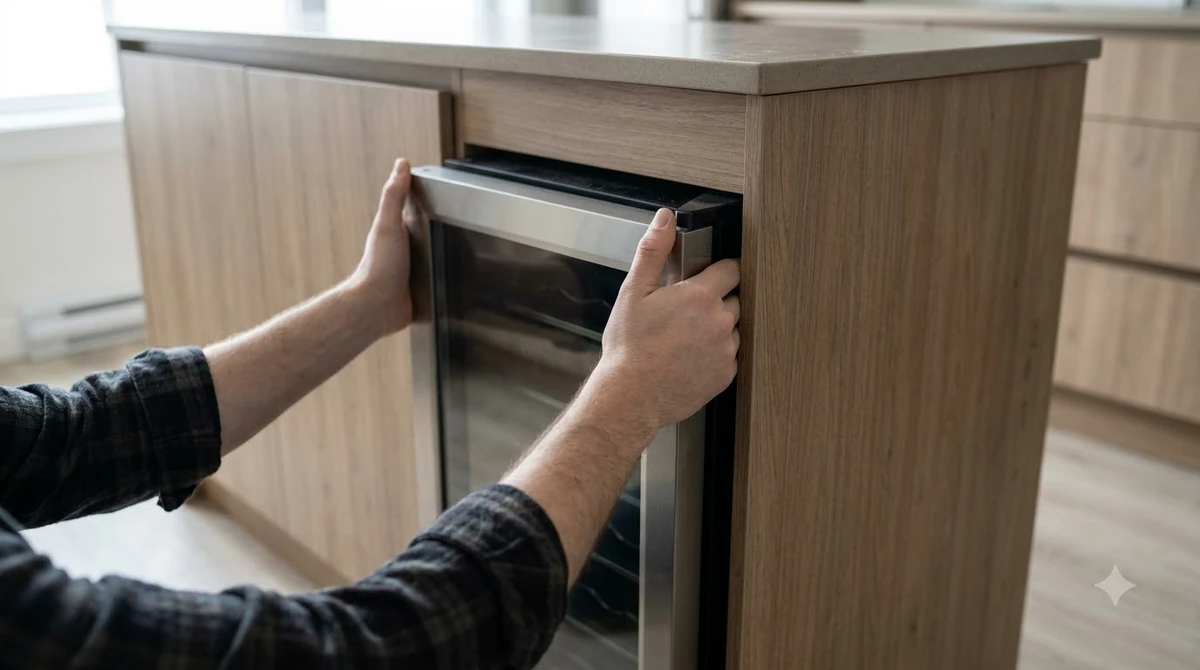
People who want built-in installation should skip this particular configuration. Newair identifies the NWC012SS00 as a freestanding wine refrigerator, not an undercounter model designed for enclosed cabinetry. Placing a freestanding appliance inside a tight cabinet can interfere with ventilation and cooling performance.
Long-term collectors should also compare larger wine cabinets that provide more stable storage arrangements and greater capacity. A compact wine refrigerator is primarily a convenience appliance. It should not automatically be treated as a substitute for a dedicated cellar designed for a substantial collection of age-worthy wines.
How It Compares to Alternatives
The most useful comparison is between Newair’s different 12-bottle designs and cooling systems rather than assuming that every product with the same capacity is identical. The current stainless steel NWC012SS00 is compressor-cooled, while the older AW-121E is a thermoelectric design and the Shadow-T NWC12TBK00 is another distinct thermoelectric model.
Newair’s current product information describes the NWC012SS00 as a narrow stainless steel refrigerator with a compressor and built-in fan. The Shadow-T black model uses thermoelectric cooling and a mirrored triple-pane glass door. Its published dimensions are 19.5 inches deep, 13.6 inches wide, and 18.8 inches high, making it a countertop-oriented alternative rather than the same tall, narrow configuration.
| Comparison | NWC012SS00 | NWC12TBK00 | AW-121E |
|---|---|---|---|
| Capacity | 12 bottles | 12 bottles | 12 bottles |
| Cooling technology | Compressor | Thermoelectric | Thermoelectric |
| Temperature range | 41°F–64°F advertised | 46°F–65°F | 54°F–66°F |
| Width | 9.92 inches | 13.6 inches | See model-specific manual |
| Height | 31.18 inches | 18.8 inches | See model-specific manual |
| Door design | Double-pane tempered glass | Triple-layer tempered glass | Glass door |
| Temperature zones | Single | Single | Single |
The NWC012SS00 is the more appropriate choice for someone who wants a tall, narrow wine cabinet and prefers compressor cooling. Its 31.18-inch height and 9.92-inch width create a different installation profile from the shorter NWC12TBK00. However, its compressor and fan should be considered when evaluating noise and placement.
The NWC12TBK00 is more suitable for someone who wants a countertop-sized appliance with a mirrored black appearance. Newair specifies a 38 dB noise level, a 60-watt rating, and a temperature range of 46°F to 65°F for that model. Its thermoelectric cooling system is different from the compressor arrangement in the stainless steel NWC012SS00.
The AW-121E is an older design with its own documented specifications. Its manual lists 50 watts of power consumption and a temperature range of 54°F to 66°F. It should not be confused with the current stainless steel model simply because both products have a 12-bottle capacity and similar styling.
For buyers comparing different capacities and manufacturers, the broader wine cooler model reviews collection can provide another starting point. The most important comparison points are cooling technology, usable bottle space, temperature range, ventilation requirements, and whether one or two zones are needed.
Installation, Temperature Settings, and Everyday Wine Storage
Proper placement and sensible temperature settings are essential for getting useful performance from a compact wine refrigerator. The NWC012SS00 has a digital temperature display and single-zone controls, so owners should select a setting that suits the bottles they store most frequently.
For serving, sparkling wine is generally best chilled to 40°F–50°F, light whites and rosé to 45°F–50°F, and fuller-bodied whites to 50°F–55°F. Light reds generally benefit from 55°F–60°F, while fuller reds are commonly served around 60°F–65°F. These are serving ranges rather than universal long-term storage targets.
A single-zone wine fridge requires compromise if it contains several wine styles. For example, a setting around 55°F can be a practical middle ground for a mixed collection, although it will not serve every bottle at its ideal temperature. A sparkling wine may need additional chilling before serving, while a full-bodied red may need a little time outside the refrigerator.
Wine storage also benefits from consistency. Frequent temperature swings, direct sunlight, and strong vibrations are undesirable conditions for bottles intended to remain stored for extended periods. The glass door helps reduce external exposure, but the refrigerator should still be positioned away from sunny windows and appliances that generate substantial heat.
Planning the installation location
Measure the available space before moving the appliance into position. The manufacturer’s listed dimensions are 9.92 inches wide, 17.72 inches deep with the handle, and 31.18 inches tall. Account for the door opening, electrical connection, and any ventilation clearances specified in the current manual.
Because the NWC012SS00 is freestanding, avoid treating its narrow dimensions as permission to enclose it inside cabinetry. Compressor-based refrigerators need appropriate airflow to release heat. A cramped installation can interfere with cooling and place additional demands on the appliance.
Use a stable, level surface that can support the refrigerator and its contents. A cabinet that rocks or tilts can make loading bottles awkward and potentially affect door alignment. Keep the power cord away from areas where it can be crushed or pulled, and use an appropriate grounded electrical outlet.
Organizing different bottle styles
Place standard Bordeaux-style bottles in the regular rack positions first. If the collection includes wider Burgundy bottles, Champagne, or sparkling wine, test the available clearance before filling every shelf. The removable racks make rearrangement possible, but changing the configuration may reduce the number of bottles that fit comfortably.
A useful arrangement is to group bottles by intended use. Keep everyday whites and rosés together, place reds in a separate section, and reserve the most accessible position for bottles likely to be opened next. This organization can make a small cabinet feel more practical even when the collection is close to its rated capacity.
For cork-finished bottles, horizontal storage helps keep the cork in contact with the wine. Avoid repeatedly moving bottles around simply to find a particular label. Keeping the collection organized reduces unnecessary handling and makes it easier to track which bottles should be opened first.
After opening a bottle, return unfinished still wine to a refrigerator and use a suitable closure. Most opened still wines retain reasonable quality for approximately three to five days, while sparkling wine generally lasts one to three days with an appropriate sparkling-wine stopper. These are typical windows rather than guarantees.
Food pairing can also influence which bottles deserve the most accessible positions. A lighter Pinot Noir can work well with poultry, while Sauvignon Blanc is a useful match for dishes with bright acidity. For a dinner featuring chicken Marsala, consider a medium-bodied red with enough acidity to complement the savory sauce without overwhelming the food.
For casual gatherings, chilled sparkling wine and spritz ingredients are another reason to keep a small selection organized. A bottle intended for an Aperol Spritz should be properly chilled before preparation, while the refrigerator can hold other bottles for meals and everyday enjoyment.
Frequently Asked Questions
These five questions address additional purchasing and ownership details, including the difference between model numbers, bottle measurements, electrical requirements, and practical storage expectations.
Is the Newair 12-bottle wine fridge the same as the AW-121E?
No. The current stainless steel NWC012SS00 is a compressor-cooled refrigerator, whereas the AW-121E is an older thermoelectric model. Their published specifications and operating characteristics differ, so replacement parts, manuals, and temperature information should always be matched to the exact model number.
Can the Newair 12-bottle refrigerator accommodate 1.5-liter wine bottles?
The manufacturer’s standard capacity rating is based on conventional wine bottles, not every oversized format. A 1.5-liter magnum is substantially larger than a standard 750 ml bottle and may require removing a shelf or using another storage location. Confirm the internal shelf dimensions before assuming a magnum will fit.
Does the NWC012SS00 have an automatic temperature memory function?
The published product specifications identify manual temperature controls and a digital readout, but they do not clearly establish every power-interruption memory behavior. Buyers who experience frequent electrical outages should request confirmation from Newair about whether the previous temperature setting is restored automatically after power returns.
Can the Newair wine fridge be used to store food?
It is designed for wine storage rather than general food refrigeration. Wine cabinets are configured around beverage storage requirements, bottle positioning, and different operating temperatures. Perishable foods should be kept in an appropriate food refrigerator rather than a dedicated wine cooler.
How many glasses of wine can 12 standard bottles provide?
A standard 750 ml bottle provides approximately five 5-ounce servings. Therefore, 12 full-size bottles represent roughly 60 standard glasses of wine. Actual servings depend on pouring size, bottle format, and whether any wine is reserved for cooking or entertaining.
The Newair 12-bottle stainless steel wine fridge is a sensible option for households that prioritize a slim footprint, dedicated bottle storage, and straightforward digital controls. Its compressor cooling, adjustable racks, and double-pane glass are useful features, but the single-zone configuration and limited capacity will not suit every collection. Confirm the NWC012SS00 temperature range and installation requirements directly with Newair before purchasing, and compare the available space against the bottles you actually intend to store.
More in Model Reviews
 Magic Chef 44 Bottle Wine Cooler Review for Flexible StorageUpdated Nov 21, 2026
 Whynter 164 Bottle Wine Cooler Review: Capacity, Features, and FitUpdated Nov 21, 2026
 Insignia NS WC16BK6 Review: Compact 16-Bottle Wine StorageUpdated Nov 21, 2026
 Wine Enthusiast Electric Blue Omega Review: Opening, Pouring, and Preserving Made EasierUpdated Nov 21, 2026
 Koolatron 20 Bottle Wine Cooler Review: Features, Fit, and PerformanceUpdated Nov 21, 2026
 NewAir AWC 330E Review for Home Wine StorageUpdated Nov 21, 2026