

We may earn a commission when you buy through links on this page, at no extra cost to you. Learn more.
The haier 50 bottle wine fridge is a practical 50-bottle storage option for wine drinkers who want adjustable shelving, a reversible glass door, and straightforward temperature controls. The Haier HVB050ABH is a single-zone cooler with six chrome shelves and a mechanical thermostat offering six settings across a stated 39°F to 65°F range. Its built-in installation design is useful for appropriately configured cabinetry, but its discontinued status, single-zone cooling, and older mechanical controls make condition and installation compatibility especially important considerations.
The Haier 50-bottle wine cooler deserves a closer look because its capacity and flexible installation design address a common household storage problem: keeping a growing wine collection organized without dedicating an entire room to bottles. The HVB050ABH is the specific US-market model examined in this review. Its features are relatively straightforward, but buyers should distinguish its documented specifications from assumptions about other Haier wine cabinets sold internationally. In particular, a 50-bottle capacity does not automatically mean dual-zone temperature control or compatibility with every modern kitchen cabinet.
Specs and Key Features of the Haier HVB050ABH
The Haier HVB050ABH combines a 50-bottle advertised capacity with six adjustable chrome shelves, a reversible door, and mechanical temperature control. Its strongest practical features are storage flexibility and a cabinet design intended to accommodate built-in installation when the required opening and ventilation are provided.
Tip: Confirm the model number before purchasing a used Haier 50-bottle wine cooler. Other Haier models with similar capacities can have different voltage requirements, dimensions, temperature zones, and installation arrangements.
The following specifications relate specifically to the HVB050ABH, rather than other Haier models with similar names or capacities.
| Specification | Haier HVB050ABH |
|---|---|
| Advertised capacity | 50 bottles |
| Temperature zones | 1 |
| Temperature settings | 6 mechanical settings |
| Stated temperature range | 39°F–65°F |
| Number of shelves | 6 |
| Shelf material | Chrome-plated metal |
| Door | Reversible glass door |
| Lighting | Soft interior light |
| Unit width | 23 7/8 inches |
| Unit depth | 23 3/4 inches |
| Unit height | 34 11/16 inches |
| Electrical requirement | 115 volts, grounded 15-amp outlet |
| Temperature control | Mechanical thermostat |
| Leveling | Four adjustable legs |
| Availability status | Discontinued listing |
Capacity is the headline feature, but the distinction between advertised capacity and everyday usable capacity matters. The 50-bottle figure describes the manufacturer’s intended standard-bottle arrangement. It should not be interpreted as a guarantee that 50 bottles of every shape and size will fit simultaneously. Champagne bottles, sparkling wine bottles, and wider Pinot Noir bottles can take up more room than conventional Bordeaux-style bottles. Collectors with a mixed selection should plan for fewer than the advertised maximum.
The temperature system is deliberately simple. According to the Haier HVB050ABH user manual, the control knob has six settings, with setting 1 representing the warmest position and setting 6 the coolest. The stated operating range is 39°F to 65°F. There is no independently controlled second compartment, so the appliance cannot maintain separate red-wine and white-wine temperatures at the same time.
Its glass door, adjustable leveling legs, and reversible opening direction add practical convenience. The tinted glass offers a view of the collection while providing a more enclosed presentation than an open wine rack. The interior light makes bottle labels easier to see, and the six chrome shelves can be repositioned to accommodate different bottle dimensions.
One important qualification concerns installation. Best Buy identifies this model as a built-in appliance, while Lowe’s describes it as suitable for built-in or freestanding use. The owner’s manual also explains that built-in installation depends on an unobstructed front ventilation grille. These descriptions make it a potentially flexible appliance, but they do not remove the need to follow the original installation measurements and ventilation requirements.
What Owners and Product Listings Highlight
The most attractive aspects of the Haier 50-bottle wine fridge are its six adjustable shelves, reversible door, simple mechanical thermostat, and relatively conventional cabinet dimensions. These features make it an interesting option for someone who values straightforward storage rather than app-connected controls or multiple cooling compartments.
Storage flexibility is particularly useful for households that buy several wine styles. The manual describes chrome-plated shelves that slide out and can be repositioned along the cabinet’s molded tracks. This allows the owner to change the spacing instead of treating every shelf as a permanent, fixed-size compartment. Larger bottles and magnums are intended to fit more easily toward the bottom of the cooler.
That arrangement can be useful when a collection includes regular Bordeaux bottles alongside broader Burgundy-style bottles or occasional sparkling wines. A collector can reserve more space near the bottom for larger formats and keep standard bottles arranged above them. It is not a guarantee that every unusual bottle will fit, but the adjustable configuration is more accommodating than a cabinet with permanently fixed shelf spacing.
A straightforward temperature system
Another positive feature is the uncomplicated thermostat. Some modern wine refrigerators use touch displays, digital menus, Wi-Fi connections, and mobile applications. The HVB050ABH takes a simpler approach. Its mechanical dial provides six numbered settings, and the manual describes the warm-to-cold direction clearly.
This can appeal to owners who prefer a basic appliance without an additional connected account or electronic interface. It also makes the operating process easy to understand: select a setting, allow the cabinet to stabilize, and monitor the actual internal temperature with a suitable thermometer. The trade-off is reduced precision compared with a wine cooler offering a digital temperature display and direct numerical adjustment.
The distinction matters because the thermostat setting is not itself a verified bottle temperature. Ambient room conditions, the frequency of door openings, the number of bottles inside, and the placement of the appliance can all influence cooling performance. Owners should therefore assess the actual temperature inside the cabinet rather than assuming that a particular dial position always corresponds to a precise temperature.
Useful door and lighting features
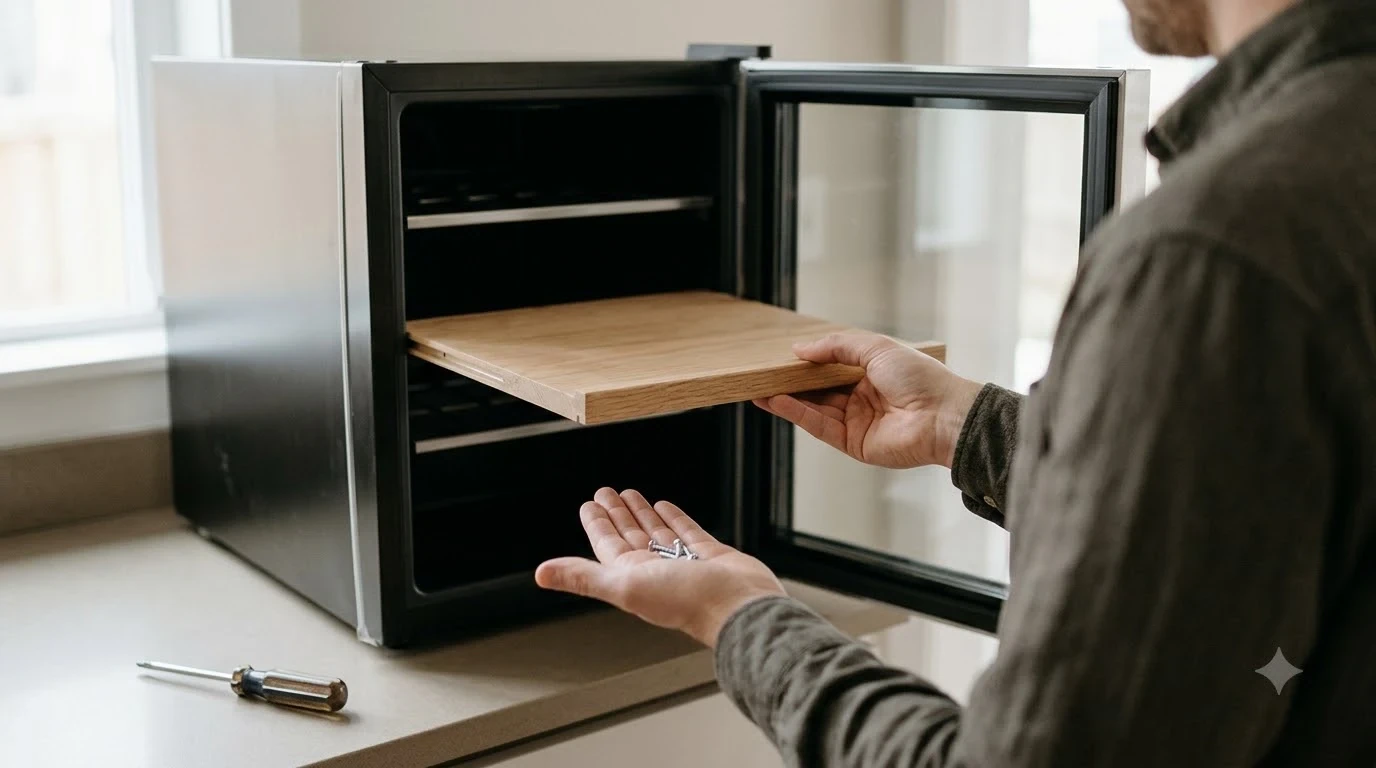
The reversible door is another practical advantage. A reversible opening direction can help the appliance fit different kitchen layouts and reduce conflicts with nearby cabinets or walls. The manual describes the door-reversal process, including the need to move hinge components and reposition the light-switch bracket. This is a mechanical task that requires care, rather than a simple change made through a front-panel setting.
The soft interior light provides visibility without requiring the owner to remove bottles just to identify a label. Its switch is located toward the lower front of the appliance. The light is primarily a convenience feature, however, rather than a substitute for good storage conditions. Keeping the door closed and avoiding unnecessary exposure remain sensible habits for a wine collection.
Public product information provides more support for the feature list than for claims about long-term owner satisfaction. Best Buy’s listing does not contain customer reviews, and Lowe’s also displays no customer reviews for this product. It would therefore be misleading to describe widespread owner approval or claim a verified reliability record based on those pages. The documented advantages are real design features, but they should not be confused with independently established performance ratings.
Common Complaints and Important Limitations
The most significant drawbacks are the single temperature zone, discontinued availability, mechanical controls, and the possibility of reduced usable capacity with larger bottles. These limitations matter more than cosmetic preferences because they affect how the cooler fits into an actual wine-storage routine.
The absence of dual-zone cooling is the first consideration. A single compartment maintains one overall cooling environment. That is appropriate for a collection primarily intended for storage, but it is less convenient for someone who wants red wines and white wines ready to serve at different temperatures. A dual-zone refrigerator can provide separate temperature settings, while the HVB050ABH cannot independently create those conditions.
For a single-zone appliance, a middle-ground storage setting can be more practical than attempting to serve every bottle directly from the cabinet. Red and white wines can be brought to their preferred serving temperatures shortly before drinking. For example, light-bodied reds generally benefit from approximately 55°F to 60°F, while light whites are commonly served around 45°F to 50°F. A single-zone cabinet can support general storage, but it cannot replace the flexibility of two independently controlled compartments.
Mechanical controls limit precision
The six-position thermostat is simple, but it does not provide the same degree of control as a digital interface with a numerical temperature readout. The manual identifies a 39°F to 65°F operating range, but the numbered settings do not provide six documented exact temperature values. Owners should not assume that setting 3, for example, always represents a particular temperature.
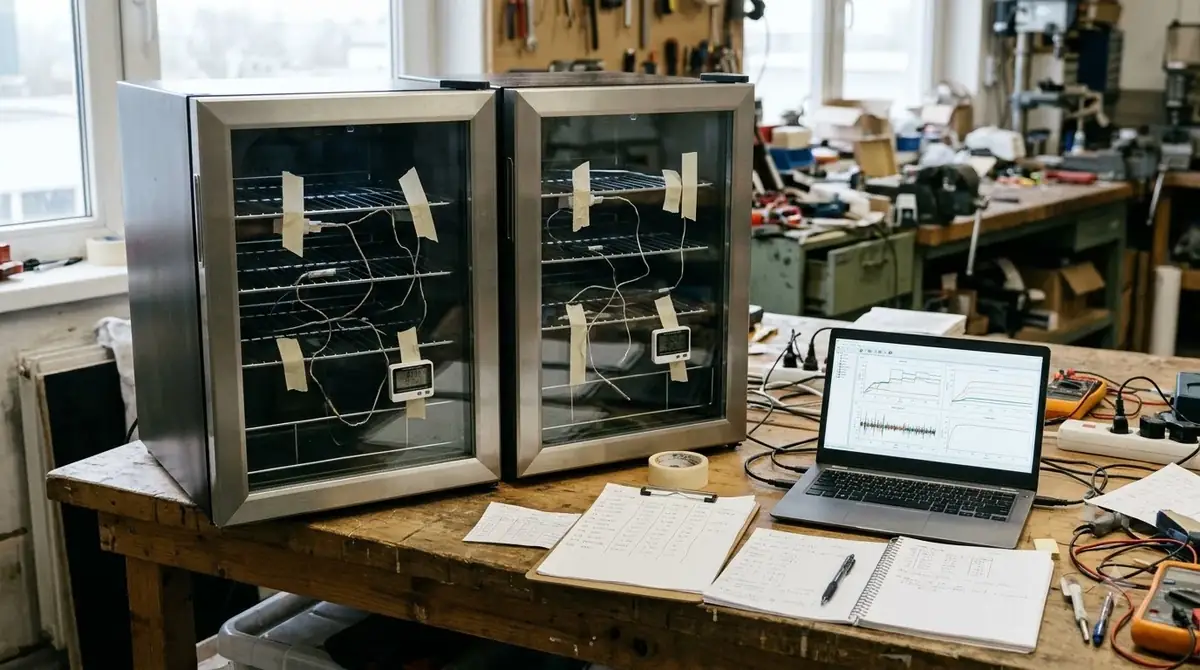
This also makes temperature verification important after installation. A separate refrigerator thermometer can help establish the actual conditions inside the cabinet. Allow the appliance to settle after a change in setting, then compare readings over time rather than reacting to a single measurement taken immediately after opening the door.
Capacity is not universal
The 50-bottle rating is another potential source of disappointment. Standard Bordeaux-style bottles are relatively consistent in shape, but Champagne, Burgundy, and some specialty bottles have wider bodies or different shoulder profiles. Their dimensions can reduce the number that fit on a shelf.
The sliding shelves help because their positions can be changed. However, removing or repositioning shelves to make room for magnums necessarily reduces the remaining storage space. Buyers with a large collection of sparkling wines or broad-format bottles should treat the advertised capacity as a maximum reference rather than an everyday expectation.
Discontinued status changes the buying equation
Availability is a particularly important concern. Best Buy identifies the HVB050ABH as no longer available in new condition, and Lowe’s describes it as a discontinued product that is no longer sold on its website. This makes the model more relevant to secondhand buyers, replacement searches, and people comparing an existing appliance with newer alternatives.
A used appliance introduces questions that do not arise in the same way when buying a new refrigerator. The compressor, thermostat, door gasket, hinges, lighting, shelves, and electrical components all deserve inspection. A cabinet that looks attractive from the outside may have inconsistent cooling or a door that no longer seals properly.
There is also an important distinction between the HVB050ABH and other Haier wine cabinets. Some international Haier 50-bottle models have different power requirements, dimensions, and electronic features. Their specifications should not be transferred to this US model simply because the capacity and brand are similar.
Who Should Buy and Who Should Skip the Haier 50 Bottle Wine Fridge
The Haier HVB050ABH makes the most sense for a buyer who needs a straightforward 50-bottle-class cabinet, can accommodate its installation requirements, and is comfortable evaluating a discontinued appliance. It is less attractive for collectors who require two independently controlled temperatures, modern digital functions, or a new appliance with readily documented current support.
Who should consider it
A household with a growing wine collection may appreciate the six adjustable chrome shelves and the ability to accommodate different bottle shapes. Someone who regularly purchases Cabernet Sauvignon, Merlot, Chardonnay, Sauvignon Blanc, and other standard bottle formats can benefit from the basic organization provided by the cabinet.
The reversible door also makes it worth considering for a kitchen where opening direction is important. In a narrow room, a door that opens toward the wrong side can interfere with drawers, walkways, or adjacent cabinets. The ability to reverse the hinges provides more installation flexibility, assuming the buyer can complete the required mechanical adjustments correctly.
Buyers who value basic mechanical controls may also find the design appealing. There are no complicated menus to learn, and the six-position dial provides a familiar operating method. For someone who primarily wants to keep a collection together in a dedicated cabinet, this simplicity can be a genuine benefit.
Who should skip it
Collectors who regularly alternate between serving sparkling wine, white wine, and red wine at different temperatures should consider a dual-zone model instead. The Haier has only one cooling zone, so separate red and white storage temperatures are not available. A second zone can be especially useful for households that entertain frequently and want bottles ready to serve without additional chilling or warming time.
Buyers seeking an appliance with digital temperature adjustment, remote monitoring, or smart-home connectivity should also look elsewhere. The HVB050ABH uses a mechanical thermostat, and its documented feature list does not establish any Wi-Fi or app-based functionality.
People who want a new appliance with current manufacturer support should be cautious as well. Because the product is discontinued in the retailer listings examined, availability of replacement parts, service options, and warranty coverage may depend on the particular unit and its purchase history. A used appliance should never be assumed to carry the same protection as a newly purchased current-production refrigerator.
Finally, anyone planning to install the cooler in an outdoor kitchen, an unheated garage, or an unusually cold utility room should reconsider. The manual explicitly warns that the appliance was not designed to operate in environments below 55°F. A location that experiences large seasonal temperature swings is not an appropriate substitute for a controlled indoor space.
How It Compares to Alternative Wine Storage Options
The Haier HVB050ABH competes most directly with other single-zone wine refrigerators and newer dual-zone cabinets. Its selling points are a 50-bottle advertised capacity, adjustable shelves, and a reversible door, while its limitations are older controls and discontinued availability.
A current single-zone wine refrigerator is the closest functional alternative. It serves the same general purpose of storing a collection in one consistent cooling environment. Depending on the particular model, a newer appliance may provide a digital thermostat, a more informative temperature display, updated lighting, and more readily available manufacturer support. The Haier may still be worth considering if a suitable used unit is available in excellent condition, but age and serviceability need to be included in the comparison.
A dual-zone wine refrigerator offers a more meaningful functional difference. Separate compartments make it possible to maintain one temperature for white wines and another for reds. This is convenient for a collection that contains a broad range of drinking styles. However, the benefit depends on the owner’s actual habits. A collector who stores most bottles for longer periods at a consistent cellar temperature may not need the additional complexity.
A traditional wine rack is another alternative for someone who already has a consistently cool, dark, and suitable storage room. It avoids electrical components and refrigeration maintenance, but it does not actively regulate temperature. A standard kitchen cupboard or an open shelf near a window is not an equivalent storage environment. For collectors in homes where indoor temperatures fluctuate substantially, a dedicated cooler remains more useful.
| Storage option | Main advantage | Main limitation | Best suited to |
|---|---|---|---|
| Haier HVB050ABH | 50-bottle capacity and adjustable shelves | Single zone and discontinued status | Existing-unit owners and used-appliance buyers |
| Modern single-zone cooler | One consistent storage environment | No independent serving temperatures | Collectors with similar storage requirements |
| Dual-zone cooler | Separate temperature settings | More complex configuration | Mixed red and white wine collections |
| Traditional wine rack | No refrigeration components | No active temperature regulation | Suitable climate-controlled rooms |
Why temperature requirements matter more than capacity alone
Wine storage is not simply a question of finding enough spaces for bottles. The temperature environment, light exposure, vibration, and consistency of conditions all contribute to the quality of storage. A large cabinet that cannot maintain appropriate conditions is less useful than a smaller unit that meets the collection’s actual needs.
For longer-term storage, a consistent temperature near 55°F is a commonly used target. The Haier’s stated temperature range includes this temperature, although the actual internal conditions should be checked. Temperature stability is more important than repeatedly changing settings in response to minor fluctuations.
Serving temperature is a separate consideration. Sparkling wines generally benefit from 40°F to 50°F, light-bodied whites and rosés from 45°F to 50°F, full-bodied whites from 50°F to 55°F, light reds from 55°F to 60°F, and fuller reds from 60°F to 65°F. These differences explain why one storage temperature cannot perfectly prepare every bottle for immediate service.
Food pairing also influences the type of collection a household keeps. Sauvignon Blanc and other high-acidity whites work particularly well with acidic dishes, while softer Merlot can complement meals that do not require the stronger tannin structure of Cabernet Sauvignon. A collection with several wine styles may therefore benefit more from flexible storage than from simply maximizing the number of bottles inside a cabinet.
For entertaining, bottles intended for immediate use can be moved to a suitable serving refrigerator or chilled separately. An Aperol spritz recipe is another example of a drink that involves different chilling and serving considerations from still wine. The point is to choose storage equipment around the bottles and drinks actually consumed rather than assuming one wine refrigerator can do everything.
For readers comparing more appliances, the wine cooler model reviews section can provide a useful starting point for considering capacity, temperature zones, and installation styles. The most useful comparison is between products with similar dimensions and intended installation arrangements, not merely products carrying the same bottle-capacity label.
Frequently Asked Questions
Is the Haier 50 bottle wine fridge discontinued?
The HVB050ABH appears as discontinued in the Lowe’s product specifications, and Best Buy also identifies it as unavailable in new condition. This does not establish that every remaining unit is unusable or that no replacement components exist. Buyers should distinguish retailer availability from the availability of individual used units and service parts.
Can the Haier HVB050ABH be used as a freestanding appliance?
Lowe’s describes the appliance as suitable for built-in or freestanding use. However, the original manual emphasizes front ventilation and an unobstructed lower grille for efficient operation. Before choosing a freestanding position, examine the actual cabinet construction and follow the installation requirements for the specific unit.
Does the Haier wine cooler have an automatic defrost system?
The available HVB050ABH manual includes guidance for appliance care, cleaning, and power interruptions, but the specifications examined do not establish an automatic frost-free feature. Buyers should not assume that the appliance has the same defrost technology as a newer refrigerator. Inspect the interior and consult the complete manual for maintenance instructions.
Can the Haier HVB050ABH be connected to a smart-home system?
The documented HVB050ABH uses a mechanical thermostat and does not list Wi-Fi connectivity or a companion application. Its temperature adjustment is performed through the physical control knob. Smart monitoring would therefore require a separate compatible monitoring solution rather than a built-in appliance feature.
Can a Haier 50-bottle cooler be transported on its side?
Refrigeration appliances should generally be transported upright whenever possible to reduce the risk of problems involving the compressor and refrigerant system. If a particular transport situation requires another orientation, obtain instructions specific to that model before moving or powering it. After transportation, allow the appliance to settle according to the manufacturer’s guidance before reconnecting it.
The Haier 50-bottle wine fridge remains an interesting option for collectors who value adjustable shelving, straightforward temperature controls, and flexible door positioning. The HVB050ABH is best approached as a discontinued single-zone appliance, with particular attention paid to its cooling condition, electrical requirements, and installation measurements. For buyers who can verify those details, it may still serve as useful wine storage; anyone seeking modern dual-zone performance or a new appliance with current support should compare newer alternatives before making a decision.
More in Model Reviews
 Magic Chef 44 Bottle Wine Cooler Review for Flexible StorageUpdated Nov 21, 2026
 Whynter 164 Bottle Wine Cooler Review: Capacity, Features, and FitUpdated Nov 21, 2026
 Insignia NS WC16BK6 Review: Compact 16-Bottle Wine StorageUpdated Nov 21, 2026
 Wine Enthusiast Electric Blue Omega Review: Opening, Pouring, and Preserving Made EasierUpdated Nov 21, 2026
 Koolatron 20 Bottle Wine Cooler Review: Features, Fit, and PerformanceUpdated Nov 21, 2026
 NewAir AWC 330E Review for Home Wine StorageUpdated Nov 21, 2026