

We may earn a commission when you buy through links on this page, at no extra cost to you. Learn more.
The kitchenaid dual zone wine fridge is a premium undercounter wine storage option for homeowners who want separate cooling settings for red and white wines, an integrated cabinet appearance, and convenient pull-out racks. KitchenAid’s 46-bottle models offer two independently controlled temperature zones, UV-protected glass doors, and motion-activated interior lighting. However, the advertised capacity assumes standard Bordeaux-size bottles, and owner feedback raises legitimate questions about bottle clearance and practical storage space. The best buying decision depends on your collection, available cabinetry, and expectations for temperature control.
KitchenAid makes several undercounter wine cellar configurations, so the name dual-zone wine fridge does not identify just one appliance. The KUWR214KSB is a useful model to examine because it combines wood-front full-extension racks, two temperature zones, and a flush-installation design. Other models, including the KUWR314KSS and KUWL314KBS, offer related configurations with different rack finishes and exterior details. Understanding these distinctions helps prevent confusion when comparing specifications, retailer listings, and customer experiences.
Specs and Key Features
The KitchenAid KUWR214KSB combines a 46-bottle advertised capacity with independent cooling zones, full-extension racks, and built-in installation features. Its strongest selling points are the cabinet-friendly appearance and the ability to maintain different serving and storage temperatures for red and white wines.
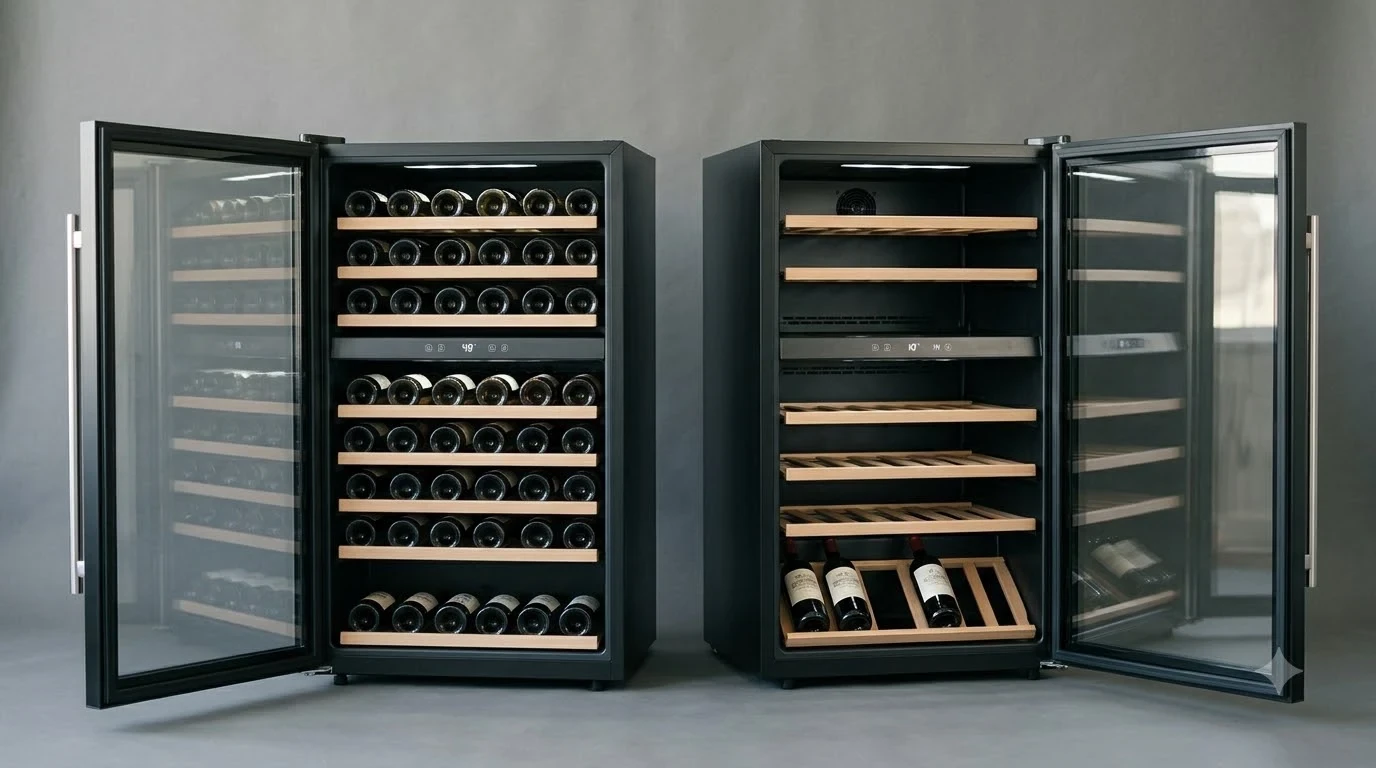
KitchenAid positions this appliance as an undercounter wine cellar rather than a basic beverage refrigerator. The controls sit between the two temperature sections, allowing users to adjust each zone separately. The upper compartment accommodates whites at 42–54°F, while the lower compartment offers a broader 42–64°F range for reds. That arrangement provides useful flexibility for households that regularly serve several wine styles.
The six-rack arrangement is another important feature. KitchenAid specifies space for eight standard Bordeaux-size bottles on each of the five upper racks and six Champagne-style bottles on the bottom rack. This adds up to 46 bottles, although the manufacturer explicitly warns that wider and taller bottle shapes can reduce the usable capacity.
| Specification | KitchenAid KUWR214KSB |
|---|---|
| Appliance type | Undercounter wine cellar |
| Advertised capacity | 46 standard bottles |
| Wine racks | 6 |
| Upper temperature range | 42–54°F |
| Lower temperature range | 42–64°F |
| Height | 34.375 inches |
| Width | 23.875 inches |
| Depth | 23.625 inches |
| Rack construction | Full-extension wood-front SatinGlide |
| Lighting | Motion-activated LED |
| Door | UV-protected thermal glass |
| Additional monitoring | Temperature and door alarms |
| Door opening | 115 degrees |
One particularly useful addition is the temperature-monitoring system. KitchenAid says sensors monitor the interior, with an over-temperature alarm and indicator light activating if temperatures exceed 70°F for more than four hours. This provides an additional warning if the appliance experiences an extended temperature problem. It does not eliminate the need to monitor an appliance that stores valuable bottles, but it gives owners another way to identify a potential issue.
The door also incorporates UV-protected thermal glass. Ultraviolet exposure can contribute to premature wine deterioration, so filtering UV rays is a sensible feature for a refrigerator with a display-style glass front. The glass also lets owners see their collection without opening the appliance.
KitchenAid includes backlit touch controls between the compartments. The display shows the current temperature of each zone and relevant status alerts. Automatic defrost, a door alarm, and motion-activated LED lighting round out the feature set. Together, these details make the KUWR214KSB more sophisticated than a basic single-temperature cooler.
For the complete manufacturer specification, temperature ranges, and feature descriptions, consult KitchenAid’s official KUWR214KSB product specifications.
What Owners Like
Customer feedback generally highlights the KitchenAid wine cellar’s appearance, construction, and convenient sliding racks. Owners who prioritize an integrated kitchen design and separate wine temperatures have several reasons to consider the appliance.
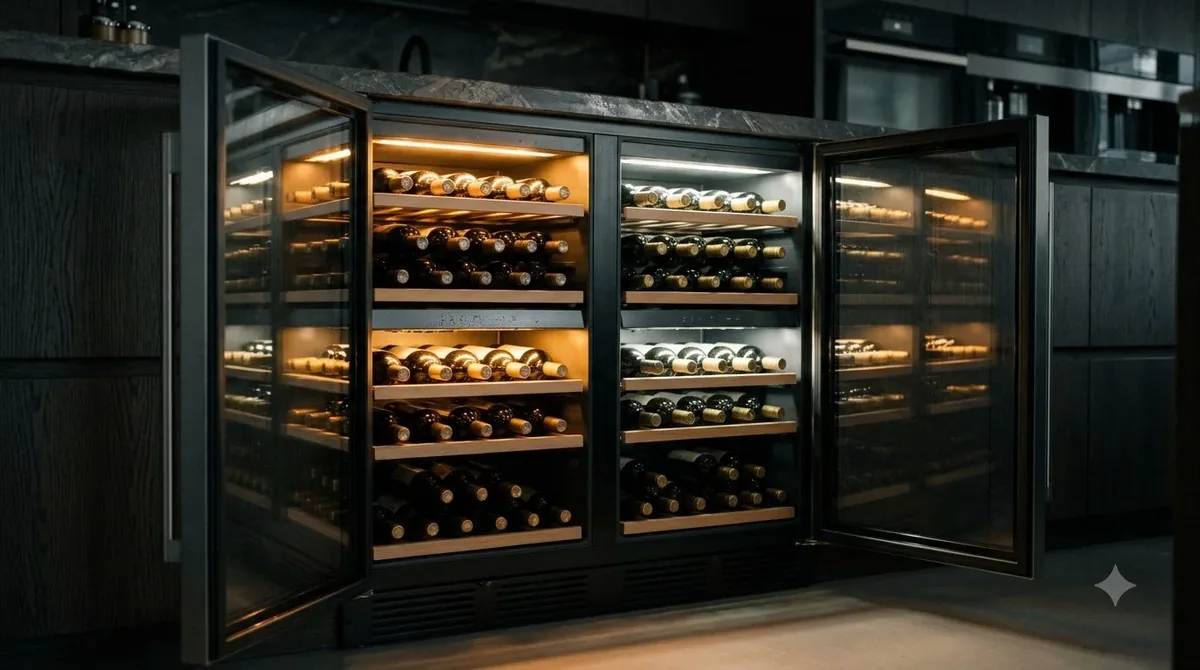
The exterior design is one of the more consistent positive themes. The stainless-steel finish and hidden hinges help the refrigerator blend into surrounding cabinetry, rather than looking like a separate countertop appliance. For a kitchen with coordinated stainless-steel appliances, this creates a cleaner visual appearance.
KitchenAid’s flush-installation approach is particularly appealing in kitchens where cabinetry alignment matters. The door is designed to sit flush with neighboring cabinet fronts when closed, and the hinges allow it to open 115 degrees. That combination is useful in a home bar, kitchen island, or dedicated entertaining area where an exposed appliance might interrupt the overall design.
Customer reviews also provide positive comments about the shelves. On Best Buy’s review page for the KUWR214KSB, one owner specifically praised the smooth operation of the pull-out racks. Full-extension shelves make it easier to reach bottles at the back without removing several other bottles first.
This convenience becomes more important as a collection grows. A wine refrigerator can have an attractive exterior and useful temperature controls but still be frustrating if bottles are difficult to retrieve. The SatinGlide system addresses that everyday concern by allowing racks to extend outward for loading and selection.
Another positive theme is the separation of red and white wine storage. A household that regularly opens Sauvignon Blanc, Chardonnay, Pinot Noir, and Cabernet Sauvignon can benefit from having different temperature settings available simultaneously. Instead of repeatedly changing the temperature of one compartment, owners can maintain two separate environments.
The motion-activated lighting is also a practical feature. It illuminates the bottles as someone approaches, making it easier to identify labels without leaving the door open. The gradual dimming behavior is more convenient than relying on a manually operated light every time someone wants to select a bottle.
There is also encouraging feedback on KitchenAid’s own product page. Owners describe the refrigerator as attractive, quiet, and functional, with several mentioning satisfaction with the two temperature zones. These experiences suggest that the design can work well in a properly installed kitchen.
However, customer satisfaction should not be interpreted as proof that every unit performs identically. Appliance installation, individual bottle collections, and long-term operating conditions can influence the experience. The strongest positive case is for buyers who value the cabinetry integration and sliding-rack design more than maximum bottle density.
Common Complaints
The biggest buying concern is practical bottle capacity, not the headline 46-bottle specification. Customer feedback also raises questions about temperature performance, shelf clearance, and long-term reliability, making it important to examine the actual model rather than relying on the product name alone.
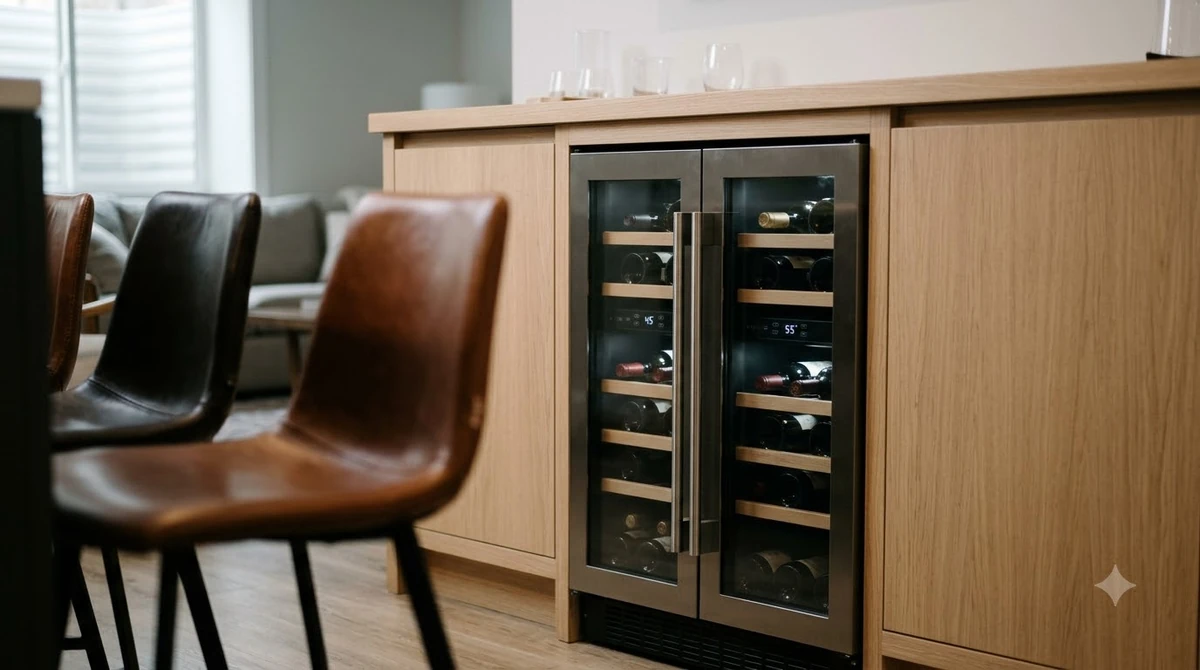
KitchenAid bases its 46-bottle claim on standard bottle dimensions. That is a reasonable way for manufacturers to describe capacity, but real wine collections rarely consist entirely of identical bottles. Champagne, Burgundy, Chardonnay, and some premium California wine bottles can have different widths and lengths from standard Bordeaux bottles.
Best Buy customer feedback includes critical reviews describing difficulty fitting the advertised number of bottles into the racks. Some reviewers report being unable to load eight bottles into the upper shelves and describe a smaller practical capacity for their collections. These are individual experiences, not universal measurements, but they illustrate why the advertised number should not be treated as a guaranteed usable count.
The concern is relevant even for buyers who do not collect unusual bottles. Different producers use different glass molds, and some standard 750 ml bottles have wider shoulders or longer necks than others. A rack can technically accommodate the advertised bottle count while remaining inconvenient for a collection with varied dimensions.
Temperature feedback deserves attention as well. Some customer reviews describe dissatisfaction with temperature range or consistency. These reports should be assessed in the context of the specific wine cellar model rather than complaints about unrelated KitchenAid refrigerators. Nevertheless, the broader lesson is to verify actual operating temperatures after installation rather than assuming the display alone confirms perfect conditions.
Other complaints concern the limits of the upper zone. Because the KUWR214KSB’s upper compartment only adjusts between 42°F and 54°F, it does not offer the same broad adjustment range as the lower section. Buyers who want to use both compartments for unusual beverage-storage purposes may find the arrangement restrictive.
Reliability is another consideration for a premium built-in appliance. Some customers report positive experiences with previous KitchenAid wine refrigerators lasting many years, while others express concern about performance or service experiences. Individual reports cannot establish an expected service life, so buyers should examine the written warranty and local repair support before committing.
Installation problems can also affect satisfaction. A wine cellar installed with insufficient clearance, an unsuitable electrical connection, or an improperly prepared cabinet opening may not perform as intended. Buyers should distinguish between a manufacturing problem and an installation issue, particularly when a refrigerator is being incorporated into newly constructed cabinetry.
Overall, the complaints do not make the KitchenAid automatically unsuitable. They do mean that buyers should prioritize bottle compatibility and installation planning rather than focusing entirely on its appearance and advertised capacity.
For a broader look at owner experiences, including comments about rack fit, temperature operation, and appearance, see Best Buy’s KitchenAid KUWR214KSB customer reviews.
Who Should Buy and Who Should Skip
The KitchenAid dual-zone cellar is best suited to homeowners who want an integrated undercounter appliance and maintain a mixed collection of red and white wines. It is less attractive for buyers who need maximum capacity, extensive temperature flexibility, or storage for many oversized bottles.
Who should consider it
Homeowners planning a kitchen renovation are among the strongest potential buyers. The 24-inch cabinet-oriented format, hidden hinges, and stainless-steel exterior can create a coordinated appearance alongside other built-in appliances. The flush design is especially appealing when the wine refrigerator will be positioned in a kitchen island or dedicated bar cabinet.
Regular wine drinkers can also benefit from the dual-zone arrangement. For example, a household might keep Sauvignon Blanc and sparkling wine in the upper compartment while storing Pinot Noir and Merlot in the lower compartment. The separate temperature controls make it possible to prepare different wines for serving without constantly changing one shared setting.
Collectors who purchase mostly standard Bordeaux-style bottles may find the advertised storage arrangement useful. The full-extension racks also help owners organize and retrieve bottles without repeatedly disturbing the rest of the collection.
Entertainers have another reason to consider this format. Keeping reds and whites in separate compartments can simplify preparation before a dinner party. A bottle of Chardonnay can be kept cooler while Cabernet Sauvignon occupies the lower section. This is particularly useful when the appliance sits close to the kitchen or dining area.
Who should skip it
Buyers with collections dominated by Champagne, large-format bottles, or unusually wide Burgundy bottles should investigate shelf clearance carefully. The manufacturer itself acknowledges that nonstandard dimensions reduce total capacity. A collection containing 46 bottles does not necessarily fit simply because the appliance carries a 46-bottle rating.
Budget-conscious buyers may also prefer a less expensive freestanding wine refrigerator. KitchenAid’s emphasis on cabinetry integration, wood-front racks, and premium finishing makes more sense for a renovation or a permanent entertaining space than for someone who simply needs cold storage in a utility room.
People seeking dedicated long-term wine-aging conditions should consider their requirements carefully. Dual-zone cooling is convenient for serving and everyday storage, but temperature consistency, vibration, humidity, and environmental stability all matter to serious collectors. The product’s advertised features should not be interpreted as a guarantee of professional cellar conditions.
Finally, buyers with limited installation space should avoid purchasing before measuring the cabinet opening. The manufacturer’s dimensions are specific, and even a small discrepancy can create installation difficulties. Door clearance and access to the appliance for future servicing also deserve attention.
Tip: Before ordering, measure your five most common bottle shapes, including Champagne and Burgundy bottles if you collect them. Compare their actual widths and lengths with the rack clearance rather than planning your collection around the advertised 46-bottle maximum.
How It Compares to Alternatives
KitchenAid’s different wine cellar configurations provide alternatives for buyers who prefer another rack finish or a different cabinetry arrangement. The most useful comparison is between its wood-front and metal-front undercounter models, rather than assuming every appliance carrying the KitchenAid name has identical specifications.
The KUWR214KSB uses full-extension wood-front racks and has a stainless-steel exterior. The KUWR314KSS is a related 46-bottle model with metal-front racks. The KUWL314KBS is another 24-inch dual-zone configuration, featuring a black stainless finish and the same general emphasis on integrated installation.
These models illustrate why checking the complete model number matters. The KUWR and KUWL designations identify different door-swing configurations, while the suffix helps distinguish finish and model variations. A listing that simply says KitchenAid 46-bottle wine cooler may not provide enough information to confirm which appliance is being sold.
KitchenAid also has the KUWL204E family, documented in a separate manufacturer specification sheet. That model provides six racks, touch controls, LED lighting, and a 46-bottle stated capacity. Its listed dimensions differ from the newer KUWR214KSB measurements. These figures should not be substituted when planning an installation for another model.
The newer 324S and 524S undercounter wine cellar families provide another comparison. KitchenAid’s product lineup documentation identifies metal-front SatinGlide racks for the 324S family and wood-front racks for the 524S family. Both include dual temperature zones, motion-activated lighting, and a temperature-monitoring system.
For buyers comparing finishes, the difference between wood and metal rack fronts is largely a design and preference decision. Wood-front racks can coordinate with warm cabinetry and traditional kitchens, while metal-front racks may complement more contemporary stainless-steel interiors.
However, rack finish should not be the only comparison criterion. Bottle clearance, door swing, installation depth, control placement, and service accessibility are more important to everyday satisfaction. Two models with the same advertised capacity can still be unsuitable for different collections or cabinet layouts.
KitchenAid’s undercounter wine cellars also differ from its beverage centers. A beverage center may offer a colder compartment for cans, mixers, and other refreshments, while a dedicated wine cellar is designed around wine bottle storage. Buyers who primarily need a place for soft drinks, beer, and entertaining supplies should consider whether a beverage center is a more practical purchase.
For additional appliance comparisons, the model reviews section provides a useful starting point for evaluating different product categories. The right choice is the appliance that matches your storage habits and available space, not necessarily the model with the most impressive feature list.
For a home bar, consider how the refrigerator will work alongside the drinks you regularly prepare. A separate Aperol Spritz recipe can help illustrate why sparkling wine and chilled mixers need accessible storage, while a Hugo Spritz recipe provides another example of a refreshing sparkling-wine cocktail. For dinner entertaining, a chicken Marsala recipe is a useful reminder that wine storage can support both cooking and serving routines.
Frequently Asked Questions
Can the KitchenAid wine refrigerator operate during a power outage?
No dedicated backup battery or uninterrupted power supply is identified among the KUWR214KSB’s listed features. A power interruption therefore means the compressor cannot maintain the programmed cooling conditions. Owners storing valuable bottles should consider a household backup-power strategy and avoid opening the door unnecessarily during an outage.
Does the KitchenAid wine cellar have a reversible door?
Door orientation is model-specific, so buyers should not assume the hinges can be reversed after installation. The KUWR214KSB is identified as a right-door-swing model, while KitchenAid also uses KUWL designations for left-door-swing configurations. Choose the appropriate orientation before finalizing cabinetry and appliance placement.
Can wine be stored upright in a KitchenAid dual-zone refrigerator?
The appliance is designed around horizontal wine racks, rather than a dedicated upright-bottle storage system. Horizontal storage is particularly useful for traditional cork-finished bottles because it keeps wine in contact with the cork. Buyers who regularly store opened bottles or bottles with unusual closures should consider how those items will be organized separately.
Does the KitchenAid wine cellar require a separate ventilation cabinet?
The manufacturer’s installation instructions should determine the required cabinet opening and ventilation arrangement. Built-in refrigeration appliances need the specified installation conditions to dissipate heat correctly. A decorative cabinet surround should never obstruct required ventilation paths or replace the manufacturer’s installation clearances.
Can the KitchenAid wine refrigerator be used to store unopened wine for several years?
It can provide refrigerated storage for suitable wines, but not every wine benefits from extended aging. Many inexpensive white, rosé, and sparkling wines are intended for relatively early consumption. Serious collectors should also consider humidity, vibration, light exposure, and temperature stability when deciding whether a kitchen appliance is appropriate for a valuable aging collection.
The KitchenAid dual-zone wine cellar is an attractive choice for homeowners who want separate red and white wine storage, coordinated cabinetry, and convenient full-extension racks. Its main compromises are the limitations of the advertised bottle capacity and the relatively narrow upper temperature range. Check the exact model, measure your bottles, and confirm installation requirements before purchasing. For a kitchen or home bar built around regular wine entertaining, the combination of dual-zone controls and integrated styling makes this KitchenAid range worth serious consideration.
More in Model Reviews
 Magic Chef 44 Bottle Wine Cooler Review for Flexible StorageUpdated Nov 21, 2026
 Whynter 164 Bottle Wine Cooler Review: Capacity, Features, and FitUpdated Nov 21, 2026
 Insignia NS WC16BK6 Review: Compact 16-Bottle Wine StorageUpdated Nov 21, 2026
 Wine Enthusiast Electric Blue Omega Review: Opening, Pouring, and Preserving Made EasierUpdated Nov 21, 2026
 Koolatron 20 Bottle Wine Cooler Review: Features, Fit, and PerformanceUpdated Nov 21, 2026
 NewAir AWC 330E Review for Home Wine StorageUpdated Nov 21, 2026