

We may earn a commission when you buy through links on this page, at no extra cost to you. Learn more.
The haier 12 bottle wine fridge is a compact wine storage option for households that want separate temperature settings for red and white wines without dedicating space to a full-size cellar. The Haier HVTEC12DABS is a dual-zone, thermoelectric model with a 12-bottle capacity, four chrome racks, and independent electronic controls. Its quiet-running design and narrow cabinet are attractive features, but discontinued availability, limited bottle flexibility, and questions about long-term reliability deserve attention before buying.
A small wine refrigerator can make everyday wine storage more convenient, particularly when a kitchen refrigerator is already crowded with food and beverages. Haier’s 12-bottle wine cellar occupies a relatively narrow footprint while offering two separately controlled compartments. However, the Haier name covers several older 12-bottle models with different controls, dimensions, and temperature ranges. This review focuses primarily on the HVTEC12DABS and its closely related HVTEC12DAB listing, while distinguishing them from older HVT12-series countertop refrigerators. That distinction matters if you are shopping for a used appliance, comparing specifications, or checking whether a particular listing describes the right product.
Specs and Key Features
The Haier HVTEC12DABS combines a 12-bottle capacity with two independently controlled compartments and thermoelectric cooling. Its most distinctive features are the narrow 10-inch cabinet, four chrome racks, and separate digital temperature displays.

Haier lists the appliance at 26.5 inches high, 10 inches wide, and 20.625 inches deep. That relatively narrow profile makes it an interesting option for a home bar, apartment, or small dining area. However, the depth is substantial compared with the width, so measuring only the available width can give an inaccurate impression of how easily the refrigerator will fit.
The four full-width chrome racks organize bottles horizontally, keeping the collection accessible while allowing the compartments to maintain separate settings. The cabinet has a curved, insulated glass door with a dark finish, and the interior lighting helps identify bottles without removing them individually. Two LED displays and touchscreen controls provide temperature adjustments for the upper and lower compartments.
One important specification detail deserves attention. Haier’s product feature description gives the lower compartment a range beginning at 42°F, while the detailed specifications list 46°F as its minimum. The upper compartment is listed at 54°F to 66°F. Because these published figures differ, buyers should not assume that every advertised temperature setting is available throughout the entire cabinet.
| Specification | Haier HVTEC12DABS |
|---|---|
| Rated capacity | 12 bottles |
| Cooling technology | Thermoelectric |
| Temperature zones | 2 independent zones |
| Upper temperature range | 54°F–66°F |
| Lower temperature range | 42°F–66°F in feature description; 46°F–66°F in detailed specifications |
| Storage racks | 4 full-width chrome racks |
| Height | 26.5 inches |
| Width | 10 inches |
| Depth | 20.625 inches |
| Net weight | 31.3 pounds |
| Electrical requirement | 115 volts, 60 Hz |
| Installation | Freestanding |
| Cooling ventilation | Rear venting |
| Warranty | Limited one-year parts and labor |
These specifications come from Haier’s product information and its published specification sheet. The official Haier HVTEC12DABS product page also identifies the model as discontinued. That is an important purchasing consideration because availability of replacement parts and service options may differ from those of a currently manufactured refrigerator.
The cooling system is another defining feature. Thermoelectric technology does not use a conventional compressor. Instead, it transfers heat through a semiconductor cooling system, which can reduce mechanical vibration and make operation quieter. Haier describes this model as vibration-free and ultra-quiet, although the presence of an operating fan means that completely silent operation should not be expected.
The appliance is also designed for freestanding installation. Its rear ventilation arrangement means it should not be treated like a built-in undercounter wine refrigerator. A tight cabinet enclosure can restrict airflow and interfere with cooling performance. Haier’s published dimensions are therefore only the starting point when calculating the space needed for installation.
For a collection of ordinary 750 ml bottles, the stated capacity is useful. Still, the number represents a nominal storage figure rather than a guarantee that every combination of bottle shapes will fit. Champagne bottles, sparkling wine bottles, and wider specialty bottles can occupy more room than standard Bordeaux-style bottles.
What Owners Like
Owner feedback for the Haier HVTEC12DAB points to three recurring strengths: convenient temperature controls, compact placement, and useful dual-zone storage. These features explain why the appliance appealed to households looking for a relatively small dedicated wine refrigerator.
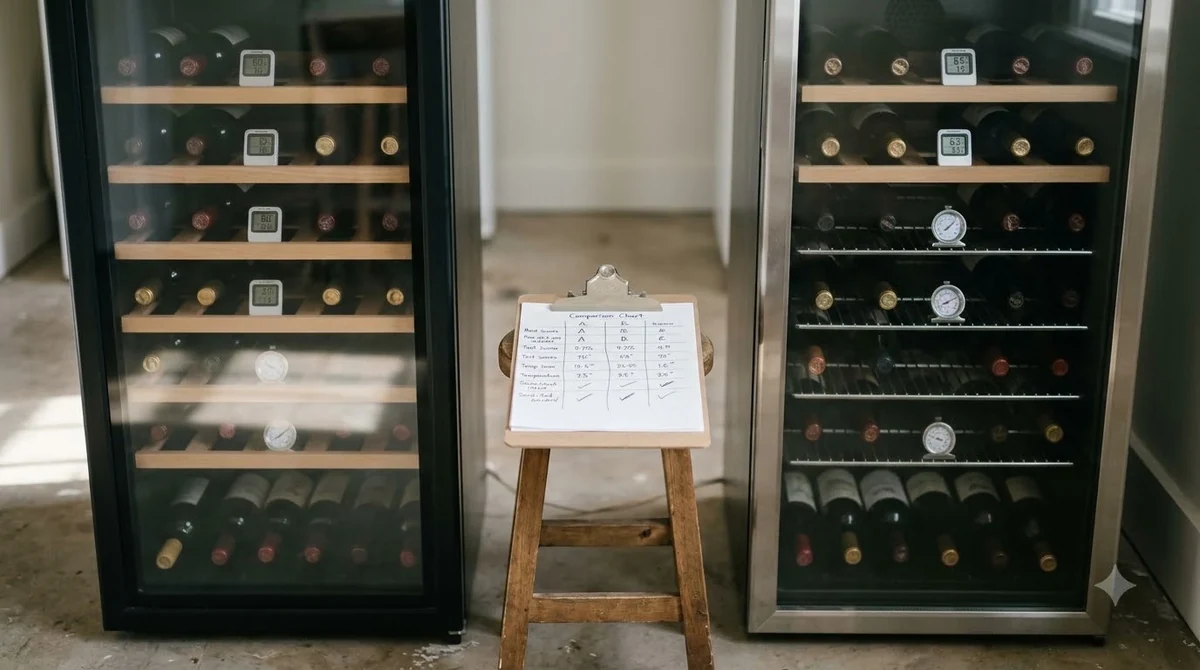
Temperature control is among the most frequently mentioned positive features in Best Buy’s customer feedback. Its listing identifies temperature control as a leading customer topic, followed by capacity and fit. Several reviewers describe the appliance as maintaining its selected temperatures well, which is particularly relevant for people who keep different wine styles in the same refrigerator.
The dual-zone arrangement offers a practical advantage over a single-temperature beverage refrigerator. Red wines and white wines do not generally benefit from being served at identical temperatures. The separate compartments allow owners to organize their collection according to intended serving temperature rather than repeatedly adjusting one shared thermostat.
For example, a household might reserve the upper section for lighter reds and the lower section for whites. A Pinot Noir intended for a slightly cooler serving temperature can occupy the upper section, while a Sauvignon Blanc can be stored in the cooler compartment. The precise settings should reflect the wine styles being stored and the appliance’s actual operating performance.
Owners also appreciate the relatively narrow cabinet. A 10-inch width is considerably easier to accommodate in a small corner than a conventional full-size wine cabinet. Several Best Buy reviewers specifically mention finding a suitable location in a living room, bar area, or otherwise restricted space.
The glass door is another practical feature. It allows users to see the collection without opening the refrigerator every time they want to select a bottle. This can make organizing a small assortment easier, particularly when the collection includes several different grape varieties or bottles reserved for particular meals.
Interior lighting also receives positive mentions in customer feedback. Although illumination is not essential to wine storage, it makes bottle labels easier to identify in a dimly lit entertainment area. The light is useful for occasional selection, although leaving unnecessary interior lighting switched on is not a priority for proper wine storage.
Thermoelectric cooling is attractive to buyers who want to limit compressor-related vibration. The absence of a conventional compressor can make this type of refrigerator suitable for a living room or home bar where operating noise matters. Several owners describe their units as quiet, reinforcing the appeal of the technology.
There is also a practical benefit to having a dedicated wine appliance rather than using an ordinary kitchen refrigerator. Wine bottles remain organized horizontally, labels are easier to find, and the collection does not have to compete with food containers or everyday beverages.
However, owner feedback needs to be interpreted carefully. Best Buy’s review page contains 18 reviews, most of which are positive, but the reviews are historical rather than evidence of current production quality. The feedback also concerns a specific model listing. It should not automatically be applied to every Haier 12-bottle refrigerator.
For shoppers considering a used HVTEC12DABS, these positive comments provide a useful picture of the features owners appreciated. They do not replace a proper inspection of the individual appliance, particularly when its previous operating history is unknown.
Common Complaints
The biggest concerns surrounding older Haier 12-bottle wine refrigerators are long-term reliability, cooling limitations in warm surroundings, and restricted bottle dimensions. The specific model matters because complaints about an older tabletop refrigerator should not automatically be attributed to the later dual-zone tower design.
Reliability deserves particular attention. WineCoolerReviews published an assessment of the HVT12ABS and reported that 10 of the 13 reviewers in its cited sample described their refrigerators failing within a few months. The same review identified reliability as a major reason for its negative recommendation.
That finding is a warning about the older HVT12ABS, not proof that the HVTEC12DABS has the same failure rate. The models have different designs and should be evaluated separately. Nevertheless, the older reports make it sensible to investigate the operating history of any secondhand Haier wine cooler rather than buying solely because the cabinet looks clean.
Noise is another issue. Thermoelectric cooling is often described as quiet, but the cooling fan still produces sound. Best Buy’s HVTEC12DAB reviews include a complaint about a fan that runs continuously and becomes noticeable. This contrasts with other owners who describe the same general appliance as very quiet.
That difference is understandable. Noise perception depends on where the refrigerator is installed, the condition of the fan, surrounding room acoustics, and the owner’s expectations. A fan that is barely noticeable in a kitchen might become irritating in a quiet bedroom or living room.
Cooling performance in warm rooms also deserves attention. Thermoelectric refrigerators rely on the surrounding air to dissipate heat. As the ambient temperature rises, the cooling system has less ability to maintain a low interior temperature. A unit that performs acceptably in a climate-controlled room may struggle in a hot garage or an enclosed space without adequate airflow.
The user manual for the HVTEC12DABS specifically emphasizes proper installation, ventilation, and suitable ambient conditions. It warns against placing the refrigerator in locations without appropriate insulation or heating, such as unsuitable garages, and identifies 55°F as a lower ambient operating limitation in its installation guidance.
There are also limitations in bottle accommodation. Standard Bordeaux-style bottles are the most realistic expectation for the advertised 12-bottle capacity. Wider Champagne bottles and unusually shaped bottles may prevent the racks from holding the full stated number.
Older HVT12-series owner feedback specifically mentions difficulties accommodating larger bottles. Although this is not direct evidence about every HVTEC12DABS configuration, it illustrates why bottle shape should be considered when evaluating compact wine refrigerators.
Another issue is the discontinued status of the HVTEC12DABS. Haier’s product page identifies the model as no longer manufactured. That means shoppers should not assume they can purchase a brand-new unit through ordinary retail channels or obtain every component as easily as they could for a current appliance.
Replacement parts, service arrangements, and warranty eligibility are particularly important for used equipment. The manufacturer’s listed one-year limited warranty does not mean that an appliance purchased secondhand automatically has remaining coverage.
Finally, the cabinet’s depth can surprise buyers. Although the 10-inch width looks space-efficient, the 20.625-inch depth requires a meaningful amount of floor or counter clearance. A narrow appliance is not necessarily a shallow appliance, so measuring the full installation area is essential.
Who Should Buy and Who Should Skip
The Haier 12-bottle dual-zone refrigerator makes the most sense for someone who wants a small collection of ready-to-serve wines organized in two temperature compartments. It is less appropriate for serious long-term aging, frequent storage of oversized bottles, or installation in a hot, enclosed location.
Who may appreciate this refrigerator
Apartment residents and homeowners with limited floor space are natural candidates. The 10-inch width makes the HVTEC12DABS relatively easy to position beside a home bar or dining area, provided its depth and ventilation requirements are accommodated.
People who regularly drink both red and white wine may also appreciate the two separate temperature controls. Instead of storing every bottle at one compromise temperature, they can divide their collection between two compartments and prepare different styles for serving.
A small household with a modest collection is another suitable audience. Twelve standard bottles can represent a useful selection without requiring a large wine cabinet. A collection might include several bottles of Cabernet Sauvignon, a few Pinot Noirs, and a selection of Sauvignon Blanc or Chardonnay.
Entertainers who occasionally serve wine at home may also value the convenience. A bottle of sparkling wine can be chilled separately from a red intended for dinner, subject to the actual temperature limits of the lower compartment.
The refrigerator can complement a modest home wine collection that includes bottles intended for relatively near-term consumption. It offers organization and temperature separation rather than the capacity or environmental controls of a dedicated long-term wine-aging cabinet.
Who should consider another option
Collectors planning to store dozens of bottles should look at a larger refrigerator. A 12-bottle unit leaves little room for expanding a collection, especially when some bottles are wider than standard Bordeaux shapes.
Buyers who regularly purchase Champagne, sparkling wine, or large-format bottles should be especially careful. A nominal 12-bottle rating does not mean that 12 unusually shaped bottles will fit simultaneously.
People who need a built-in appliance should skip this model. Haier specifies a freestanding installation, and its rear ventilation arrangement makes a sealed cabinet installation inappropriate.
Buyers seeking a dependable long-term aging environment should also consider a more suitable wine cabinet. Consistent temperature, controlled light exposure, limited vibration, and an appropriate storage environment matter more for extended aging than simply having a refrigerator with two compartments.
Finally, anyone uncomfortable purchasing discontinued equipment should choose a currently manufactured model with clearly documented support. The HVTEC12DABS may have useful features, but its discontinued status introduces uncertainty around availability, repairability, and future ownership costs.
How It Compares to Alternatives
The Haier HVTEC12DABS is best understood as a compact dual-zone thermoelectric wine cellar rather than a general-purpose beverage refrigerator. Its closest comparisons are other small wine refrigerators, including Haier’s older single-zone tabletop designs and larger-capacity wine cabinets.
One relevant comparison is the older Haier HVT12AVS. Best Buy’s product information describes that model as a 12-bottle wine cellar with analog controls, three full-width wire racks, and a temperature adjustment range of approximately 46°F to 65°F. It also includes a reversible door hinge.
The HVT12AVS therefore offers a simpler control arrangement than the HVTEC12DABS. Its analog settings are straightforward, but it does not provide the same separately controlled upper and lower compartments. Buyers interested in storing red and white wines at different temperatures should pay attention to that difference.
The HVTEC12DABS is more appealing on paper for households that want separate temperature zones. It also has four chrome racks and two LED displays, whereas the HVT12AVS uses three wire racks and analog adjustment.
However, neither model should be purchased simply because it carries a Haier badge. Both are older products, and their discontinued availability makes the condition of an individual unit particularly important.
The HVT12ABS tabletop model is another useful comparison, although it is not identical to the dual-zone tower. WineCoolerReviews describes it as a thermoelectric 12-bottle refrigerator with three chrome racks, an insulated glass door, and a mechanical thermostat.
That independent review also raises substantial concerns about the HVT12ABS’s reliability. Its reported owner experiences should be treated as a caution about that specific product family rather than a verified failure statistic for the HVTEC12DABS.
For buyers comparing the different designs, the following distinctions are useful:
| Comparison | HVTEC12DABS | HVT12AVS | HVT12ABS |
|---|---|---|---|
| Nominal capacity | 12 bottles | 12 bottles | 12 bottles |
| Temperature controls | Electronic touchscreen | Analog | Mechanical thermostat |
| Temperature zones | 2 | 1 | 1 |
| Cooling technology | Thermoelectric | Thermoelectric | Thermoelectric |
| Rack configuration | 4 chrome racks | 3 wire racks | 3 chrome racks |
| Door feature | Curved insulated glass | Double-pane glass, reversible hinge | Double-pane insulated glass |
These comparisons are based on the respective manufacturer or retailer descriptions and the independent HVT12ABS review. They are not interchangeable model specifications. In particular, the temperature settings and physical dimensions should be checked against the exact model number before arranging a purchase.
A larger wine cabinet may be a better choice for anyone whose collection is growing. A higher-capacity appliance generally provides more room for different bottle formats and reduces the need to replace a small refrigerator as the collection expands.
Another option is a modern single-zone wine refrigerator. This can be suitable for someone who primarily drinks one style of wine or wants to maintain a consistent storage temperature. A dual-zone system is not automatically superior if the owner does not need two different temperature environments.
For readers comparing other wine storage appliances, the wine refrigerator model reviews section provides a useful starting point for evaluating different capacities and configurations.
Wine storage is only part of the experience, however. The refrigerator should support how the collection is actually used. Someone who regularly prepares an Aperol Spritz may want dedicated space for chilled sparkling wine and aperitif ingredients, while someone who enjoys a chicken Marsala recipe may prefer to keep a selection of reds available for dinner.
The right alternative therefore depends on bottle capacity, cooling performance, installation requirements, and whether separate zones are genuinely useful. A simpler refrigerator with dependable support can be a more sensible purchase than an older dual-zone appliance with uncertain service availability.
Frequently Asked Questions
Is the Haier HVTEC12DABS the same as the HVTEC12DAB?
These model designations appear in Haier and retailer listings for the 12-bottle dual-zone wine cellar, with the additional S appearing in some product documentation. Do not assume that every similarly named Haier refrigerator has identical specifications. Compare the rating plate, model documentation, and physical controls before ordering replacement components or arranging service.
Does the Haier wine cellar have a door lock?
The published HVTEC12DABS feature and specification information does not identify a dedicated security lock as a standard feature. Buyers who need restricted access should inspect the actual appliance rather than assuming that a glass door includes a locking mechanism. This is particularly relevant when placing the refrigerator in a shared office or entertainment space.
Can the Haier 12-bottle refrigerator store unopened wine for several years?
Its compact dual-zone design is primarily suited to organizing a small collection for convenient access and serving. Extended wine aging benefits from stable environmental conditions over long periods, and a small thermoelectric refrigerator is not automatically equivalent to a dedicated aging cellar. Collectors with valuable bottles intended for several years of storage should evaluate a purpose-built wine cabinet.
Does the Haier wine cellar automatically change its interior light?
Haier describes the HVTEC12DABS as having soft interior lighting, but the product information does not establish an automatic lighting schedule. The light is intended to help owners view and organize bottles. Its presence should not be confused with a temperature-control feature or an automatic wine-preservation system.
Can a Haier wine refrigerator be transported on its side?
Moving instructions depend on the exact appliance and its cooling-system design. The safest approach is to consult the specific owner’s manual before transportation, keep the refrigerator protected against impact, and allow it to settle upright before reconnecting power if the manual requires that precaution. This is especially important when moving an older appliance with an uncertain service history.
The Haier HVTEC12DABS remains an interesting compact wine refrigerator because it combines 12-bottle storage, two temperature zones, and a relatively narrow cabinet. Its discontinued status and mixed considerations around cooling, noise, and long-term ownership mean that the condition of the individual unit matters as much as its original specifications. For buyers who find a properly functioning example and can accommodate its freestanding installation requirements, it may serve as a convenient small wine cellar; shoppers who prioritize current manufacturer support should compare newer alternatives before making a decision.
More in Model Reviews
 Magic Chef 44 Bottle Wine Cooler Review for Flexible StorageUpdated Nov 21, 2026
 Whynter 164 Bottle Wine Cooler Review: Capacity, Features, and FitUpdated Nov 21, 2026
 Insignia NS WC16BK6 Review: Compact 16-Bottle Wine StorageUpdated Nov 21, 2026
 Wine Enthusiast Electric Blue Omega Review: Opening, Pouring, and Preserving Made EasierUpdated Nov 21, 2026
 Koolatron 20 Bottle Wine Cooler Review: Features, Fit, and PerformanceUpdated Nov 21, 2026
 NewAir AWC 330E Review for Home Wine StorageUpdated Nov 21, 2026