


We may earn a commission when you buy through links on this page, at no extra cost to you. Learn more.
The Ivation 12 bottle wine fridge is a compact wine-storage option for households that want dedicated space for a small collection, with thermoelectric and compressor versions offering different cooling capabilities. Its 12-bottle capacity, digital temperature controls, and relatively narrow designs make it appealing for apartments, dining rooms, and home bars. However, buyers should distinguish between the two cooling technologies, check the exact dimensions, and consider whether the advertised capacity will accommodate their preferred bottle shapes.
Ivation offers several 12-bottle wine refrigerator configurations rather than one universal model. The thermoelectric version emphasizes quiet, vibration-free operation, while the compressor versions offer a lower minimum temperature and additional features on certain configurations. This review examines the specifications, owner feedback, practical limitations, and purchasing considerations that matter before choosing one.
Specs and Key Features
The Ivation 12-bottle wine fridge combines a compact cabinet with a single-zone cooling system. The most important distinction is the cooling technology: the black thermoelectric version operates between 46°F and 64°F, while the slim compressor version extends the lower limit to 41°F.
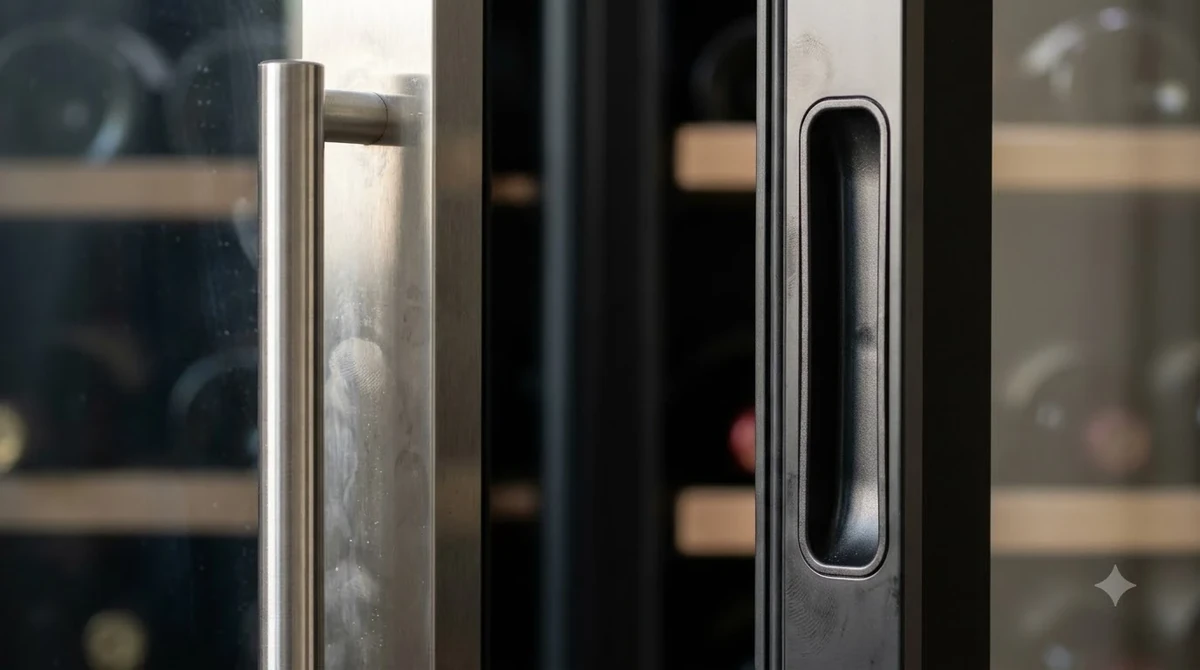
The following comparison separates the two principal configurations. These are different appliances, so specifications should not be mixed when comparing retailer listings or replacement models.
| Specification | Thermoelectric model | Slim compressor model |
|---|---|---|
| Rated capacity | 12 bottles | 12 bottles |
| Cooling technology | Thermoelectric | Compressor |
| Temperature range | 46°F–64°F | 41°F–64°F |
| Temperature zones | 1 | 1 |
| Width | 10.4 inches | 9.92 inches |
| Depth | 20.3 inches | 17.72 inches |
| Height | 25.6 inches | 31.18 inches |
| Weight | 26.5 pounds | 38.6 pounds |
| Power | 65 watts | 95 watts |
| Electrical supply | 115V, 60Hz | 115V, 60Hz |
| Door lock | No | Keyed lock |
| Shelf material | Chrome | Chrome |
Specifications are from Ivation’s manufacturer listings. The compressor model’s dimensions and weight refer specifically to the slim configuration, not every 12-bottle compressor cabinet.
The thermoelectric version has a black-and-glass exterior, smoked tempered glass, polyurethane foam insulation, and chrome shelving. Its manufacturer describes the cooling system as operating without a compressor or refrigerant. This arrangement is intended to reduce mechanical vibration, which can be attractive for people storing bottles in a living or dining area.
The compressor version adds several practical features. Ivation describes a built-in fan for circulating air, double-paned UV-resistant Thermopane glass, removable racks, touch controls, an LCD temperature display, and interior LED lighting. The slim black configuration also includes a keyed door lock.
One important limitation applies to both versions: a single-zone refrigerator cannot independently maintain two different temperatures. A collection containing both red and white wines must share the same selected setting.
For the manufacturer’s specifications, see the Ivation thermoelectric wine cooler product listing.
What Owners Like
Owner feedback highlights three recurring advantages of the Ivation 12-bottle refrigerator: its compact footprint, attractive appearance, and convenient temperature controls. These qualities make it particularly interesting for households that want a dedicated wine cabinet without allocating space to a large cellar-style appliance.
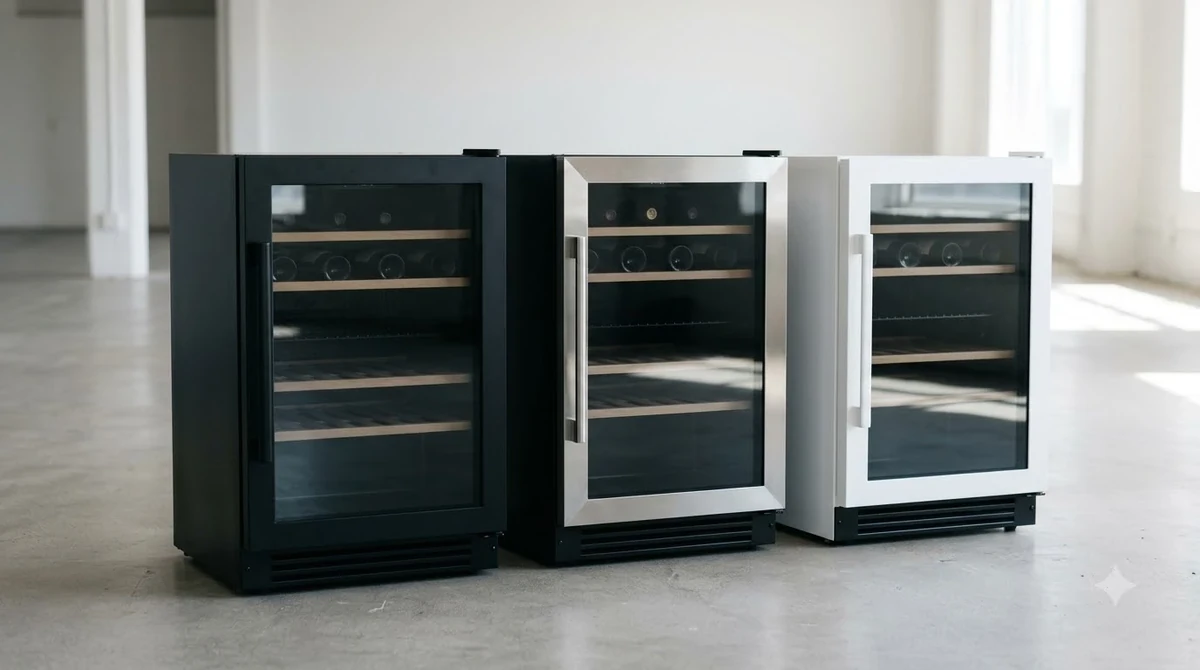
Compact dimensions are a major selling point. The thermoelectric version is approximately 10.4 inches wide, making it easier to consider for a narrow section of a room than a conventional full-size wine refrigerator. The slim compressor configuration is even narrower at 9.92 inches, although its 31.18-inch height means buyers need to plan vertically rather than simply checking available floor width.
The appearance also receives positive attention in retailer feedback. The black finish, glass door, and visible bottle arrangement give the refrigerator a purpose-built wine-storage appearance. Rather than keeping bottles in a kitchen cabinet or on an exposed counter, owners can display a small collection behind a dedicated door.
Temperature controls are another appealing feature. A digital display makes it easier to select a setting than relying on a basic mechanical dial. On the compressor configuration, touch controls and an LCD display provide additional convenience, while the interior light helps users identify bottles without removing them.
Retailer feedback provides some useful context. Home Depot’s listing for model IVFWCC121B displays 164 reviews and a 67% recommendation figure. This suggests a generally positive but mixed ownership picture rather than universal satisfaction.
Wayfair’s review summary similarly identifies compact dimensions and quiet operation as frequently appreciated qualities. Customers also comment favorably on the appearance and general functionality of the appliance. These observations support the idea that the refrigerator can work well as a small household wine-storage solution.
However, customer feedback should be interpreted carefully. A favorable comment about a particular 18-bottle version does not establish that the 12-bottle version performs identically. Likewise, different compressor and thermoelectric configurations should not be treated as interchangeable simply because they share the Ivation name.
Common Complaints
The most important concerns involve usable bottle capacity, temperature consistency, and long-term reliability. A nominal 12-bottle rating does not guarantee that every combination of wine bottles will fit comfortably, and customer experiences indicate that performance can vary.
Advertised capacity versus practical capacity
The 12-bottle rating refers to standard wine bottles rather than every possible bottle shape. Traditional Bordeaux-style bottles are relatively narrow and uniform, while many Pinot Noir, Champagne, sparkling wine, and specialty bottles have wider or differently shaped bodies.
This matters because the usable interior space is limited. A collection containing mostly standard 750 ml bottles is a more realistic match than one containing large sparkling bottles, unusually broad Burgundy bottles, or mixed-format bottles. The arrangement of the shelves can also affect how easily individual bottles slide into position.
Home Depot feedback includes a customer describing difficulty fitting apparently normal-sized bottles into a related Ivation 18-bottle configuration. Although that review does not establish the exact usable capacity of the 12-bottle version, it illustrates why bottle dimensions deserve attention before purchasing.
Temperature fluctuations
Some retailer feedback raises concerns about temperature accuracy and fluctuations. This is an important distinction because the displayed temperature is not necessarily a guarantee that every bottle experiences precisely the same temperature at every moment.
Compressor systems use a cooling cycle and fan-assisted circulation, while thermoelectric systems depend on their surrounding environment and heat dissipation. Room temperature, ventilation, door openings, and cabinet placement can all influence cooling performance.
Reliability concerns
Long-term reliability deserves particular attention. One Home Depot reviewer reported that a cooler stopped cooling 13 months after purchase, shortly after the reported 12-month warranty period had ended. That is an individual experience, not proof of a widespread defect, but it demonstrates why warranty coverage and retailer return policies should be considered before buying.
Other complaints involving related configurations include interior icing and unexpected operating noise. These reports should not automatically be attributed to every 12-bottle model, but they reinforce the importance of confirming the exact product number and understanding the seller’s support arrangements.
There is also a practical limitation with the thermoelectric version: it does not have a door lock. Buyers who want restricted access should consider a compressor configuration with a keyed lock instead.
Who Should Buy and Who Should Skip
The Ivation 12-bottle wine fridge is best suited to occasional wine drinkers, small households, and home-bar owners who want a dedicated place for a modest collection. It is less appropriate for collectors who need multiple temperature zones, extensive capacity, or tightly controlled long-term cellar conditions.
Good candidates for the thermoelectric version
The thermoelectric configuration makes sense for someone who values low-vibration operation and wants a relatively lightweight appliance. Its 26.5-pound listed weight also makes it easier to position than the 38.6-pound slim compressor configuration.
It can be useful for a collection of everyday reds and whites that will be consumed within a reasonable period. The 46°F to 64°F range provides flexibility for serving-oriented storage, although the absence of a setting below 46°F limits its usefulness for people who want colder storage for sparkling wine.
Its single-zone arrangement is most practical when the collection has broadly similar serving requirements. A household that primarily drinks medium-bodied reds or keeps several bottles of one preferred wine style may find this arrangement straightforward.
Good candidates for the compressor version
The compressor configuration is the more versatile choice for buyers who want a lower temperature setting. Its 41°F minimum gives additional flexibility for sparkling wine and chilled whites, while the built-in fan is intended to circulate cool air throughout the cabinet.
The slim configuration is also useful where floor width and depth are restricted. Its footprint is narrower and shallower than the thermoelectric cabinet, although its extra height requires enough vertical clearance.
The keyed lock, removable racks, and digital controls make the compressor configuration attractive for a more feature-oriented home bar. These additions are particularly useful when the appliance is installed in a shared household space.
Who should skip it
Serious collectors should look beyond a small single-zone refrigerator if they intend to age valuable bottles for many years. A 12-bottle appliance has limited capacity, and neither configuration offers independently controlled red and white wine compartments.
Buyers who frequently purchase Champagne, large-format bottles, or unusually shaped wine bottles should also consider a larger cabinet with more flexible shelf arrangements. Similarly, anyone expecting a completely silent appliance should avoid assuming that a refrigerator described as quiet produces no operating sound.
For households building a broader wine-storage setup, the wine appliance model reviews category can help compare different capacities and configurations.
How It Compares to Alternatives
The most useful comparison is between Ivation’s own 12-bottle cooling configurations. Although both are designed for the same nominal collection size, the thermoelectric and compressor models solve different storage problems.
The thermoelectric unit prioritizes reduced vibration and a lighter cabinet. The compressor version prioritizes a lower minimum temperature and includes features such as fan-assisted circulation and, on the slim black model, a keyed lock.
| Buying consideration | Thermoelectric | Slim compressor |
|---|---|---|
| Quiet-oriented operation | Strong feature emphasis | Fan and compressor system |
| Lowest setting | 46°F | 41°F |
| Maximum setting | 64°F | 64°F |
| Cabinet height | 25.6 inches | 31.18 inches |
| Cabinet depth | 20.3 inches | 17.72 inches |
| Listed weight | 26.5 pounds | 38.6 pounds |
| Door security | No lock | Keyed lock |
| Cooling circulation | Thermoelectric cooling | Built-in fan |
These differences are more useful than comparing the two models solely by capacity. Both advertise 12 standard bottles, but their minimum temperatures, cabinet proportions, and cooling systems affect where they fit and how they should be used.
Thermoelectric versus compressor cooling
Thermoelectric technology uses an electronic cooling mechanism rather than a conventional compressor. The absence of a compressor helps reduce mechanical vibration, which is one reason this design appeals to people who want to keep bottles in a quiet room.
Its disadvantage is that cooling performance can be more sensitive to ambient conditions. A warm room can make it harder for a thermoelectric refrigerator to maintain its intended temperature. This is particularly relevant in kitchens or rooms that receive direct sunlight.
Compressor cooling is generally the more suitable approach when lower temperatures and stronger cooling performance are priorities. The Ivation slim model’s 41°F lower limit provides a useful advantage for sparkling wine and whites that benefit from colder serving temperatures.
Single-zone versus dual-zone storage
Both configurations discussed here have one temperature zone. That is perfectly reasonable for a small collection that can share a common setting, but it is less convenient for households that want their reds and whites maintained at different temperatures.
A dual-zone refrigerator provides two independently adjustable compartments. This arrangement can be more practical for someone who regularly serves chilled Sauvignon Blanc alongside lighter reds such as Pinot Noir.
However, dual-zone appliances generally require more planning and may have different capacity and dimension trade-offs. Buyers should compare actual usable space rather than assuming that a larger feature list automatically makes a refrigerator more suitable.
How to Choose a Model and Set It Up
Choosing the correct Ivation configuration starts with the temperature requirements of the collection and the available installation space. The cooling technology matters, but so do the bottles, room conditions, electrical supply, and intended use.
- Identify your preferred wines. Decide whether the collection consists mainly of red wine, white wine, sparkling wine, or a combination. This helps determine whether the 46°F thermoelectric minimum is sufficient or whether the compressor model’s 41°F minimum is more appropriate.
- Measure the installation area. Compare the full cabinet dimensions with the available width, depth, and height. The thermoelectric model measures 10.4 by 20.3 by 25.6 inches, while the slim compressor version measures 9.92 by 17.72 by 31.18 inches.
- Check ventilation requirements. These are freestanding refrigerators, so do not assume they can be installed inside a tightly enclosed kitchen cabinet. Follow the clearance requirements in the exact model’s manual and leave the ventilation space required by the manufacturer.
- Consider bottle shapes. Count your actual bottles and compare their widths and lengths with the available shelf arrangement. If your collection includes several Champagne bottles or broad Burgundy bottles, allow for a lower practical capacity.
- Compare the electrical requirements. The thermoelectric version is listed at 65 watts, while the slim compressor model is listed at 95 watts. Both manufacturer specifications identify a 115V, 60Hz electrical supply.
- Choose the cooling system. Prioritize the thermoelectric model if reduced vibration is your main concern. Choose the compressor configuration if colder settings, a keyed lock, and fan-assisted circulation matter more.
- Review the purchase terms. Confirm the exact model number, included accessories, return period, warranty coverage, and available customer support before completing the purchase.
- Set an appropriate temperature. Allow the appliance to stabilize according to its instructions before loading valuable bottles. Use a suitable independent thermometer if you want to check actual cabinet conditions.
Temperature selection should reflect whether the goal is storage or immediate serving. A common cellar-storage target is approximately 55°F, while serving temperatures vary considerably by wine style.
For example, light whites and rosé are generally served at 45°F to 50°F, full-bodied whites at 50°F to 55°F, and lighter reds at 55°F to 60°F. Full-bodied reds are generally served at 60°F to 65°F. These are serving guidelines rather than instructions to repeatedly change the refrigerator setting for every bottle.
Tip: If the refrigerator will hold a mixture of red and white wines, choose one practical storage temperature rather than constantly changing the setting. A single-zone cooler cannot independently maintain different temperatures for separate wine styles.
Once the refrigerator is installed, organize bottles so that the wines you expect to drink soon are easy to reach. Avoid frequent door openings, which can disturb the cabinet’s temperature, and do not overload the shelves beyond their intended arrangement.
For occasional entertaining, keeping a few bottles ready for serving can be more convenient than using the appliance as a permanent cellar for a growing collection. A chilled white or sparkling bottle can be moved to serving temperature without requiring the entire collection to be stored at an excessively cold setting. For a simple sparkling cocktail, the Aperol Spritz recipe offers one way to use a properly chilled bottle of Prosecco.
Care, Storage, and Long-Term Use
Proper placement and routine care are important for maintaining consistent operation. Even a compact wine refrigerator needs suitable ventilation, a stable location, and sensible temperature management to perform as intended.
Start by placing the appliance on a level, stable floor or surface. An uneven installation can contribute to unwanted vibration, movement, or operational noise. Keep the refrigerator away from direct sunlight, ovens, radiators, and other heat-producing appliances.
Room temperature is particularly important for thermoelectric cooling. Unlike a compressor refrigerator, a thermoelectric unit may struggle to maintain a substantial temperature difference when the surrounding air becomes hot. A shaded indoor location with reasonable ventilation is a better choice than a warm utility room or an exposed area beside a sunny window.
Keep the door and interior clean
Wipe the exterior and glass door with a soft, nonabrasive cloth. Avoid harsh cleaning chemicals that could damage the finish or leave unwanted odors around the stored wine.
Clean the interior according to the manufacturer’s instructions before loading bottles. Remove spills promptly, since sticky residue can accumulate around the shelves and interior surfaces. If shelves are removable, handle them carefully rather than forcing them out of their supports.
Store bottles sensibly
Wine bottles with natural cork closures are generally stored on their sides for longer-term storage. This helps keep the cork in contact with the wine. Keep bottles away from strong light and unnecessary movement, particularly if they contain older wines with sediment.
For a small collection, organization is especially useful. Group bottles by style or drinking occasion so that you do not need to move several bottles whenever you want one. A simple inventory can also prevent forgotten bottles from occupying limited space.
Remember that a 12-bottle refrigerator is primarily a compact storage and temperature-management appliance. It does not automatically reproduce every condition of a professional wine cellar, especially for long-term aging over many years.
Manage opened bottles separately
Once a bottle has been opened, its storage requirements change. Most opened still wines can generally be kept in the refrigerator for approximately three to five days, while opened sparkling wines usually retain their best character for around one to three days when properly sealed.
These timeframes are general guidelines rather than guarantees. Wine style, age, exposure to oxygen, and closure quality affect how quickly an opened bottle changes. A dedicated wine refrigerator can provide useful cool storage, but an appropriate sparkling-wine stopper or still-wine closure remains important.
Also consider the practical serving temperature. A bottle of full-bodied red kept around cellar temperature may need time outside the refrigerator before serving, while a crisp white may be ready much sooner. The cooler should support the way the collection is used rather than forcing every wine into the same serving routine.
For a meal featuring a richer sauce and poultry, the chicken Marsala recipe can also help inspire a bottle choice from the collection, particularly a medium-bodied red that suits the dish.
Frequently Asked Questions
Does the Ivation 12-bottle wine fridge have a reversible door?
The reviewed manufacturer specifications do not establish a reversible-door feature for the two configurations discussed. Door orientation is important when installing a refrigerator beside a wall or kitchen furniture. Confirm the hinge arrangement in the exact model’s instruction manual before purchasing.
Can the Ivation wine fridge be used as a beverage refrigerator?
It is designed primarily for wine bottles rather than cans and general beverage storage. Its wine shelves and interior dimensions may not provide convenient space for taller bottles or cans. A dedicated beverage refrigerator is a better option if mixed drinks and canned beverages are the main priority.
Does the Ivation wine fridge have a humidity control?
The reviewed 12-bottle product specifications do not identify a separately adjustable humidity control. Buyers who require precise humidity management for a valuable cork-sealed collection should investigate a wine cabinet designed specifically for that purpose. The presence of insulated glass and foam insulation does not mean humidity can be independently programmed.
Can the wine refrigerator be transported while loaded?
It is preferable to remove the bottles and secure removable shelves before moving the appliance. Compressor refrigerators also have handling requirements that should be followed before reconnecting power after transportation. Consult the specific model’s manual for upright positioning and any recommended waiting period.
Does the interior light need to remain switched on?
No, the interior LED lighting on the described compressor configuration is an illumination feature rather than a cooling requirement. Keeping unnecessary lighting off reduces exposure when the door is opened, although the manufacturer’s specifications should determine the available lighting controls. The thermoelectric product description does not establish the same lighting and control configuration.
The Ivation 12-bottle wine fridge is a practical option for a modest household collection, especially when compact dimensions and dedicated wine storage are more important than extensive capacity. The thermoelectric version is attractive for reduced-vibration operation, while the compressor configuration is the stronger choice for colder storage and additional convenience features. Compare the exact model number, bottle dimensions, ventilation needs, and warranty terms before deciding which version belongs in your home.
More in Model Reviews
 Magic Chef 44 Bottle Wine Cooler Review for Flexible StorageUpdated Nov 21, 2026
 Whynter 164 Bottle Wine Cooler Review: Capacity, Features, and FitUpdated Nov 21, 2026
 Insignia NS WC16BK6 Review: Compact 16-Bottle Wine StorageUpdated Nov 21, 2026
 Wine Enthusiast Electric Blue Omega Review: Opening, Pouring, and Preserving Made EasierUpdated Nov 21, 2026
 Koolatron 20 Bottle Wine Cooler Review: Features, Fit, and PerformanceUpdated Nov 21, 2026
 NewAir AWC 330E Review for Home Wine StorageUpdated Nov 21, 2026