

We may earn a commission when you buy through links on this page, at no extra cost to you. Learn more.
The Whynter beverage cooler BR-128WS is a worthwhile option for households that need compact, high-capacity drink storage, offering room for 127 standard 12-ounce cans, compressor cooling, five adjustable shelves, and a lockable glass door. Its 3.1-cubic-foot cabinet provides useful storage without taking up the space of a full-size refrigerator. However, its freestanding-only installation, mechanical temperature control, and reports of uneven cooling make it less suitable for every kitchen or beverage collection. It is best viewed as a dedicated drink refrigerator rather than a replacement for a wine cellar or built-in undercounter appliance.
A dedicated beverage refrigerator can make entertaining easier by keeping sodas, sparkling water, beer, mixers, and other drinks organized and ready to serve. Whynter offers several refrigerator designs, from compact freestanding units to larger built-in models. The BR-128WS is one of its recognizable options, combining substantial can capacity with a relatively narrow footprint. This review examines its specifications, owner feedback, installation requirements, and practical limitations to help determine whether it belongs in your home.
Whynter BR-128WS Specifications and Key Features
The BR-128WS combines a 127-can stated capacity with compressor refrigeration and a glass-front design. Its strongest selling points are organized storage, a reversible door, and a temperature range suited to a variety of everyday beverages.
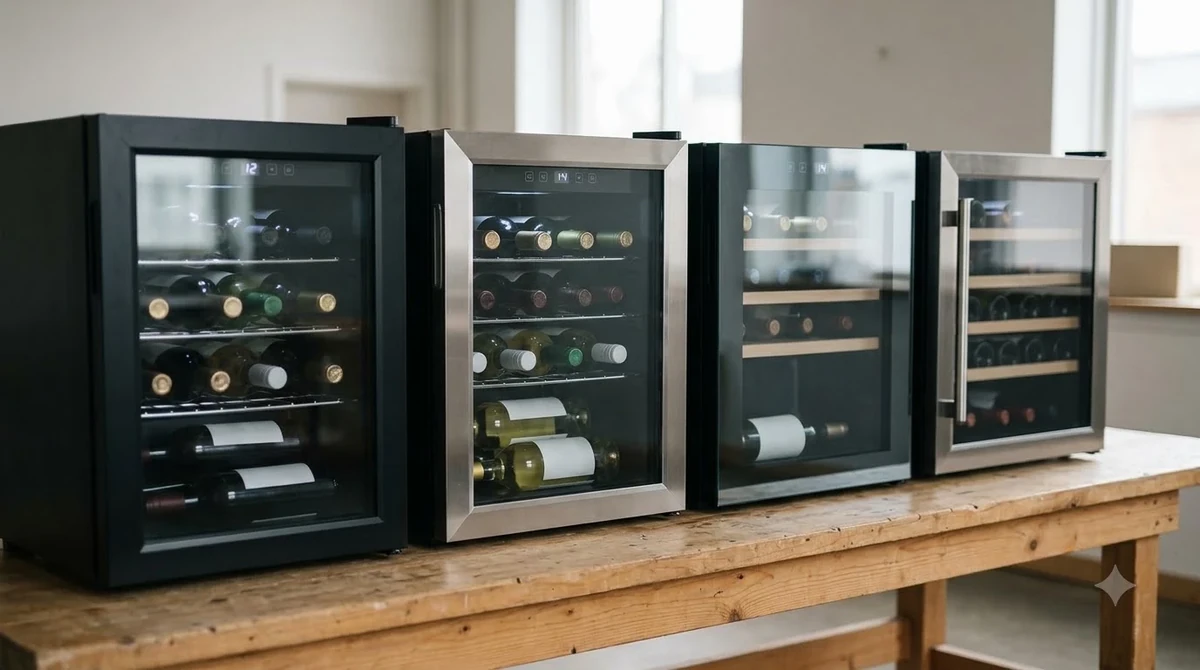
The cabinet measures 17 inches wide, 18.5 inches deep, and 32.75 inches high, making it a relatively compact appliance for its advertised capacity. Its 3.1-cubic-foot interior is arranged around five slide-out wire shelves. This layout provides more flexibility than a basic single-compartment mini refrigerator, especially when different drinks need separate storage areas.
Whynter uses a stainless steel-trimmed, double-pane glass door with a white cabinet. The glass allows users to see the available drinks without opening the refrigerator, while the manufacturer specifies improved UV isolation and energy efficiency from its double-pane construction. An interior LED light makes the contents easier to identify, and a separate switch controls the illumination.
The cooling system uses a compressor with internal fan-forced circulation. This is an important distinction from small thermoelectric beverage refrigerators, which use a different cooling approach. The BR-128WS also includes a mechanical temperature control rather than a digital touchscreen. Its stated operating range extends from the high 30s to the mid-60s Fahrenheit.
| Specification | Whynter BR-128WS |
|---|---|
| Rated capacity | 127 standard 12-ounce cans |
| Cabinet volume | 3.1 cubic feet |
| Installation | Freestanding |
| Temperature range | High 30s to mid-60s °F |
| Cooling system | Compressor with internal fan |
| Shelf count | 5 slide-out wire shelves |
| Door | Double-pane glass, reversible |
| Security | Cylinder lock and 2 keys |
| Dimensions | 18.5 D x 17 W x 32.75 H inches |
| Net weight | 57.5 pounds |
| Electrical rating | 115V / 60Hz |
| Input power | 85 watts |
| Refrigerant | R600a |
These specifications come from Whynter’s official BR-128WS product information and instruction manual. The 127-can figure refers to standard 12-ounce cans, so larger energy-drink cans, tallboy cans, and bottles can reduce the practical capacity. The five shelves can be repositioned or removed to accommodate a more varied collection, although the actual arrangement will depend on container dimensions.
The reversible door is another useful feature for household layouts. It gives owners more flexibility when choosing a location, particularly in kitchens where the refrigerator needs to open away from a nearby cabinet or doorway. However, Whynter notes that the recessed handle arrangement does not apply in the same way after reversing the door.
For a closer look at the official specifications, the Whynter BR-128WS product page provides the manufacturer’s feature list, dimensions, electrical information, and warranty details.
What Owners Like About the Whynter Beverage Refrigerator
Customer feedback points to three recurring advantages: useful beverage capacity, attractive appearance, and effective cooling. The BR-128WS is particularly appealing to households that want a dedicated location for drinks rather than filling their main refrigerator with cans and bottles.
Storage capacity is one of the most frequently appreciated characteristics. A stated capacity of 127 standard cans gives the appliance enough room for family gatherings, game-day refreshments, and regular household use. Five slide-out shelves also make it easier to organize drinks by type instead of stacking everything into one compartment.
Home Depot customer feedback includes owners who appreciate being able to transfer drinks out of their primary refrigerator. This can be especially useful in kitchens where food storage already takes up most of the available refrigerator space. A dedicated beverage appliance also gives guests convenient access to refreshments without repeatedly opening the main refrigerator.
The appearance receives positive attention as well. The stainless steel trim and glass door create a display-style look that works in many modern kitchens, home entertainment rooms, and office spaces. Interior lighting adds visibility, particularly when the refrigerator is placed in a room with limited ambient light.
Some owners also report that the refrigerator keeps beverages cold effectively without being especially noticeable during ordinary operation. One Home Depot reviewer described the appliance as very quiet while another praised its cooling performance after loading it with drinks. These experiences suggest that noise perception and cooling satisfaction can vary with the installation environment and operating conditions.
The lock is another practical advantage. Two keys are included, allowing owners to restrict access in shared offices, entertainment rooms, or other spaces where drinks need to be secured. This is not necessarily a major requirement in every household, but it makes the BR-128WS more versatile than beverage refrigerators without a locking mechanism.
Home Depot’s published customer feedback also gives a more balanced picture than relying on manufacturer descriptions alone. Its BR-128WS listing shows a 3.9-out-of-5 average from 395 reviews, with 67% of reviewers recommending the product. That feedback is mixed rather than overwhelmingly positive, so buyers should consider the complaints alongside the favorable comments.
Overall, owners who value straightforward drink storage, a visible glass-front cabinet, and a relatively large capacity appear to appreciate the product most. Its appeal is less about advanced controls and more about having a dedicated, organized place for frequently used beverages.
Common Complaints and Cooling Limitations
The main concerns reported by some owners involve temperature consistency, freezing near the rear of the cabinet, operating noise, and condensation. These issues do not establish that every BR-128WS will experience problems, but they deserve consideration before purchase.
Temperature distribution is particularly important because the refrigerator uses a single-zone mechanical control. A reviewer on Home Depot reported differences of approximately five degrees between beverage locations, with cans toward the back potentially freezing when the control was set too cold. Another reviewer described an instance of cans freezing near the rear of the appliance.
This matters for households storing drinks that should remain above freezing. Carbonated beverages can become unpleasant or potentially create a mess if their contents freeze and expand. A refrigerator that has a low advertised temperature setting is not necessarily a refrigerator that maintains identical temperatures at every shelf and position.
The internal fan is intended to circulate cool air, but fan-forced circulation does not guarantee perfectly uniform temperatures. Door openings, shelf placement, room temperature, how densely the cabinet is loaded, and the position of individual containers can all influence cooling behavior.
Noise is another consideration. Some owners describe relatively quiet operation, while others report buzzing, gurgling, or louder-than-expected running sounds. Compressor refrigerators naturally produce operating sounds, and the perception of those sounds depends partly on where the unit is installed. A refrigerator in a busy kitchen may be less noticeable than one placed immediately beside a desk or seating area.
Condensation has also appeared in customer complaints. One Home Depot reviewer reported water collecting around the door and dripping onto the floor in a humid enclosed porch. Whynter’s customer service response recommended inspecting the door seal for gaps or pinched areas. This is a useful reminder that a beverage refrigerator needs a suitable indoor environment and a properly sealing door.
Delivery condition is another issue worth checking. Some customers have reported receiving units with dents around the door or cabinet. These complaints concern transportation and packaging rather than necessarily indicating a refrigeration defect, but inspecting the appliance promptly after delivery can make any damage easier to document.
Tip: Avoid immediately setting the mechanical thermostat to its coldest position. Start with a moderate setting, allow the refrigerator to stabilize, and check the temperature at different shelf positions with an independent refrigerator thermometer before loading expensive beverages or leaving cans against the rear wall.
For buyers who are particularly sensitive to sound or need highly consistent temperatures, these reported limitations deserve more weight. A refrigerator with independently controlled zones or more precise digital settings may be a better fit for a specialized beverage collection.
Who Should Buy the Whynter BR-128WS and Who Should Skip It
The BR-128WS makes the most sense for households that want a relatively narrow, high-capacity, freestanding beverage refrigerator. It is less appropriate for buyers who need a built-in appliance, precise temperature management, or dedicated long-term wine storage.
Who should consider buying it?
Families and frequent hosts: The 127-can stated capacity provides substantial room for sodas, sparkling water, canned cocktails, and other refreshments. It can reduce the number of drinks stored in the main kitchen refrigerator, leaving more space for everyday groceries.
Home entertainment rooms: The glass door and interior lighting make it easy to see available beverages. The lock also provides an additional level of control when the appliance is installed in a shared space.
Home offices: A dedicated beverage refrigerator can be convenient for offices where employees or visitors need access to drinks throughout the day. Its 17-inch width may also be easier to accommodate than a conventional full-size refrigerator.
Buyers who prefer simple controls: The mechanical thermostat avoids the need to learn a complicated touchscreen interface. Owners who want a basic refrigerator for everyday beverages may appreciate this uncomplicated approach.
Who should look elsewhere?
Kitchen remodeling projects requiring built-in installation: The BR-128WS is specifically designed for freestanding use. It requires ventilation space around the cabinet, including approximately five inches at the back and sides according to the installation manual. It should not be enclosed inside cabinetry.
Wine collectors: Although the manufacturer permits beverage and wine storage, this is a single-zone beverage refrigerator rather than a dedicated wine cellar. Collectors who want separate serving temperatures for red and white wines should consider a dual-zone wine refrigerator.
People requiring precise temperature management: The mechanical control and owner reports of temperature differences make this a less compelling choice for sensitive collections. Buyers who need closely monitored storage should look for a model with more advanced controls and independently verifiable temperature performance.
Outdoor entertainment areas: The instruction manual specifically says not to install the BR-128WS outdoors or in wet conditions. It is intended for a suitable indoor environment, not an exposed patio, garage with extreme temperatures, or uncovered outdoor kitchen.
For buyers comparing dedicated wine storage with general beverage refrigeration, the best rated wine cooler options provide a useful starting point. A wine refrigerator designed around bottle dimensions and appropriate wine-serving temperatures may be more suitable than a can-focused appliance.
How the BR-128WS Compares With Other Whynter Refrigerators
Whynter offers several beverage refrigerator configurations, so the BR-128WS is not necessarily the right choice for every installation. The most important distinction is whether the refrigerator is intended to stand independently or fit into a prepared undercounter opening.
The manufacturer’s beverage refrigerator comparison page lists several alternatives with different widths and capacities. For example, the BSR-080SB is listed as a 128-can, 15-inch-wide built-in-ready beverage refrigerator. The BSR-140SB is a larger 166-can model with a 24-inch width and built-in-ready installation.
| Model | Stated capacity | Width | Installation type |
|---|---|---|---|
| BR-128WS | 127 cans | 17 inches | Freestanding |
| BSR-080SB | 128 cans | 15 inches | Built-in ready |
| BSR-140SB | 166 cans | 24 inches | Built-in ready |
These models illustrate why capacity alone should not determine the purchase. The BR-128WS offers a conventional freestanding design with a glass-front cabinet, while the BSR-080SB is designed around a narrower undercounter installation. The BSR-140SB provides greater stated capacity but needs a wider installation space.
For a kitchen renovation, the BSR-080SB or BSR-140SB may be more appropriate if the project calls for an appliance designed for built-in use. Buyers should still review the individual installation instructions because built-in-ready appliances have specific ventilation and cabinet requirements.
For a simpler kitchen or entertainment-room setup, the BR-128WS has a straightforward advantage: it does not require a custom cabinet opening. It can be placed on a suitable level floor as long as the necessary ventilation clearance is maintained.
The distinction also matters for appearance. A freestanding refrigerator can remain visible as a separate appliance, whereas a built-in-ready refrigerator is intended to work with surrounding cabinetry. Neither configuration is inherently better; the right selection depends on the room layout and available space.
Whynter’s broader collection also includes wine refrigerators and combination wine-and-beverage units. Those products are worth considering when a household wants to store bottles and cans in the same appliance or maintain different temperature zones. For someone primarily storing canned refreshments, however, the BR-128WS remains a more direct match.
Installation, Temperature Setup, and Everyday Care
Proper installation is important for the BR-128WS because ventilation, leveling, and room temperature can influence its operation. Following the manufacturer’s setup instructions also helps avoid preventable problems during the first few days of use.
Prepare the location
Choose a dry, well-ventilated indoor location with a hard, level floor. The instruction manual recommends an ambient temperature above 60°F and below 90°F. It also advises against installing the refrigerator near ovens, grills, or other heat sources.
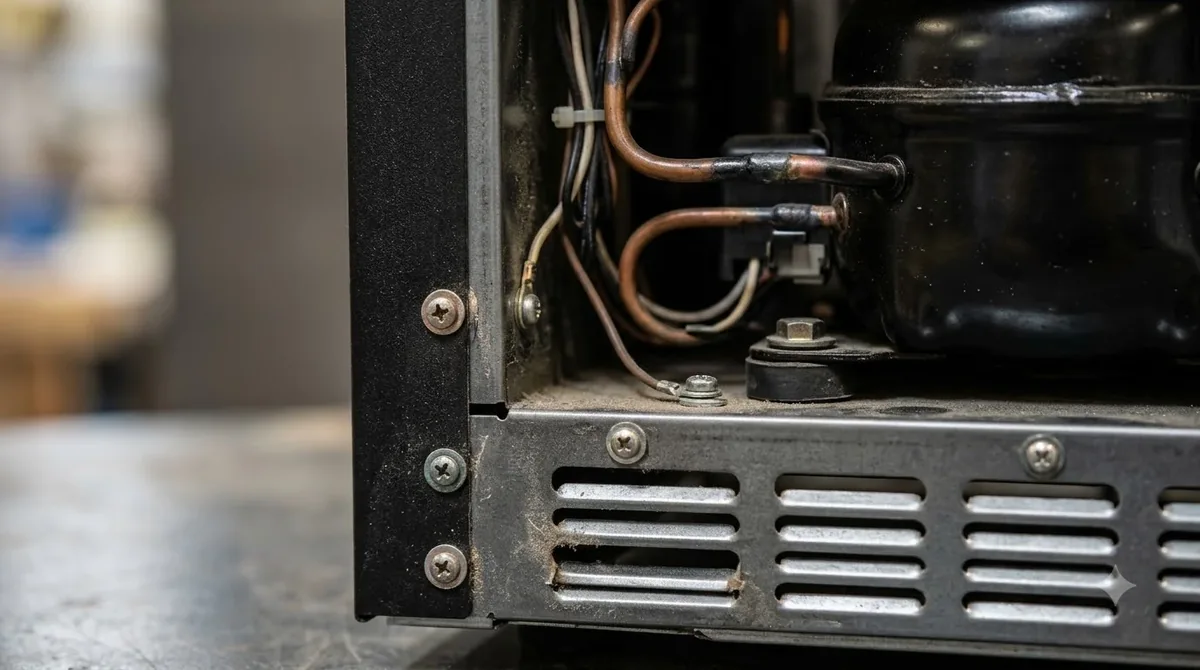
Allow approximately five inches of clearance behind and beside the refrigerator. This space helps air circulate around the compressor and condenser. Do not place the appliance inside an enclosed cabinet or position it where the base ventilation area is obstructed.
Allow the refrigerator to settle
After unpacking, Whynter recommends allowing the appliance to stand upright for approximately four hours before connecting it to power. This waiting period helps reduce the possibility of cooling-system problems caused by transportation and handling.
Clean the interior with lukewarm water and a soft cloth before loading drinks. Position the refrigerator on a stable surface and adjust the leveling legs as necessary. Because the appliance weighs 57.5 pounds before loading, two people should handle moving and installation.
Use the correct electrical connection
The BR-128WS requires a grounded three-prong electrical outlet compatible with its 115-volt, 60-Hz rating. Whynter recommends a dedicated electrical outlet and advises against using an extension cord. Electrical installation questions should be handled by a qualified electrician.
Establish a suitable temperature
Begin with a moderate thermostat setting rather than immediately selecting maximum cooling. Give the refrigerator sufficient time to stabilize before judging its performance. An independent thermometer can help identify temperature differences between the upper shelves, lower shelves, and rear portion of the cabinet.
Keep beverages organized without blocking the internal circulation system. Avoid placing hot drinks inside the refrigerator, and close the door promptly after removing or adding items. These simple practices help reduce unnecessary temperature fluctuations.
Keep the cabinet clean
Unplug the refrigerator before performing cleaning or maintenance. Use a soft cloth and appropriate mild cleaning materials rather than abrasive or solvent-based cleaners. Check the door seal periodically for visible gaps, dirt, or damage, particularly if condensation appears around the glass door.
Do not use the BR-128WS to store perishable foods, medicines, or other products requiring a different temperature environment. The manufacturer specifically describes the unit as a beverage and wine refrigerator, not a general-purpose food refrigerator.
For households that regularly serve mixed drinks, the refrigerator can also keep soda water and mixers ready for entertaining. A chilled supply of sparkling water and citrus-based mixers is useful for an Aperol Spritz recipe, while a separate supply of cooking ingredients can remain in the main refrigerator for meals such as chicken Marsala.
Frequently Asked Questions
Does the Whynter BR-128WS have automatic defrost?
The BR-128WS product information and manual describe compressor cooling and a mechanical thermostat but do not list automatic defrost as a feature. Buyers should not assume that it has an automatic defrost system simply because other Whynter beverage models include one. Follow the model-specific maintenance instructions if frost or excess moisture develops.
Can the BR-128WS accommodate glass bottles?
Yes, the removable wire shelves provide flexibility for storing different beverage containers. However, the advertised 127-can capacity applies to standard 12-ounce cans, not glass bottles. Bottle height, diameter, and shelf spacing will determine how many can fit comfortably.
Does the Whynter BR-128WS have a digital temperature display?
No digital touchscreen or numerical temperature display is specified for this model. It uses a mechanical temperature control. Owners who need an exact numerical reading can use a separate refrigerator thermometer to monitor the interior.
Can the door be reversed after installation?
Yes, Whynter lists a reversible door as a feature. The change requires following the manufacturer’s hinge and installation instructions rather than simply turning the refrigerator around. The recessed handle arrangement is also affected by reversing the door swing.
Is the BR-128WS suitable for a garage?
It may be suitable for an appropriate indoor garage environment, provided the ambient temperature remains within the manufacturer’s recommended 60°F to 90°F range. An unheated garage in winter or an extremely hot garage in summer may fall outside those conditions. The manual also requires a dry location and adequate ventilation.
The Whynter BR-128WS is a practical beverage refrigerator for households that prioritize generous can capacity, a glass-front display, and straightforward freestanding installation. Its reported temperature inconsistencies and lack of built-in capability are meaningful limitations, but buyers with a suitable indoor location and ordinary drink-storage needs may find its feature set appealing. Before purchasing, measure the installation area, confirm ventilation clearance, and decide whether a single-zone mechanical-control refrigerator matches the beverages you plan to store.
More in Model Reviews
 Magic Chef 44 Bottle Wine Cooler Review for Flexible StorageUpdated Nov 21, 2026
 Whynter 164 Bottle Wine Cooler Review: Capacity, Features, and FitUpdated Nov 21, 2026
 Insignia NS WC16BK6 Review: Compact 16-Bottle Wine StorageUpdated Nov 21, 2026
 Wine Enthusiast Electric Blue Omega Review: Opening, Pouring, and Preserving Made EasierUpdated Nov 21, 2026
 Koolatron 20 Bottle Wine Cooler Review: Features, Fit, and PerformanceUpdated Nov 21, 2026
 NewAir AWC 330E Review for Home Wine StorageUpdated Nov 21, 2026