

We may earn a commission when you buy through links on this page, at no extra cost to you. Learn more.
An orrefors decanter is a worthwhile choice for wine drinkers who value Scandinavian glass design, attractive table presentation, and practical serving functionality. The Enjoy is the most versatile option for everyday wine and water service, while the Nobel and Sofiero models offer more decorative crystal designs. The right choice depends on capacity, stopper style, cleaning requirements, and whether you want a working wine decanter or a statement piece for your dining room.
Orrefors has a long association with Swedish glassmaking and designer-led tableware. Its decanters range from simple, generously proportioned serving vessels to elaborate crystal pieces with distinctive decorative details. That variety makes the brand interesting for both regular wine drinkers and collectors, but it also means that choosing by appearance alone can lead to the wrong purchase. This review examines the main designs, their published specifications, everyday usability, and the details worth checking before choosing one.
Orrefors Decanter Review: Specs and Key Features
Orrefors offers several distinct approaches to wine service, with differences in capacity, proportions, decoration, and maintenance. The Enjoy is the practical all-rounder, while the Nobel, Sofiero, and Street designs place greater emphasis on decorative glasswork and distinctive presentation.
| Model | Capacity | Dimensions | Material and design | Care |
|---|---|---|---|---|
| Enjoy | 34 oz / 100 cl | 7.875 in W × 9.25 in H | Crystal glass; bowl-shaped body and tapered neck | Dishwasher safe according to manufacturer |
| Nobel | 118 cl / approximately 39.9 oz | 130 mm W × 300 mm H | Crystal glass; gold-detailed glass stopper | Hand wash |
| Sofiero | 75 cl / approximately 25.4 oz | 125 mm W × 245 mm H | Lead-free crystal; decorative cut pattern | Not dishwasher safe |
| Street | Approximately 35.1 oz | Approximately 12 in H | Glass; hand-cut grid pattern and square black stopper | Hand wash recommended |
The specifications show why these designs should not be treated as interchangeable. The Enjoy has a relatively broad body that gives wine room to spread out, whereas the Street is much taller and narrower. The Nobel has the largest published capacity in this comparison, and its gold-accented stopper gives it a more formal appearance. Sofiero is smaller, making it a particularly interesting choice for someone who wants a decorative vessel that does not dominate the table.

One important distinction is the material terminology. Orrefors identifies the Enjoy and Nobel as crystal glass, while the Sofiero is specifically described as lead-free crystal. These descriptions should be preserved rather than assuming that every Orrefors decanter uses identical glass composition. The designs also have different care requirements, so a dishwasher-safe specification for the Enjoy should never be applied automatically to the other models.
For the Enjoy, the official US product listing provides a capacity of 34 ounces, while Orrefors’s European listing gives 100 cl. These are effectively the same approximate capacity. The difference between product descriptions and regional listings is a reminder to compare the exact product number and dimensions rather than relying only on a collection name.
For additional serving context, the wine glasses guide explains how glass shape and capacity influence presentation. A well-proportioned decanter should complement the glasses and the wine being served, rather than simply matching their appearance.
What Owners and Buyers Are Likely to Appreciate
The strongest attraction of Orrefors decanters is their combination of recognizable design and useful serving proportions. The Enjoy offers an especially practical shape for wine and water, while the Nobel and Sofiero provide more distinctive decorative details for formal dining and gifting.
The Enjoy is an appealing option for someone who regularly serves wine at home. Its rounded bowl and tapered neck create a straightforward pouring arrangement, and its 34-ounce capacity is sufficient for a standard 750 ml wine bottle with some room remaining. The same vessel can also serve water at dinner, making it more useful than a decanter reserved exclusively for occasional red wine service.
Another advantage is the design contribution of Erika Lagerbielke. Orrefors identifies her as the designer of Enjoy, and the brand notes her longstanding collaboration with the company. The resulting design has a functional character without looking like generic restaurant equipment. Its broad silhouette also makes it visually appropriate for a dining table, kitchen counter, or drinks cabinet.
The more elaborate models appeal to a different buyer. The Nobel has a glass stopper with hand-painted gold details, giving it an immediately recognizable appearance. It was created by Gunnar Cyrén for the 90th anniversary of the Nobel Prize in 1991. Its connection to the Nobel Banquet at Stockholm City Hall gives the design an additional historical association that makes it particularly interesting as a collector’s or presentation piece.
Sofiero has a different visual character. Its cut pattern creates light-reflecting surfaces throughout the crystal, making it attractive in rooms with natural or directed lighting. The design dates to 1960, and Orrefors also identifies it as suitable for serving spirits. That versatility is useful for households that want one decorative vessel for several types of entertaining.
The Street design is another distinctive option. Its hand-cut grid pattern, narrow proportions, and square black stopper create a more contemporary appearance than the traditional decorative treatment of Sofiero. Dillard’s lists its approximate capacity at 35.1 ounces, which makes it suitable for a full standard bottle with additional room for pouring.
Independent retailer 2Modern also lists the Enjoy as a 34-ounce vessel with a diameter of approximately 7.9 inches and a height of 9.25 inches. Its Orrefors Enjoy Decanter product listing provides a useful second reference for buyers comparing the US manufacturer’s dimensions and care information with another retailer’s specifications.
These are product-design advantages rather than verified claims about universal customer satisfaction. The official US Enjoy listing displays no customer reviews, and the available product information does not establish a consistent pattern of owner feedback across all four models. Buyers should therefore distinguish documented features from assumptions about long-term owner experiences.
Tip: For a decanter that will be used frequently, prioritize a comfortable pouring neck, enough room for a standard 750 ml bottle, and manageable cleaning requirements before choosing decorative details.
Common Complaints and Practical Limitations
The main disadvantages to consider are cleaning differences, delicate decorative details, storage requirements, and the possibility that a particular design may be less convenient than its appearance suggests. These are practical ownership considerations rather than evidence of widespread product defects.
The Enjoy is the easiest model to recommend to buyers who prefer straightforward maintenance because Orrefors identifies it as dishwasher safe. However, its American product listing also describes hand washing or wiping with a cloth as care options. Someone who wants to preserve the appearance of a premium glass vessel may still prefer careful hand washing, even when a manufacturer permits dishwasher cleaning.
Sofiero requires more attention. Orrefors explicitly states that it is not dishwasher safe. Its decorative cuts also create more surfaces that need careful attention during cleaning. A soft cloth and gentle hand washing are more appropriate than treating it like an ordinary everyday water jug.
The Nobel also requires hand washing. Its gold-detailed glass stopper is a prominent decorative feature, but it should be handled carefully rather than exposed to aggressive cleaning or abrasive materials. The stopper is part of what makes the model visually distinctive, so preserving that detail matters to anyone buying it as a special-occasion piece.
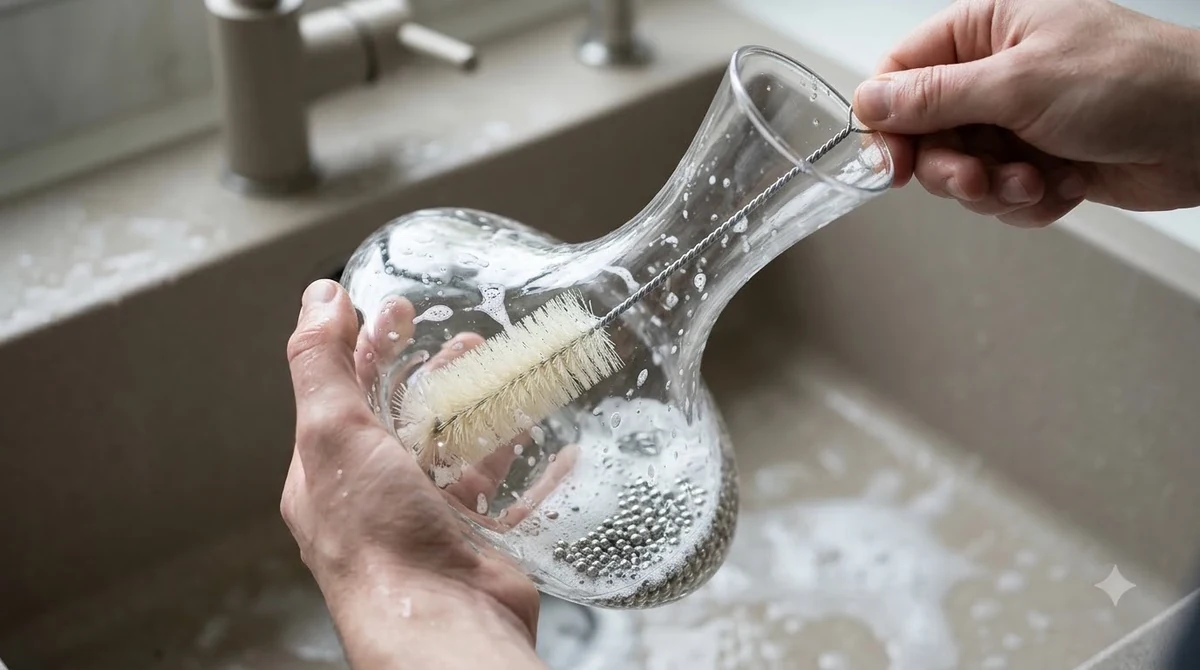
The Street decanter has a relatively narrow footprint and a tall profile. At approximately 12 inches high, it may require more vertical clearance in a cabinet than a lower, wider model. Its narrow body also creates a different cleaning challenge from the wide-bowled Enjoy. A cleaning brush designed for glassware may be useful if the opening makes it difficult to reach the interior.
Another limitation is that a decanter is not automatically an ideal storage vessel. Wine is generally better returned to a properly sealed bottle or another suitable container after service rather than left exposed in a decorative decanter for extended periods. The wide opening of a decanter can encourage air contact, which is useful for some young reds before serving but less useful for preserving leftover wine.
Availability is another consideration. Product listings can differ between the US and European Orrefors websites, and a collection may be shown even when an individual model is unavailable. The US Enjoy listing, for example, includes product-specific availability and packaging information. Buyers should verify the exact item, packaging, and return conditions before ordering, especially when purchasing a decanter as a gift.
Finally, the most decorative option is not necessarily the most practical. A collector may prefer the Nobel’s presentation, but someone who pours wine every evening may get more value from the Enjoy’s broad body and more straightforward care instructions. Matching the vessel to actual use is the best way to avoid disappointment.
Who Should Buy an Orrefors Decanter and Who Should Skip It
An Orrefors decanter makes the most sense for buyers who appreciate well-designed glassware and want an attractive serving vessel that can remain on display. It is less suitable for someone who needs inexpensive, heavy-duty restaurant equipment or expects every model to be dishwasher safe.
Choose the Enjoy if: You want one versatile decanter for red wine, white wine, and water. Its 100 cl capacity and broad bowl make it a practical match for a standard 750 ml bottle. The relatively simple silhouette also works with a wide variety of table settings, from casual meals to more formal dinners.
Choose the Nobel if: You want a decorative centerpiece with a historical design connection. Its 118 cl capacity and gold-detailed stopper make it especially appropriate for formal entertaining, milestone celebrations, or a collection of designer glassware. Its 30 cm height and hand-wash requirement are important considerations for cabinet space and maintenance.
Choose the Sofiero if: You prefer traditional cut crystal and want a smaller vessel that can serve both wine and spirits. Its 75 cl capacity is equivalent to a standard wine bottle, while its 1960 design heritage gives it a distinctive decorative identity. The trade-off is the need for hand washing and additional care around the cut surfaces.
Choose the Street if: You like contemporary geometric design and prefer a tall, narrow silhouette. Its black stopper and hand-cut grid pattern create a strong visual contrast that suits modern interiors. It is also a sensible consideration for someone who wants a decanter with enough capacity for a standard bottle.
Skip Orrefors if: Your priority is a low-cost utility decanter that can be used roughly, washed without attention, and replaced easily. A simpler glass carafe may be a more practical purchase for a busy household, particularly if the vessel will be used mainly for water rather than wine presentation.
It is also worth considering how frequently the decanter will be used. A decorative Nobel or Sofiero may be a rewarding purchase for occasional dinners, but the more practical Enjoy can make better sense for everyday service. Buyers who rarely decant wine may be better served by investing in suitable stemware first.
For a coordinated table, consider the style of your existing red wine glasses. A broad, rounded decanter pairs naturally with generous wine bowls, while a more elaborate cut-crystal model may suit a traditional collection of stemware.
How It Compares to Alternative Orrefors Designs
The Enjoy, Nobel, Sofiero, and Street demonstrate that Orrefors does not rely on one universal decanter shape. Each model has a different balance of capacity, decoration, and practical usability, so the comparison should focus on what the vessel needs to accomplish.
The Enjoy is the most straightforward everyday option. Its 100 cl capacity and bowl-shaped design make it a natural choice for serving a full bottle of wine. The wide body is particularly useful when a young red benefits from increased exposure to air before serving. Its tapered neck also helps direct the pour, although careful handling remains important when the decanter is full.
The Nobel is more of a formal serving piece. At 118 cl, it provides additional capacity, and its gold-detailed stopper gives it a more elaborate appearance. The design’s association with the Nobel Prize makes it especially distinctive. However, the additional decorative detail and hand-wash care make it a different proposition from the simpler Enjoy.
Sofiero is the choice for buyers who prefer cut crystal. Its 75 cl capacity is smaller than the Enjoy and Nobel, but it is still substantial enough for a standard bottle. Its decorative facets and lead-free crystal construction give it a particular visual character. Its suitability for spirits is another reason to consider it beyond wine service.
Street takes a more geometric approach. The hand-cut grid pattern and black stopper make it stand out from the rounded, more traditional appearance of the other designs. Its 35.1-ounce capacity is close to that of Enjoy, although its height and narrower profile change how it sits on the table and fits into storage.
There are also different reasons to choose an Orrefors decanter over a basic glass carafe. A conventional carafe can serve wine perfectly well, and it may be easier to replace or clean. Orrefors is more compelling when glass design, craftsmanship, presentation, and the relationship between serving pieces are important parts of the purchase.
For sparkling wine, a dedicated vessel and appropriate stemware may be more useful than a large red-wine decanter. Browse the champagne flutes guide if sparkling wine is a regular part of your entertaining routine. Likewise, the Glassware Brands guide offers a broader way to compare designer glassware collections before committing to a coordinated set.
For a closer look at the decorative Nobel design, Orrefors provides its official Nobel Decanter specifications and design history. The manufacturer’s description confirms the 118 cl capacity, Gunnar Cyrén’s design credit, the gold-painted stopper, and the hand-wash requirement. These details help distinguish the Nobel from the more functional Enjoy model.
Cleaning, Storage, and Wine-Serving Tips
Good care helps preserve the appearance of crystal and makes an Orrefors decanter more practical to use regularly. The correct cleaning method depends on the specific model, while the best serving routine depends on the style and age of the wine.
Start by separating dishwasher-safe models from those that require hand washing. Orrefors identifies Enjoy as dishwasher safe, but specifies that Nobel requires hand washing and Sofiero is not dishwasher safe. Dillard’s recommends hand washing for Street. These distinctions matter because a dishwasher-safe designation for one product does not mean that every item from the same brand can be cleaned in the same way.
For hand washing, use lukewarm water and a mild dishwashing liquid. Avoid abrasive sponges, harsh chemicals, and sudden temperature changes. Hold the decanter securely around its body rather than lifting it by the neck or stopper. Rinse thoroughly so that detergent residue does not remain inside the vessel.
Drying can be challenging when the opening is narrow. Allow the decanter to drain upside down on a suitable drying rack, taking care that the rim does not rest against a hard surface. A soft lint-free cloth can be used to remove exterior water marks. If the interior remains damp, allow additional air drying before putting the decanter away.
Storage deserves similar attention. Keep a decanter in a stable cabinet where it cannot be knocked by other glassware. Tall models such as Street and Nobel need sufficient vertical clearance, while broad models such as Enjoy need more shelf width. Keep decorative stoppers separate if doing so reduces the chance of accidental damage, but store them where they cannot roll or fall.
When using the decanter for red wine, remember that not every bottle requires extensive aeration. Young, full-bodied reds can benefit from approximately 30 to 60 minutes of decanting, while delicate older wines may need much less time. The purpose is to improve the wine’s presentation and, where appropriate, allow it to open up without leaving it exposed for longer than necessary.
Serving temperature is equally important. Light reds generally show well at 55 to 60 degrees Fahrenheit, while fuller-bodied reds are usually served around 60 to 65 degrees. A decanter does not replace temperature control, so avoid leaving wine in a warm room for an extended period before serving.
For a standard 750 ml bottle, a 34-ounce Enjoy has ample room for the wine and some additional air space. A 75 cl Sofiero, by contrast, has a capacity close to the bottle volume itself. Pour slowly, particularly when using a smaller vessel, and avoid filling the decanter to its rim. This makes pouring more comfortable and reduces the chance of spills.
Leftover wine should not be stored in an open decanter overnight if freshness matters. Transfer it to a suitable sealed bottle or container and refrigerate it. Most opened still wines are best consumed within approximately three to five days, depending on the wine and storage conditions. Clean the decanter after use rather than allowing wine residue to dry inside.
Frequently Asked Questions
Where are Orrefors decanters made?
Orrefors is a Swedish glassware brand associated with the town of Orrefors and the wider Swedish glassmaking tradition. Individual products can have different manufacturing origins, so the brand’s Swedish heritage should not be interpreted as proof that every current item is manufactured in Sweden. Check the specific product’s origin information when country of manufacture is important to your purchase.
Does an Orrefors decanter come with a stopper?
Stopper arrangements differ between designs. The Nobel has a decorative glass stopper with hand-painted gold details, and the Street listing specifies a square black stopper. Before purchasing another model, confirm whether its stopper is included rather than assuming that all Orrefors decanters use the same configuration.
Can an Orrefors decanter be used for olive oil or vinegar?
Some Orrefors designs are intended for serving different beverages, but wine decanters are not necessarily designed as oil dispensers. Oils can leave a persistent coating and may be difficult to remove from narrow openings. A dedicated oil cruet is generally a more practical choice for regular kitchen use.
Does crystal glass change the flavor of wine?
The main purpose of a decanter is to provide a serving vessel and, where appropriate, increase wine exposure to air. Its glass composition does not need to be treated as a flavoring ingredient. Cleanliness, wine condition, aeration time, and serving temperature have a more direct influence on the drinking experience.
Is an Orrefors decanter suitable as a wedding gift?
Yes, particularly for couples who enjoy entertaining or collecting Scandinavian design. The Nobel is an interesting commemorative-style gift because of its connection to the Nobel Prize, while Enjoy is a more versatile option for everyday use. If the decanter is intended for a wedding registry, coordinate the design with the couple’s existing stemware and confirm whether gift packaging is included.
Orrefors makes several appealing decanters, but the Enjoy is the strongest starting point for buyers who want a practical combination of capacity, shape, and versatility. Nobel, Sofiero, and Street offer more distinctive decorative identities for collectors and formal entertaining. Compare the exact dimensions and care requirements before choosing, and prioritize the design that will genuinely suit the way you serve wine.
More in Wine Glasses
 Zwiesel Glas Champagne Flutes for Durable Everyday Sparkling WineUpdated Nov 20, 2026
 Vera Wang Crystal Wine Glasses: Design, Quality and Buying AdviceUpdated Nov 20, 2026
 West Elm White Wine Glasses: Compare Designs for Better Everyday Wine ServiceUpdated Nov 20, 2026
 Zalto Stemless Wine Glasses: Discover Their Distinctive DesignsUpdated Nov 20, 2026
 Viski Champagne Glasses That Match Your Style and Sparkling WineUpdated Nov 20, 2026
 Vista Alegre Decanter Review: Crystal Style and Wine ServiceUpdated Nov 20, 2026