


We may earn a commission when you buy through links on this page, at no extra cost to you. Learn more.
The oxo corkscrew is a well-designed manual winged wine opener that makes removing standard wine corks straightforward with its self-centering screw, comfortable turning knob, and leverage-assisted handles. The OXO Steel Winged Corkscrew adds a detachable foil cutter and a substantial metal construction, making it a practical choice for home wine drinkers who prefer a traditional two-stage opening mechanism. However, its relatively bulky design and mixed owner feedback about durability mean it is not the right fit for everyone.
A dependable corkscrew is one of those small bar accessories that can make opening wine considerably easier. OXO’s Steel Winged Corkscrew combines familiar winged operation with thoughtful details, including curved handles, a coated screw, and integrated foil-cutter storage. Its design aims to simplify bottle opening without relying on batteries, electrical power, or complicated mechanical controls. This review examines its construction, operating method, owner experiences, limitations, and suitability for different wine-drinking habits.
Specs and Key Features
The OXO Steel Winged Corkscrew is a manual wine opener designed around a rotating screw and two rising side handles. Its main selling points are a nonslip turning knob, a coated wire screw, and a sturdy body intended to provide stability during extraction.
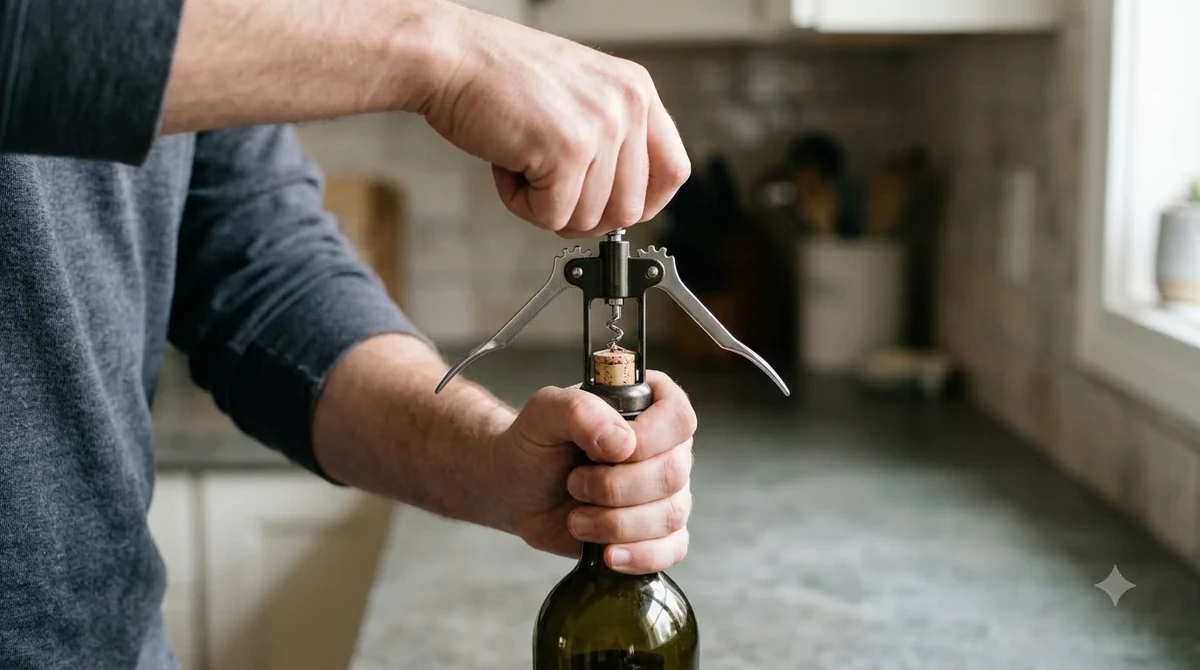
OXO’s product information describes a gear-driven mechanism that raises the wings as the screw moves deeper into the cork. Once the screw is properly inserted, pressing both wings downward lifts the cork out of the bottle. This familiar arrangement gives users a visible indication of how far the screw has traveled and when the extraction step is ready to begin.
The construction combines die-cast zinc and stainless steel, according to the manufacturer. These materials give the opener a substantial feel compared with lightweight plastic alternatives. The soft turning knob adds a different type of material where the hand makes direct contact, providing a more secure grip during rotation.
| Specification | Published information | Practical significance |
|---|---|---|
| Product name | OXO Steel Winged Corkscrew | Manual wing-style opener |
| Manufacturer SKU | 1058011 | Useful for identifying the listed product |
| Dimensions | 1.5 x 3 x 7.875 inches | Manufacturer-listed measurements |
| Main materials | Die-cast zinc and stainless steel | Metal construction for everyday handling |
| Screw design | Coated wire screw | Designed to travel through the cork |
| Extraction mechanism | Gear-driven wings | Provides leverage for cork removal |
| Turning control | Soft nonslip knob | Helps maintain a secure grip |
| Foil preparation | Detachable cutter | Provides convenient bottle-top preparation |
| Cleaning | Hand-wash only | Requires manual cleaning |
One useful detail is the extended body. Sur La Table describes this design as providing additional stabilization while opening a bottle. That matters because a winged corkscrew needs to remain reasonably centered over the bottle neck while the screw enters the cork. A stable position can make the entire process feel more controlled, particularly for someone who does not regularly use this type of opener.
The detachable foil cutter is another practical feature. Instead of requiring a separate accessory stored in a drawer, the cutter can be removed from the base and returned to its storage position afterward. This arrangement keeps two bottle-opening tasks together and makes the opener convenient to store with other bar accessories.
OXO also describes the product as substantial in the hand. That characterization is consistent with the metal construction, although the added weight will appeal more to some users than others. A person who prefers a lightweight pocket-sized corkscrew may find the overall design less convenient.
For additional product information, the official OXO Steel Winged Corkscrew specifications explain the mechanism and identify its construction materials.
What Owners Like
Owner feedback generally highlights ease of operation, a sturdy feel, and the usefulness of the winged extraction mechanism. These characteristics make the OXO corkscrew particularly appealing to people who want a straightforward opener for regular household use.
One frequently appreciated feature is the turning knob. A wine corkscrew requires controlled rotation, especially when the cork is relatively firm or tightly fitted. A smooth knob with a nonslip surface gives the user a more comfortable contact point than a narrow metal handle. It also makes the twisting motion easier to control without having to grip a small component with the fingertips.
The curved wings receive positive attention as well. Their broad surfaces provide room for the hands to apply downward pressure during extraction. Compared with a compact waiter-style opener, the winged design makes the leverage mechanism more visible and intuitive. Users do not need to learn how to position a small hinged lever against the bottle rim.
Bloomingdale’s customer feedback includes multiple positive descriptions of the opener as easy to operate, smooth, and substantial. Some reviewers also appreciate the impression of sturdiness provided by its heavier construction. These comments suggest that the overall design works well for people who prefer a solid-feeling kitchen or bar tool.
Another advantage is the self-centering screw described by Sur La Table. Keeping the screw aligned with the cork is important because a sharply angled insertion can increase the chance of damaging the cork. A design intended to guide the screw into position can make the initial step less intimidating for beginners.
Convenience for regular wine opening
The OXO design is particularly convenient when opening several bottles during a dinner or gathering. Once the foil has been removed, the user can position the opener, rotate the knob, and press the wings downward. The same basic sequence works for each bottle, so there is little need to remember complicated instructions.
The detachable cutter also reduces the number of separate tools required during preparation. Keeping it with the corkscrew means that the two main opening accessories can be stored together. This is useful for households that keep their wine glasses, bottle stoppers, and serving accessories in one dedicated location.
OXO’s extended body and curved handles also help make the opener feel less like a small precision instrument and more like a substantial countertop accessory. People who prefer a stable grip may appreciate this design, particularly when opening bottles with firm natural corks.
The winged mechanism is another practical advantage for users who have limited experience with wine accessories. Rather than pulling a cork directly with a short lever, the opener uses the movement of its two arms to provide additional mechanical advantage. The user can see when the screw has entered the cork and when the extraction stage is ready.
For a home bar that includes several wine accessories, the OXO opener also fits naturally alongside glassware, serving tools, and bottle stoppers. A dedicated bar cart can keep these items organized and accessible without requiring a large amount of cabinet space.
Common Complaints
The most notable drawbacks in owner feedback concern weight, bulk, and inconsistent durability experiences. Although the metal construction can feel reassuring, a heavier opener is not automatically more comfortable or convenient for every household.
Some Bloomingdale’s reviewers describe the OXO Steel Winged Corkscrew as heavier than expected. One owner specifically found its weight inconvenient, while another initially considered it bulky before finding the opening process comfortable. This difference illustrates an important distinction: a substantial feel can be a positive feature for one buyer and an unnecessary burden for another.
Storage is another consideration. A winged corkscrew naturally occupies more room than a compact waiter-style opener because its handles extend outward. The OXO model also includes a detachable foil cutter, which adds another component to its overall design. People with limited drawer space or a very small bar setup may prefer something more compact.
Mixed experiences with durability
Long-term reliability is another area where feedback is not entirely consistent. Some owners describe the opener as sturdy and well made, while others report mechanical problems after relatively limited use.
Bloomingdale’s published customer feedback includes a complaint from an owner whose screw reportedly broke during use after a few months. Other reviewers express satisfaction with the construction and describe the tool as solid. These individual experiences do not establish a general failure rate, but they do show that durability should not be assumed solely from the product’s metal appearance.
The screw is particularly important because it performs the central job of the corkscrew. If it bends, becomes damaged, or stops engaging with the cork properly, the entire opening process becomes difficult. Users should avoid forcing the knob when resistance becomes unusually high.
Occasional cork-removal difficulties
Some owner comments across retailer feedback describe corks becoming difficult to remove from the screw after extraction. This can be frustrating because the bottle may be open while the cork remains attached to the opener.
A winged opener depends on the screw entering the cork at a suitable depth and maintaining its alignment. If the screw travels too far or the cork is unusually soft, extraction and release can become less convenient. A damaged, brittle, or previously compromised cork may also behave differently from a firm, intact natural cork.
The foil cutter is useful, but its presence does not eliminate every bottle-preparation problem. Users still need to position the cutter correctly and remove the foil before placing the opener over the cork. The detachable component also needs to be returned to its storage position after use so it does not become separated from the main tool.
Tip: If the corkscrew suddenly becomes difficult to turn, stop rather than applying excessive force. Check that the opener is centered, that the screw is entering the cork correctly, and that the cork itself is not damaged. Forcing a misaligned screw can make removal harder and may damage the cork or mechanism.
Overall, these complaints do not make the OXO a poor choice, but they are relevant for buyers who prioritize a lightweight design, minimal storage requirements, or a particularly simple mechanism. The product’s strongest characteristics are its grip and winged operation; its weight and mixed durability feedback are the main reasons to consider alternatives.
Who Should Buy and Who Should Skip
The OXO Steel Winged Corkscrew makes the most sense for home wine drinkers who want a traditional opener with a comfortable turning knob and visible leverage mechanism. It is less appealing to people who prioritize compact storage, minimal weight, or a different opening style.
For occasional wine drinkers, the two-stage mechanism offers a relatively simple way to open standard bottles. There is no battery to charge, electrical component to maintain, or complicated operating sequence to learn. The user only needs to position the opener, turn the knob, and press the wings downward.
It is also a sensible consideration for households that entertain regularly. The curved handles and integrated foil-cutter storage help make repeated bottle opening more convenient. Someone preparing several bottles for a dinner party may appreciate having the cutting and extraction tools in one place.
Good candidates for this corkscrew
- First-time wine accessory buyers: The visible wing mechanism makes the opening process relatively easy to understand.
- Regular home wine drinkers: The manual construction is convenient for routine bottle opening.
- Hosts and entertainers: The detachable foil cutter helps consolidate bottle-preparation accessories.
- People who like substantial tools: The zinc and stainless steel construction provides a solid feel.
- Traditional winged-opener fans: The design follows a familiar operating method rather than introducing a new mechanism.
For someone setting up a first home bar, the OXO can serve as a dedicated wine opener alongside a bottle stopper, wine glasses, and a decanter. It does not require special storage conditions, and its manual mechanism remains available without electrical power.
Who should consider another design?
Buyers who want a compact opener for travel or occasional outdoor use may prefer a smaller alternative. A waiter-style corkscrew generally takes up less room and can fit into a kitchen drawer more easily. Its folding construction also makes it convenient for people who want to carry a wine opener with picnic supplies.
People who dislike heavy kitchen tools should also consider a lighter model. The OXO’s substantial construction is one of its recognizable characteristics, but it is not necessarily an advantage if the opener will be stored in a crowded drawer or handled by someone who prefers a smaller grip.
Buyers who frequently open older bottles with fragile corks may want to consider a specialized opener rather than relying exclusively on a conventional winged screw. A traditional corkscrew can sometimes cause a deteriorating cork to crumble or break during extraction. A two-pronged cork puller is a different option for certain delicate corks.
Anyone who prefers a more automated opening process may also find a lever-style or electric wine opener more suitable. These designs use different mechanisms and can reduce the amount of manual turning required, although they introduce their own storage and maintenance considerations.
Readers comparing several traditional opening mechanisms can also explore our best rabbit corkscrew guide to understand how lever-based alternatives differ from winged designs.
How It Compares to Alternatives
The OXO Steel Winged Corkscrew occupies a middle ground between basic manual openers and more elaborate lever-operated designs. Its biggest advantage is the combination of a familiar winged mechanism, comfortable grip points, and a detachable foil cutter.
Choosing between corkscrew styles is less about finding one universally superior mechanism and more about identifying the type of opening experience that suits a household. The OXO is designed around visible mechanical leverage, while other styles rely on different combinations of rotation, pulling force, and handle positioning.
Winged corkscrew versus waiter-style corkscrew
A waiter-style corkscrew is a compact tool with a folding screw, a small handle, and a hinged lever that rests against the bottle neck. It is popular with restaurant professionals because it is portable and relatively straightforward once the user learns the technique.
The OXO winged design offers a different experience. Its two raised arms provide a more visible leverage system, and the broad turning knob gives the hand a larger contact surface. This can be more approachable for people who do not regularly use wine openers.
However, the waiter-style design is usually easier to store in a narrow drawer or carry in a bag. It also requires less counter space during use. For someone who values portability more than a large turning grip, the smaller design may be more practical.
Winged corkscrew versus lever-style opener
A lever-style corkscrew uses a longer handle and a different mechanical arrangement to insert and extract the screw. Depending on the model, the user moves the lever through one or more motions rather than pressing two wings downward.
The OXO winged opener is more traditional in appearance and operation. Its mechanism is relatively easy to understand because the rising arms show the progress of the screw. A lever-style model may be preferable for someone who wants a more controlled pumping or pulling motion.
Neither approach eliminates the importance of proper positioning. A corkscrew should remain centered on the bottle opening, and the screw should enter the cork without unnecessary sideways movement. These basic principles matter regardless of the mechanism.
Winged corkscrew versus electric opener
An electric wine opener is designed to reduce manual effort by using a powered motor to engage and extract the cork. This can be attractive for households that open wine frequently or prefer a push-button operating process.
The OXO has a different set of advantages. It does not need charging, a power outlet, or a battery replacement schedule. Its operation is mechanical, and its overall design is more straightforward than an electric device.
Electric models can also occupy more vertical storage space and introduce additional components that may require maintenance. A manual opener is generally simpler to keep ready for occasional use.
For readers who are still comparing traditional mechanisms, our rabbit corkscrew reviews provide another useful starting point for understanding the differences between winged and lever-operated designs.
Choosing the right opening mechanism
Consider how often wine is opened, where the tool will be stored, and how much manual effort is comfortable. A compact waiter-style opener is a practical choice for portability, a winged opener is convenient for familiar leverage-based operation, and an electric model prioritizes powered extraction.
The OXO is particularly appropriate when the winged mechanism itself is part of the appeal. Its curved handles, nonslip knob, and detachable cutter provide useful features without changing the basic operating method. It is not a universal replacement for every corkscrew style, but it covers the needs of many standard household wine-opening situations.
Frequently Asked Questions
Can the OXO Steel Winged Corkscrew open bottles of olive oil?
Yes. Sur La Table specifically describes the opener as suitable for many cork-closed oil and vinegar bottles as well as wine bottles. The bottle opening still needs to be compatible with the tool’s base, so unusually narrow or irregular closures may not work as conveniently.
Does the OXO corkscrew include a bottle opener for beer?
The Steel Winged Corkscrew’s listed accessory is a detachable foil cutter, not a separate beer bottle opener. OXO also sells other winged corkscrew designs with different features, so buyers should distinguish the Steel model from the Good Grips version before choosing one for multiple bottle-opening tasks.
Can the OXO Steel Winged Corkscrew be used with synthetic corks?
OXO describes its coated wire screw as suitable for cork insertion, while Sur La Table identifies the self-centering worm as compatible with different cork types. Synthetic corks can feel firmer or more resistant than some natural corks, so steady alignment and controlled rotation remain important.
Does the OXO Steel Winged Corkscrew require assembly?
Sur La Table lists one winged corkscrew in the package rather than a collection of components requiring a separate assembly process. The foil cutter is removable for use and storage, but it is designed as part of the opener’s integrated arrangement.
Can the OXO Steel Winged Corkscrew be used in a professional restaurant?
It can open standard cork-closed wine bottles in a hospitality setting, but its larger winged construction may be less convenient for servers who need to carry a compact opener throughout a shift. A folding waiter-style corkscrew is generally more practical for a uniform pocket or apron.
The OXO Steel Winged Corkscrew is a practical manual wine opener with a comfortable turning knob, visible leverage mechanism, and convenient detachable foil cutter. Its substantial construction and straightforward operation make it a worthwhile option for many home bars, although its weight, storage footprint, and mixed durability feedback deserve consideration. Buyers who enjoy traditional winged corkscrews and want a more substantial everyday tool will find its design appealing, while those prioritizing portability may prefer a compact alternative.
More in Wine Accessories
 Coravin Vs Vacu Vin: Choose the Right Wine Saver for Your BottlesUpdated Nov 21, 2026
 Zwilling Wine Stopper Review: Preserve Open Bottles LongerUpdated Nov 21, 2026
 Wine Enthusiast Wine Preserver Review: Features, Benefits and LimitationsUpdated Nov 21, 2026
 Wine Enthusiast Wine Stopper: An Easier Way to Reseal Open BottlesUpdated Nov 21, 2026
 Vintorio Wine Opener: Two-Step Cork RemovalUpdated Nov 21, 2026
 Zwilling Wine Aerator Review: Aerate, Pour, and Seal With One ToolUpdated Nov 21, 2026