

We may earn a commission when you buy through links on this page, at no extra cost to you. Learn more.
The stanley wine tumbler is a good choice for keeping wine cold during outdoor gatherings, casual dinners, and everyday use, thanks to its stainless-steel construction and double-wall vacuum insulation. The 10-ounce GO Everyday model stands out for its comfortable shape, convenient drink-through lid, and strong cold-retention performance. Its biggest limitation is that the lid is not leakproof, so it works better on a patio table than inside a packed bag. Stanley also offers the newer 11-ounce Reserve version, which adds a sliding lid, silicone base, and stackable design.
Insulated wine tumblers occupy a useful middle ground between traditional stemware and travel mugs. They are easier to take outside than fragile wine glasses and help maintain serving temperature longer than ordinary drinking glasses. Stanley has several options in this category, and understanding the differences between the Everyday GO and Reserve designs is important before choosing one. This review examines their practical features, owner feedback, insulation performance, and suitability for different wine-drinking occasions.
Stanley Wine Tumbler Verdict and Key Features
The Stanley GO Everyday Wine Tumbler earns its strongest marks for insulation, comfortable handling, and straightforward construction. It is particularly appealing for people who want a compact stainless-steel vessel for chilled wine without the bulk of a large handled travel cup.

The GO model holds 10 ounces and uses 18/8 stainless steel with double-wall vacuum insulation. Its rounded but relatively slim profile feels more like a conventional stemless wine glass than a large hydration tumbler. A press-fit Tritan lid covers the opening while leaving a drinking channel accessible, allowing the user to sip without removing the entire top.
That design makes the cup convenient for a backyard dinner, a picnic table, or an outdoor concert. The insulation helps chilled Sauvignon Blanc, Pinot Grigio, and sparkling wine remain cooler than they would in an ordinary glass. It also reduces condensation on the outside, which is useful when the tumbler sits on a wooden table or outdoor furniture.
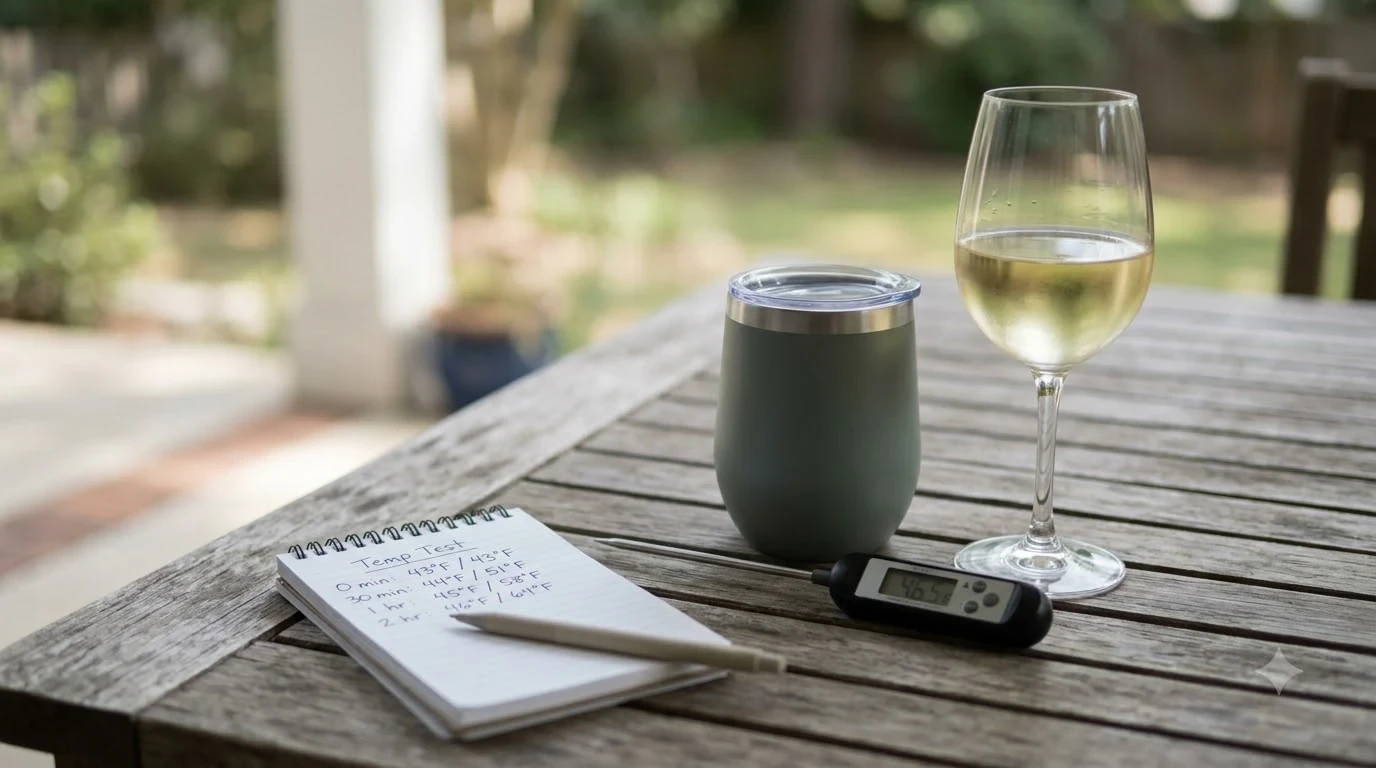
Independent testing provides a particularly useful indication of its performance. Serious Eats compared 13 insulated wine tumblers using chilled Sauvignon Blanc, ice, hourly temperature readings, handling assessments, drop tests, and leak checks. The Stanley Everyday GO finished first among the models without a sliding lid. It reached 32.9 degrees Fahrenheit after one hour and recorded 41.1 degrees after four hours in that specific test.
Those results are encouraging, although they should not be interpreted as a guarantee that every wine will maintain those temperatures. Starting temperature, ambient conditions, ice, serving volume, and how often the lid is removed all influence the result. The test does establish that the Stanley’s construction performs well against a substantial group of competing insulated wine cups.
The central compromise is the drinking opening. The press-fit lid helps limit splashes, but it does not close completely. If the tumbler tips over, liquid can escape through the drinking channel or around the lid. Buyers who expect a sealed travel container should consider a different lid design.
Stanley’s newer Reserve Wine Tumbler offers another approach. Its 11-ounce capacity, sliding lid, silicone base, and stackable construction make it a more feature-focused alternative. The two designs share the general goal of keeping wine at a pleasant temperature, but their lids and handling characteristics differ enough to influence which one makes more sense.
Specs and Key Features
The Stanley GO Everyday is a compact insulated cup rather than a large wine vessel. Its 10-ounce capacity, stainless-steel body, and removable lid make it practical for an individual serving, while the insulation helps preserve chilled drinks over an extended period.
| Specification | GO Everyday | Reserve |
|---|---|---|
| Capacity | 10 oz | 11 oz |
| Construction | 18/8 stainless steel | 18/8 recycled stainless steel |
| Insulation | Double-wall vacuum | Double-wall vacuum |
| Lid | Press-fit Tritan | Sliding lid |
| Base | Non-skid design | Silicone base |
| Dishwasher safe | Yes | Yes |
| BPA-free | Yes | Yes |
| Stackable | Not specified | Yes |
The GO’s 10-ounce capacity is a sensible size for wine. A standard wine serving is 5 ounces, so the cup can accommodate a measured pour with enough additional room to avoid filling it to the rim. That also leaves space for a few ice cubes if someone prefers a chilled wine cocktail rather than an undiluted glass of wine.
The Reserve adds a little more capacity without becoming a particularly large drinking vessel. Its 11-ounce interior can accommodate a generous pour while leaving room for the lid and drinking clearance. The silicone base is another practical distinction because it helps protect surfaces and gives the tumbler a more stable contact point.
One important difference concerns the lid. The GO uses a press-fit design, while the Reserve uses a sliding closure intended to reduce splashes. Neither should automatically be treated as a completely sealed bottle. The word splash-proof describes a different level of protection from a leakproof closure that remains secure when a filled cup is turned upside down.
The temperature-retention figures associated with the GO are also worth understanding. Stanley’s published specifications state up to 1.5 hours for hot drinks, 5 hours for cold drinks, and 20 hours for iced drinks. These are different test conditions, not interchangeable promises. Ice remaining in a vessel for 20 hours does not mean wine without ice will remain at its original serving temperature for the same period.
For wine drinkers, cold retention is the most relevant specification. The independent Serious Eats test offers a useful real-world comparison because it measured the temperature of wine rather than relying exclusively on general insulation claims. Its findings support the GO as a strong performer for chilled beverages.
What Owners Like About the Stanley Wine Tumbler
Owner feedback consistently points toward three appealing qualities: convenient size, effective insulation, and easy everyday handling. These characteristics make the Stanley a practical alternative to ordinary glassware for people who regularly drink wine outdoors.
The first advantage is the compact shape. A 10-ounce tumbler is easier to hold than many oversized insulated cups, and its lower profile feels appropriate for a wine-serving occasion. The absence of a handle also makes it easier to pass around a table or carry alongside a plate of food.
Customers discussing the GO model frequently mention its comfortable grip and manageable weight. Backcountry lists a claimed weight of approximately 8 ounces, making it a relatively light stainless-steel drinking vessel. That is useful when carrying several cups to a picnic or setting up an outdoor dinner.
Insulation is another recurring positive. Customers describe using the cup for chilled wine, sparkling water, and other cold drinks. The double-wall construction reduces the temperature exchange between the beverage and surrounding air, while the exterior stays more comfortable to hold than an uninsulated metal cup containing ice.
The silicone or nonslip bottom on versions that include it is also appreciated. A stable base is useful when placing a drink on a patio table, kitchen counter, or picnic surface. It can reduce sliding and help protect the surface from direct contact with the metal body.
Cleaning is another practical strength. The GO has a comparatively simple two-piece construction: the cup and removable lid. There are fewer small components to take apart than on some complicated travel lids, and the dishwasher-safe specification makes routine cleanup easier.
For households that use one cup for several beverages, the versatility is appealing. The GO can accommodate wine, cocktails, water, and coffee. However, using a single cup for every beverage may not be ideal for people who are particularly sensitive to lingering aromas. Washing thoroughly between drinks is sensible, especially after strongly flavored cocktails or coffee.
The Stanley design also appeals to people who already own other products from the brand. Matching colors and a recognizable exterior make the wine tumbler an easy addition to an existing collection. That visual consistency may matter to gift buyers who want a coordinated set of drinkware rather than a traditional wine-glass gift.
There is a practical advantage to using stainless steel at outdoor gatherings, too. Unlike conventional wine glasses, the tumbler does not have a fragile stem or thin bowl that can break easily when knocked over. It is not indestructible, but it is better suited to casual outdoor settings where ordinary glassware may be inconvenient.
For someone who frequently hosts backyard dinners, the combination of compact dimensions, cold retention, and reusable construction makes a convincing case. It is a functional cup first, with the recognizable Stanley appearance as an additional attraction.
Common Complaints and Design Limitations
The biggest drawback of the Stanley GO is its lid, not its insulation. The drink-through opening remains accessible, which makes sipping easy but leaves the tumbler vulnerable to spills, insects, and exposure to warm air.
Serious Eats specifically reported leakage when the GO was tilted 90 degrees during its testing. The lid was not designed to function as a fully sealed travel closure. That distinction matters for people who plan to carry a filled tumbler inside a backpack, beach bag, or picnic basket.
Some owners also wish the drinking opening could be covered completely. This is a reasonable concern at outdoor events, where insects can be attracted to sweet wine, fruit garnishes, and cocktail ingredients. A permanently open sipping channel cannot provide the same protection as a fully closing lid.
The lid can also require a little attention when replacing it. Serious Eats found that pressing the one-piece Tritan lid back into position was slightly finicky. The issue is not particularly complicated, but it is less convenient than a lid that attaches with a simple threaded or hinged mechanism.
Another consideration is the drinking experience. Wine glasses have a thin rim and a shape designed around the way wine is served and evaluated. A stainless-steel tumbler offers a different sensation against the lips, and some wine drinkers simply prefer glass.
This difference matters most with wines where aroma and presentation are important. A delicate Pinot Noir or aromatic Riesling can still be enjoyed from stainless steel, but the tumbler does not provide the same visual access to color or the same bowl shape as traditional stemware.
There are also practical limitations around capacity. Ten ounces sounds generous, but it does not mean the user should fill the vessel to the top. A 5-ounce serving leaves useful headroom, while a large pour combined with ice can make the drinking opening crowded.
Carrying dimensions deserve attention as well. The GO is more compact than a large handled tumbler, but it should not automatically be assumed to fit every vehicle’s cup holder. Cup-holder dimensions vary, and the widest part of the cup can be more important than its height.
Finally, the exterior finish deserves ordinary care. Stainless steel is durable, but painted or decorative finishes can still become scratched through rough handling, contact with abrasive objects, or unsuitable cleaning methods. Buyers choosing a particular color should consider how the cup will be stored and transported.
These drawbacks do not make the GO a poor wine tumbler. They simply establish its intended role: a reusable cup for upright drinking rather than a sealed container for careless transport.
Who Should Buy the Stanley Wine Tumbler?
The Stanley GO is best suited to people who want cold wine in a durable, compact cup and expect to keep that cup upright most of the time. Outdoor dining, backyard entertaining, camping, and casual gatherings are its strongest use cases.
For a patio dinner, the 10-ounce capacity works particularly well. Pouring a measured 5-ounce serving of chilled Chardonnay or Sauvignon Blanc leaves enough room to drink comfortably without bringing the liquid close to the lid. The double-wall insulation helps slow warming while the drink sits between sips.
It is also a sensible choice for casual events where traditional glassware is inconvenient. At a picnic, for example, a stainless-steel tumbler is easier to transport and less vulnerable to breakage than a set of stemmed glasses. The compact shape makes it practical to carry alongside food and other outdoor supplies.
People who enjoy chilled white wine, rosé, and sparkling wine will probably appreciate the insulation most. These styles are generally served cool, and a double-wall tumbler helps slow the temperature increase that happens when a drink sits in warm surroundings.
Light reds can also work. A Pinot Noir or Gamay served slightly chilled is comfortable in an insulated cup, especially during an outdoor meal. For fuller reds such as Cabernet Sauvignon, some drinkers may prefer a traditional glass because the larger bowl and open rim make swirling and aroma assessment easier.
Buyers who want a more protective lid should consider the Reserve. Its sliding closure is intended to help prevent splashes, and the silicone base offers additional stability. The extra ounce of capacity and stackable construction are useful differences for people who keep several cups together.
On the other hand, serious wine enthusiasts who prioritize aroma, visual presentation, and traditional tasting technique may prefer conventional stemware. A stainless-steel cup is not a substitute for every wine glass. It is a convenience-oriented alternative designed for occasions when breakage, temperature changes, or portability matter more.
There are also people who should skip the GO entirely. Anyone who needs a truly leakproof vessel, plans to carry wine in a closed bag, or wants to prevent insects from entering through the drinking opening should look at a different closure design.
Tip: For outdoor white wine service, chill the wine before pouring rather than relying on the tumbler to cool a warm bottle. Serve light whites and rosé around 45–50 degrees Fahrenheit, and use a measured 5-ounce pour to leave enough room for comfortable sipping.
Gift buyers have another reason to consider the Stanley. The distinctive shape and color options make it a useful present for someone who enjoys outdoor entertaining or already collects reusable drinkware. A personalized alternative may be more appropriate when the recipient values an individual design or a matching set, so consider a wine tumbler personalized option when appearance is the main priority.
How It Compares to Other Wine Tumblers
The Stanley GO is particularly strong in cold retention and straightforward handling, but it is not the only design worth considering. Competitors offer different combinations of capacity, closure mechanisms, insulation, and drinking comfort.
The most useful comparison is with the Stanley Reserve, CamelBak Horizon, and YETI Rambler wine tumbler. Each takes a slightly different approach to the balance between portability and comfortable wine service.
Stanley GO vs. Stanley Reserve
The GO is the simpler design, with a 10-ounce capacity and press-fit lid. Its main attraction is its straightforward shape and strong cold-retention performance. It is a good fit for someone who mainly drinks at a table and wants an uncomplicated cup.
The Reserve increases capacity to 11 ounces and adds a sliding lid, silicone base, and stackable construction. These features make it more appealing for people who want additional splash protection and easier storage. Its 18/8 recycled stainless-steel body retains the general insulated construction found in the GO.
Stanley’s official product information describes the Reserve lid as splash-proof rather than fully leakproof. Buyers should still keep it upright during transport. You can compare the details of the Stanley Textured Reserve Wine Tumbler before deciding whether the extra features justify choosing it over the simpler GO.
Stanley GO vs. CamelBak Horizon
The CamelBak Horizon is a useful alternative for people who prefer a sliding lid. Serious Eats selected it as its preferred tumbler with a sliding cover. Its 12-ounce capacity is larger than the Stanley GO’s 10 ounces, and its three-position slider allows different drinking-flow settings.
The slider offers more control, but it does not eliminate every spill risk. Serious Eats found that the CamelBak leaked when tilted during its testing. Its advantage is a more adjustable drinking opening, not a completely sealed transport system.
Stanley GO vs. YETI Rambler
The YETI Rambler 10-ounce Wine Tumbler is another relevant comparison. Serious Eats found that it performed particularly well during one portion of its cold-retention test, although the wider, rounded exterior was less comfortable for some hands.
The same comparison identified concerns about dents and the absence of a silicone base. The Stanley GO had a more comfortable profile in the testers’ assessment and resisted visible damage during their drop test. The choice therefore depends on whether a buyer values a particular lid design, hand comfort, and construction details more than a single insulation result.
For a broader overview of available designs, the wine tumbler with lid category is a useful starting point. It helps distinguish simple press-fit covers from sliding closures and more secure mechanisms.
Serious Eats provides a particularly helpful comparison because its evaluation included the Stanley, CamelBak, YETI, and several other popular designs under the same test conditions. Its insulated wine tumbler comparison also explains why a lid’s presence alone does not determine whether a cup will resist leaks or maintain a low beverage temperature.
Overall, the Stanley GO makes the most sense for straightforward cold-drink service. The Reserve is a more feature-rich Stanley option, while CamelBak and YETI offer worthwhile alternatives for shoppers who prefer different lid arrangements or exterior shapes.
Cleaning, Care, and Everyday Storage
Taking care of an insulated wine tumbler is relatively simple, but the lid and exterior deserve attention. Regular cleaning helps prevent wine residue, sticky cocktail ingredients, and lingering aromas from accumulating between uses.
The GO Everyday is listed as dishwasher-safe, which makes routine maintenance convenient. Removing the lid before cleaning allows both components to receive attention. Owners who prefer handwashing can use warm water, ordinary dish soap, and a soft sponge to clean the interior and exterior.
Pay particular attention to the drinking channel and the areas where the lid meets the rim. Small amounts of wine can remain around these surfaces after a pour, especially when the beverage contains sugar or fruit. Rinse the lid thoroughly rather than wiping only the visible surface.
The Reserve is also listed as dishwasher-safe. Its sliding lid deserves additional inspection because the moving closure can collect residue around its edges. Keeping the slider clean helps preserve smooth operation and prevents sticky deposits from building up over time.
Although dishwasher-safe construction is convenient, abrasive pads and harsh cleaning tools are unnecessary. They can damage decorative finishes or leave scratches. A soft cleaning cloth is generally sufficient for ordinary maintenance.
Dry the tumbler thoroughly before placing it in a cabinet or storing it with other drinkware. This is particularly useful when the lid has been washed separately. Allowing moisture to remain trapped in a closed vessel is an avoidable source of unpleasant odors.
For storage, the Reserve has a useful advantage because Stanley specifically identifies its construction as stackable. That can save cabinet space when several matching cups are stored together. The GO should be stored according to its actual shape rather than assumed to have the same stacking capability.
Temperature preparation also makes a difference. Chill white wine and rosé in the refrigerator before serving. A tumbler is designed to slow warming, not rapidly reduce the temperature of a warm beverage.
For light whites and rosé, a serving range of 45–50 degrees Fahrenheit is a practical starting point. Full-bodied whites such as oaked Chardonnay generally benefit from a slightly warmer range of 50–55 degrees. Sparkling wine is typically served colder, around 40–50 degrees.
Red wine can also be served in the tumbler, but temperature still matters. Light reds such as Pinot Noir are often more enjoyable around 55–60 degrees, while fuller reds are commonly served around 60–65 degrees. Insulation helps reduce rapid temperature changes, but it does not replace proper preparation.
For anyone who prefers traditional wine presentation at home but wants an insulated alternative outdoors, a stemless wine tumbler is another useful category to compare. The main difference is whether the design prioritizes conventional glassware appearance or the practical advantages of insulated stainless steel.
Finally, keep the tumbler upright when carrying it. This is especially important for the GO, whose press-fit lid does not provide a leakproof closure. Treating the cup as a reusable drinking vessel rather than a sealed bottle is the simplest way to avoid disappointing spills.
Frequently Asked Questions
Does a Stanley wine tumbler change the taste of wine?
Stainless steel is generally considered a neutral material for beverage containers, and the Stanley’s 18/8 construction is designed for everyday drinkware use. However, a metal rim feels different from the thin rim of a traditional wine glass, which can affect the drinking experience even when the beverage itself is unchanged.
Can the Stanley wine tumbler hold sparkling wine?
Yes. The tumbler can hold sparkling wine, including Prosecco and Champagne, and its insulated construction is useful for maintaining a cool serving temperature. Pour gently because sparkling wine produces foam, and leave sufficient headroom to accommodate the bubbles.
Can the Stanley wine tumbler be used for wine cocktails?
Yes. Its stainless-steel construction and insulated walls make it suitable for chilled spritzes, sangria, and other wine-based cocktails. Drinks containing citrus, fruit pieces, or added sweeteners should be rinsed out promptly after use to prevent sticky residue around the drinking opening.
Does the Stanley wine tumbler have a removable base?
The Stanley Reserve includes a silicone base as part of its construction, while the GO is described with a nonslip bottom on applicable versions. These features should not be confused with a removable replacement base, which is a separate design consideration when comparing insulated cups.
Can the Stanley wine tumbler be used for wine tasting events?
It can be used for casual wine events, outdoor tastings, and informal gatherings. However, professional tasting commonly relies on clear stemmed glasses because they make it easier to assess color, swirl wine, and evaluate aromas. The Stanley is better suited to convenient drinking than formal sensory evaluation.
The Stanley wine tumbler is a practical choice for anyone who wants insulated drinkware that is compact, durable, and comfortable to use outdoors. The GO Everyday offers particularly strong cold-retention performance, while the newer Reserve adds a sliding lid and stackable design for people who want additional convenience. Choose the GO for straightforward everyday sipping or the Reserve for its extra features, and remember that neither should be treated as a guaranteed leakproof travel container.
More in Wine Accessories
 Zwilling Wine Stopper Review: Preserve Open Bottles LongerUpdated Nov 21, 2026
 Wine Enthusiast Wine Preserver Review: Features, Benefits and LimitationsUpdated Nov 21, 2026
 Wine Enthusiast Wine Stopper: An Easier Way to Reseal Open BottlesUpdated Nov 21, 2026
 Vintorio Wine Opener: Two-Step Cork RemovalUpdated Nov 21, 2026
 Zwilling Wine Aerator Review: Aerate, Pour, and Seal With One ToolUpdated Nov 21, 2026
 Zazzol Wine Opener Review: Features, Comfort, and Buying AdviceUpdated Nov 21, 2026