

We may earn a commission when you buy through links on this page, at no extra cost to you. Learn more.
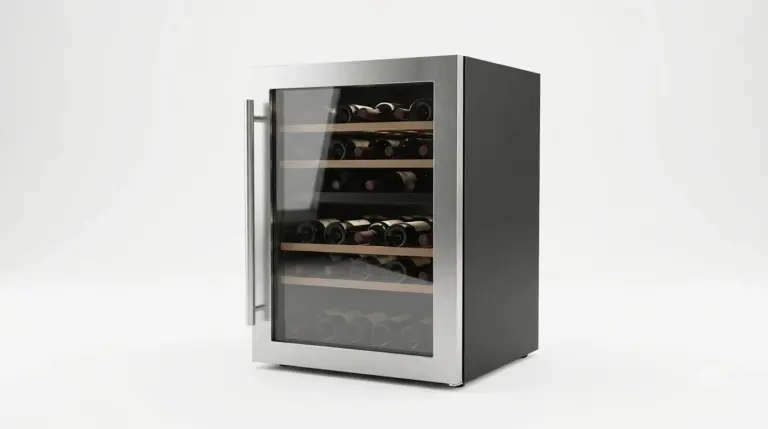
A EuroCave wine fridge is a French-made, cellar-grade storage cabinet engineered to hold steady temperature, active humidity, and low vibration for multi-decade bottle aging. Built in France since 1976, the brand targets collectors storing 74 to 182+ bottles rather than casual shoppers looking for a compact kitchen beverage cooler. Across lines like La Première, Pure, Revelation, and Royale, EuroCave pairs insulated aluminum interiors with adjustable rolling shelves and charcoal air filtration to mimic an underground limestone cellar.
While many mass-market wine coolers focus on slim under-counter footprints and quick chilling for weeknight pours, EuroCave builds furniture-grade cabinets meant to protect valuable vintages for 15 to 20 years or longer. Understanding how each collection manages humidity, single-zone versus dual-zone cooling, and real-world bottle capacity helps buyers choose the right model before committing to a heavy freight delivery.
EuroCave Brand Overview and French Heritage
EuroCave invented the self-contained wine maturation cabinet in France in 1976 to give collectors underground cellar conditions inside a standard home or restaurant. Every EuroCave manufacturing facility in Fourmies in northern France spans more than 5,000 square meters, where more than 38 pairs of hands assemble and inspect each cabinet before shipment.
The French government awarded EuroCave the Living Heritage Company (EPV) label in 2021 in recognition of its artisanal and industrial craftsmanship. Alongside its primary assembly plant in Fourmies, EuroCave Group also operates manufacturing in Pont de Chéruy, France, and markets a sister consumer line called ArteVino through select large retailers in France and the United States.
Unlike appliance conglomerates that badge-engineer refrigerators across dozens of factories, EuroCave focuses exclusively on wine preservation, cellar conditioners, and cigar humidors. Internally, cabinets use stucco-textured aluminum walls rather than molded plastic liners because aluminum conducts cold evenly, resists odors, and avoids emitting volatile organic compounds (VOCs) that can seep through natural corks over years of aging.
EuroCave Product Lines Explained
EuroCave divides its current residential and restaurant lineup into four core collections—La Première, Pure, Revelation, and Royale—plus specialized built-in and Champagne cabinets. All four core lines share French assembly, compressor cooling, UV-filtered doors, and Main du Sommelier (MDS) individual bottle cradles, while stepping up in lighting, humidity automation, and cabinet trim.
| Collection | Typical Capacity (750 ml Bordeaux) | Temperature Configuration | Humidity & Air System | Noise Rating | Key Distinguishing Features |
|---|---|---|---|---|---|
| La Première | 50 to 146 bottles (S, M, L sizes) | Single zone or multi-temperature | Passive thermal regulation, charcoal filter | ~37–38 dB(A) | Entry-level aging cabinet; solid or double-pane argon glass door |
| Pure | 74 to 182 bottles (S, M, L sizes) | Single zone (41°F–68°F) or Dual zone (41°F–52°F / 59°F–68°F) | Lava rock humidity cassette, digital hygrometer, charcoal filter | 38 dB(A) | Hot-cold heating/cooling circuit, amber LED header, 4 climate alarms |
| Revelation | Up to 182 bottles | Single zone (43°F–66°F) or multi-temperature | Humidity cassette, hygrometer, charcoal filter | ~37 dB(A) | Soft-close rolling shelves, full-perimeter interior LED light ring |
| Royale | Up to 124 bottles (Large only) | Maturing mode (pre-set 54°F) or Serving mode (43°F–65°F) | Autonomous Hygrocontrol (70% RH) + patented woven VOC filter | 34 dB(A) | Triple-glazed 99% UV glass, variable-speed compressor, numbered units |
In the EuroCave Pure L Wine Cellar specification sheet, the large single-zone model holds up to 182 standard Bordeaux bottles across 10 rolling shelves and 1 adjustable shelf, measuring 71.26 inches high by 26.75 inches wide by 29.52 inches deep with the handle installed. The dual-zone Pure L splits the cabinet into an upper white-wine and Champagne compartment adjustable from 41°F to 52°F and a lower red-wine compartment adjustable from 59°F to 68°F.
Collectors who want full-cabinet presentation lighting and soft-close shelf tracks step up to the Revelation series, while the flagship Royale collection replaces manual water cassettes with the autonomous Hygrocontrol system that maintains 70% relative humidity automatically when set to its 54°F (12°C) maturing mode. For shoppers comparing broader appliance makers across budget tiers, the Brand hubs directory outlines how dedicated cellar builders stack up against mainstream kitchen brands.
What EuroCave Does Well
EuroCave cabinets excel at thermal stability, quiet operation, and multi-decade component longevity that typical kitchen wine coolers rarely match. By pairing thick polyurethane insulation with both heating and cooling circuits, units like the Pure L maintain steady internal conditions even when placed in rooms where ambient temperatures swing between 32°F and 86°F.
Library-Quiet Vibration Control
Vibrations disturb sediment and accelerate chemical reactions in maturing reds such as Cabernet Sauvignon and Syrah. EuroCave isolates its compressors on shock-absorbing mounts and fits each cabinet with rubber-damped leveling feet, keeping sound output at 38 dB(A) on the Pure L and down to 34 dB(A) on the variable-speed Royale—roughly equivalent to a quiet library.
Main du Sommelier (MDS) Shelving
Each sliding steel frame carries removable rubberized bottle cradles that flex around slim Riesling flutes, standard 750 ml Bordeaux bottles, and wider Burgundy or Champagne bottles without letting glass clink together when a shelf rolls out 74% of its depth. Long-term owners on wine collector forums routinely report running the same EuroCave cabinet for 15 to 20 years with only annual charcoal filter swaps and occasional display battery changes.
Tip: Leave at least a 1-inch air gap between bottle bases and the interior back wall so cooled air circulates freely across the thermal plate and drains moisture into the rear evaporation channel.
Common Complaints and Real-World Limitations
Even with a reputation as the benchmark for home wine cabinets, verified buyer reviews and long-term collector threads highlight four recurring trade-offs that prospective buyers should plan for before ordering.
Real Bottle Capacity vs. Bordeaux Ratings
Like all wine cabinet manufacturers, EuroCave calculates maximum bottle counts—such as 182 bottles in the Pure L or 124 bottles in the Royale—using uniform, slim 750 ml Bordeaux bottles stacked neck-to-base. Once collectors load wider Pinot Noir, Chardonnay, Rhône, or Champagne bottles onto rolling MDS shelves, real capacity drops from 12 bottles per shelf to roughly 9 or 10 bottles per shelf, reducing usable total capacity by 15% to 25%.
Condensation in High-Humidity Climates
In humid regions such as coastal Texas, Florida, or Hawaii, owners report water droplets collecting along the aluminum rear wall or near the bottom filter tray during summer months, which can wrinkle paper labels if bottles touch the back liner. Keeping bottles spaced off the rear wall, minimizing door openings, and replacing the activated charcoal filter every 12 months prevents stagnant air and excess condensation.
Heavy Freight Delivery and U.S. Post-Warranty Parts
A Pure L cabinet weighs 298 pounds empty and 333 pounds crated, requiring two-person freight delivery that occasionally results in misaligned door handles or transit damage if carriers rush the setup. In addition, U.S. owners note that while warranty service through authorized distributors like Wine Enthusiast covers early issues, sourcing replacement control boards or display modules for 15-year-old cabinets out of warranty can be slow and expensive compared to simpler entry-level coolers—an important contrast when weighing is black and decker a good brand for smaller, easily replaced countertop units.
How to Choose the Right EuroCave Model
Selecting the right EuroCave wine fridge comes down to four practical measurements: realistic bottle count, temperature zoning, installation clearance, and door style. Matching these details to your collection prevents overpaying for unused capacity or cramming wider bottles onto fixed shelves.
Single-Zone Maturing vs. Dual-Zone Serving
Choose a single-zone cabinet set around 54°F to 55°F—the standard cellar aging range cited by EuroCave and Wine Enthusiast—if your main goal is aging red and white wines together over five or more years. Opt for a dual-zone cabinet—such as the EuroCave Pure L Dual Zone, which Wine Enthusiast lists with an upper compartment range of 41°F to 52°F for sparkling wines, Sauvignon Blanc, and Chardonnay and a lower compartment range of 59°F to 68°F for full-bodied reds—only if you want bottles ready to pour straight from the fridge without pre-chilling or warming on the counter.
Sizing Up for Burgundy Bottles and Ventilation
Because a 182-bottle Pure L—rated by Wine Enthusiast using standard 750 ml Bordeaux bottles—drops closer to 140 or 150 bottles in real-world owner reports on KnowWines once wider Pinot Noir, Rhône, and Champagne shapes are loaded, buyers with 120 bottles on hand usually benefit from sizing up to a Large cabinet rather than a Medium. Per Wine Enthusiast installation guidelines for freestanding EuroCave cabinets, leave at least 2 inches of ventilation clearance at the back, sides, and top unless purchasing a dedicated flush-fit built-in model engineered with front-venting airflow.
Solid Door vs. UV-Filtered Glass Door
A solid insulated door offers maximum thermal efficiency and total darkness for collectors storing high-value bottles in bright living spaces or basements. Glass doors—double-pane argon-filled on Pure and Revelation models, or triple-glazed with up to 99% UV filtration on the Royale—let you read labels without opening the door and letting warm room air rush inside. Shoppers comparing entry-level home appliances before stepping up to dedicated cellar cabinetry can also check is rovsun a good brand or is galanz a good brand to see how budget compact coolers differ in insulation and compressor design.
EuroCave Wine Cooler Manual Care and Maintenance
Routine upkeep outlined in the EuroCave wine cooler manual takes only a few minutes per season and keeps internal humidity and airflow within target specs. Neglecting basic filter or water-tray care is the most common reason older cabinets lose humidity or develop musty cellar odors.
Annual Charcoal Filter and Humidity Tray Upkeep
Replace the round activated charcoal air filter at the top of the cabinet once every 12 months so outside kitchen odors cannot pass through natural corks into aging wine. On Pure and Revelation models equipped with a lava-rock humidity cassette, long-term Performance and Pure owners note on KnowWines that adding roughly 2 ounces of distilled water when winter indoor heating drops relative humidity below 55% brings the cabinet back into the ideal 60% to 70% range.
Coil Cleaning and Door Gasket Checks
Once or twice a year, unplug the cabinet or switch it off briefly to vacuum dust from the rear condenser coils and wipe the magnetic door gasket with warm water so the seal stays airtight. Keep digital hygrometer and display backup batteries fresh—typically a standard coin cell or AA battery depending on the control panel generation—so temperature and humidity readouts remain visible during brief power interruptions.
Warranty and U.S. Support Coverage
Warranty terms on a EuroCave wine fridge vary significantly depending on whether you purchase through an authorized U.S. distributor or through European retail channels. Reviewing the exact coverage document before delivery avoids surprises years down the road.
According to Wine Enthusiast product documentation for the U.S. market, new EuroCave Pure cabinets sold in the United States include a 1-year parts and labor warranty plus a 5-year warranty covering sealed refrigeration system parts. By comparison, EuroCave’s European product listings state a 5-year warranty on standard collections and a 10-year manufacturer warranty on the flagship Royale cabinet, meaning U.S. buyers should register their serial number immediately upon delivery and confirm authorized local refrigeration technicians in their metro area.
Frequently Asked Questions
How much electricity does a full-size EuroCave wine fridge use per day?
Long-term owner measurements reported on KnowWines show a full-size EuroCave cabinet consumes roughly 0.8 kWh of electricity per day under normal indoor room conditions. Actual draw depends on ambient room temperature, door-opening frequency, and whether you choose a solid door or a glass door.
What refrigerant does a modern EuroCave wine cooler use?
According to Wine Enthusiast technical specifications for the EuroCave Pure L, current models use R600a (isobutane) refrigerant paired with a hot-cold heating and cooling circuit. R600a operates at lower pressure than older synthetic refrigerants while delivering high thermodynamic efficiency.
Can you stack bottles directly on top of each other on EuroCave rolling shelves?
Each Main du Sommelier rolling shelf is designed for a single layer of bottles resting in individual cradles, whereas fixed storage shelves allow double-stacking to reach maximum rated bottle counts. Wine Enthusiast owner reviews also recommend checking and tightening shelf rail screws periodically if rolling shelves carry heavy 1.5-liter magnums or thick sparkling bottles.
What is the difference between EuroCave and ArteVino wine cabinets?
As noted in KnowWines’ brand overview, EuroCave Group manufactures both EuroCave and ArteVino in France, positioning ArteVino as a streamlined, value-oriented sister brand with fewer shelf and trim configurations. Flagship EuroCave collections offer broader customization, finer humidity controls, and upgraded Main du Sommelier cradling.
Does a EuroCave wine cabinet work in an unheated garage?
According to Wine Enthusiast operating specs for the Pure L, EuroCave’s integrated heating and cooling system maintains internal cellar temperatures across ambient room conditions from 32°F to 86°F. However, placing a cabinet in an unconditioned garage where summer heat exceeds 86°F or winter temperatures drop below freezing will strain the compressor and void warranty coverage.
A EuroCave wine fridge represents a long-term appliance built for collectors who prioritize quiet operation, steady humidity, and multi-decade aging over low upfront cost. By accounting for real Burgundy bottle capacity, leaving proper ventilation clearance, and keeping up with annual charcoal filter replacements, owners can rely on a single cabinet to protect hundreds of bottles across decades of collecting.
More in Brand Hubs
 Icyglee Wine Fridge: Compare Capacities, Features and ModelsUpdated Nov 20, 2026
 Fomup Wine Fridge: Explore Models, Features, and Buying TipsUpdated Nov 20, 2026
 Aaobosi Wine Fridge: Compare Models and Choose the Right CoolerUpdated Nov 20, 2026
 Orymuse Wine Fridge Reviews: Compare Capacities, Features and WarrantyUpdated Nov 20, 2026
 Tylza Wine Fridge: Find the Right Cooler for Your CollectionUpdated Nov 20, 2026
 Vintec Wine Fridge: Features, Warranty, and Buying AdviceUpdated Nov 20, 2026