

We may earn a commission when you buy through links on this page, at no extra cost to you. Learn more.
How cold should a wine cellar be? Keep it at approximately 55°F, with an ideal target range of 53°F to 57°F, for consistent long-term wine storage. This temperature works for red, white, rosé, sparkling, and fortified wines, so a mixed collection generally does not need separate storage temperatures. Maintaining stable conditions, controlling humidity, and protecting bottles from sunlight and vibration are just as important as choosing the right thermostat setting.
A wine cellar is designed to preserve bottles over months or years, not simply to chill wine before serving. The right environment slows unwanted changes while allowing age-worthy wines to develop gradually. Whether you have a dedicated underground cellar, a converted closet, or a temperature-controlled cabinet, understanding the relationship between temperature, humidity, and storage conditions helps protect your collection.
The Ideal Temperature for a Wine Cellar
Aim for 55°F, with 53°F to 57°F providing an excellent target range for most collections. Consistency is more important than hitting one exact number every hour, and a stable cellar at 56°F is generally preferable to one that repeatedly swings between warm and cold conditions.
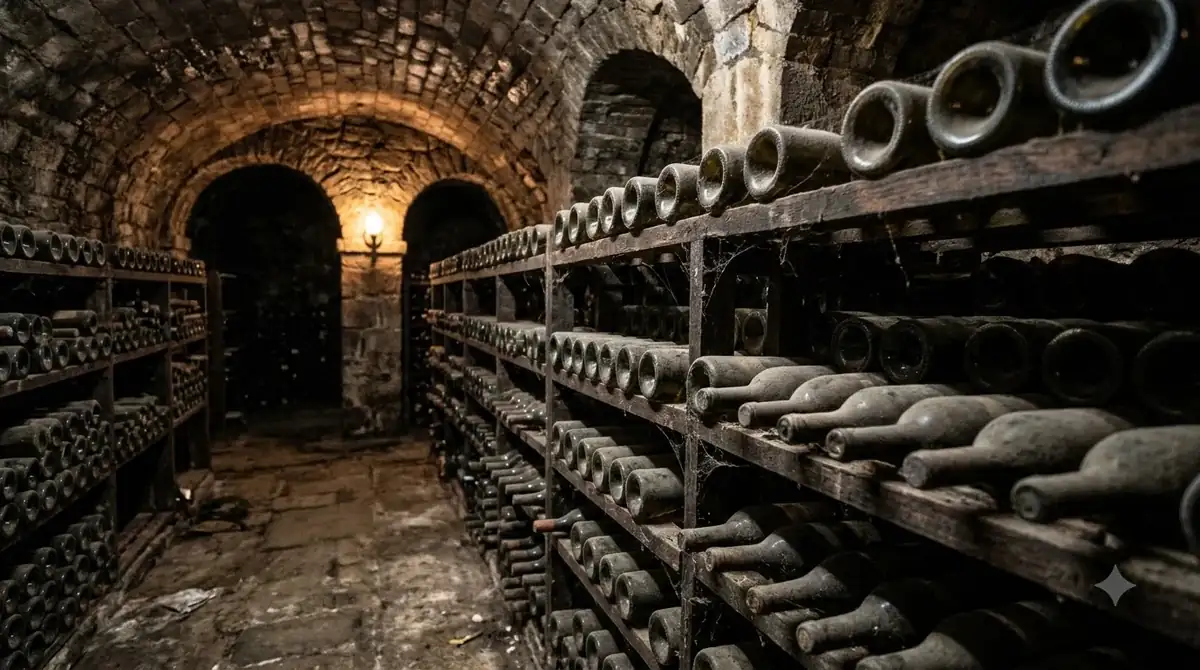
Wine Enthusiast recommends approximately 55°F for storing red, white, sparkling, and fortified wines. This is useful for collectors who keep several styles together because it eliminates the need to create separate temperature zones for every bottle. A Bordeaux Cabernet Sauvignon, Oregon Pinot Noir, California Chardonnay, and Champagne can all remain in the same properly controlled cellar. The publication’s wine storage recommendations also explain why humidity and light deserve attention alongside temperature.
There is also a broader acceptable range. Purdue Extension identifies 50°F to 60°F as the traditional long-term storage range for wine. The narrower 53°F to 57°F target provides a practical middle ground within that range, especially when you intend to keep bottles for several years.
Think of 55°F as your reference point rather than a number that must never change. A cellar reading of 54°F or 56°F does not require an adjustment. However, regular temperature movement deserves attention, particularly if the room becomes noticeably warmer during the afternoon or colder overnight.
Temperature affects the chemical reactions responsible for wine development. These reactions influence aromas, flavors, color, and structure. Cooler conditions slow their progress, while warmer conditions accelerate them. A wine intended to mature gradually over a decade may develop differently if it spends that time in a consistently warm room.
Why Temperature Consistency Matters More Than Exact Precision
A steady cellar temperature helps wine develop predictably, while repeated changes can accelerate deterioration and compromise bottle closures. Avoid large daily or seasonal swings, and investigate any persistent movement outside your intended temperature range.
According to Purdue Extension, wine-aging reactions do not all respond to temperature increases at the same rate. Some reactions accelerate more quickly than others, which means storing wine in a warmer environment does not simply make it mature faster in the same way it would under proper cellar conditions.
Temperature fluctuations can also affect the closure. Wine and the air inside a bottle expand and contract as temperatures change. Repeated pressure changes can put stress on corks and increase the possibility of seepage or air entering the bottle. Once unwanted oxygen reaches the wine, its aromas and flavors can deteriorate.
Consider a cellar that reaches 55°F overnight but climbs to 68°F every afternoon. Its average temperature might appear reasonable, but the repeated warm periods are not ideal for long-term storage. A more consistent room at 58°F is a better environment, even though it sits slightly above the preferred target.
The GCCF Commodity Storage & Handling Manual identifies temperatures above 60°F as a concern because they accelerate maturation and can shorten a wine’s expected life. Temperatures above 75°F can cause particularly undesirable changes in aroma, flavor, and color.
That does not mean a bottle becomes ruined the moment the thermometer reaches 61°F. Duration matters. A brief temperature increase is different from keeping an entire collection in a warm room for months. However, repeated exposure should be treated as a storage problem rather than accepted as normal operation.
Tip: Record the cellar’s minimum and maximum temperatures for at least two weeks. Check readings in the morning and late afternoon to identify daily patterns that a single thermostat reading might miss.
What Happens When a Wine Cellar Is Too Warm or Too Cold
Excessive warmth generally presents the greater long-term risk, but extremely cold conditions can also damage wine. A cellar should stay within the recommended storage range rather than functioning like a household refrigerator or an ordinary heated room.
Warm storage speeds up chemical reactions and can change the characteristics that make a wine distinctive. A delicate white wine may lose freshness, while a red wine may develop prematurely aged aromas. At higher temperatures, oxidation and changes to color become more concerning.
The GCCF manual identifies 86°F as a temperature wine should never encounter during storage. It also explains that temperatures above 75°F can cause undesirable changes much more quickly than ordinary cellar conditions. Sparkling wines require particular care because warming increases pressure inside their bottles.
Cold storage presents a different set of problems. Below 50°F, some wines may develop more slowly and fail to reach their full aromatic and flavor potential at the expected time. This is usually a concern about delayed development rather than immediate spoilage.
More extreme cold can cause physical changes. Purdue Extension explains that exposure to 32°F or below can produce potassium bitartrate crystals. These crystals are naturally occurring wine deposits, not necessarily a sign that the wine is defective.
Below 23°F, wines containing 14% alcohol or less can begin freezing. As the liquid expands, corks may move out of position and bottles can eventually break. A residential cellar should never approach this temperature.
| Temperature | Storage interpretation | Recommended response |
|---|---|---|
| 40°F to 49°F | Too cold for the preferred long-term target | Review the cooling setting |
| 50°F to 52°F | Acceptable lower storage range | Monitor consistency |
| 53°F to 57°F | Preferred cellar target | Maintain conditions |
| 58°F to 60°F | Acceptable upper storage range | Watch for seasonal increases |
| 61°F to 75°F | Warmer than recommended | Investigate cooling and insulation |
| Above 75°F | Significant heat exposure concern | Move bottles to a cooler stable location |
| 32°F or below | Risk of tartrate precipitation | Correct excessive cooling |
| Below 23°F | Freezing risk for many wines | Protect bottles immediately |
These figures are practical storage reference points, not guarantees that every wine will react identically. Alcohol content, wine composition, closure type, previous storage, and exposure duration all influence the result.
Wine Cellar Humidity and Its Effect on Corks
Maintain relative humidity around 50% to 75%, with approximately 60% to 70% providing a useful working target. Proper humidity helps prevent corks from drying out without creating unnecessary moisture problems for labels, packaging, and cellar surfaces.
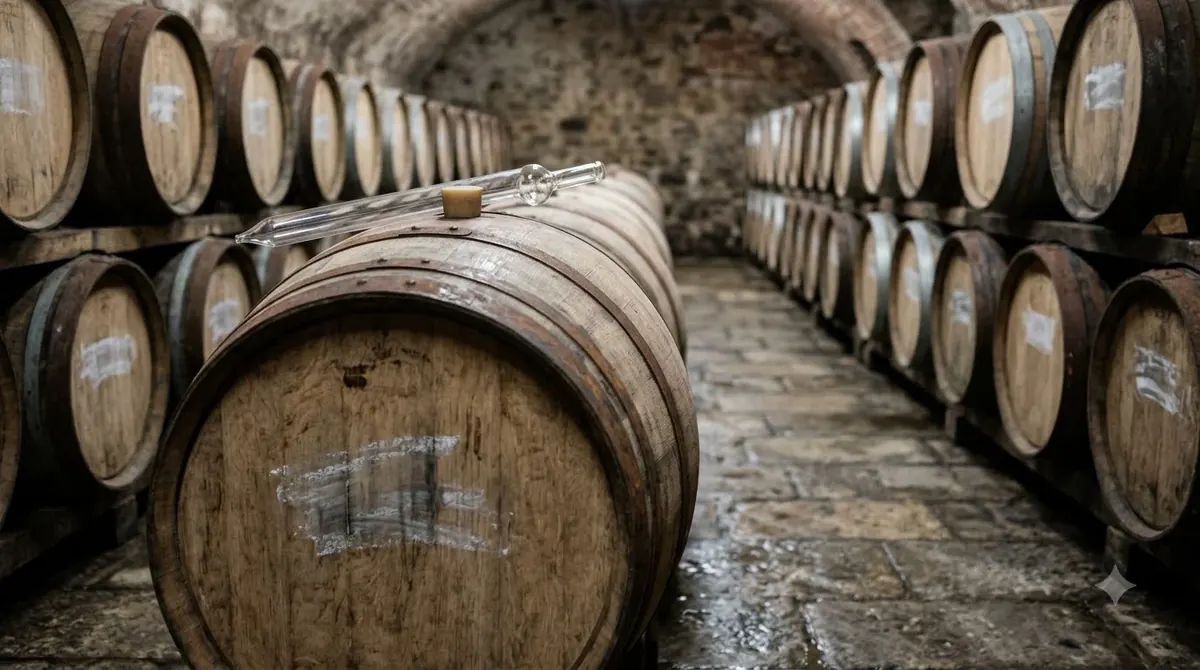
Temperature receives most of the attention in wine storage, but humidity is another important consideration. Natural cork can lose moisture in an excessively dry environment. A compromised cork may allow more oxygen into the bottle, accelerating oxidation and reducing the wine’s quality.
Wine Enthusiast recommends keeping humidity within a broad range that helps corks retain moisture. This becomes particularly important when bottles will remain in the cellar for several years rather than being opened within a few months.
Humidity that stays too high creates different problems. Damp conditions can encourage mold on labels, cardboard cartons, wooden racks, and other cellar materials. Although mold on the outside of a bottle does not automatically mean the wine inside is damaged, it can make labels difficult to read and create maintenance problems.
A digital hygrometer measures relative humidity and often includes a temperature display. Position the instrument near the bottle racks rather than directly beside a cooling vent, where readings may not represent the conditions experienced by most of the collection.
Check humidity regularly instead of responding to every short-lived change. A single reading of 48% does not mean every cork has suddenly dried out. Look for a persistent pattern before changing the cellar’s humidity settings.
If the room is consistently too dry, a suitable humidification system may help. If condensation or damp surfaces become regular problems, investigate ventilation, insulation, and moisture control. Adding water without understanding the cause can create additional issues.
How to Set Up Temperature Control in a Home Wine Cellar
A home wine cellar needs cooling equipment appropriate for its room size, insulation, heat load, and bottle capacity. A dedicated wine cellar cooling system is generally more suitable than ordinary household air conditioning because it is designed for wine storage conditions.
Start by assessing the location. A basement is often a practical choice because underground spaces tend to experience less direct sunlight and can have more stable temperatures than rooms exposed to outdoor heat. However, not every basement is automatically suitable.
Measure the temperature in different seasons before committing to a storage arrangement. A basement that stays at 55°F during cooler months might climb to 70°F during a hot summer. In that situation, natural cooling alone is not sufficient for reliable long-term storage.
Insulation is another essential part of the design. A cellar with poor insulation allows outdoor heat to enter more easily, forcing cooling equipment to work harder. Proper insulation, an appropriately sealed door, and controlled airflow help the system maintain its target temperature.
Choosing the right cooling equipment
Wine cellar cooling systems are available in several configurations, including through-the-wall, split, and ducted systems. Each has different installation requirements and is suited to different room layouts.
A through-the-wall unit is often practical for a smaller enclosed cellar. A split system separates the evaporator from the condenser, which can provide more flexibility in equipment placement. A ducted system can suit a larger installation where the cooling equipment needs to remain outside the wine room.
Consider the following factors before selecting equipment:
- Room dimensions: Measure the cellar’s length, width, and height to calculate its volume.
- Insulation: Assess wall, ceiling, floor, and door insulation.
- Glass exposure: Large glass panels and windows can increase the cooling load.
- Local climate: A cellar in a hot, humid climate requires different planning from one in a naturally cool region.
- Bottle capacity: Account for the collection you intend to store, including future growth.
- Ventilation: Ensure the cooling unit can release heat according to its manufacturer’s installation requirements.
Equipment sizing should be based on an actual heat-load calculation rather than room volume alone. An undersized unit may struggle to maintain 55°F during hot weather, while an unsuitable oversized system may create unnecessary temperature and humidity problems.
For a larger installation, have a qualified wine cellar contractor or HVAC professional evaluate the room before purchasing equipment. This is particularly important when the cellar is enclosed behind glass or located in a room with substantial heat exposure.
How to Monitor and Maintain Cellar Conditions
Use a reliable thermometer and hygrometer to monitor temperature and humidity continuously or at regular intervals. Keeping a written or digital record helps identify gradual changes before they affect the collection.
A basic thermometer provides an immediate reading, but a digital monitor with minimum and maximum memory offers more useful information. Some systems also record readings over time and send alerts when the cellar moves outside a selected range.
Place monitoring equipment at approximately bottle height, away from direct sunlight, doors, and cooling outlets. If your cellar has several sections, take readings in more than one location. A room can contain warmer and cooler areas even when the thermostat shows the correct temperature.
For example, bottles stored on an upper rack near a ceiling may experience different conditions from bottles on lower racks near a concrete floor. Checking more than one location helps identify uneven cooling and airflow problems.
Establish a simple maintenance routine:
- Check temperature: Confirm that the cellar remains near 55°F.
- Check humidity: Aim for approximately 50% to 75% relative humidity.
- Inspect the cooling unit: Look for blocked vents, dirty filters, and unusual operating noise.
- Examine the room: Look for water leaks, condensation, mold, or damaged insulation.
- Review the readings: Compare current measurements with previous weeks and seasonal patterns.
Cooling equipment also needs sufficient ventilation. Many cellar cooling systems release heat outside the refrigerated room. If that heat cannot escape properly, the equipment may struggle to maintain its target temperature.
Pay attention to unusual compressor activity, persistent water accumulation, or sudden changes in temperature. These may indicate an installation or maintenance issue. Addressing a problem early is generally easier than trying to stabilize a room after it has become excessively warm.
Organization makes monitoring easier, too. Grouping bottles by region, grape variety, or intended drinking date helps you inspect the collection without repeatedly moving bottles. See our advice on how to organize a wine cellar for practical storage arrangements that make bottle identification and inventory management simpler.
Wine Cellar Storage Versus Wine Serving Temperature
Long-term storage temperature and serving temperature serve different purposes. Most wines benefit from a consistent cellar environment around 55°F, but the ideal serving temperature varies according to the wine’s style and structure.
A bottle stored at 55°F does not necessarily need to be served at that temperature. Before opening it, adjust the temperature to suit the wine. This helps preserve freshness, balance, aroma, and texture during drinking.
For example, a light Sauvignon Blanc generally benefits from being served colder than a full-bodied Chardonnay. A delicate Pinot Noir is usually more enjoyable slightly cooler than a powerful Cabernet Sauvignon.
The following ranges provide useful serving guidance:
- Sparkling wines: 40°F to 50°F.
- Light white wines and rosé: 45°F to 50°F.
- Full-bodied white wines: 50°F to 55°F.
- Light-bodied red wines: 55°F to 60°F.
- Full-bodied red wines: 60°F to 65°F.
- Sweet white wines: 43°F to 50°F.
A regular refrigerator can help chill a bottle before serving, but it is not the same as a dedicated wine cellar. Household refrigerators generally operate at much colder temperatures and are designed for food preservation rather than gradual wine development over several years.
For short-term storage, a regular refrigerator can be a practical alternative to leaving wine in a hot room. Colder conditions slow development, but this is not the same as maintaining ideal long-term cellar conditions.
If you frequently entertain, keep the cellar at its stable storage temperature and chill individual bottles separately when needed. Our guide on how to keep wine cold at a party explains practical ways to maintain serving temperatures without changing your cellar settings.
Collectors planning a dedicated storage room should also distinguish between the cost of building the space and the cost of maintaining its environment. Cooling equipment, insulation, humidity control, and monitoring all contribute to the overall project. For planning considerations, see how much does a wine cellar cost.
Frequently Asked Questions
Can wine be stored at 55°F in a wine cellar without a cooling unit?
Yes, if the room naturally maintains stable conditions throughout the year. An underground stone cellar or well-insulated basement may provide suitable temperatures without mechanical cooling. However, a room that only stays cool during winter should not be assumed to provide reliable year-round storage.
Does wine cellar temperature affect the color of wine?
Yes. Excessive heat can accelerate reactions that affect wine pigmentation, particularly in white wines, which may develop unwanted browning. Red wines can also experience changes in color as their chemical components evolve. These changes depend on the wine’s composition and exposure history.
Should unopened screw-cap wine bottles be stored horizontally?
Not necessarily. Screw-cap closures do not depend on contact with wine to maintain cork moisture, so upright storage is generally acceptable. Horizontal storage can still be useful for organizing bottles and maximizing rack space.
Can a wine cellar develop condensation even at 55°F?
Yes. Condensation depends on the relationship between surface temperature and the surrounding air’s moisture content, not just the cellar thermostat setting. Poor insulation, cold surfaces, and humid outside air entering the room can all contribute to condensation.
Do all wines benefit from being aged for several years?
No. Many everyday wines are made to be enjoyed relatively young, while only a smaller proportion are designed for extended bottle aging. The grape variety, winemaking approach, acidity, tannin structure, and overall balance influence how well an individual wine develops over time.
For most home collectors, maintaining a stable temperature around 55°F and relative humidity between 50% and 75% provides a dependable foundation for wine storage. Monitor conditions throughout the year, protect bottles from heat and sunlight, and investigate persistent fluctuations rather than chasing an exact thermostat reading. A well-managed cellar helps preserve the character of your collection until each bottle is ready to enjoy.
More in Wine Basics
 Which Rose Is Best for Your Taste, Budget, and Food PairingsUpdated Nov 21, 2026
 Is Cheap Wine Bad? How to Find Bottles Worth DrinkingUpdated Nov 21, 2026
 What To Write On A Wine Gift Tag: Thoughtful Messages For Every OccasionUpdated Nov 21, 2026
 Which Wine Is Best For Weight Loss? Compare Lower-Calorie ChoicesUpdated Nov 21, 2026
 What Is The Best Wine For Mimosas? Choose Bubbly That Balances Orange JuiceUpdated Nov 20, 2026
 Which Prosecco Is Best for Your Taste and OccasionUpdated Nov 20, 2026