

We may earn a commission when you buy through links on this page, at no extra cost to you. Learn more.
Montefalco vineyards are the hillside plantings around Montefalco in Umbria, central Italy, best known for the Sagrantino grape and its powerful red DOCG wine. The growing area also produces Sangiovese-led Montefalco Rosso, Trebbiano Spoletino-based whites, and Grechetto. Its vineyards vary in elevation, exposure, and soil, so the region offers more than one expression of Umbrian wine.
Montefalco is a compact wine landscape in the province of Perugia, where rows of vines share the hills with olive groves, small farms, and medieval settlements. Understanding its boundaries, soils, grape varieties, and appellation rules makes it easier to read a bottle label, plan a winery visit, or choose a style that fits the table.
Where Montefalco’s Vineyards Are Located
Montefalco’s wine country occupies a small group of hills in central Umbria, southeast of Perugia. The production area covers all of the municipality of Montefalco and parts of Bevagna, Giano dell’Umbria, Gualdo Cattaneo, and Castel Ritaldi.
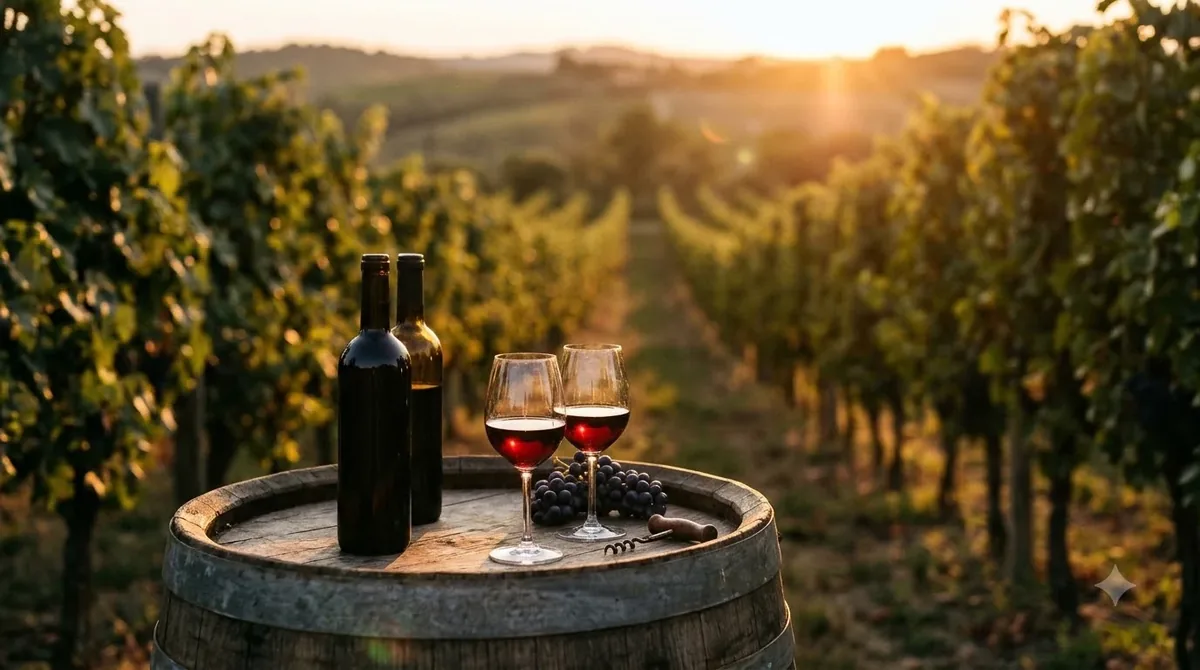
The vineyards sit between 220 and 472 meters (about 720 to 1,550 feet) above sea level, according to the Montefalco wine consortium and the European Union’s product specification. That altitude range is meaningful in a relatively compact district: lower parcels and higher slopes do not share identical exposure, airflow, or ripening conditions. Higher sites may retain cooler conditions, while sheltered lower slopes can follow a different ripening rhythm. Individual vineyard orientation and incline add further variation, so a producer’s site selection can matter as much as the name of the commune on the label.
Montefalco is a hill town overlooking the countryside, while Bevagna and the other municipalities extend the growing zone beyond its immediate slopes. Vineyards alternate with olive groves, cereal fields, and woodland, so a wine-country visit can include more than cellar appointments.
Do not confuse Montefalco DOC with nearby Spoleto DOC: their territories overlap in places, but each has its own production rules. Montefalco DOC or Montefalco Sagrantino DOCG identifies a defined origin, not simply any Umbrian wine. The site’s Wine Regions resource explains how Italian place names and designations work.
Soils, Elevation, and the Umbrian Climate
Montefalco’s soils are varied, even though calcareous clay is common across the production area. The local combination of clay, limestone, sand, gravel, and marl gives vineyards different drainage and water-retention conditions across a short distance.
The Montefalco wine consortium describes four broad geological sub-zones. Fluvial-lacustrine conglomerates, including yellow sands, occur around San Clemente, Camiano, Turrita, and Pietrauta; clays and lacustrine sands appear near Limigiano, southwest of Bevagna, and around Bastardo. These soils do not hold or release water in the same way, which can affect vine growth and ripening. In practical terms, the same summer weather can produce different levels of vine stress across parcels, especially where soil depth and drainage vary.
Alluvial deposits occur around Cantalupo, Bevagna, and La Bruna, while the fourth group includes marl and sandstone formations with grey silty marls. This geology is a map, not a ranking of vineyard quality: soil depth, aspect, slope, vine age, and farming decisions all affect an individual parcel.
The climate is Mediterranean with a subcontinental influence: summers are warm, winters are cold, and rainfall is moderate. The consortium gives average summer temperatures of 18 to 23 degrees Celsius and winter averages of 4 to 6 degrees Celsius, with annual rainfall ranging from 750 to 1,300 millimeters. The range reflects conditions across the territory rather than a single weather station. For growers, the combination of warm growing seasons and cooler winter months supports red grapes that need time to ripen, while differences in exposure help explain why not every parcel reaches the same balance at the same moment.
Sagrantino and the Work of Managing the Vines
Sagrantino is the grape most closely associated with Montefalco, and it gives the area’s signature red wine its unusual depth and firm tannic structure. Growing it well requires careful site choice and precise vineyard management because the grape can produce formidable tannins when ripeness and extraction are not well judged.
Montefalco Sagrantino DOCG must be made from 100% Sagrantino, and the EU specification caps yields at 8,000 kilograms of grapes per hectare for both dry and passito wines. The limit defines a production ceiling, not a quality guarantee. Growers also work to balance crop load, vine vigor, and fruit development through canopy management and, where appropriate, green harvesting.
Harvest timing is especially important because the goal is ripe tannins without losing freshness. Wine Enthusiast identifies careful leaf management, suitable vineyard sites, and selective crop thinning as tools for managing Sagrantino’s naturally firm structure. After harvest, the DOCG requires at least 37 months of aging before release, including one year in oak, giving the wine time to integrate its tannins. Typical Sagrantino notes can include blackberry, dark plum, rose, baking spice, and balsamic or pine-like accents. Bright acidity helps balance the wine’s full body and, in some bottlings, substantial alcohol.
Montefalco also makes a traditional sweet wine, Montefalco Sagrantino Passito DOCG. Producers dry selected Sagrantino bunches on racks for at least two months before fermentation. Decanter has noted that contemporary Sagrantino styles now range from traditional, powerful reds to more supple versions, including examples fermented in amphorae; producer choices can change texture without erasing the grape’s identity.
Tip: When comparing Sagrantino bottles, ask about vineyard elevation, harvest timing, oak aging, and the producer’s preferred drinking window. Those details help explain why two wines from the same DOCG can feel quite different.
Montefalco DOC and DOCG Wines Beyond the Flagship Red
Montefalco’s appellations include several styles, not just Sagrantino DOCG. Montefalco Rosso is a Sangiovese-led blend, while the white wines bring Trebbiano Spoletino and Grechetto into focus.
The blend rules distinguish the bottles. Montefalco Rosso DOC contains 60 to 80% Sangiovese and 10 to 25% Sagrantino, with up to 30% other permitted red grapes. Its Riserva has a longer aging requirement. Montefalco Bianco DOC needs at least 50% Trebbiano Spoletino, while Montefalco Grechetto DOC needs at least 85% Grechetto.
| Appellation or style | Grape composition | Defining production detail |
|---|---|---|
| Montefalco Sagrantino DOCG | 100% Sagrantino | At least 37 months of aging before release, including 12 months in oak |
| Montefalco Rosso DOC | 60–80% Sangiovese; 10–25% Sagrantino; up to 30% other red grapes | At least 18 months of aging before release |
| Montefalco Rosso Riserva DOC | Same core blend ranges as Montefalco Rosso | At least 30 months of aging, including 12 months in oak |
| Montefalco Bianco DOC | At least 50% Trebbiano Spoletino | Other permitted grapes may make up the remaining 0–50% |
| Montefalco Grechetto DOC | At least 85% Grechetto | Other permitted grapes may make up the remaining 0–15% |
The blend and aging figures above summarize the published production descriptions from the Montefalco wine consortium and Wine Enthusiast. They are legal composition or maturation requirements, not tasting guarantees. A Rosso with a high share of Sangiovese may feel more lifted and approachable, while the Sagrantino component can contribute color, body, and grip. Wine Enthusiast describes many Rosso bottlings in terms of cherry and wild-berry fruit, with Riserva examples generally fuller and more complex. Producers can also shape texture through extraction and oak choices.
The white wines deserve attention in their own right. Trebbiano Spoletino is a local variety with a growing profile in central Umbria; Decanter describes it as versatile across still and sparkling styles and notes its natural disease resistance. Grechetto tends to produce a structured white with lively acidity and a more generous palate than the name “simple Italian white” might suggest. For readers comparing Sangiovese-led regional traditions, the site’s guide to Chianti Classico vineyards offers a useful point of contrast: both areas rely on Sangiovese, but Montefalco brings Sagrantino and its local white varieties into a different regional mix.
Planning a Visit to Montefalco Vineyards
A vineyard visit works best when it is planned around the kind of wine and landscape you want to understand. Montefalco’s estates are spread across rural roads and neighboring villages, so arranging appointments ahead of time is more practical than assuming every cellar accepts walk-ins.
Wine Enthusiast’s travel guide identifies Montefalco as the heartland of Sagrantino and notes that many Umbrian wine estates welcome visitors. It highlights Tabarrini for tasting Sagrantino and Fongoli for experiencing Trebbiano Spoletino and other local wines. These are useful starting points for building an itinerary, but tasting formats, opening days, and languages can change. Contact each winery directly to confirm appointment availability, visit length, the wines poured, and whether the tour includes vineyard time or only the cellar. Two well-spaced appointments usually leave more room for questions and the drive between estates than a packed schedule of short tastings.
Decanter’s Umbria guide points to producers shaping modern Sagrantino, including Moretti Omero and Le Thadee. Ask whether a tasting includes an older vintage, Montefalco Rosso, or a white wine as well as Sagrantino; side-by-side comparisons reveal how grape and producer choices affect style.
Leave time for the countryside between appointments. Montefalco, Bevagna, and smaller communities each offer a different view of the valley and hills; a car or pre-arranged driver is the most flexible way to reach rural wineries. Umbria’s cured pork, wild boar, truffles, olive oil, legumes, and pasta dishes are also part of the experience, so consider an estate visit that includes a meal or local food pairing. Confirm winery appointments and transport before setting out.
How to Taste, Serve, and Pair Montefalco Wines
Match the wine’s structure to the food and give each style enough room in the glass. Sagrantino is the most forceful option, Montefalco Rosso is often the more flexible red at the table, and the local whites suit lighter dishes or the first courses of an Umbrian meal.
The Montefalco wine consortium recommends serving Montefalco Sagrantino at 18 degrees Celsius, Montefalco Rosso at 16 degrees Celsius, and Montefalco Bianco and Grechetto at 10 degrees Celsius. In Fahrenheit, these are approximately 64, 61, and 50 degrees respectively. These temperatures are practical starting points: a full-bodied red served too warm can seem heavier, while a white served very cold can lose some of its aroma and texture. Open a structured red in advance; younger, full-bodied reds can benefit from 30 to 60 minutes of decanting. When tasting several wines, move from lighter styles toward the most structured red: try the Rosso first, then a white, and finish with Sagrantino or Passito. A small pour is enough to assess color, aroma, tannin, acidity, and finish without allowing the strongest wine to overwhelm more delicate examples.
For food, start with the region’s classic combinations. Sagrantino’s tannin works well with grilled or braised red meat, game, and aged hard cheese; salt and fat soften the wine’s grip. Montefalco Rosso can accompany stuffed pasta, roasted meat, pizza, and medium-aged cheeses. Grechetto’s freshness suits salumi, fresh cheeses, soups with beans or grains, and savory pies. Trebbiano Spoletino can pair with fish, white meat, risotto, and vegetable-forward starters.
Keep the basic pairing rules in mind. A dish with substantial acidity needs a wine with equal or higher acidity, while a sweet wine should be at least as sweet as the dessert. Chili heat can feel stronger alongside alcohol and tannin, so a powerful Sagrantino is not the easiest match for very spicy food. Oily fish can also clash with tannic reds; choose a white such as Trebbiano Spoletino instead. These simple adjustments make the region’s range easier to enjoy with a full meal.
Frequently Asked Questions
What is the minimum alcohol level for Montefalco Sagrantino secco?
The EU product specification lists a minimum total alcoholic strength of 13.00% by volume for Montefalco Sagrantino secco. That is a legal minimum, not a prediction of the alcohol level in every bottle; individual wines may be substantially higher.
How does the official description say Sagrantino changes with age?
The official product description characterizes the dry wine as intense ruby red, sometimes with purple hints, and tending toward garnet as it ages. It also describes a distinctive aroma recalling blackberries, which provides a useful reference point when assessing a mature bottle.
Can a Montefalco Sagrantino label also use the word Umbria?
Yes. EU rules allow the broader geographical name Umbria on the label, but it must be separated from the Montefalco Sagrantino designation and the DOCG wording. Its type size must be smaller than the designation itself.
How sweet is Montefalco Sagrantino Passito under its specification?
The EU specification sets residual sugar for the Passito style between 80 and 180 grams per liter and a minimum total alcoholic strength of 18% by volume. The wine is therefore a distinctly sweet, concentrated style, even though Sagrantino’s tannin can make the finish seem less sweet than expected.
When was the Montefalco Sagrantino DOCG established?
The EU product specification says the traditional production process has been authorized since the DOCG was established in 1992. That date refers to the controlled and guaranteed designation, rather than the beginning of grape growing in the area.
Montefalco’s appeal comes from the relationship between a distinctive red grape and a landscape with real variation in altitude, soil, and exposure. Start with Sagrantino to understand the region’s signature, then compare Montefalco Rosso and the local whites to see how much more the vineyards offer.
More in Wine Regions
 Willcox Wine Trail: Discover Arizona’s High-Elevation Wine CountryUpdated Nov 20, 2026
 Yakima Valley Wine Region: Find the Best Styles to TryUpdated Nov 20, 2026
 Vosne Romanee Wine Tasting: Identify Aromas and Choose Better PairingsUpdated Nov 20, 2026
 Yakima Valley Wine Festival: Find the Best Seasonal Wine EventsUpdated Nov 20, 2026
 Wales Vineyards: Discover Cool-Climate Wines and Where to VisitUpdated Nov 20, 2026
 Yountville Wine Festival: Discover Napa Wines and Local FoodUpdated Nov 20, 2026