

We may earn a commission when you buy through links on this page, at no extra cost to you. Learn more.
How much electricity does a wine fridge use? Most home wine coolers consume approximately 100 to 200 kilowatt-hours (kWh) annually. An analysis of certified wine and beverage coolers found a median of 152 kWh per year, with 8 in 10 listed models using between 99 and 199 kWh. Actual consumption depends on cabinet size, cooling technology, room temperature, ventilation, and how frequently the door is opened.
A wine refrigerator operates throughout the year, but its electricity use is generally modest compared with that of major household appliances. The most useful specification for comparing models is annual kWh, not the wattage of the compressor or fan. Understanding that measurement, along with the conditions that affect it, makes it easier to choose an appropriately sized cooler and operate it efficiently.
Typical Annual Electricity Use for a Wine Fridge
A useful starting range for a home wine fridge is 100 to 200 kWh per year, equivalent to approximately 0.27 to 0.55 kWh per day. In an analysis of ENERGY STAR-certified wine and beverage coolers, FridgeCompare found a median annual consumption of 152 kWh, with 80 percent of the listed models falling between 99 and 199 kWh.
These figures provide a practical reference rather than a guarantee for every appliance. The certified listings combine wine coolers and beverage coolers, so they include equipment designed for bottles as well as units intended for cans and other drinks. FridgeCompare’s analysis covers 156 certified models from 36 brands. Its results offer a useful picture of certified equipment, but they should not be treated as a complete survey of every wine refrigerator available or every older appliance still operating in a home.
Capacity is important, but bottle count alone does not determine electricity consumption. For example, Frigidaire lists its Gallery GRWE5726AS as a 57-bottle wine cooler with a 5.3-cubic-foot interior and annual consumption of 157 kWh. That figure is close to the 152 kWh median in the certified-model analysis, even though the Frigidaire is a relatively large cabinet. Insulation, cooling hardware, door design, and operating conditions help explain why similar-sized appliances can have different annual consumption figures.
Small countertop units may use less electricity in absolute terms because they have less interior space to cool. However, a small model can be inefficient relative to its capacity if it has poor insulation, limited ventilation, or a cooling system that runs for long periods. Large freestanding cabinets usually need more cooling capacity, but their annual kWh ratings remain the best way to compare actual energy requirements.
What Annual kWh and Wattage Mean
Annual kilowatt-hours measure the total electricity an appliance uses over a year, while watts describe its electrical power at a particular moment. A wine fridge rated at 152 kWh annually uses an average of approximately 17.4 watts across the full year, although its actual electrical draw changes as the cooling system cycles.
A wine refrigerator does not necessarily operate its compressor or cooling module continuously. The thermostat monitors the cabinet temperature and activates the cooling system when additional cooling is needed. Once the target temperature is reached, the compressor or thermoelectric system can reduce activity or switch off temporarily. Fans, electronic controls, displays, and interior lighting may continue to use some electricity depending on the model.
This cycling explains why multiplying a compressor’s wattage by 24 hours and then by 365 days can produce an unrealistic annual estimate. A component rated at 80 watts does not necessarily draw 80 watts every hour of the year. It may operate intermittently, with the total annual consumption depending on how often it needs to run and how much electricity the other components use.
For example, 152 kWh represents 152,000 watt-hours annually. Dividing that figure by 8,760 hours gives an average power draw of approximately 17.4 watts. This is an annual average, not the operating wattage shown on the compressor or appliance label. An electricity meter that records cumulative kWh can provide a more useful measurement of a particular unit’s real consumption.
Tip: Compare annual kWh figures before comparing wattage. A model that draws more power while its compressor is running can still use less electricity over a full year if it cools efficiently and maintains its temperature with shorter operating cycles.
How to Calculate Daily and Monthly Electricity Use
Daily and monthly electricity use are easy to estimate from the annual kWh rating. Divide annual consumption by 365 for an approximate daily figure or by 12 for an average month, then compare models with similar capacities and installation requirements.
| Annual consumption | Average daily use | Average monthly use | Average continuous power equivalent |
|---|---|---|---|
| 99 kWh | 0.27 kWh | 8.25 kWh | 11.3 watts |
| 152 kWh | 0.42 kWh | 12.67 kWh | 17.4 watts |
| 199 kWh | 0.55 kWh | 16.58 kWh | 22.7 watts |
The middle row illustrates the calculation for a cooler using 152 kWh each year. Dividing 152 by 365 gives approximately 0.42 kWh per day. Dividing the same annual figure by 12 gives approximately 12.67 kWh per average month. The final column converts annual consumption into an average power equivalent using the 8,760 hours in a standard year.
These are averages, not fixed daily measurements. Electricity use can rise during warmer months when a room heats up, then fall during cooler periods. Loading several bottles at once can also create a temporary increase because the cooling system has to bring the new bottles and surrounding air down to the selected temperature. A monthly electricity reading will therefore not necessarily match the table exactly.
For a more accurate measurement, use a compatible plug-in electricity meter on a freestanding wine fridge. Record its cumulative kWh reading over at least seven days of normal operation, then multiply the weekly result by 52 for a rough annual estimate. A longer measurement period is more representative because compressor cycles, room temperature, and door openings vary from day to day. For seasonal comparisons, record the same appliance under both warmer and cooler room conditions.
What Makes a Wine Fridge Use More Electricity
Room temperature, ventilation, temperature settings, and door openings are major influences on actual electricity consumption. A cabinet operating in a warm 78°F room generally has to remove more heat than the same appliance placed in a cooler, properly ventilated space.
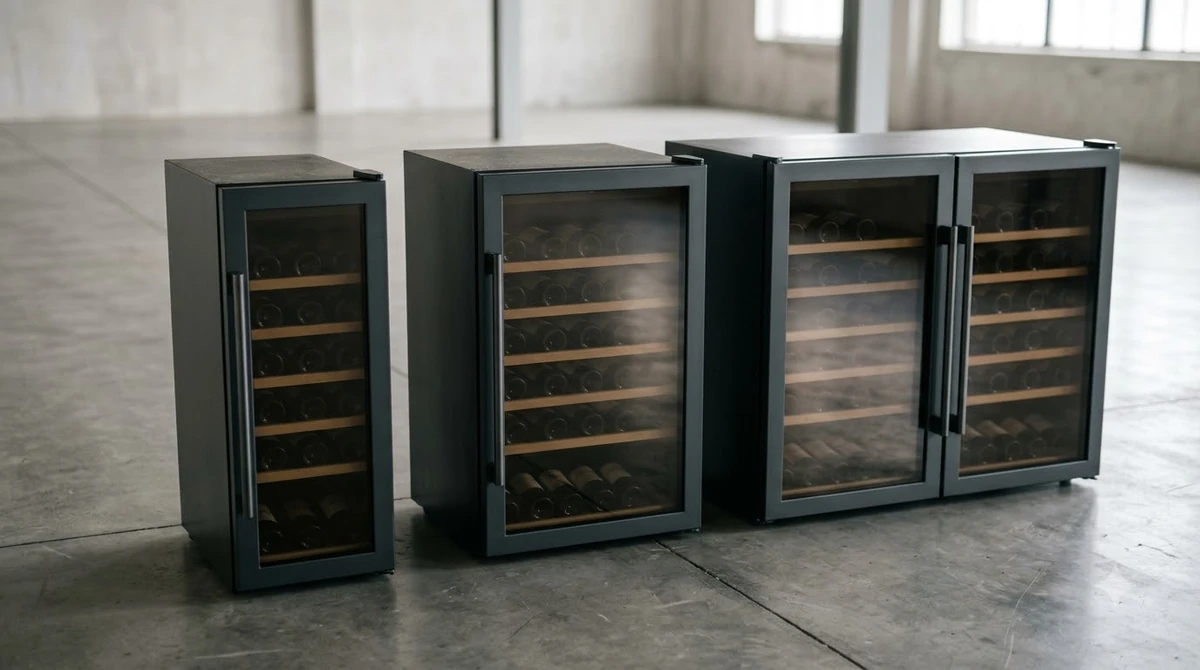
Ambient temperature is particularly important because heat continuously moves from the room into the cooler cabinet. When the surrounding air is warm, the cooling system may need to operate more frequently to maintain the selected temperature. A wine fridge installed beside an oven, dishwasher, heating vent, or sunny window can face an additional heat load. Placing a unit in a hot garage can have a similar effect, especially when summer temperatures remain high for long periods.
Ventilation gives the appliance somewhere to release the heat removed from the interior. Freestanding wine fridges generally need clearance around their sides, back, or other specified ventilation areas. Pushing one tightly against a wall or enclosing it in cabinetry without the required space can trap heat around the cooling system. A built-in model is designed for a different installation arrangement and may use front ventilation, so the installation instructions for one type should not automatically be applied to another.
Temperature settings also influence electricity use. A cabinet set to 45°F in a 78°F room has a larger temperature difference to maintain than one set to 55°F in the same room. The lower setting generally requires more cooling work. For long-term wine storage, many collectors use a steady temperature around 55°F rather than repeatedly changing the control to chill individual bottles quickly.
Door openings add warm air to the cabinet, particularly when the door remains open while someone searches through the bottles. Loading several room-temperature bottles at once can also increase cooling demand until the contents reach the setpoint. FridgeCompare identifies room temperature, door-opening frequency, and how full a cooler is as factors that influence real-world electricity consumption. These variables help explain why a single laboratory-style annual rating may differ from an appliance’s performance in a particular home.
Compressor, Thermoelectric, and Dual-Zone Wine Fridges
Wine refrigerators use different cooling technologies, and those designs affect operating conditions, noise, and temperature performance. Compressor and thermoelectric models should be compared using their individual annual kWh specifications rather than assuming one technology always consumes less electricity.
Thermoelectric cooling uses an electrical current between conductors to transfer heat through a solid-state module. Fans help move air through the cabinet and disperse the heat. These units are often quiet and appear in smaller wine coolers, making them attractive for apartments, offices, and other indoor spaces. However, they need sufficient clearance for heat removal and may struggle in warmer surroundings. A small thermoelectric cooler in a climate-controlled room can operate quite differently from the same model in a hot garage.
Compressor wine fridges use refrigerant and a refrigeration cycle similar to that found in a household refrigerator. They can generally achieve lower temperatures and handle warmer surrounding conditions more effectively than many thermoelectric models. This makes them common in larger cabinets and appliances designed to hold substantial collections. The trade-offs can include additional noise, vibration, and weight. Wine Enthusiast explains these differences in its comparison of thermoelectric and compressor wine coolers.
Dual-zone wine fridges maintain two separate temperature areas, often allowing white wines and red wines to be stored at different settings. A model might maintain one compartment around 45°F and another around 55°F, depending on its design and intended use. Dual-zone equipment may include additional fans, controls, and temperature sensors, but two compartments do not automatically mean twice the electricity consumption. Cabinet construction, insulation, capacity, door design, and operating conditions remain important considerations.
For a fair comparison, look at the annual kWh rating alongside bottle capacity and physical dimensions. A 30-bottle thermoelectric cooler should not be compared with a large, dual-zone compressor cabinet solely on the basis of cooling technology. The appliances have different intended uses and cooling requirements. Models with similar capacities and installation types provide a more meaningful comparison.
How to Reduce Electricity Use Through Better Installation and Care
The most effective ways to reduce electricity consumption are to limit unnecessary heat exposure, maintain airflow, and use sensible temperature settings. Proper placement and routine care help a wine fridge maintain stable conditions without making its cooling system work harder than necessary.
Start by choosing a suitable location. Keep the cabinet away from direct sunlight, ovens, dishwashers, radiators, and heating vents. Avoid placing a freestanding model in a tight enclosure unless the manufacturer specifically permits that installation. Leave the recommended clearance around its ventilation areas and keep the floor stable and level. General wine fridge installation and care guidance can help with placement, airflow, and routine maintenance.
Next, select a practical storage temperature. A stable setting around 55°F is widely used for long-term wine storage and generally requires less cooling than an unnecessarily low setting. A wine fridge is designed to maintain an appropriate storage environment, not necessarily to chill every bottle rapidly before serving. If a bottle needs to be colder for immediate service, a separate chilling method is preferable to continually lowering the entire cabinet’s temperature.
Keep the door closed while deciding which bottle to remove. Organize bottles so frequently selected wines are easy to find, and avoid leaving the door open while rearranging the collection. Add room-temperature bottles in manageable batches where possible. After loading, allow the appliance time to recover rather than changing the thermostat repeatedly in an attempt to speed up cooling.
Routine cleaning also matters. Dust around accessible vents and condenser areas can interfere with heat dissipation, depending on the design of the appliance. Follow the manual’s instructions for cleaning any grille, filter, or serviceable component. Do not remove covers or handle refrigeration components that are intended for qualified technicians. Door gaskets should also remain clean and flexible so that the door seals properly when closed.
When Higher Electricity Use Indicates a Problem
Longer operating cycles during hot weather or after loading new bottles do not automatically indicate a fault. A compressor that rarely stops, a cabinet that cannot reach its selected temperature, or a sudden increase in operating time can point to a ventilation, sealing, sensor, or cooling problem.
Begin with simple checks. Confirm that the door closes completely and that bottles or shelves are not preventing the gasket from sealing. Look for visible gaps, damaged seals, or condensation around the door. Check the temperature setting and compare the displayed reading with the conditions inside the cabinet. Restore the required ventilation clearance if the appliance has been pushed against a wall or enclosed too tightly.
Give the wine fridge time to recover after correcting an installation problem. If it continues running almost constantly in a moderate room, investigate further rather than assuming that the behavior is normal. A blocked condenser area, failing fan, faulty temperature sensor, defective thermostat, or refrigeration-system problem can prevent the cabinet from maintaining its target temperature. Some problems require a qualified appliance technician, particularly when they involve refrigerant or electrical components.
Cooling trouble and unusual electricity consumption can occur together because a unit that cannot remove heat effectively may keep operating without reaching its target. For brand-specific troubleshooting, see the guide to an Allavino wine fridge that is not cooling or the steps in Allavino wine fridge repair. Owners of another common brand can also review the advice for a Magic Chef wine fridge that is not cooling.
One important distinction is the difference between normal cycling and continuous operation. A compressor may run longer immediately after the door has been open or after a large batch of bottles has been added. Once the cabinet stabilizes, it should generally return to its usual operating pattern. Persistent temperature problems, unusual noises, or repeated warning signals deserve attention even when the appliance still appears to be running.
Frequently Asked Questions
These five questions cover practical details that can affect how a wine fridge is installed, measured, and used beyond its annual electricity rating.
Should a wine fridge be plugged directly into a wall outlet?
Most manufacturers recommend connecting a wine refrigerator to a properly grounded wall outlet rather than relying on an extension cord or an overloaded power strip. The electrical requirements vary by model, so follow the appliance manual and the rating information on its electrical label. A dedicated circuit may be required for certain installations.
Does the displayed temperature always match the temperature of the wine?
No. A temperature sensor measures conditions at its location inside the cabinet, while the wine in a bottle changes temperature more slowly than the surrounding air. A bottle may therefore remain warmer or cooler than the displayed reading for some time after a temperature adjustment.
Can a wine fridge be installed on carpet?
A soft or uneven floor can make it difficult to keep a wine fridge level and may interfere with ventilation if the appliance draws air through its base. A firm, level surface is generally preferable. Follow the manufacturer’s instructions about floor clearance, adjustable feet, and acceptable installation surfaces.
What happens to electricity use after a power interruption?
The cooling system may operate for an extended period after power returns because the cabinet has warmed during the interruption. Some models also restore their previous settings automatically, while others may require the temperature controls to be checked again. Keeping the door closed during an outage helps limit the amount of warm air entering the cabinet.
Does an interior LED light affect annual electricity consumption?
An LED interior light generally uses much less electricity than the main cooling system, particularly when it operates only briefly during bottle selection. Leaving the door open to keep the light on is a different matter because it also allows warm room air to enter. Use the light as intended and close the door promptly after retrieving a bottle.
Most home wine fridges use approximately 100 to 200 kWh annually, with a certified-model median of 152 kWh providing a useful point of reference. Compare annual consumption figures, provide adequate ventilation, and maintain a sensible temperature setting to keep operation predictable. A sudden change in running behavior or an inability to maintain temperature deserves troubleshooting rather than being dismissed as ordinary electricity use.
More in Storage & Fridge Care
 How Long Can You Store Wine in a Wine Fridge? Protect Bottle QualityUpdated Nov 20, 2026
 Can You Store Beer in a Wine Fridge? Keep Both Drinks FreshUpdated Nov 20, 2026
 Is It Worth Repairing a Wine Fridge? Spot the Cheap Fixes Before You ReplaceUpdated Nov 20, 2026
 Wine Fridge Condensation: Identify Causes and Fix Moisture ProblemsUpdated Nov 20, 2026
 Wine Fridge Too Cold: Protect Your Wine and Fix the TemperatureUpdated Nov 20, 2026
 How to Reset Wine Fridge: Restore Cooling and SettingsUpdated Nov 20, 2026