

We may earn a commission when you buy through links on this page, at no extra cost to you. Learn more.
How to make a wine cellar in a closet starts with creating a cool, dark, insulated space and maintaining stable temperature and humidity. Choose an interior closet away from heat and vibration, seal and insulate its walls, ceiling, and door, then install a wine-specific cooling system sized for the finished space. Add horizontal racks, low-heat lighting, and reliable temperature and humidity monitors before moving in the bottles.
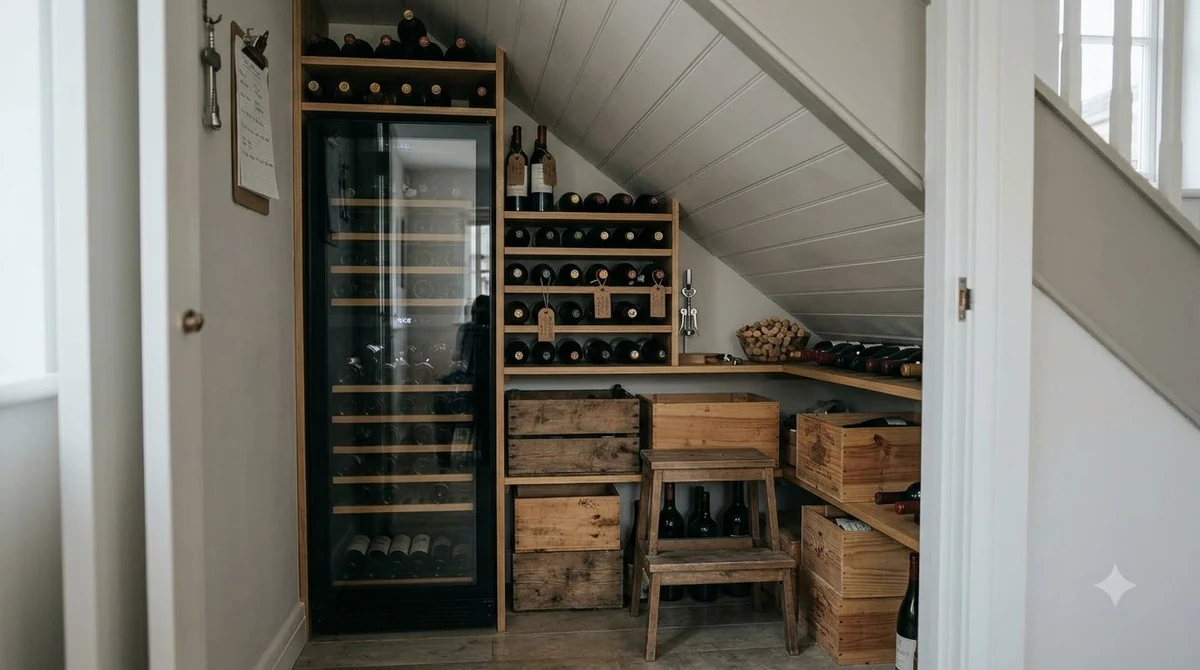
A spare reach-in or walk-in closet can become useful wine storage without taking over a basement or spare room. The important distinction is between a closet that simply holds bottles and a cellar that protects them for months or years: the latter needs a controlled environment, a properly built enclosure, and equipment that can reject heat safely. Plan the space around the bottles you expect to keep, not just the empty square footage. The step-by-step overview of how to convert a closet into a wine cellar is a useful companion for mapping the project.
Choose a Closet That Can Hold Stable Conditions
The best starting point is an interior closet with a solid floor, limited exposure to outdoor temperature swings, and an adjoining room where a cooling unit can release heat. A hallway or spare-room closet is often easier to adapt than one beside a kitchen range, dryer, water heater, or sunny exterior wall.
Inspect the four walls, ceiling, and floor before committing. Note nearby plumbing, electrical access, and what sits on the other side of each wall. A closet beside an oven or dryer faces extra heat; one below an unconditioned attic needs careful ceiling insulation.
Measure the space in feet and record the width, depth, and height. A 3-by-3-foot reach-in closet with an 8-foot ceiling has 72 cubic feet of volume. A 6-by-8-foot walk-in closet with the same ceiling height has 384 cubic feet. Those figures help an HVAC professional estimate the cooling load; they do not, by themselves, determine how many bottles will fit or which unit is appropriate.
Decide whether you are storing everyday bottles for a few months or age-worthy wines for several years, then match the project to the collection you actually own.
Plan Bottle Capacity and an Accessible Layout
Closet dimensions set the outer limit, but rack style and access determine the practical capacity. A 3-by-3-foot reach-in may hold around 100 standard bottles with floor-to-ceiling racks on the back and one side wall, while a 5-by-6-foot walk-in can accommodate roughly 200 to 400 bottles with well-planned racks on two or three walls.
Inventory your bottle shapes before buying racks. Standard 750-milliliter Bordeaux-style bottles fit many slots, but Champagne bottles, broad Burgundy bottles, and magnums need wider openings. Reserve a few flexible spaces for larger formats and frequently opened bottles.
| Closet layout | Approximate volume | Typical bottle capacity | Planning note |
|---|---|---|---|
| 3 × 3 × 8 ft reach-in | 72 cu. ft. | Up to about 100 | Rack the back and one side wall |
| 5 × 6 × 8 ft walk-in | 240 cu. ft. | About 200–400 | Use two or three walls |
| 6 × 8 × 8 ft walk-in | 384 cu. ft. | Several hundred | Capacity depends on rack depth and aisle |
These are estimates, not guarantees: capacity changes with rack depth, slot width, bottle sizes, and whether you use individual cradles or bulk bins. Individual slots make labels easier to see and reduce the need to move neighboring bottles. In a walk-in, preserve an aisle of about 30 inches where possible; in a reach-in, keep the door swing clear and leave the cooling unit’s intake and outlet unobstructed.
Sketch each wall and mark the unit, door, light, monitor, and racks. Keep frequently opened wines near the entrance, bottles intended for aging farther back, and oversized formats in dedicated slots.
Insulate the Enclosure and Control Moisture
A closet cellar needs a sealed thermal envelope, not just a cold appliance. Insulation slows heat entering the room, while a continuous vapor-control layer helps prevent warm, humid household air from condensing inside a cooled wall or ceiling.
Closets are normally built to stay close to the temperature of the surrounding rooms. Holding one at approximately 55°F while adjacent rooms are much warmer creates a temperature difference across the walls. Warm, moist air can move into the wall cavity and reach a cold surface, where it may condense. The Wine Guardian Dealer closet-conversion guidance describes R-19 wall insulation, R-30 ceiling insulation where an attic or unconditioned space is above, and a continuous 6-mil polyethylene vapor barrier on the warm side as a common construction approach. These are project specifications to review with a qualified local contractor, not a universal prescription for every climate or building assembly.
Remove closet rods and shelves, then insulate every surface facing warmer space, including the ceiling and exposed exterior walls. Vapor-barrier placement depends on climate, wall assembly, and local code; do not assume plastic belongs on the cooled interior face. Have a building professional specify the vapor-control strategy and seal penetrations around wiring, pipes, and the unit.
Finish the walls with moisture-resistant board, and choose tile, sealed concrete, or sealed stone rather than carpet, which can trap moisture. Repair leaks before closing the walls. Treat the door as part of the enclosure: a hollow-core door leaks heat, while a solid-core exterior-grade or double-pane insulated door can work with weather-stripping, a continuous gasket, and an automatic door bottom.
Tip: Do not install a cooling unit before the insulation, vapor-control details, and door seal are designed. A powerful unit cannot compensate for a leaky enclosure, and cooling warm humid air that enters through gaps can create condensation problems in hidden spaces.
Select a Wine Cooling System and Plan Its Exhaust
Use a dedicated wine-cellar cooling system when the closet cannot naturally remain near 55°F with modest seasonal variation. The unit must be sized for the finished room’s volume, insulation, door, glass area, surrounding temperature, and heat load—not selected from bottle capacity alone.
A through-the-wall system is a common choice when the closet shares a wall with a ventilated interior room. The cool side faces the bottles, while the warm side releases heat into the adjoining room. That receiving room must have enough air circulation to carry the heat away; a small sealed closet or an unventilated cabinet is not a suitable exhaust space. The unit also needs the clearances specified by its manufacturer so it can operate and be serviced.
A ductless split system is worth considering when there is no good adjoining room for exhaust or when compressor noise should be kept away from a bedroom. Its indoor component serves the cellar while the condenser sits elsewhere; a qualified HVAC technician should install the refrigerant lines. A ducted system can work when a nearby utility space can hold the equipment and insulated ducts.
Do not substitute a standard window or room air conditioner. Wine-cellar equipment is designed for a lower set point and stable cellar conditions; a household air conditioner may remove too much moisture or fail to hold the required temperature. Have the installer calculate the load and confirm the equipment’s operating range before purchase.
Plan for condensate, power, and service access before closing the walls. Water removed from the air needs a drain, condensate pump, or manufacturer-designed evaporation system. Wine Guardian Dealer lists through-the-wall models rated at 1,440 and 2,650 BTU per hour for different configurations, but two 72-cubic-foot closets can have different heat loads because of insulation, ceiling exposure, and door glazing. Keep filters and service panels reachable, and have the installer size the unit for the actual room.
Install Racks, Lighting, and a Well-Sealed Door
Once the enclosure and cooling plan are settled, install racks that support bottles securely and allow air to circulate. Most cork-sealed bottles should lie horizontally so the wine remains in contact with the cork; the arrangement also makes labels easier to read when each bottle has its own slot.
Wood racks can fit alcoves, while powder-coated metal or wall-mounted rails preserve floor space in a shallow closet. Choose supports for the bottle body and neck, and keep racks clear of supply and return vents. Use sturdy anchors: bottles are heavy, so ask a contractor to assess wall framing and floor loading before installing floor-to-ceiling racks or stacking cases. Keep heavy cases low and secure them against sliding.
Choose low-heat LED lighting, preferably on a door switch or motion sensor so it is on only while someone is in the closet. Avoid incandescent and halogen fixtures that add heat. Wine is sensitive to strong light, especially ultraviolet exposure, and a cellar should be dark most of the time. If you choose a glass door, double-pane insulated glass is a better starting point than a single pane, but it still adds heat load and should be included in the cooling calculation.
Keep the room free of strong odors and household chemicals. Wine Enthusiast warns that nearby odors can affect wine over time, particularly through natural cork closures, so do not store paint, cleaners, solvents, scented candles, or food in the cellar. The site’s Wine Basics resource can help organize bottles by style and drinking window without requiring frequent handling.
Set the Storage Targets and Monitor the Cellar
A useful target for a home wine cellar is approximately 55°F with relative humidity around 50 to 70 percent. Stable conditions matter more than chasing a perfect number every hour, so use a cellar thermometer and hygrometer to identify trends and catch equipment failures early.
Wine Enthusiast identifies about 55°F as a suitable storage temperature across reds, whites, sparkling, and fortified wines. Decanter describes a traditional cellar temperature of about 53°F and warns against large variations; its specialist advice on fine-wine storage also places the preferred humidity around 65 to 70 percent. Taken together, these sources support a practical closet target near 55°F and a moderate humidity range that helps protect corks without encouraging mold or damaged labels. For a more detailed explanation of storage conditions, read Wine Enthusiast’s guide to storing wine properly and Decanter’s humidity guidance.
Place the thermometer and hygrometer away from supply air, the door, and lights; a central shelf or wall gives a representative reading. During the first few weeks, record morning and evening readings and note unusual heat or an open door. Minimum-and-maximum records or phone alerts can flag equipment trouble. If the cellar misses its target, check leaks, blocked vents, exhaust ventilation, and insulation before lowering the thermostat.
Store cork-sealed bottles on their sides, away from direct light, vibrating appliances, and strong odors; keep handling to a minimum, especially for bottles you plan to hold for several years. Use the cellar for storage, not serving: bring a bottle out ahead of time and adjust it to its serving temperature, since light whites and rosés are served colder than full-bodied reds. Keeping the two uses separate avoids changing the cellar temperature for dinner.
Frequently Asked Questions
These final details cover screw-cap storage, Decanter’s 8°C to 15°C cellar range, and signs of excess humidity such as loose labels.
Can screw-cap wine bottles be stored upright?
Yes. A screw cap does not rely on a moist natural cork to form its seal, so upright storage is generally suitable for bottles with this closure. Keep them in a stable rack and away from strong light and heat just as you would cork-sealed bottles.
Can every wine benefit from years in a closet cellar?
No. Many wines are intended for early drinking and are not expected to improve with long aging. A controlled closet protects them from poor storage conditions, but it cannot give a simple, fresh wine the structure or aging potential it was not made to have.
What should I do if the humidity rises above the target?
First, look for a water leak, wet flooring, a blocked condensate drain, or humid air entering around the door and equipment penetrations. Sustained excessive humidity can loosen labels and encourage mold on cellar surfaces, so correct the source rather than placing an open container of desiccant beside the bottles.
Is a closet that stays between 46°F and 59°F usable for wine storage?
That range corresponds roughly to the 8°C to 15°C span Steven Spurrier cites as acceptable around a classic cellar temperature of 53°F. The key qualification is that the temperature should not swing sharply or repeatedly; a more consistent setting near 55°F is preferable for a dedicated cellar.
Should I keep the original closet shelves for wine bottles?
Ordinary closet shelves are usually too deep or too widely spaced to support bottles safely and efficiently, and they may not be anchored for the weight of a full collection. Replace them with bottle racks or case storage designed for the bottle formats you own, and confirm the wall and floor can support the loaded system.
A successful closet wine cellar is built around consistency: an insulated and sealed enclosure, a properly sized cooling system, horizontal bottle storage, and regular monitoring. Start with a careful site assessment and a layout that leaves room for maintenance, then bring in qualified building and HVAC help for the parts that affect moisture control, electrical work, and equipment sizing.
More in Wine Basics
 What Is The Best Wine For Mimosas? Choose Bubbly That Balances Orange JuiceUpdated Nov 20, 2026
 Which Prosecco Is Best for Your Taste and OccasionUpdated Nov 20, 2026
 Which Wine Is Best For Health? Understand the Risks and BenefitsUpdated Nov 20, 2026
 Which Champagne Is Best for Your Taste and OccasionUpdated Nov 20, 2026
 What To Put In A Wine Gift Basket For A Thoughtful, Memorable GiftUpdated Nov 20, 2026
 What Is the Best Wine for Mulled Wine? Choose a Smooth, Fruity RedUpdated Nov 20, 2026