


We may earn a commission when you buy through links on this page, at no extra cost to you. Learn more.
The viski wine glasses lineup suits buyers who want lead-free crystal, modern silhouettes, and distinct choices for reds, whites, and mixed wine styles. Its strongest options include the 23-ounce Liminal universal glass, the 13-ounce Laurel white glass, and the 31-ounce Reserve Inez Burgundy bowl. The main trade-off is that delicate, slender crystal needs careful handling, and cleaning instructions differ by model.
Viski approaches wine service as part of a coordinated home-bar setup rather than limiting its catalog to one traditional bowl shape. That gives shoppers room to choose between restrained universal stemware, angular contemporary designs, and larger red-wine bowls. The right choice depends less on the name of the collection than on the glass’s capacity, silhouette, weight, and care instructions.
Specs and Key Features
Viski’s strongest practical feature is variety: the range includes a 23-ounce all-purpose glass, a 13-ounce white-wine shape, an 18-ounce red-wine shape, and oversized Burgundy stemware. Most of the models reviewed here use lead-free crystal, but the finish and cleaning directions are not identical across the range.
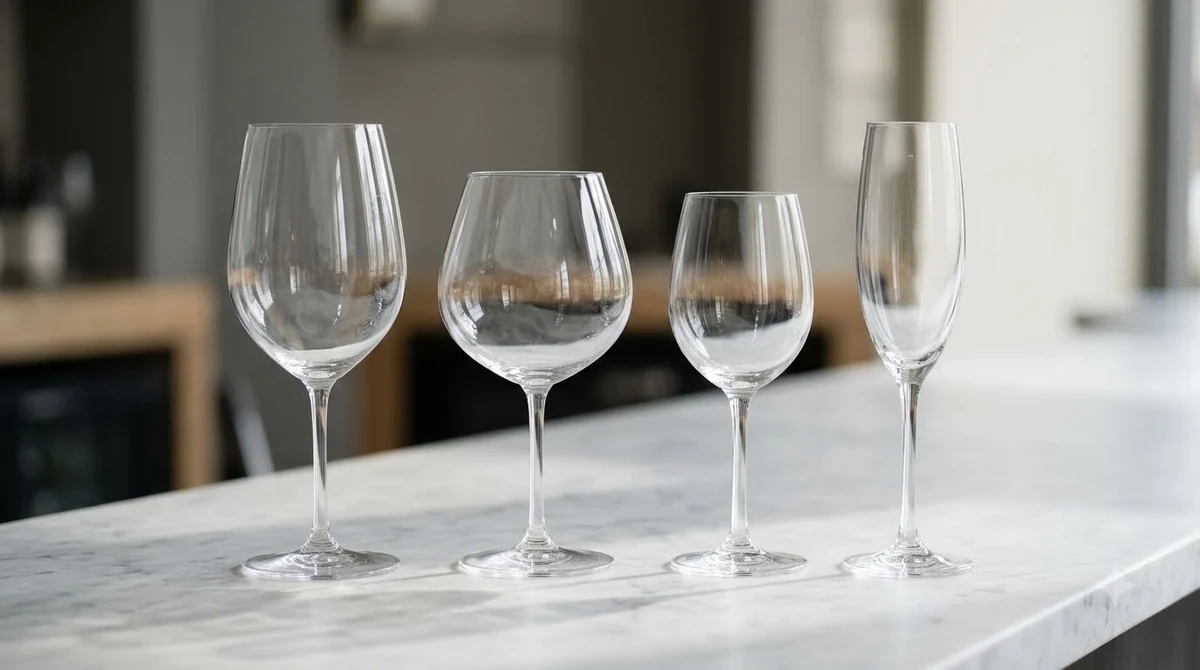
The Liminal Universal Wine Glass is the easiest place to start if one glass needs to cover red wine, white wine, and rosé. Viski lists a 23-ounce capacity, lead-free crystal construction, a generous bowl, a tall stem, and top-rack dishwasher care. The company describes it as thinner and lighter than traditional glassware. Those details point to a delicate, light-feeling glass with enough room for a measured pour and swirling, rather than a thick everyday tumbler. Review the Viski Liminal Universal Wine Glass specifications before choosing a single glass or a larger set.
Laurel gives the range a more clearly divided approach. Its white-wine glass holds 13 ounces, while the matching red-wine model holds 18 ounces; both are sold as pairs, use lead-free crystal, and are listed as top-rack dishwasher safe. Their square silhouette and long stems look more decorative than a plain tulip glass. Reserve Inez takes the opposite direction with a 31-ounce Burgundy bowl, a four-glass set, and European lead-free crystal; Viski describes it as suited to complex reds as well as rosé and white wine. Decorative designs bring different care considerations: Wayfair lists the 16-ounce Meridian pair with its rippled texture and gold-electroplated rim as hand-wash only, while the 16-ounce Raye and 15.5-ounce Seneca pairs are listed as dishwasher safe.
| Model | Capacity | Set size | Material and care | Best fit |
|---|---|---|---|---|
| Liminal Universal | 23 oz. | 1 glass per listing | Lead-free crystal; top-rack dishwasher | One shape for red, white, and rosé |
| Laurel White | 13 oz. | 2 glasses | Lead-free crystal; top-rack dishwasher | White wine and rosé |
| Laurel Red | 18 oz. | 2 glasses | Lead-free crystal; top-rack dishwasher | Red wine in a larger bowl |
| Reserve Inez Burgundy | 31 oz. | 4 glasses | European lead-free crystal; dishwasher safe | Large-bowled red-wine service |
| Meridian | 16 oz. | 2 glasses | Lead-free crystal with gold rim; hand wash | Decorative table settings |
| Raye Angled Bordeaux | 16 oz. | 2 glasses | Lead-free crystal; dishwasher safe | Angular Bordeaux-style presentation |
| Seneca Diamond | 15.5 oz. | 2 glasses | Lead-free crystal; dishwasher safe | Faceted, versatile stemware |
Capacity is not a recommended pour size: a 23-ounce glass does not call for a 23-ounce serving, and a 31-ounce Burgundy bowl is not an instruction to fill it deeply. Leave headspace for swirling and aromas. Viski’s range divides into universal shapes, varietal-led sizes such as Laurel, and embellished pieces such as Meridian and Seneca, so choose the form and maintenance routine together rather than treating every model as interchangeable.
What Owners Like
Owner feedback most consistently favors the visual design and light feel of Viski’s more distinctive glasses. The angled Raye shape and faceted Seneca bowl are two clear examples: their appeal is not just that they hold wine, but that they give a table setting a recognizable silhouette.
Wayfair’s customer-summary section for Raye notes that shoppers appreciate its elegant appearance, good quality, size, and feel. The same retailer’s Seneca summary highlights its diamond-like appearance and lightweight construction. These comments align with the product designs: Raye has an angled Bordeaux profile, while Seneca uses a faceted bowl and angled base. People who want glassware that looks intentional beside dinner plates or on a bar cart have a concrete reason to consider these styles.
Versatility is another advantage. Liminal is explicitly presented by Viski as suitable for red wine, white wine, and rosé, which makes it a practical candidate for homes that do not want separate glasses for every grape. Laurel provides a more tailored alternative without asking buyers to leave the same modern design language: its 13-ounce white glass is smaller than its 18-ounce red glass. That difference gives a household a straightforward two-shape setup without a large collection.
Hosts can coordinate different settings without leaving the brand’s design language: Inez makes a dramatic red-wine presentation, Meridian adds a gold-rimmed accent, and Seneca offers a faceted profile for more than one wine color. Several Viski crystal styles are listed as dishwasher safe, including Laurel, Liminal, Raye, and Seneca; that is convenient for stemware when pieces are spaced apart and each model’s directions are followed. For more options, compare these with other wine glasses for everyday use and entertaining.
Common Complaints
The most important drawback is the trade-off between a fine, light feel and everyday durability. Wayfair’s review summary for Raye mentions customers who like the look and feel but also reports concerns about thin glass and breakage during washing; the Seneca summary similarly records comments about its light construction and perceived fragility.
Those comments should be treated as a caution, not proof that every Viski glass is unusually breakable. They do, however, matter for buyers who regularly load a crowded dishwasher, have limited cabinet space, or expect glassware to tolerate frequent handling by a large group. Thin rims and long stems can feel refined at the table, but they need more clearance around plates, sink fixtures, and other glasses. A heavier, thicker-walled glass may be a better fit for a busy household where durability is the first priority.
Care instructions also vary. Liminal, Laurel, Raye, and Seneca are listed as dishwasher safe, with top-rack wording specified for Liminal and Laurel; Meridian is hand wash only because of its gold-electroplated rim. Large capacity can be another mismatch: Liminal’s 23-ounce bowl and Inez’s 31-ounce bowl need more storage room than a compact white-wine glass. Measure cabinet shelves and rack clearance before ordering several tall-stemmed or broad-bowled glasses, and do not assume a single washing method applies to every Viski piece.
Finally, a distinctive shape is not automatically a better tasting glass for every wine. The Michelin Guide’s expert discussion explains that a larger bowl can increase air exposure, but very delicate whites and older wines may lose their aromas more quickly in an oversized vessel. The article also notes that a tulip shape narrows at the rim to collect aromas. In practice, choose a large bowl for wines that benefit from air and a more restrained shape for delicate, aromatic bottles rather than buying the largest glass on the assumption that bigger is always better.
Who Should Buy and Who Should Skip
Viski is a sensible match for shoppers who prioritize design, lead-free crystal, and a choice of bowl sizes over heavy-duty construction. Liminal is the strongest one-glass option for mixed wine preferences, Laurel is a clear split between 13-ounce white and 18-ounce red service, and Inez suits people who specifically want a generous Burgundy-style bowl.
For a household that mostly drinks Sauvignon Blanc, Riesling, Pinot Grigio, or rosé, Laurel White is the more focused purchase than an oversized red-wine bowl. Its 13-ounce capacity is compact enough to keep a chilled pour controlled, and the long stem helps keep warm hands away from the bowl. Someone who regularly serves Cabernet Sauvignon, Merlot, or other reds may prefer Laurel Red’s 18-ounce capacity, or the broader Inez form for wines that benefit from more air. The ideal bowl depends on the wine and how it is served, not simply on whether the drink is red or white.
Choose Liminal if the household alternates between reds and whites and wants one stemmed shape for both. Its 23-ounce capacity provides more room than the 13-ounce Laurel White, but its universal purpose also makes it less specialized. If presentation is the main reason for replacing basic glassware, Meridian and Seneca offer more decorative details. Meridian’s gold rim and 16-ounce size are particularly suited to occasional dinners, while Seneca’s 15.5-ounce faceted profile is a more flexible accent for red wine, white wine, or rosé.
Skip the thinnest or most decorative options if glasses are handled roughly, stacked tightly in a dishwasher, or used as everyday tumblers by children. Meridian also will not suit anyone who does not want to hand wash glassware, while shoppers who need a broad stemless base for outdoor use may prefer a dedicated tumbler; see the guide to stemless wine glasses. There is little reason to buy several Viski shapes at once: start with Laurel for a preferred wine color or Liminal for mixed use, then add a larger or more decorative glass only if it fills a clear role.
Tip: Before ordering a set, decide where the glasses will live and how they will be washed. A 31-ounce Burgundy bowl needs more cabinet space than a 13-ounce white-wine glass, and a gold-rimmed Meridian should be kept out of the dishwasher.
How It Compares to Alternatives
Viski is strongest as a design-led stemware range, while alternatives can make more sense for buyers whose priorities are stemless convenience, a different material, or a proven all-purpose tumbler format. The most useful comparison is therefore about shape, capacity, and handling rather than assuming that one maker is universally better.
Food & Wine’s stemless-glass comparison includes the Riedel Wine Friendly Tumbler at 20 ounces and the Schott Zwiesel Prizma Stemless at 12.75 ounces. Both are stemless alternatives, while Viski’s Liminal is a 23-ounce stemmed universal glass. The larger Liminal bowl gives it room for swirling and its stem separates the hand from the bowl; the Riedel format removes the stem, and the smaller Prizma is a more compact option. Those are meaningful differences for storage, temperature handling, and the kind of table setting a buyer wants.
Food & Wine describes the Schott Zwiesel Prizma’s Tritan crystal construction as a durability advantage in its stemless category, while its Riedel Wine Friendly review emphasizes a light but not overly delicate feel. That gives buyers a useful benchmark if concern about breakage outweighs the appeal of Viski’s decorative silhouettes. It does not mean the Viski models have been tested head-to-head against those pieces; the available editorial comparison covers the alternatives, not a direct trial of the Viski range.
Within Viski, the best comparator is often another Viski shape. Laurel White’s 13-ounce form is noticeably more compact than Liminal’s 23-ounce universal design, while Inez expands to 31 ounces for a more generous red-wine bowl. A buyer who wants two dedicated options can pair Laurel Red and White; someone who wants fewer pieces can choose Liminal. For shoppers comparing more traditional red-focused stemware, the guide to red wine glasses can provide a broader benchmark for bowl proportions and use.
Viski is one choice among several design-focused glassware makers rather than a replacement for every type of wine glass. The best alternative depends on whether the household needs a stemless profile, extra durability, dishwasher convenience, or a smaller bowl for aromatic whites. The broader Glassware Brands overview helps compare makers before choosing a set. For an occasional host who values appearance, Viski has clear appeal; a high-turnover household may prefer a sturdier everyday glass and reserve it for dinner parties. The verdict is positive but selective: choose a specific shape for a specific job.
Frequently Asked Questions
These answers cover practical points that do not show up clearly in a capacity chart, including pour size, crystal terminology, and how to use a large bowl without overfilling it.
Does a 23-ounce Liminal glass mean a 23-ounce wine pour?
No. The listed capacity is the vessel’s total volume, not a serving recommendation. A standard 5-ounce pour uses about 22 percent of a 23-ounce glass, leaving ample space above the wine for aromas and controlled swirling.
Is lead-free crystal shatterproof?
No. Lead-free describes the material composition; it does not mean the glass is impact-resistant or unbreakable. A crystal bowl can still chip at the rim or break if its stem strikes a hard surface.
Can a Viski wine glass be used for cocktails?
Some shapes can serve more than wine. Wayfair’s Seneca listing specifically mentions using its 15.5-ounce faceted glass for an Aperol spritz as well as Riesling, so a versatile goblet can work for mixed drinks when the recipe suits its bowl.
How many glasses can one 750 ml bottle fill?
A 750 ml bottle holds about 25.4 US fluid ounces. At a 5-ounce pour, that is roughly five full glasses, with a small amount left over; the glass’s advertised capacity does not change the bottle’s serving count.
Does holding a stemmed glass by the bowl affect the wine?
Yes. Holding the bowl transfers more hand warmth to the wine and can leave fingerprints across the glass, while holding the stem helps avoid both. This is especially useful for keeping chilled white wine at its intended serving temperature.
Viski wine glasses are best viewed as a varied, design-forward range with several genuinely useful shapes and a few care trade-offs to understand before buying. Choose the capacity and washing routine that match the wines most often served, and the result can be attractive stemware that earns a regular place at the table.
More in Wine Glasses
 Zwiesel Glas Champagne Flutes for Durable Everyday Sparkling WineUpdated Nov 20, 2026
 Vera Wang Crystal Wine Glasses: Design, Quality and Buying AdviceUpdated Nov 20, 2026
 West Elm White Wine Glasses: Compare Designs for Better Everyday Wine ServiceUpdated Nov 20, 2026
 Zalto Stemless Wine Glasses: Discover Their Distinctive DesignsUpdated Nov 20, 2026
 Viski Champagne Glasses That Match Your Style and Sparkling WineUpdated Nov 20, 2026
 Vista Alegre Decanter Review: Crystal Style and Wine ServiceUpdated Nov 20, 2026